Account Based Marketing Automation: The 2026 Playbook
Account based marketing automation in 2026 is less about MQLs and more about coordinated buying-committee plays. Here's the stack, the workflows, and the metrics that actually move pipeline.
Account Based Marketing Automation: The 2026 Playbook
TL;DR
- Account based marketing automation in 2026 is a coordination problem, not a sending problem. The hard part is keeping ads, email, sales, and CS aimed at the same 200 accounts in the same week.
- The modern ABM stack splits into four layers: intent + signals, account data + enrichment, orchestration (workflows + scoring), and execution (ads, email, sales sequences).
- Tier accounts before you automate. Tier 1 gets 1:1 plays with human writers; Tier 2 gets 1:few with templated personalization; Tier 3 gets 1:many with programmatic ads.
- The KPIs that survived 2025 are engaged accounts, buying-group coverage, sourced + influenced pipeline, and velocity — not MQLs.
- Tomba sits at the data layer: clean buying-committee emails feed every other automation in the stack.
What is account based marketing automation in 2026?#
Account based marketing automation is the set of workflows, scoring rules, and integrations that let a small team run coordinated marketing plays against a named list of target accounts — without manually copy-pasting between LinkedIn, your CRM, your sequencer, and your ad platform.
A useful analogy: traditional marketing automation is a sprinkler. You spray content into a list and the sprinkler hits whoever happens to be standing there. ABM automation is a drip line. You aim at 200 specific accounts and feed each one exactly what its buying committee needs, on a schedule the system runs for you.
Technically, ABM automation in 2026 looks like this:
- Account selection — ICP scoring narrows your universe to a tiered target list.
- Signal capture — intent providers, website reveal, and product usage flag which accounts are "in-market."
- Buying-group resolution — enrichment fills in the 6–12 humans on each account's committee.
- Orchestration — a workflow engine routes those contacts into ads, email, sales tasks, and CS plays.
- Measurement — engaged-accounts and pipeline reporting close the loop.
Forrester's B2B Revenue Waterfall replaced the MQL funnel back in 2022 and is now the default reporting frame most ABM vendors map to.
Why has the ABM automation stack changed since 2023?#
Three things broke the old "Marketo + LinkedIn Sponsored InMail" playbook.
First, buying committees got bigger and quieter. Gartner's research on the B2B buyer journey pegs the average enterprise committee at 6–10 people who spend only 17% of their evaluation time talking to vendors. You can't email-blast your way past that — you need parallel touches across the committee.
Second, intent data went mainstream. Bombora, G2, 6sense, and Demandbase all expose surge signals at a price point a Series A company can afford. The bottleneck moved from "which accounts are in-market?" to "what do we do about it in the next 48 hours?"
Third, LLMs collapsed the cost of personalization. Sending 200 hand-researched emails used to take a week. With a clean data layer and a prompt that reads recent funding rounds, hiring posts, and product launches, one SDR can ship 200 in a day.

What does a 2026 ABM automation stack actually look like?#
Here is the layered view most revenue ops teams converge on. Tools differ; the layers don't.
| Layer | What it does | Representative tools |
|---|---|---|
| Account selection | ICP scoring, tiering, list management | 6sense, Demandbase, MadKudu, Keyplay |
| Intent + signals | 3rd-party intent, website reveal, product usage | Bombora, G2, Tomba Reveal, Koala, Common Room |
| Data + enrichment | Firmographic, technographic, contact data | Clearbit,ZoomInfo, Tomba data enrichment, Apollo |
| Orchestration | Workflows, scoring, routing | HubSpot, Marketo, Customer.io, Clay |
| Execution — ads | Account-targeted display + social | LinkedIn Ads, RollWorks, Metadata.io |
| Execution — outbound | Email + LinkedIn sequencing | Outreach, Salesloft, Smartlead, Instantly |
| CRM + measurement | Pipeline, attribution, dashboards | Salesforce, HubSpot CRM, Gong |
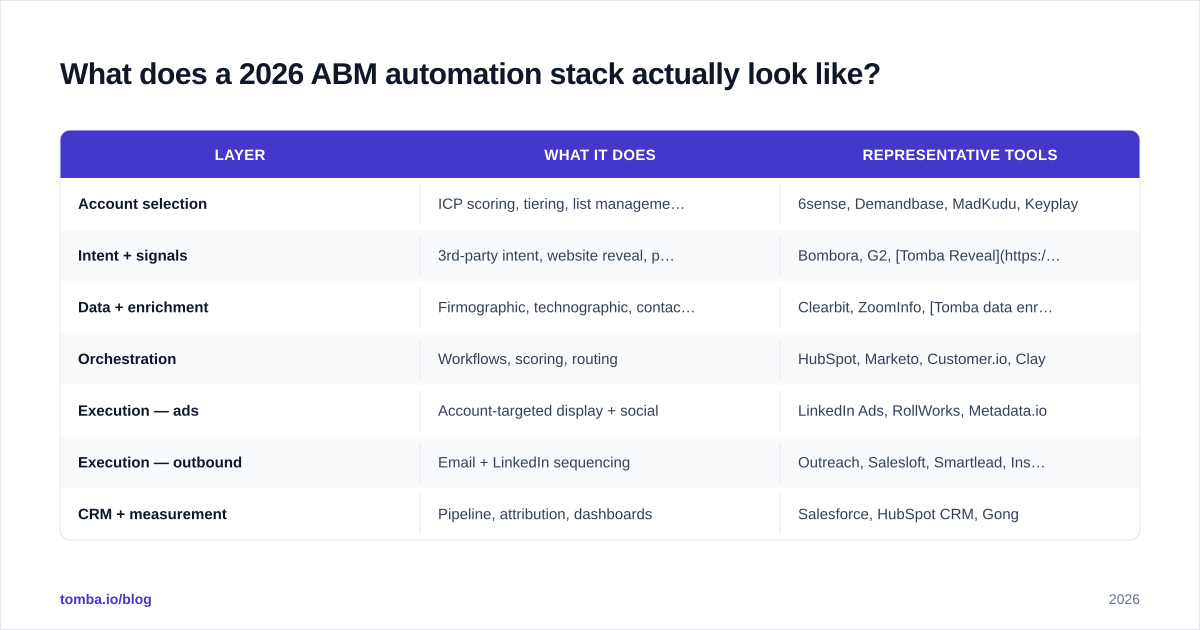
The trap teams fall into: buying every layer before they have a target list. You don't need 6sense if your tiered list is 80 accounts and you can score them in a Google Sheet.
How do you tier accounts before automating anything?#
ABM automation amplifies whatever target list you feed it. A bad list automated faster is still a bad list, just more expensive.
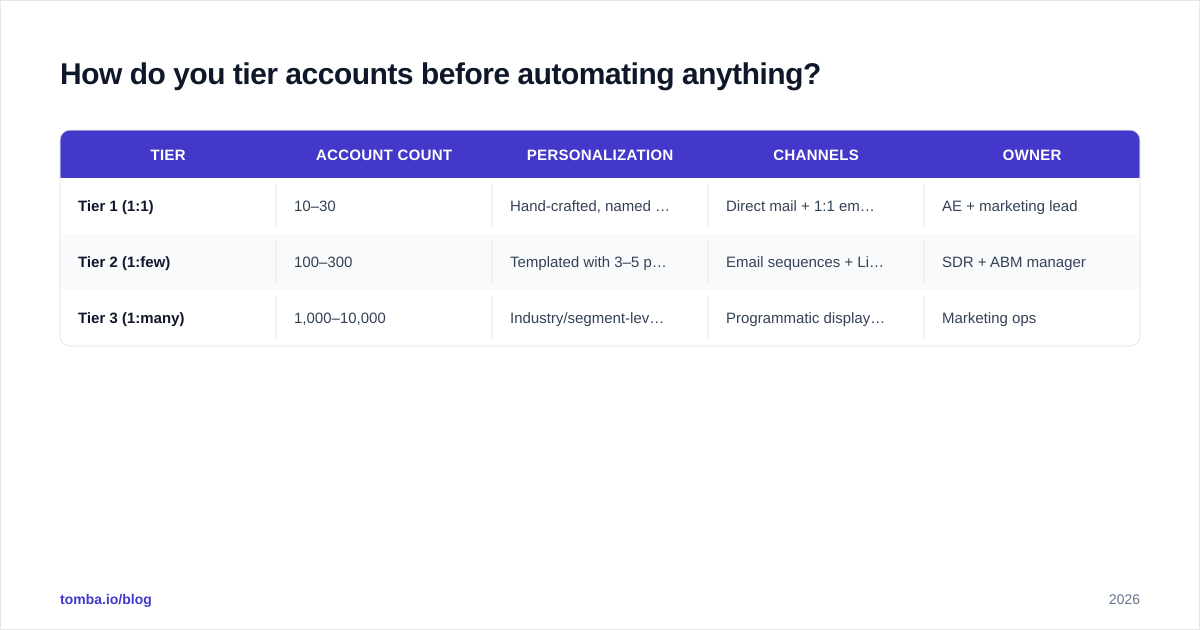
A workable tiering model:
| Tier | Account count | Personalization | Channels | Owner |
|---|---|---|---|---|
| Tier 1 (1:1) | 10–30 | Hand-crafted, named research | Direct mail + 1:1 email + executive LinkedIn + custom landing page | AE + marketing lead |
| Tier 2 (1:few) | 100–300 | Templated with 3–5 personalization tokens | Email sequences + LinkedIn ads + retargeting | SDR + ABM manager |
| Tier 3 (1:many) | 1,000–10,000 | Industry/segment-level | Programmatic display + nurture email | Marketing ops |
The point of automation is to make Tier 2 feel like Tier 1, and Tier 3 feel like Tier 2. You're not trying to remove humans from Tier 1 — you're trying to free those humans up by automating Tier 2 and 3.
What does a coordinated ABM workflow look like end-to-end?#
Take a Tier 2 account that just triggered an intent surge on "data warehouse migration."
Day 0 — signal fires
- 6sense flags the account.
- Workflow checks: is this account in our target list? Yes.
- Workflow checks: do we have the buying committee mapped (VP Data, Director Eng, CTO)? If gaps exist, fire an enrichment job to find missing emails and titles.
Day 0–1 — coordinated activation
- LinkedIn ad campaign starts serving to the 6 committee members.
- Display retargeting starts via RollWorks.
- AE gets a Slack alert with the account summary + recent activity.
- SDR queue gets the 3 contacts most likely to respond.
Day 1–7 — sequenced touches
- 5-step email sequence to the committee, each step personalized with a token pulled from enrichment (recent hire, funding, product announcement).
- AE drops a personal LinkedIn voice note to the VP Data.
- Marketing ships a 1:few microsite with the account's logo + a relevant case study.
Day 7–14 — escalate or wind down
- If engagement happens (ad click, email reply, microsite visit), the AE takes over and the workflow pauses outbound touches.
- If silence, sequence completes and the account moves to a quarterly nurture track.
The data layer underneath all of this is what makes or breaks the play. If 4 of 6 committee emails bounce, the whole workflow looks broken. Teams that get serious about ABM end up running every contact through an email verifier before the sequence touches send infrastructure.
Which automation patterns actually drive pipeline?#
After watching dozens of teams run this stuff, four patterns consistently beat the rest.
Pattern 1 — Buying-group coverage as a primary metric. Instead of optimizing for "opens" or "clicks" per contact, optimize for "% of target accounts where 3+ committee members engaged in the last 30 days." This is the single best leading indicator of pipeline.
Pattern 2 — Intent → enrichment → sequencing in <24 hours. The half-life of a surge signal is short. Workflows that take 4 days to find emails and queue a sequence miss the window. Use a bulk email finder or API call that resolves contacts in seconds, not days.
Pattern 3 — Tiering by fit AND engagement, not just fit. A Tier 2 account that has 4 engaged committee members should temporarily get Tier 1 treatment. Build the tier upgrade into the workflow, not a quarterly review.
Pattern 4 — Land-and-expand automation post-close. ABM doesn't stop at the deal. CS handoff workflows should automatically enrich the rest of the buying org, score expansion accounts, and feed them back into Tier 2 for the next product line.

How do you score accounts without a six-figure platform?#
You don't need 6sense to start. A passable account score is the sum of three components, each on a 0–10 scale:
- Fit — does this account match ICP? (industry, headcount, tech stack, geo)
- Intent — has the account shown surge on relevant topics in 30 days?
- Engagement — have committee members visited, clicked, replied, or attended in 90 days?
Multiply fit × (intent + engagement). Anything ≥ 60 goes Tier 1. 30–59 is Tier 2. <30 stays in nurture. This is roughly the MadKudu and Keyplay approach simplified to a spreadsheet you can build in an afternoon.
When you outgrow the sheet, port it to whichever automation platform owns your contacts — HubSpot Workflows, Marketo Smart Lists, or a Clay table. The scoring logic moves; the layers don't.
What's the most common ABM automation failure?#
Disconnected execution. Marketing runs LinkedIn ads, SDRs run a separate cold sequence, AEs send their own LinkedIn messages, and CS doesn't know any of it happened. The same VP of Engineering gets:
- A LinkedIn display ad on Monday
- A cold email from "Sarah" on Tuesday
- A LinkedIn connection request from the AE on Wednesday
- A second cold email from "Mike" on Thursday
- A retargeting display ad on Friday
Five touches, five different tones, zero coordination. The VP marks the emails as spam and the ad spend was wasted.
The fix is boring and unglamorous: one shared account view, one orchestration tool, and a weekly 30-minute sync between the AE, the SDR, and the ABM lead for every Tier 1 and a sample of Tier 2 accounts. Automation amplifies the coordination — it doesn't replace it.
Is HubSpot enough, or do you need a dedicated ABM platform?#
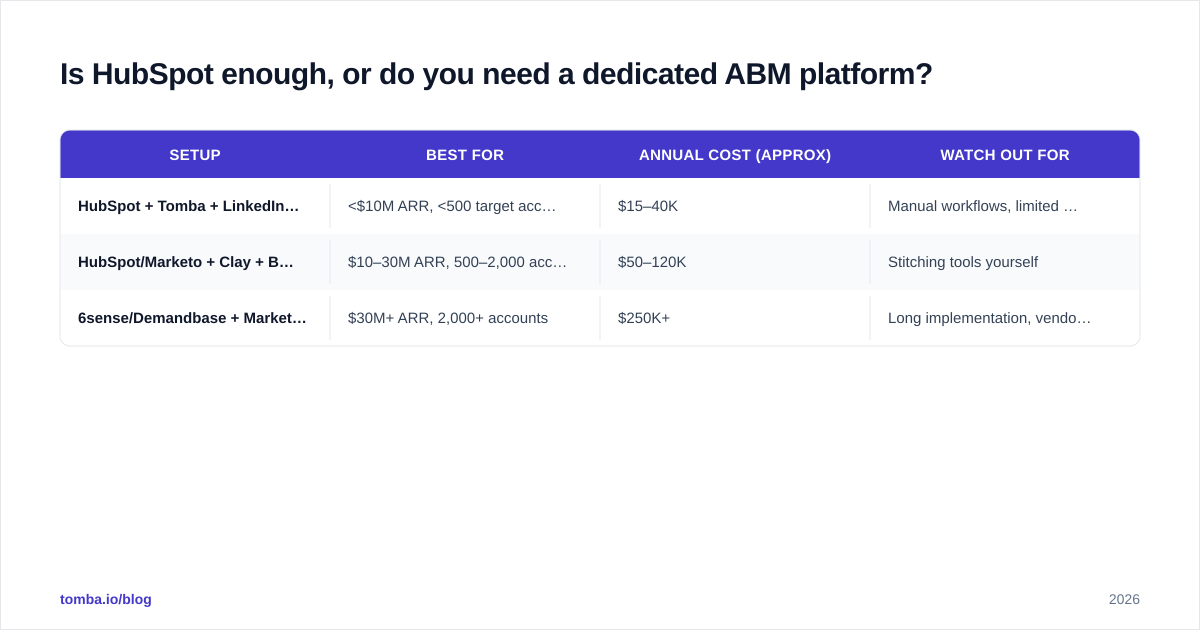
For most teams under ~$20M ARR, the answer is: HubSpot (or Marketo) plus a clean data layer plus one intent provider is enough. You don't need 6sense or Demandbase yet.
| Setup | Best for | Annual cost (approx) | Watch out for |
|---|---|---|---|
| HubSpot + Tomba + LinkedIn Ads | <$10M ARR, <500 target accounts | $15–40K | Manual workflows, limited intent |
| HubSpot/Marketo + Clay + Bombora + LinkedIn | $10–30M ARR, 500–2,000 accounts | $50–120K | Stitching tools yourself |
| 6sense/Demandbase + Marketo + Outreach | $30M+ ARR, 2,000+ accounts | $250K+ | Long implementation, vendor lock-in |
A useful exercise: list every account on your Tier 1 list and ask whether your AE could name the buying committee from memory. If yes, you're not big enough to justify a six-figure ABM platform. Fix the data layer, run the plays manually for a quarter, then automate what's working.
How does Tomba fit into ABM automation?#
Tomba is the data layer underneath the orchestration tools. Three jobs it does well:
- Find the buying committee. Use domain search to pull every public email on a target account, then filter to titles your ICP cares about.
- Verify before you send. A bounce rate above 3% tanks deliverability for the whole sender domain. Run every contact through verification first.
- Enrich at scale. The Tomba API and Zapier integration plug into HubSpot, Salesforce, Outreach, and Clay so enrichment runs inside whatever orchestration tool owns your workflows.
Pricing stays flat as you scale: Free (25 searches/mo), Starter $49/mo, Growth $99/mo, Pro $249/mo, Enterprise custom. The full breakdown is on Tomba pricing.
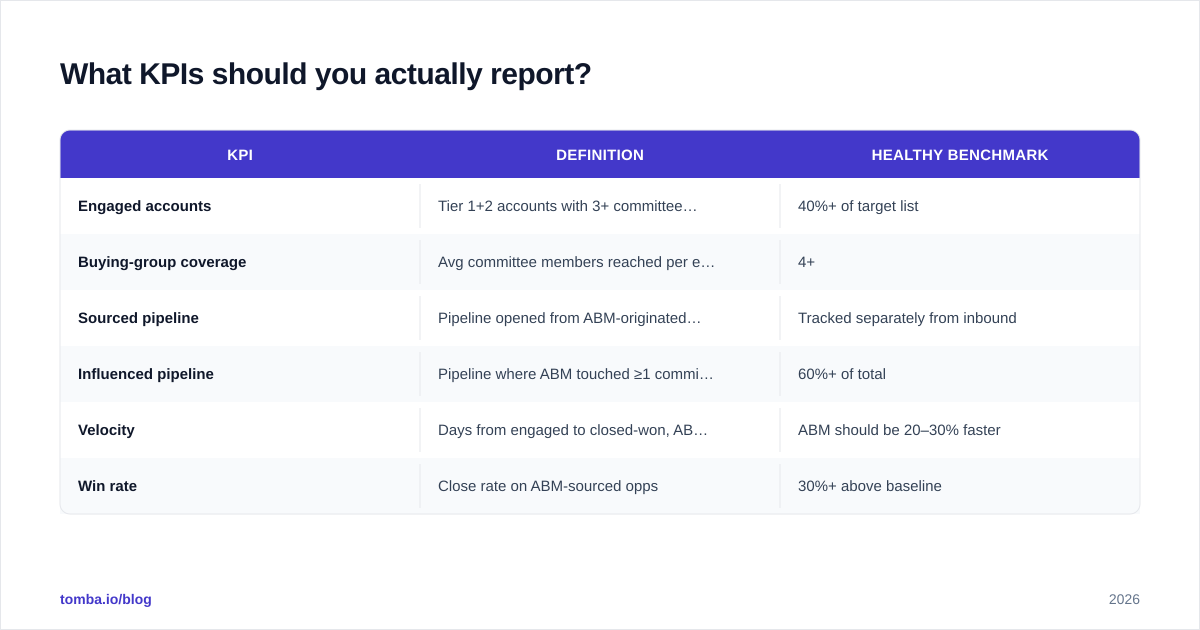
What KPIs should you actually report?#
Stop reporting MQLs. The KPIs that matter for ABM automation in 2026:
| KPI | Definition | Healthy benchmark |
|---|---|---|
| Engaged accounts | Tier 1+2 accounts with 3+ committee touches in 30 days | 40%+ of target list |
| Buying-group coverage | Avg committee members reached per engaged account | 4+ |
| Sourced pipeline | Pipeline opened from ABM-originated accounts | Tracked separately from inbound |
| Influenced pipeline | Pipeline where ABM touched ≥1 committee member pre-stage 2 | 60%+ of total |
| Velocity | Days from engaged to closed-won, ABM vs non-ABM | ABM should be 20–30% faster |
| Win rate | Close rate on ABM-sourced opps | 30%+ above baseline |
These map cleanly to the revenue operations function that owns the data, and to AE quotas that owns the outcome.
Where should you start tomorrow?#
If you have nothing automated yet:
- Pick 50 target accounts. Write them in a spreadsheet.
- Find the buying committee for each — VP, Director, manager — using a LinkedIn finder or domain search.
- Verify the emails. Drop anyone catch-all or invalid.
- Run one 5-step sequence + one LinkedIn ad campaign aimed at the same 50 accounts.
- Track engaged accounts weekly in a Slack channel. Iterate.
That's ABM automation at its simplest. You'll know within 4 weeks whether the list is right and within 8 whether the plays are working. Then you layer on intent, scoring, and orchestration — not before.
Ready to build the data layer your ABM stack runs on?#
Every workflow above breaks if the emails are wrong. Tomba Email Finder gives you verified buying-committee contacts on demand, with a free tier to test on your first 25 accounts and a Starter plan at $49/mo when you're ready to scale. Plug it into HubSpot, Salesforce, Clay, or your sequencer, and your ABM automation stops bouncing and starts converting.
Ready to find emails that actually work?
Join 150,000+ professionals who stopped guessing and started sending. Free credits on signup — no credit card required.
Get the Tomba newsletter
Practical outbound tactics and product updates — once every two weeks.
About the author