Account Based Marketing Benchmarks 2026: Real Numbers
What does good ABM actually look like in 2026? Real benchmarks for win rate, pipeline velocity, account engagement, MQA-to-opportunity conversion, and cost per opportunity.
TL;DR#
- Median ABM win rate in 2026 sits at 38% for 1:1 programs, 24% for 1:few, and 14% for 1:many — every tier still beats the 9% non-ABM B2B baseline.
- Healthy MQA-to-opportunity conversion lands between 18% and 28%. Below 12% means your account list, your messaging, or your sales follow-up is broken.
- Pipeline velocity for ABM-influenced deals is 1.6x to 2.1x faster than non-ABM, and ACV runs 30% to 70% higher.
- Cost per opportunity for mature programs sits at $1,200 to $3,800. Programs above $6,000 are usually over-spending on ads and under-spending on data hygiene.
- The cheapest lever to move every benchmark is contact data quality — bad emails and stale titles tank engagement before any creative gets read.
What are account based marketing benchmarks?#
Account based marketing benchmarks are the median performance ranges that mature B2B teams hit across the funnel when they target named accounts instead of individual leads. Unlike traditional lead benchmarks (CTR, MQL volume, cost per lead), ABM benchmarks measure account-level behavior: how many target accounts engaged, how many turned into qualified opportunities, how big those deals were, and how fast they closed.
If your CMO is still asking for MQL volume on an ABM program, you are measuring the wrong thing. The whole point of ABM is to trade volume for fit. Benchmarks reflect that trade.
The data in this post is aggregated from public reports by Forrester, Gartner, Demandbase, 6sense, Terminus, and the ITSMA/Momentum ABM Benchmark Study, normalized for 2026 reporting periods. Where the source ranges diverge, we anchor on the median and call out the spread.
Why do ABM benchmarks matter in 2026?#
Three things changed between 2023 and 2026 that make old benchmarks misleading:
- AI-generated outbound flooded inboxes, dragging reply rates on cold sequences down 40-60% across the board. ABM programs that still send a generic "saw your post" email are now performing worse than they did in 2022.
- Buying committees grew. Gartner reports the average B2B buying group is now 11 people, up from 6-10 in 2017. ABM programs that engage 2-3 contacts per account are missing two-thirds of the deal.
- Intent data matured. First-party intent from your own site (paired with third-party from G2, Bombora, 6sense) now drives most prioritization. Programs that ignore intent are spending equally on hot and cold accounts, which is why their cost per opportunity is double.
Benchmarks let you spot which of these three you are losing to.
What are the core ABM benchmarks you should track?#
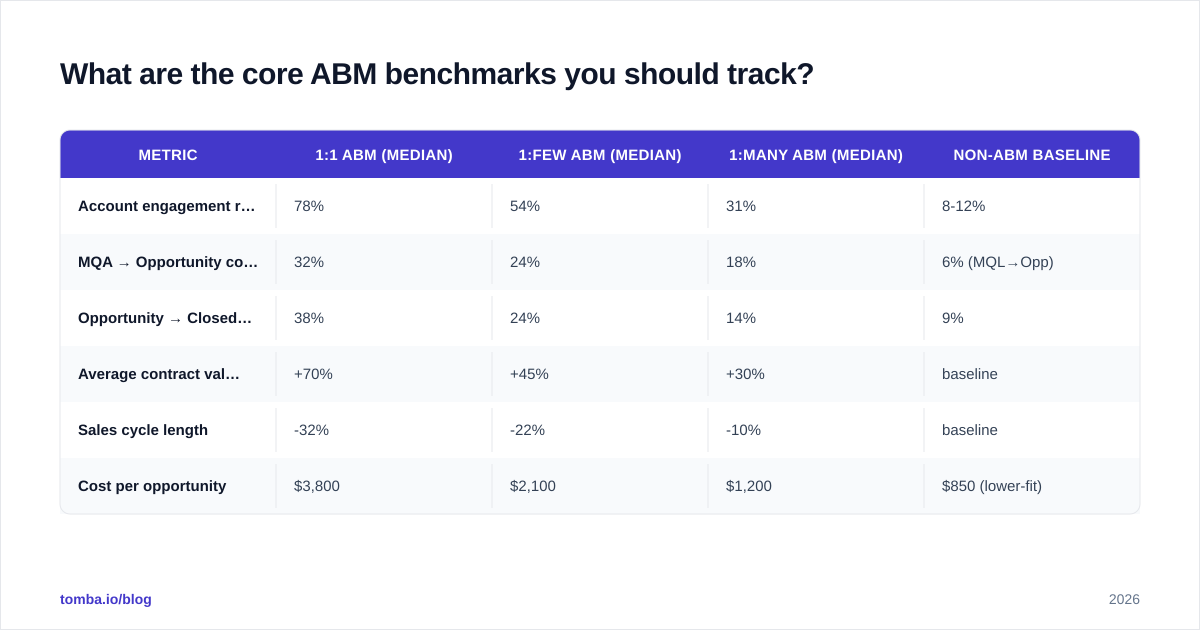
There is no single "ABM score." There are six benchmarks that together tell you whether your program is healthy. Track all of them quarterly.
| Metric | 1:1 ABM (median) | 1:Few ABM (median) | 1:Many ABM (median) | Non-ABM baseline |
|---|---|---|---|---|
| Account engagement rate | 78% | 54% | 31% | 8-12% |
| MQA → Opportunity conversion | 32% | 24% | 18% | 6% (MQL→Opp) |
| Opportunity → Closed-won win rate | 38% | 24% | 14% | 9% |
| Average contract value (ACV) lift | +70% | +45% | +30% | baseline |
| Sales cycle length | -32% | -22% | -10% | baseline |
| Cost per opportunity | $3,800 | $2,100 | $1,200 | $850 (lower-fit) |
Two things to notice. First, 1:Many ABM looks weak per-account but the volume makes it the cheapest pipeline source for most mid-market teams. Second, the cost per opportunity for 1:1 ABM is high in isolation but trivial when you divide by the 70% ACV lift. ABM benchmarks only make sense when you read them as a system.
What is a good account engagement rate?#
Account engagement is the percentage of target accounts that took at least one meaningful action (multi-page web visit, content download, ad click, event registration, sales reply) in the last 90 days.
- 1:1 programs (typically 10-50 accounts): expect 70-85%. Anything under 60% means your account selection is off — you picked accounts that have no current pain.
- 1:Few programs (50-500 accounts): 45-60% is healthy. The drop is normal; you are casting wider with less customization.
- 1:Many programs (500-5,000+ accounts): 25-40%. Below 20% usually means your ad targeting is poorly matched to your firmographic filters.
The fastest way to improve engagement is not better creative. It is better contact coverage. If you only have one email per account and that contact left the company, your engagement rate for that account is mathematically zero. Run quarterly enrichment on your account list using a data enrichment workflow that refreshes titles, emails, and phone numbers — most teams find 18-25% of their stored contacts are stale within 12 months.
What's a realistic MQA-to-opportunity conversion rate?#
Marketing Qualified Account (MQA) is the account-level version of MQL — an account that has crossed an engagement threshold and is ready for sales prioritization.
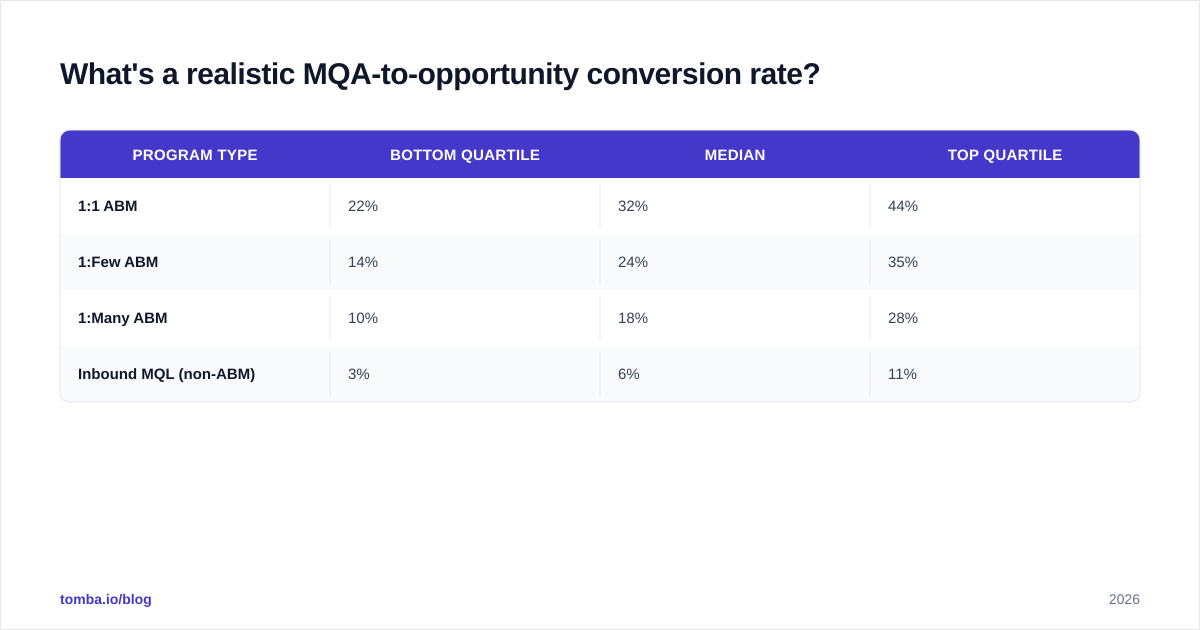
The 2026 median ranges:
| Program type | Bottom quartile | Median | Top quartile |
|---|---|---|---|
| 1:1 ABM | 22% | 32% | 44% |
| 1:Few ABM | 14% | 24% | 35% |
| 1:Many ABM | 10% | 18% | 28% |
| Inbound MQL (non-ABM) | 3% | 6% | 11% |
If you are below the bottom quartile, the root cause is almost always one of three things:
- MQA threshold is too loose. "Visited pricing page once" is not an MQA. A real MQA threshold combines fit (ICP firmographics) and intent (multiple signals across multiple stakeholders).
- Sales is ignoring MQAs. Top-quartile programs have an SLA: SDR contacts the MQA within 4 business hours, with a multi-channel sequence (email + LinkedIn + phone).
- Contact data is broken. SDRs can't follow up on accounts where they don't have phone numbers or current emails. Pair your ABM platform with a phone finder and a real-time email verifier so reps don't burn cycles on bounces.
How fast should ABM pipeline move?#
Pipeline velocity (deal value × win rate ÷ cycle length) is the metric that proves ABM is working financially, not just optically.
Benchmark spread for enterprise B2B SaaS ($25k+ ACV) in 2026:
- Non-ABM pipeline velocity: $X baseline
- 1:Many ABM: 1.3x baseline
- 1:Few ABM: 1.7x baseline
- 1:1 ABM: 2.1x baseline
The lift comes from three places. Win rate goes up because you are talking to fit accounts. ACV goes up because you are landing in larger orgs with multi-product deals. Cycle length goes down because you started engaging the buying committee months before they entered your CRM as an opportunity.
If your ABM cycles are longer than non-ABM, your sales team is treating MQAs like cold leads. Re-train.
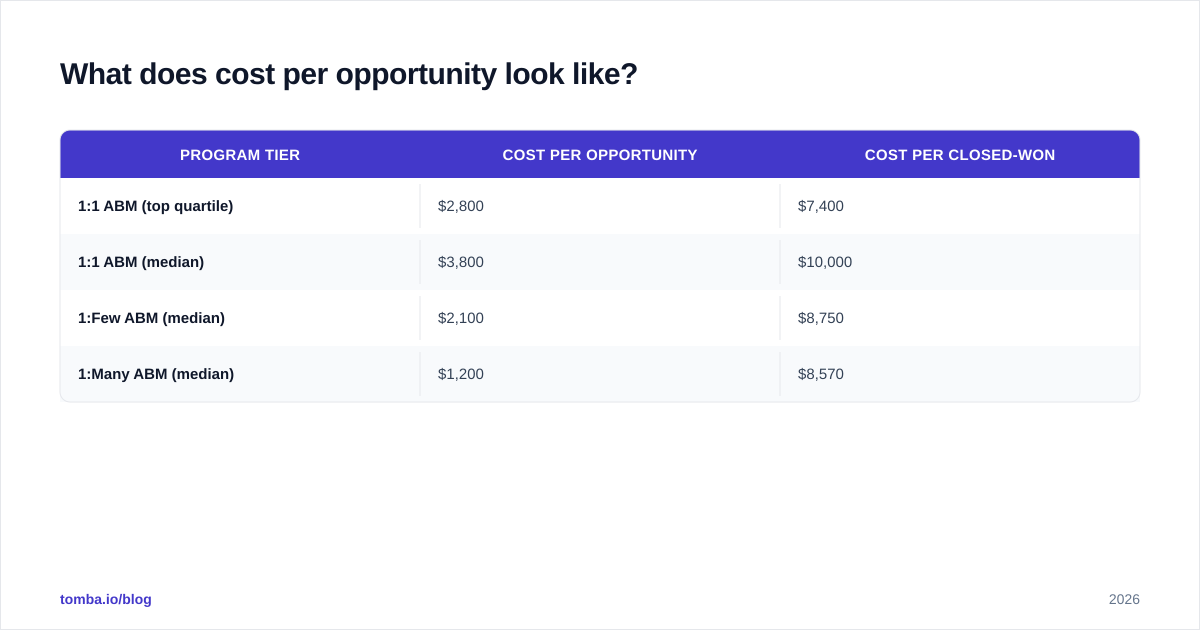
What does cost per opportunity look like?#
The honest answer: it depends on whether you bake in headcount, tools, or just media spend. The benchmarks below include media + tools + a loaded ABM team cost (1 marketer per 200 accounts in 1:Few, 1 per 30 in 1:1).
| Program tier | Cost per opportunity | Cost per closed-won |
|---|---|---|
| 1:1 ABM (top quartile) | $2,800 | $7,400 |
| 1:1 ABM (median) | $3,800 | $10,000 |
| 1:Few ABM (median) | $2,100 | $8,750 |
| 1:Many ABM (median) | $1,200 | $8,570 |
The numbers converge at the closed-won level because higher-touch programs win more often. The reason finance teams kill ABM programs is rarely cost — it is attribution. If you cannot show the multi-touch attribution path from first ad impression to closed-won, expect your budget to get cut on the next planning cycle.
How do ABM benchmarks differ by company size and ACV?#
ABM benchmarks are not universal. They move with deal size.
| Segment | Typical ACV | Best-fit ABM tier | Median win rate | Median cycle |
|---|---|---|---|---|
| SMB SaaS | $5k–$25k | 1:Many | 16% | 32 days |
| Mid-market | $25k–$100k | 1:Few | 26% | 78 days |
| Enterprise | $100k–$500k | 1:Few + 1:1 hybrid | 32% | 142 days |
| Strategic / 7-figure | $500k+ | 1:1 only | 41% | 220 days |
Two practical implications. First, if your ACV is under $25k, 1:1 ABM is mathematically nonsensical — your CAC payback will exceed the contract length. Stick with 1:Many backed by strong intent signals. Second, if your ACV is over $100k and you are still running 1:Many ABM, you are leaving 30-50% of your achievable win rate on the table.
What tools and data inputs drive top-quartile benchmarks?#
Top-quartile ABM programs share three infrastructure choices: a clean account list, real-time enrichment, and intent signal layering. Tooling categories you'll see in nearly every high-performing stack:
| Layer | Purpose | Examples |
|---|---|---|
| ABM platform | Account orchestration, ads, measurement | Demandbase, 6sense, RollWorks |
| Intent data | Third-party buying signals | Bombora, G2, 6sense |
| Contact data + enrichment | Emails, phones, titles, refresh | Tomba,ZoomInfo, Apollo |
| Engagement | Sales sequencing | Outreach, Salesloft, Smartlead |
| CRM | System of record | Salesforce, HubSpot |
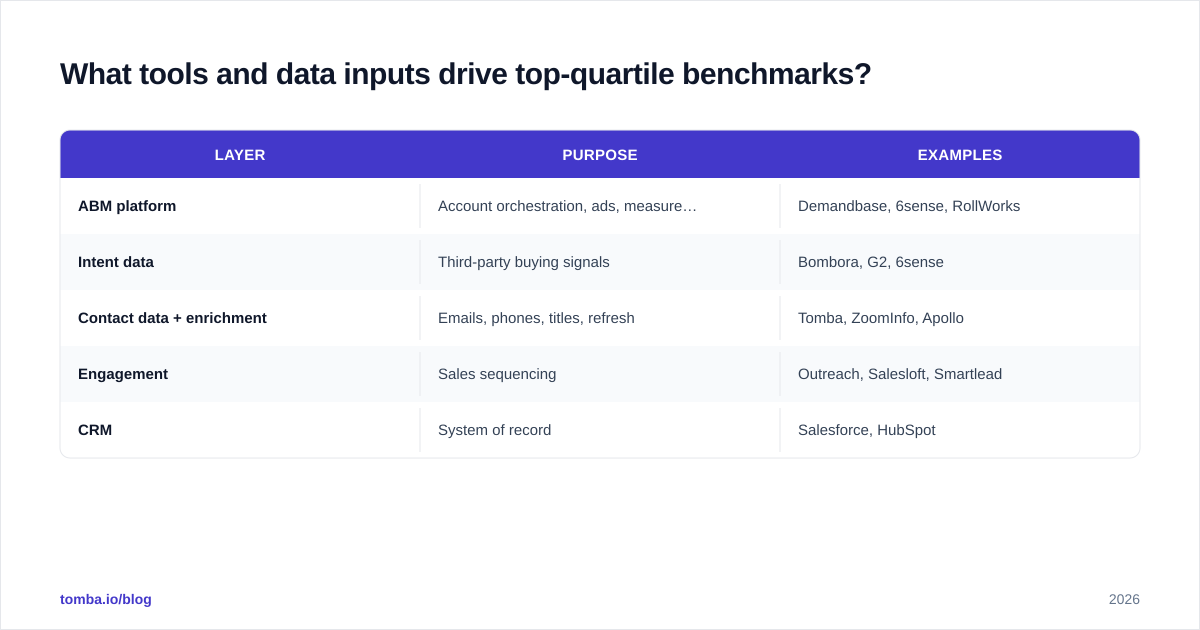
The order matters. Most teams buy the ABM platform first and then discover six months in that 30% of their account contacts are stale, which tanks engagement benchmarks regardless of how much they pay Demandbase. Get the B2B database layer right before you light up paid orchestration.
How do you build an ABM account list that hits these benchmarks?#
A target account list (TAL) is the foundation. Most TALs fail benchmark targets because they are built once, never refreshed, and based on firmographics alone with no intent overlay.
The 2026 best-practice workflow:
- Start with ICP filters — industry, employee count, tech stack, geo, revenue.
- Layer intent — Bombora, G2, 6sense, or first-party site signals. Drop accounts with zero intent in the last 90 days from your 1:1 tier; keep them in 1:Many.
- Validate contact coverage — for each account, confirm you have 4-7 buying committee contacts with verified emails and direct dials. Use a domain search to pull all known professional emails for a company, then run them through verification to drop catch-alls and traps.
- Tier by fit + intent — 1:1 tier = high fit + high intent + open opportunity signal. 1:Few = high fit + medium intent. 1:Many = ICP-fit + low intent.
- Refresh quarterly — re-score every account, retire the bottom 20%, refill from your ICP universe.
Programs that follow this loop hit median benchmarks within two quarters. Programs that build a TAL in a spreadsheet and never touch it again typically miss every benchmark by 30-50%.
How do you measure attribution without going insane?#
The reason ABM measurement is hard: 11 buyers × 6 channels × 9 months = a lot of touchpoints. Three pragmatic approaches:
- Account journey reports — your ABM platform (Demandbase, 6sense) shows every touch by account. Use this for storytelling and program optimization, not for the board deck.
- Multi-touch attribution with sourcing rules — assign credit by first-touch, last-touch, or weighted. Pick one and stick with it for at least 4 quarters so you have apples-to-apples.
- Holdout testing — pick 10% of ICP-matched accounts, exclude them from ABM, measure pipeline difference. This is the only true causal measurement and the only number CFOs respect.
Most teams run all three and use each for a different audience. Use journey reports with marketers, MTA with sales leadership, and holdout tests with finance.
What are the most common reasons ABM programs miss benchmarks?#
After looking at dozens of post-mortems, the failure patterns repeat:
- Stale or wrong contact data — engagement, conversion, and cycle metrics all tank when SDRs follow up on bouncing emails.
- Sales not bought in — if AEs treat MQAs as "marketing leads" the SLA breaks, follow-up dies, and conversion rates crash.
- Too many accounts in 1:1 tier — 1:1 ABM with 200 accounts is just 1:Few with extra ad spend. Be ruthless.
- Ignoring intent signals — spending equally on cold and hot accounts doubles your cost per opportunity.
- No buying committee mapping — engaging only the contact who downloaded the whitepaper, not the 10 other influencers, leaves win rate on the table.
Item 1 is the most common and the cheapest to fix. Before you overhaul your account selection or your sales motion, run your TAL through a bulk email finder and verifier. Most teams reclaim 15-25% of "engaged" accounts that were silently bouncing.
Hit your ABM benchmarks with cleaner account data#
You cannot out-spend bad contact data. Every ABM benchmark — engagement rate, MQA conversion, cycle length, cost per opportunity — moves the moment your reps stop wasting sequences on bouncing emails and missing decision-makers.
Tomba is the email finder and enrichment layer your ABM platform was supposed to come with. Free tier covers 25 lookups so you can test your TAL for data decay before committing. Starter is $49/month, Growth $99/month — pricing details on the Tomba pricing page. Connect it to your existing ABM stack via the Tomba API, HubSpot integration, or Salesforce integration, and stop letting bad data drag your benchmarks below the median.
Ready to find emails that actually work?
Join 150,000+ professionals who stopped guessing and started sending. Free credits on signup — no credit card required.
Get the Tomba newsletter
Practical outbound tactics and product updates — once every two weeks.
About the author