Account Based Marketing for B2B: The 2026 Playbook
Account based marketing for B2B is no longer optional for enterprise GTM teams. Here is how to build an ABM motion in 2026 that actually closes six-figure deals.
TL;DR#
- Account based marketing for B2B treats a named list of companies as the market, not individual leads in a funnel.
- The 2026 model has three tiers: 1:1 strategic, 1:few cluster, and 1:many programmatic, each with different cost and personalization budgets.
- Buying committees average 9.8 stakeholders. You cannot win a deal by emailing one champion — you need multi-thread coverage.
- Intent data, enrichment, and accurate contact data are the foundation. Without clean firmographics and verified emails, every play downstream breaks.
- ABM is a sales-and-marketing operating model, not a campaign. Treat it as a quarterly revenue program with named account lists, shared SLAs, and pipeline targets.
What is account based marketing for B2B?#
Account based marketing for B2B is a go-to-market motion where sales and marketing pick a finite list of target companies and coordinate every touch — ads, email, content, events, sales outreach — against those specific accounts. Instead of optimizing for MQL volume, you optimize for engaged accounts and qualified pipeline inside a named list.
The shift is mental as much as operational. A traditional demand-gen team measures form fills. An ABM team measures account penetration — how many target accounts had three or more stakeholders engage with a campaign in the last 30 days.
If you want a refresher on the broader operating model, see revenue operations — ABM only works inside a healthy RevOps stack with shared definitions across marketing, sales, and customer success.
Why does ABM matter more in 2026 than it did five years ago?#
Three forces reshaped B2B GTM and made ABM the default for any team selling at $25K+ ACV:
- Buying committees ballooned. Gartner's research on B2B buying (gartner.com) consistently shows the typical purchase involves 6 to 10 decision makers, each consuming four to five pieces of content independently. Single-threading is a losing strategy.
- Inbound volume collapsed. Cookie deprecation, MQL fatigue, and AI-generated content saturation cut paid acquisition efficiency in half for most categories. You can no longer rely on form-fill volume to feed sales.
- Sales cycles got longer and more political. Procurement, security, and finance now block deals that used to close on a champion's signature. ABM's multi-thread approach is the only way to navigate that.
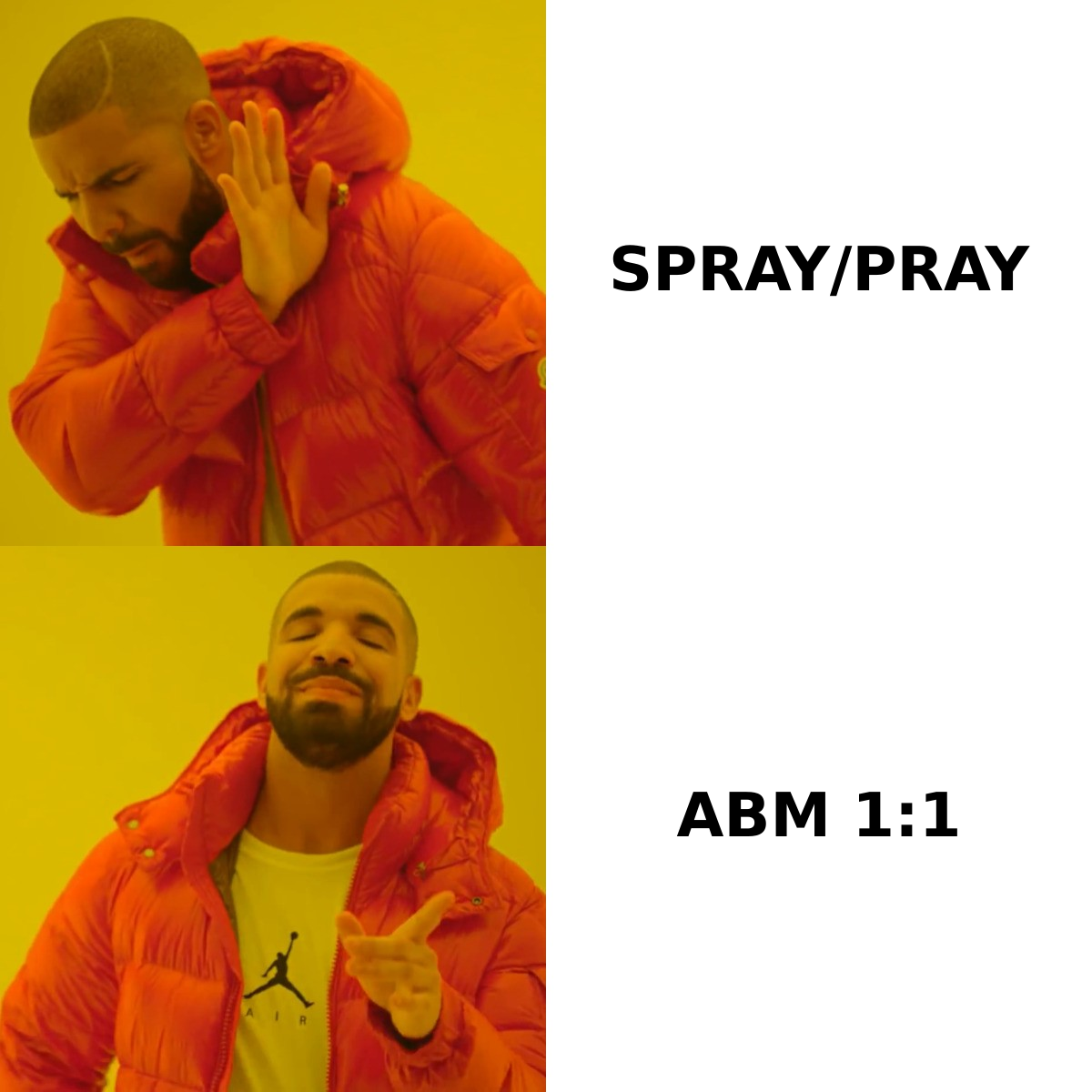
The teams winning right now stopped treating ABM as a "marketing program." They treat it as the company's GTM operating system.
How is ABM different from traditional demand generation?#
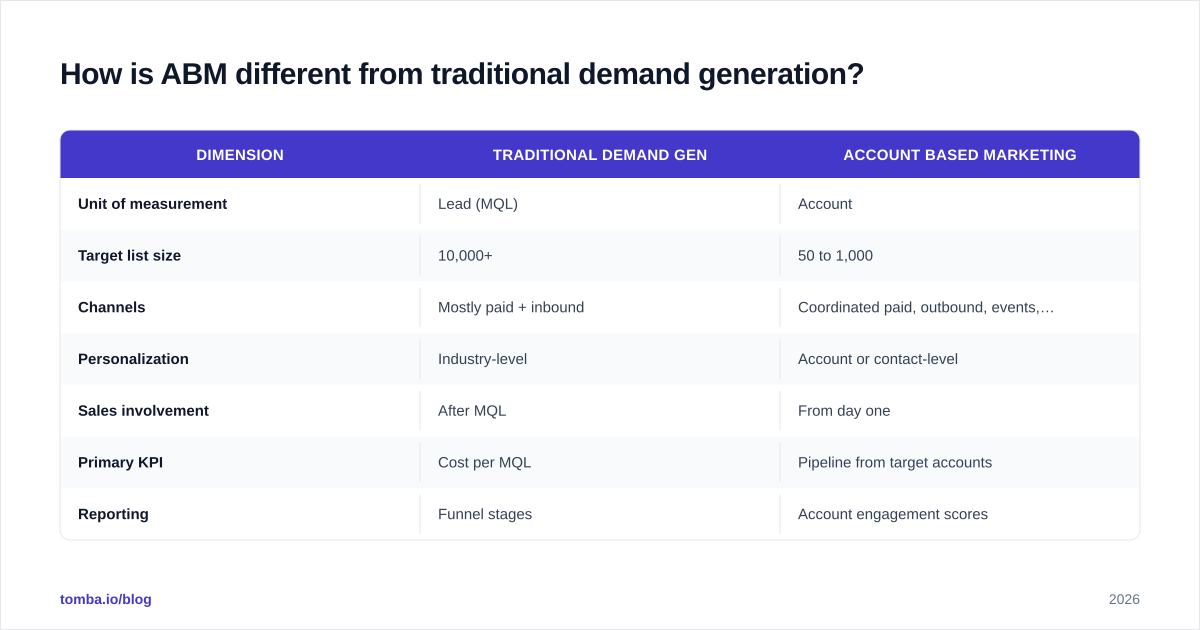
The easiest way to see it is to put the two side by side.
| Dimension | Traditional Demand Gen | Account Based Marketing |
|---|---|---|
| Unit of measurement | Lead (MQL) | Account |
| Target list size | 10,000+ | 50 to 1,000 |
| Channels | Mostly paid + inbound | Coordinated paid, outbound, events, gifting |
| Personalization | Industry-level | Account or contact-level |
| Sales involvement | After MQL | From day one |
| Primary KPI | Cost per MQL | Pipeline from target accounts |
| Reporting | Funnel stages | Account engagement scores |
| Tooling | MAP + CRM | MAP + CRM + intent + enrichment + orchestration |
Notice that ABM does not replace demand gen — it sits on top of it for the accounts that matter most. A healthy 2026 GTM team runs both: programmatic demand for the long tail, ABM for the named target list.
What are the three tiers of B2B ABM?#
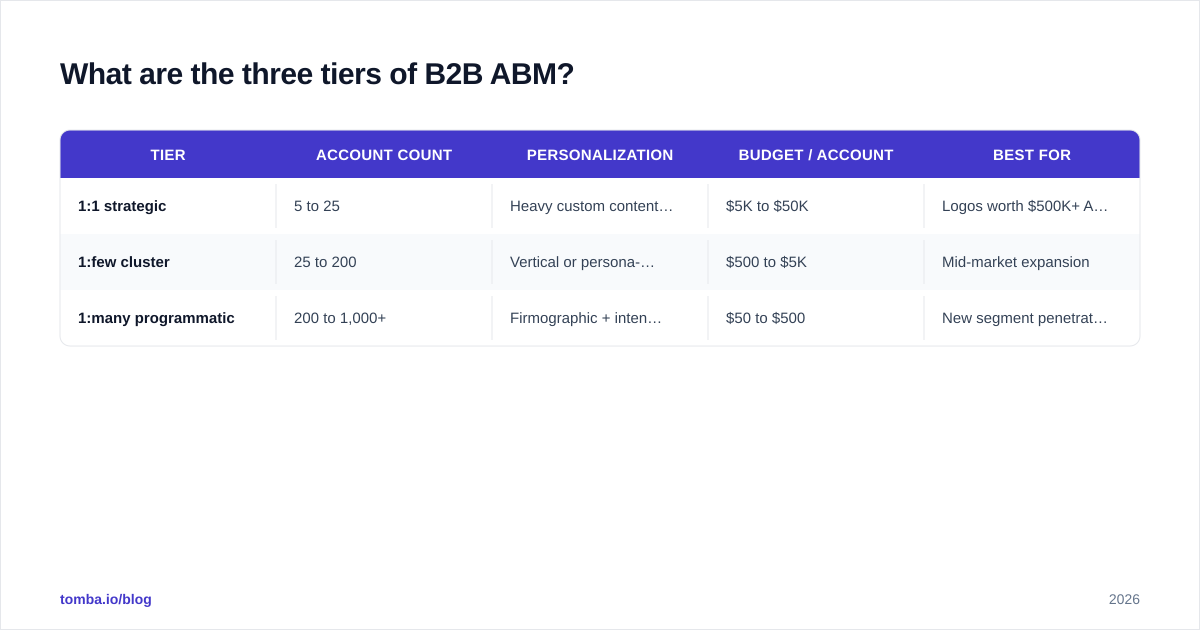
The ITSMA model still holds up in 2026. Tier your accounts by potential revenue and strategic value, then match the personalization budget to the tier.
| Tier | Account Count | Personalization | Budget / Account | Best For |
|---|---|---|---|---|
| 1:1 strategic | 5 to 25 | Heavy custom content, executive sponsor | $5K to $50K | Logos worth $500K+ ACV |
| 1:few cluster | 25 to 200 | Vertical or persona-based playbooks | $500 to $5K | Mid-market expansion |
| 1:many programmatic | 200 to 1,000+ | Firmographic + intent personalization | $50 to $500 | New segment penetration |
A common mistake is to start in the 1:1 tier because it sounds prestigious. Don't. Most teams get higher ROI in the first year by running disciplined 1:few clusters against a tight ICP, then graduating winning accounts into 1:1 plays.
How do you build a target account list that does not waste budget?#
Your target list is the single biggest lever in the whole program. A bad list ruins every downstream play. Build it in this order:
- Define ICP firmographics. Industry, employee count, revenue band, tech stack signals, geo. Be specific — "mid-market SaaS" is not an ICP; "Series B-D vertical SaaS companies, 100-500 employees, North America, running HubSpot + Stripe" is.
- Layer intent and fit signals. Use 6sense, Bombora, or G2 intent feeds to spot accounts surging on your category keywords. Score fit and intent separately so you can tier them properly.
- Validate enrichment quality. Bad firmographic data inflates account counts and burns SDR cycles. Run your list through proper data enrichment before sales touches it.
- Map buying committees. For every account, identify the economic buyer, champion, technical evaluator, end user, and blocker personas. This is where most ABM programs collapse — they target accounts without naming the humans.
- Get verified contact data. Names without emails are not contacts. Use an email finder to find the right addresses and an email verifier to confirm deliverability before any outbound touches the inbox.
Skip step 5 and your sender reputation will collapse inside two weeks of outbound. Bad data destroys ABM faster than bad creative.
What does the buying committee look like in 2026?#
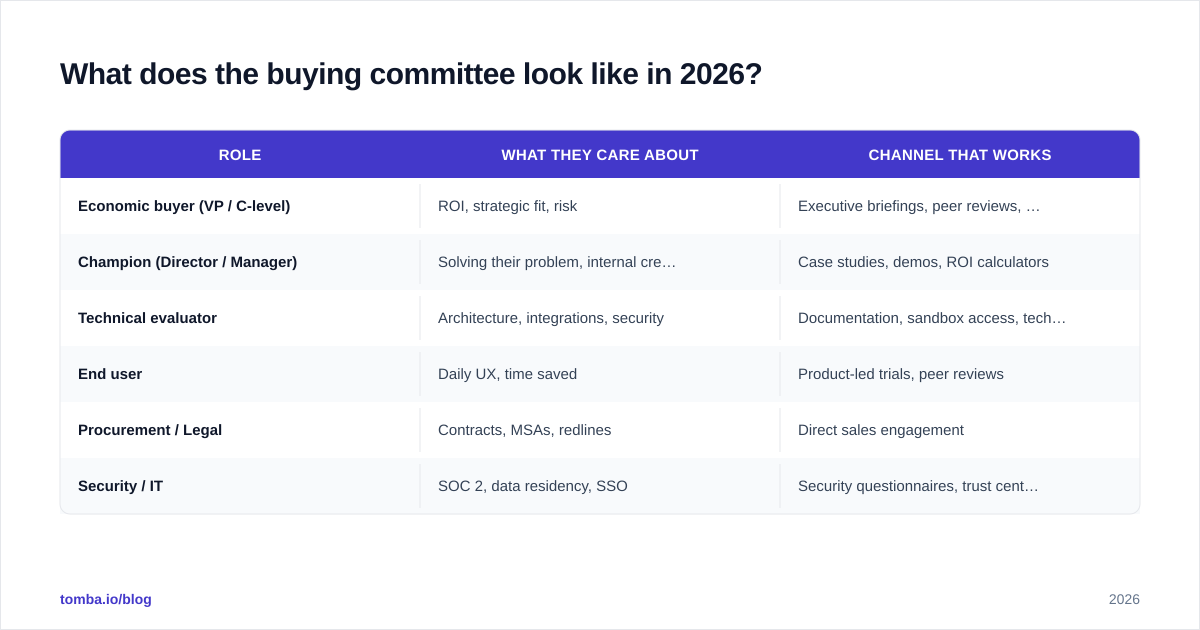
Buying committees keep getting bigger because procurement, security, finance, and IT all want a seat. A typical $50K to $250K SaaS deal in 2026 involves:
| Role | What They Care About | Channel That Works |
|---|---|---|
| Economic buyer (VP / C-level) | ROI, strategic fit, risk | Executive briefings, peer reviews, analyst content |
| Champion (Director / Manager) | Solving their problem, internal credit | Case studies, demos, ROI calculators |
| Technical evaluator | Architecture, integrations, security | Documentation, sandbox access, technical webinars |
| End user | Daily UX, time saved | Product-led trials, peer reviews |
| Procurement / Legal | Contracts, MSAs, redlines | Direct sales engagement |
| Security / IT | SOC 2, data residency, SSO | Security questionnaires, trust center |
You need a content asset and a channel for each role. The mistake is sending the same "ultimate guide" to all six personas. The champion reads it. The CFO does not.
What plays actually generate pipeline from target accounts?#
Stop running a single "ABM campaign" once a quarter. Run a portfolio of plays continuously. The ones that worked across most B2B categories in 2025-2026:
- Multi-channel surround play. Coordinate LinkedIn ads, display retargeting, personalized email, and SDR calls within a 14-day window to the same buying committee. The pattern signals intent across channels and lifts response rates 2-3x over any single channel.
- Executive-to-executive outreach. Your CEO or VP Sales emails their counterpart at the target account with a specific point of view, not a meeting request. Low volume, high conversion.
- Reverse IP / visitor reveal. When a target account hits your pricing page, fire a real-time alert to the AE and trigger a personalized retargeting sequence. Tools like website visitor reveal make this cheap to operationalize.
- Customized direct mail. Send a physical gift tied to the prospect's specific challenge — not generic swag. Pair with a video email from the AE.
- Account-based events. Small dinners or roundtables for 8-12 target accounts in a city. Higher cost per attendee, dramatically higher conversion than 500-person webinars.
- Customer-led referral plays. Map your customer base's LinkedIn graph against target accounts and ask for warm intros into mutual connections.
Which tools do you actually need to run B2B ABM?#
The ABM tool landscape is bloated. You do not need eight platforms — you need clean data feeding a small, opinionated stack. A practical 2026 stack:
| Layer | Job | Examples |
|---|---|---|
| Contact data | Find and verify decision-maker emails | Tomba, Apollo,ZoomInfo |
| Firmographic enrichment | Append company attributes | Clearbit, ZoomInfo |
| Intent data | Surface accounts researching your category | 6sense, Bombora, G2 |
| CRM | System of record for accounts and opportunities | Salesforce, HubSpot |
| Marketing automation | Email nurture and lead scoring | HubSpot, Marketo, Pardot |
| Orchestration | Coordinate ads + email + sales tasks | Demandbase, 6sense, RollWorks |
| Sales engagement | Sequence outbound | Outreach, Salesloft, Instantly |
| Analytics | Account-level engagement scoring | Native CRM dashboards + warehouse |
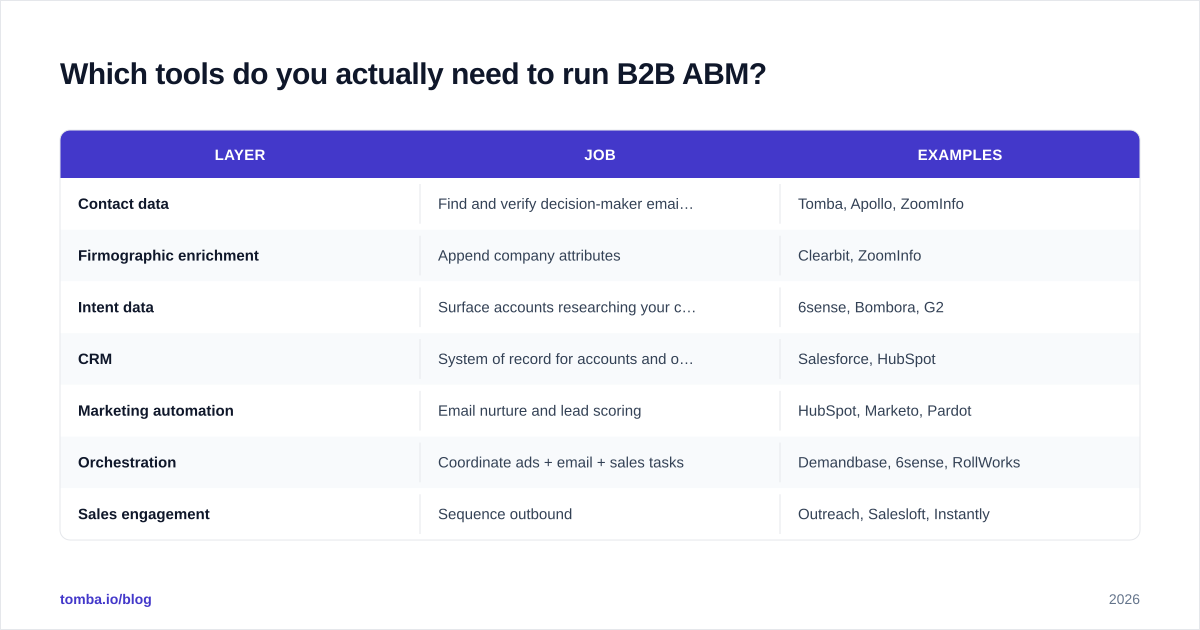
Pick one tool per layer. The fastest way to kill an ABM program is to buy five overlapping platforms and never integrate them. If you only have budget for two new tools this year, prioritize the contact-data layer (find + verify) and the intent-data layer. Without those, every downstream play degrades.
For multi-thread outbound, you will want a fast way to enrich named accounts at scale — that is the unlock the bulk email finder provides for sales ops.
How do you measure ABM impact without faking the numbers?#
ABM reporting is where most programs lose credibility with the CFO. Vanity metrics are easy. Real measurement is harder. The metrics that matter:
- Account coverage. Percentage of target accounts with at least one verified contact in CRM and an active engagement signal in the last 90 days.
- Account engagement score. Composite of web visits, content downloads, email replies, meeting attendance, ad impressions across the buying committee. Tier it (cold / warm / hot).
- Pipeline from target accounts. Dollars of pipeline created inside the named list, compared against pipeline from outside the list, monthly.
- Multi-thread rate. Percent of opportunities with three or more engaged contacts at the account. Single-threaded opps stall — this metric predicts close rate.
- Win rate vs control. Compare close rate and ACV on target-list deals against non-list deals. If they are not materially higher, your list is wrong.
- Sales cycle compression. Days from first touch to closed-won. ABM should shrink this for the right accounts.
Forrester (forrester.com) has solid benchmark research on B2B account engagement scoring if you want external validation for your internal model.
What kills most B2B ABM programs in the first year?#
After watching dozens of programs launch and stall, the patterns are consistent. Avoid these:
- Marketing builds the list, sales ignores it. If the AE team did not co-build the target list, they will hunt their own accounts and ABM dies. Co-build it.
- Personalization theater. Putting
{{first_name}}in a templated email is not personalization. If the rep cannot point to one specific reason this account is a fit, the touch is not personalized. - No data hygiene. Stale titles, wrong companies, bounced emails. Garbage in, garbage out — and ABM amplifies the garbage because you are touching the same accounts repeatedly. Run a bulk verify on every list before activation.
- One channel only. Email-only ABM is just outbound with a fancier name. The lift comes from channel coordination.
- Quarterly reporting only. ABM needs weekly engagement reviews between marketing and sales. Quarterly is too slow to course-correct.
- Mistaking ABM for a campaign. It is not a campaign. It is an operating model. Treat it as one or do not start.
Is ABM right for your company?#
Honest answer: not for everyone. ABM works best when:
- Your ACV is $25K or higher (the personalization investment needs deal size to justify it).
- You sell into a definable list — typically under 5,000 ideal companies in your TAM.
- Sales and marketing leadership are aligned and willing to share targets.
- You have or are willing to buy clean contact and firmographic data.
If you sell self-serve SaaS at $20/month with a TAM of 50 million SMBs, run demand gen, not ABM. If you sell a $150K platform to 800 enterprise insurance carriers, ABM is the only sensible model.
How do you start an ABM motion in 30 days?#
You do not need a six-month rollout. A focused 30-day pilot beats a year of slideware. Here is a compressed plan:
| Week | Focus | Deliverable |
|---|---|---|
| Week 1 | ICP + target list | 50-account pilot list, co-signed by sales |
| Week 2 | Buying committee + data | 5-7 verified contacts per account, enriched and validated |
| Week 3 | Plays + content | 1 multi-channel surround play + 3 content assets |
| Week 4 | Launch + measure | Activate, set weekly review cadence, baseline engagement scores |
Day-one tools required: a CRM, an email-send platform, an email finder to build the contact set, and an email verifier to keep deliverability clean. Add intent data and orchestration in month two once the basic motion is working.
Closing thought: where account based marketing for B2B is heading#
The big shift over the next 24 months is AI-driven personalization at the 1:few tier. Generative tools can now produce truly customized landing pages, video intros, and email sequences per account at near-zero marginal cost. That collapses the gap between 1:few and 1:1, and it pushes ABM down-market into deal sizes where the unit economics did not previously work.
The teams that win will be the ones with the cleanest data foundation. AI personalization on top of bad firmographics and bounced emails just produces bespoke garbage faster.
Build your ABM foundation with Tomba#
ABM lives or dies on contact accuracy. Before you spend a dollar on ads, intent data, or sales tooling, make sure the buying committees you are targeting actually exist and are reachable. The Tomba Email Finder gives you verified decision-maker emails for any company in your target list, with bulk enrichment, a CRM-friendly API, and a free tier to test the workflow. Pair it with the email verifier and start your ABM motion on data you can trust.
// get started
Find, verify and enrich your first contacts today
Start on the free plan with 25 searches a month, then scale when your team is ready.
Free plan · No credit card required · GDPR & CCPA
// about the author