Best Account Based Marketing Platforms in 2026: Honest Comparison
A neutral 2026 breakdown of the top account based marketing platforms — what each one actually does, where they overlap, what they cost, and how to pick without overspending.
TL;DR#
- Account based marketing platforms in 2026 split into three camps: intent + orchestration suites (6sense, Demandbase), advertising-led ABM (RollWorks, Terminus), and data-first stacks you assemble yourself (ZoomInfo + HubSpot + an enrichment layer like Tomba).
- The suites cost $50k–$250k/year and only pay back if you have a defined target account list, a sales team that will work it, and content per stage.
- If you have fewer than 500 target accounts or under $2M ARR, you do not need a full ABM suite. A target account list, enrichment, intent signals from one source, and a sequencer beats a $90k platform.
- The best platform is the one your sales reps will actually log into on Monday morning. Adoption beats features every time.
- Budget split that works in practice: 40% data and enrichment, 30% advertising, 20% orchestration, 10% measurement.
What are account based marketing platforms?#
Account based marketing platforms are software stacks that help B2B teams identify a finite list of target accounts, surface buying signals from those accounts, coordinate marketing and sales touches against them, and measure pipeline by account rather than by lead.
In plain terms: instead of running a top-of-funnel campaign that catches whoever clicks, an ABM platform helps you spend time and money on the 200 or 2,000 companies you actually want to win.
The category covers five core jobs:
- Target account selection — building and scoring the list, usually with firmographic + technographic + intent data.
- Intent and engagement detection — knowing which accounts are researching your category right now.
- Orchestration — coordinating ads, email, sales tasks, and SDR plays per account.
- Personalization — landing pages, ad creative, and outreach tailored to the account.
- Measurement — pipeline, deal velocity, and influenced revenue attributed to the account, not the lead.
Most platforms claim all five. In reality each tool is strong at one or two and average at the rest.
Which account based marketing platforms matter in 2026?#
Six platforms come up in nearly every RFP this year. Here is the honest, side-by-side view.
| Platform | Best for | Starting price (annual) | Strongest feature | Weakest spot |
|---|---|---|---|---|
| 6sense | Enterprise revenue teams | ~$60,000 | Predictive intent + AI scoring | Steep learning curve, long onboarding |
| Demandbase One | Mid-market to enterprise | ~$50,000 | Unified ABX platform + ad targeting | Reporting can lag, pricey add-ons |
| RollWorks | SMB to mid-market | ~$14,000 | ABM ads + HubSpot integration | Lighter intent data |
| Terminus | Mid-market | ~$30,000 | Chat + email signature ABM | Roadmap volatility post-acquisition |
| ZoomInfo Marketing | Teams already on ZoomInfo | ~$25,000 (on top of data seat) | Built-in B2B database | Locks you deeper into ZoomInfo |
| HubSpot ABM (Pro/Enterprise) | HubSpot-native teams | Included in Pro+ | Native to existing CRM | No deep intent layer of its own |
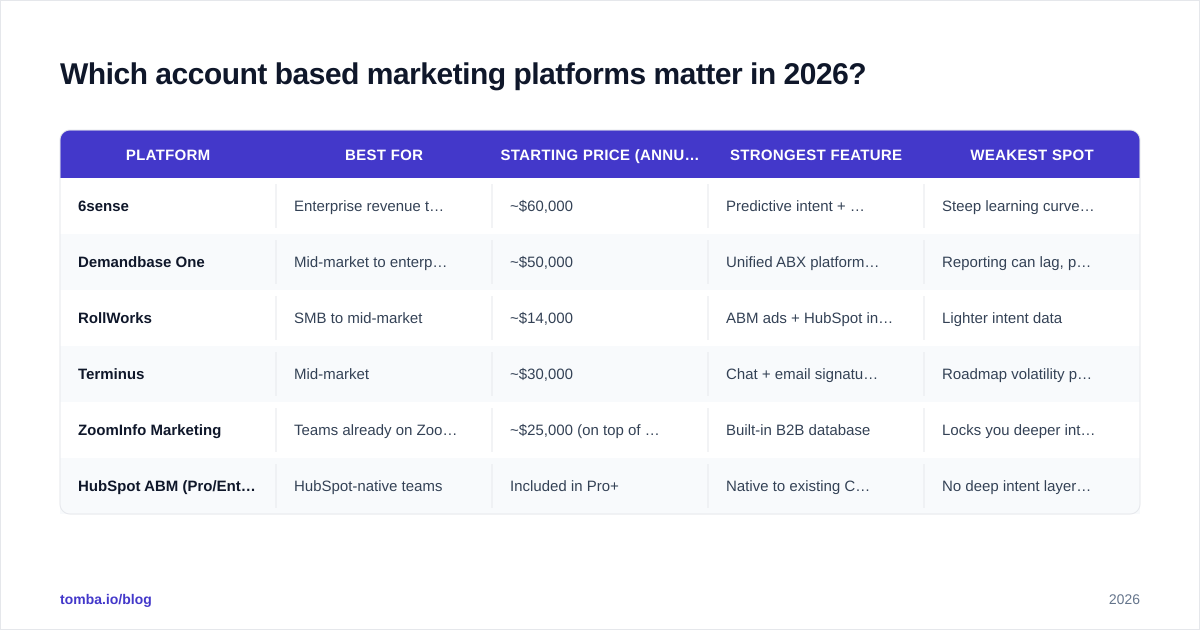
Prices above are public RFP averages reported on G2 and Capterra at the time of writing. Your quote will differ based on seats, ad spend, and contract length.
Do you actually need an account based marketing platform?#
Probably not yet, if you are honest with yourself. Three filters tell you whether a dedicated ABM platform will return on the spend.
Filter 1: Deal size. ABM math only works when ACV is at least $20k–$30k. Below that, the cost per touch eats the margin.
Filter 2: Sales motion. You need named reps assigned to named accounts. If marketing fires a signal into a generic SDR pool, the play dies in the queue.
Filter 3: Account list. You have a defined target account list of 200–2,000 companies. Larger than that and ABM becomes demand gen with a hat on. Smaller and you can run the motion manually in a spreadsheet for a quarter.
If you fail any one of those filters, skip the suite for now. Build the foundation with a B2B database, an email finder for contact discovery, and your existing CRM. Re-evaluate at the next ARR step.
How do the top platforms compare on features?#
Here is the feature-by-feature breakdown, scored from public docs, vendor demos, and customer reviews on G2 in Q1 2026.
| Capability | 6sense | Demandbase | RollWorks | Terminus | ZoomInfo MKT | HubSpot ABM |
|---|---|---|---|---|---|---|
| Predictive intent data | Strong | Strong | Moderate | Moderate | Moderate | None native |
| Display advertising | Yes | Yes | Yes | Yes | Yes | Via integrations |
| LinkedIn ad orchestration | Yes | Yes | Yes | Partial | Partial | Yes |
| Email orchestration | Limited | Limited | Limited | Yes | Limited | Strong |
| Website personalization | Yes | Yes | Limited | Yes | Limited | Yes |
| Chat / conversational | No | Add-on | No | Yes | No | Yes |
| Sales engagement | Add-on | Add-on | No | Add-on | Yes | Add-on |
| Reporting on pipeline impact | Strong | Strong | Moderate | Moderate | Moderate | Moderate |
| CRM-native | Integrated | Integrated | Integrated | Integrated | Integrated | Yes (HubSpot) |
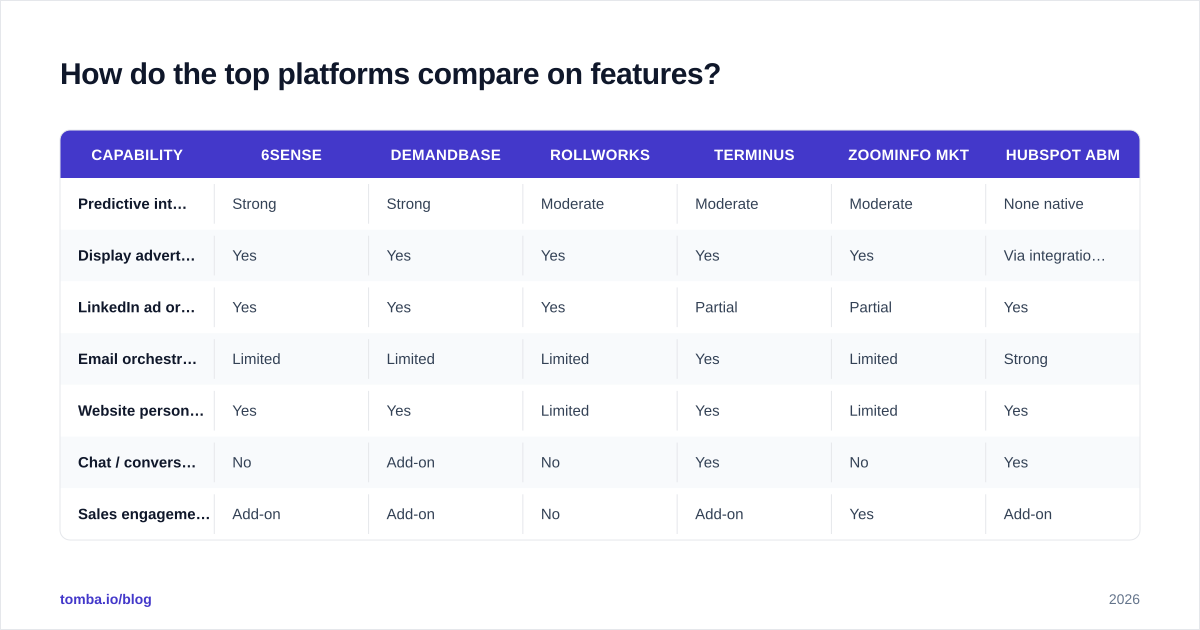
Two patterns jump out.
First, every platform claims display ads. The real differentiator is the quality of the underlying ID graph — how reliably the platform can match a target account to a bidstream cookie or a logged-in LinkedIn user. 6sense and Demandbase still lead here in 2026, with RollWorks closing the gap on the mid-market.
Second, none of these tools are great at outbound email orchestration on their own. You will end up bolting on a sequencer like Outreach, Salesloft, Apollo, or Instantly. Budget for that from day one.
What does an honest ABM stack cost in 2026?#
A realistic mid-market ABM stack — 1,000 target accounts, three SDRs, one ABM marketer — runs $120k–$220k per year all-in. Here is how the spend usually splits.
| Layer | Tool examples | Annual cost (mid-market) |
|---|---|---|
| Core ABM platform | Demandbase, 6sense, RollWorks | $30k–$90k |
| B2B data and enrichment | ZoomInfo, Apollo, Tomba | $15k–$40k |
| Sales engagement | Outreach, Salesloft, Apollo | $15k–$30k |
| LinkedIn ad spend | Sponsored content + InMail | $30k–$60k |
| Display retargeting spend | Programmatic via the ABM platform | $15k–$30k |
| Content and creative | In-house or agency | $20k–$50k |
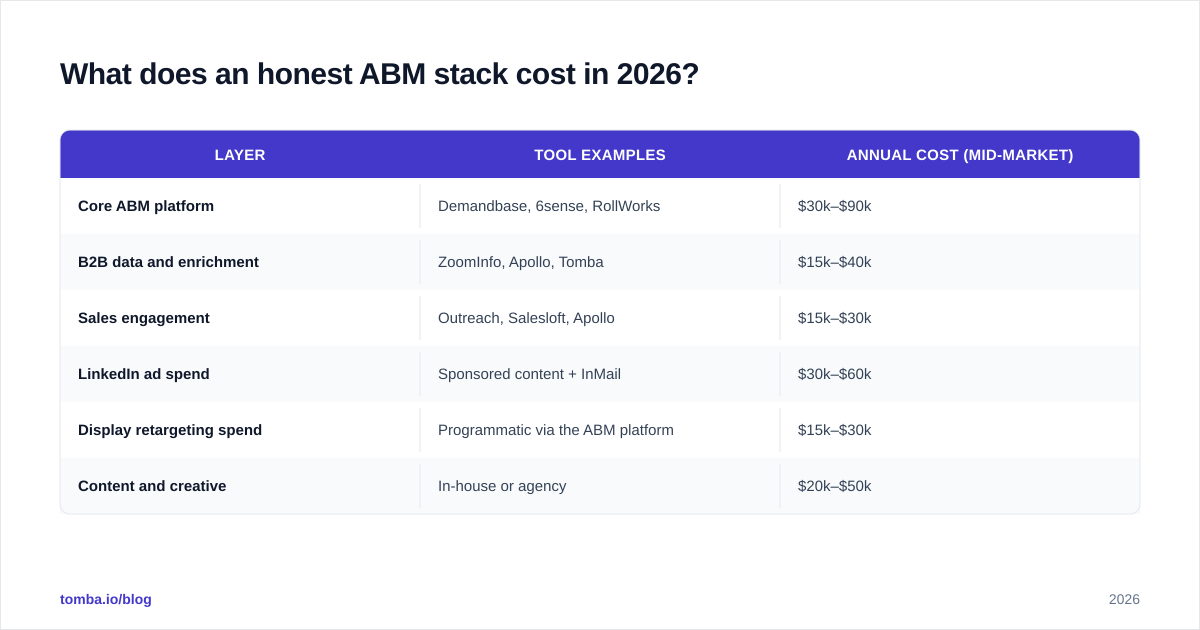
The mistake most teams make is over-indexing on the orchestration platform and under-investing in data and creative. A $90k ABM platform pointed at a dirty account list with one generic eBook will produce nothing. The same $90k split across cleaner data, three pieces of vertical-specific content, and a smaller orchestration tool will produce pipeline.
For lean teams, a stripped-down ABM stack built around data enrichment plus a sequencer plus LinkedIn ads can run under $40k/year and outperform a $90k suite in the first six months — because the team can actually use it.
Is 6sense better than Demandbase?#
This is the question every ABM buyer asks. The honest answer: it depends on which side of the stack you weight.
Pick 6sense if your buying committee is large, your sales cycle is long, and you want AI-driven account scoring that sales reps will trust. The Revenue AI engine is the strongest in the category for surfacing accounts in the early "anonymous research" stage.
Pick Demandbase if advertising is the lead channel and you want one platform that handles intent, ads, personalization, and pipeline analytics in a single UI. Demandbase One is the more unified product. The trade-off is that the analytics layer can feel a beat behind 6sense's predictions.
Pick RollWorks if you are on HubSpot, you are SMB or low-mid-market, and you want 70% of the value at 25% of the price. RollWorks is the pragmatic choice and the integration with HubSpot is genuinely native.
Customer reviews on G2's ABM category confirm the same pattern: 6sense wins on data depth, Demandbase wins on unified UX, RollWorks wins on ease of use and HubSpot fit.
How do you build a target account list before buying a platform?#
You do not need a $60k platform to build a target account list. You need three inputs and a weekend.
- Pull your closed-won deals from the last 24 months. Note industry, employee count, revenue, geography, and tech stack. The pattern is your ideal customer profile.
- Filter a B2B database for lookalikes. Use ZoomInfo, Apollo, or Tomba's B2B database to pull companies matching the ICP. Cap the list at 2,000 to keep it workable.
- Score the list manually for the first pass. Three tiers: Tier 1 must-win (50–100 accounts, named reps), Tier 2 high-fit (300–500 accounts, pooled SDRs), Tier 3 nurture (1,000+ accounts, automated touches only).
Once the list exists in your CRM, enrich each account with primary contacts — usually 5–8 stakeholders per buying committee. A domain search workflow gets you the patterns for every target domain in minutes; a bulk email finder handles the rest.
This list, plus contact data, plus intent signals from one source (G2 buyer intent, Bombora, or your own first-party data), is 80% of what an ABM platform gives you — for under $5k/year.
What signals matter most for account scoring in 2026?#
Every platform sells "intent data" but not every signal is equal. After two years of watching cohort data from buyers across the category, the signals that actually correlate with pipeline are, in order:
- First-party engagement. A target-account visitor on your pricing page beats any third-party intent signal. Tools like website visitor reveal tie anonymous traffic back to companies and feed the loop.
- Job changes in the buying committee. A new VP at a target account is the single highest-converting signal in B2B. New hires want to make a mark in their first 90 days.
- Hiring signals. A target account posting roles in your function means budget is moving. Job-board scrapes catch this before any intent vendor does.
- Funding events. Series B and Series C closes inject 12–18 months of buying. Crunchbase RSS is free and works.
- Technographic shifts. A competitor showing up — or disappearing — in the target's stack is a hard signal. BuiltWith and Wappalyzer are sufficient.
- Third-party intent surges. Useful, but noisy. Treat as a tiebreaker, not a trigger.
Most ABM platforms claim all six. The differentiation in 2026 is how well they merge them into a single account score that a sales rep believes. 6sense leads on this. Everyone else is catching up.
How should sales and marketing share an ABM platform?#
The number one reason ABM platforms fail is that marketing buys the tool and sales never logs in. Three guardrails fix this before you sign the contract.
Guardrail 1: Sales sees the same account view as marketing. Whatever account score, intent signal, or engagement timeline marketing relies on must be visible inside the CRM where reps already live — Salesforce, HubSpot, Pipedrive — not in a separate ABM dashboard. Push the data; do not make reps pull it.
Guardrail 2: One shared definition of an "engaged" account. Marketing and sales sign off on the engagement threshold (for example: 10+ engagement points across two contacts in 14 days) before launch. Without this, you will spend six months arguing over whether MQAs are real.
Guardrail 3: Closed-loop reporting in week one. If you cannot answer "what pipeline did this platform sourced or influenced last month?" by the end of the first month, the tool is not configured. Pause and fix it before scaling spend.
For a deeper dive on the operating model, the revenue operations function should own this from day one. ABM without RevOps is marketing playing dress-up.
What is the simplest ABM stack that actually works?#
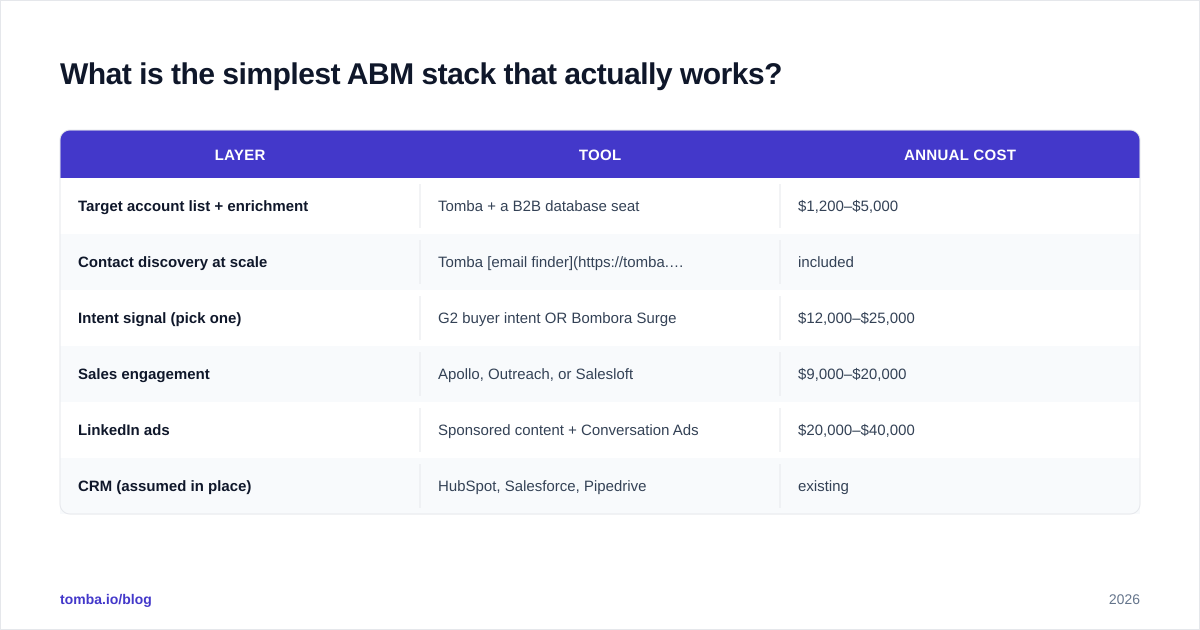
For teams that want to run ABM without committing $90k to a suite, this is the minimum viable stack that produces pipeline.
| Layer | Tool | Annual cost |
|---|---|---|
| Target account list + enrichment | Tomba + a B2B database seat | $1,200–$5,000 |
| Contact discovery at scale | Tomba email finder + phone finder | included |
| Intent signal (pick one) | G2 buyer intent OR Bombora Surge | $12,000–$25,000 |
| Sales engagement | Apollo, Outreach, or Salesloft | $9,000–$20,000 |
| LinkedIn ads | Sponsored content + Conversation Ads | $20,000–$40,000 |
| CRM (assumed in place) | HubSpot, Salesforce, Pipedrive | existing |
Total: roughly $45k–$90k/year, all-in, with no dedicated ABM platform. For most companies under $20M ARR, this beats the suites for the first 12–18 months because it forces discipline on the list and the plays.
Graduate to a full suite when one of three things happens: your target list grows past 2,000 accounts, your buying committee research happens primarily off your site (you need third-party predictive), or your board demands account-level attribution that your CRM cannot produce.
How do you measure ABM success in 2026?#
Stop measuring MQLs. They were never the right unit for ABM and they are actively misleading in 2026 when most enterprise buyers stay anonymous until decision stage.
The three metrics that matter:
- Engaged account rate. Percentage of target accounts with two or more buying-committee contacts engaged in the last 30 days. Healthy ABM programs run 25–40%.
- Tier 1 pipeline coverage. Pipeline value from Tier 1 accounts divided by annual Tier 1 quota. Target 3x for the trailing quarter.
- Account velocity. Days from first engagement to opportunity creation. ABM should compress this by 20–40% versus inbound; if it does not, the plays are not landing.
Influenced revenue and multi-touch attribution are nice to have, not load-bearing. If your CFO asks for them, run them. If not, do not let attribution debates eat your operating cadence.
How do you pick the right platform without overspending?#
Run this four-step gate before any RFP.
- Confirm the three filters above (deal size, named-rep motion, defined list). If you fail any one, skip the suite.
- List the jobs to be done. Write down the five to seven specific things you want the platform to do this year. Score each vendor on those jobs only — ignore everything else in the demo.
- Demo with your own data. Make every shortlisted vendor load your target account list and show you intent signals on it. If they cannot, the rest of the demo does not matter.
- Negotiate on term, not price. ABM vendors will discount 20–30% for a two-year deal. Use a one-year contract with a renewal option if you can stomach the higher rate — flexibility beats discount in a category this volatile.
The bottom line on account based marketing platforms#
The best account based marketing platform in 2026 is the smallest one your team will fully adopt. Suites like 6sense and Demandbase are excellent for enterprise programs with the headcount and content engine to feed them. RollWorks and HubSpot ABM cover the mid-market well. And a lean stack built on enrichment, a sequencer, and LinkedIn ads can outperform either for the first 18 months of an ABM motion.
Whichever route you pick, the platform is never the bottleneck. The list, the data quality, the named-rep ownership, and the content per buyer stage are the bottlenecks. Fix those first and any tool in the category will produce pipeline.
If your stack is still missing the data foundation — the verified emails, direct dials, and account-level contact maps that every ABM play depends on — start there. Tomba's Email Finder plugs into the workflow at the point most ABM programs leak: turning a target account list into a working contact list your reps can sequence on Monday morning. Pair it with data enrichment and a verified email verifier pass, and you have the foundation any ABM platform — or no platform at all — needs to run on.
// get started
Find, verify and enrich your first contacts today
Start on the free plan with 25 searches a month, then scale when your team is ready.
Free plan · No credit card required · GDPR & CCPA
// about the author