Account Based Marketing vs Demand Generation (2026 Guide)
ABM targets a named list of high-value accounts; demand generation builds broad market pull. Here's how to choose, blend, and resource both in 2026.
TL;DR
- Account based marketing (ABM) concentrates marketing and sales on a named list of high-value accounts and treats each one like a market of one. Demand generation builds broad awareness and pipeline across a wider audience.
- ABM optimizes for account penetration and deal size; demand gen optimizes for volume, reach, and cost per lead. They measure success differently.
- They are not rivals. The strongest 2026 GTM motions run demand gen to fill the top and feed account selection, then layer ABM on the accounts that matter most.
- Choose ABM when deals are large, buying committees are complex, and your TAM is small. Choose demand gen when your ACV is low, sales cycles are short, and you need scale.
- Both motions live or die on data quality. Bad contact data wastes ad spend and burns SDR hours — clean records from a reliable email finder keep either engine running.
What is the real difference between ABM and demand generation?#
The one-line answer: demand generation casts a wide net to create market interest; account based marketing spears a short list of specific companies you already want to win.
Think of it like fishing. Demand generation is a trawler dragging a wide net through open water — you catch a lot, you sort the keepers from the bycatch later. ABM is spearfishing — you pick the exact fish, study where it swims, and commit your effort to landing that one.
Technically, the two motions differ across almost every dimension of execution:
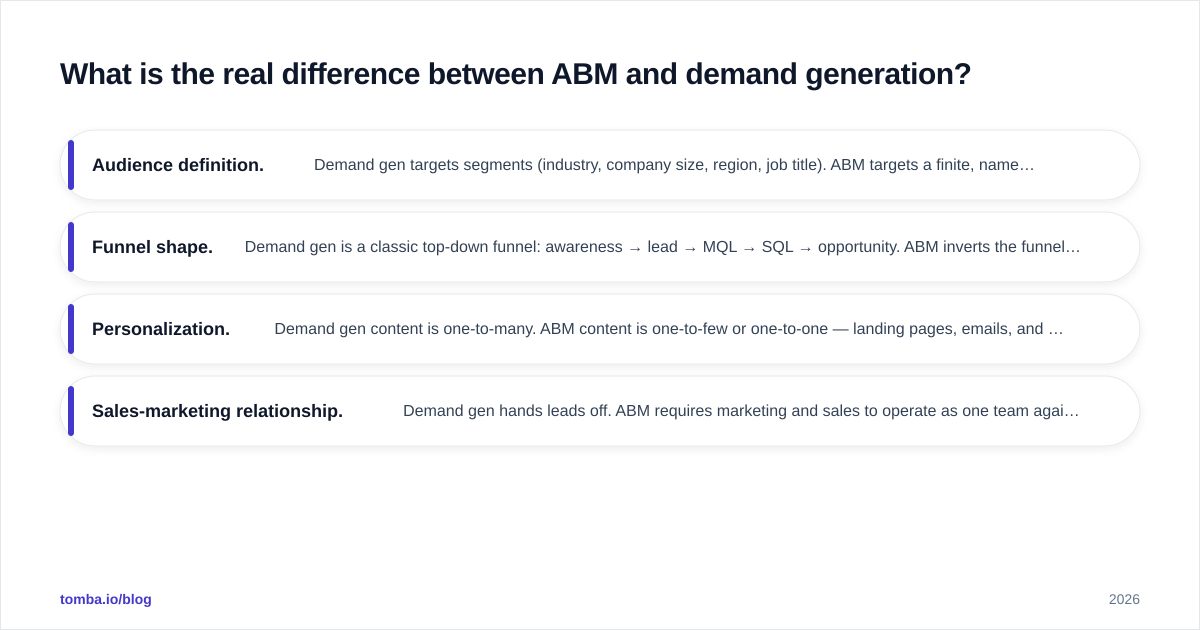
- Audience definition. Demand gen targets segments (industry, company size, region, job title). ABM targets a finite, named list — often 50 to 500 accounts chosen with sales.
- Funnel shape. Demand gen is a classic top-down funnel: awareness → lead → MQL → SQL → opportunity. ABM inverts the funnel: you start with the accounts, expand into the buying committee, then nurture each contact.
- Personalization. Demand gen content is one-to-many. ABM content is one-to-few or one-to-one — landing pages, emails, and ads tailored to a single company's pain.
- Sales-marketing relationship. Demand gen hands leads off. ABM requires marketing and sales to operate as one team against shared account goals.
If you only remember one thing: demand generation answers "how do we get more of the market to know and want us?" while ABM answers "how do we win these specific companies?"
What is demand generation, exactly?#
Demand generation is the set of programs that create and capture interest across your total addressable market. It is broader than lead generation — lead gen captures contact details, while demand gen also includes the brand-building, educational, and community work that makes people want to give you those details in the first place.
A typical demand gen stack includes:
- Content and SEO — blog posts, guides, comparison pages, and tools that rank and pull in organic traffic.
- Paid acquisition — search, social, and display ads targeting in-market buyers.
- Webinars, events, and community — top-of-funnel education that warms cold audiences.
- Lifecycle nurture — email sequences that move a subscriber from "curious" to "sales-ready."
Demand gen is measured on volume and efficiency: traffic, MQLs, cost per lead, pipeline sourced, and the all-important response rate on outbound and nurture. It scales well, but it can also flood sales with leads that never convert if your scoring is loose.

What is account based marketing, exactly?#
Account based marketing flips the model. Instead of generating many leads and hoping some belong to good-fit companies, you decide which companies you want first, then orchestrate marketing and sales around winning them.
ABM usually runs in three tiers:
- One-to-one (strategic ABM) — a handful of marquee accounts, each with bespoke campaigns, custom content, and executive sponsorship.
- One-to-few (ABM lite) — clusters of 5–25 similar accounts sharing a tailored message.
- One-to-many (programmatic ABM) — hundreds of accounts targeted with intent data and dynamic personalization at scale.
The work that makes ABM succeed is unglamorous: building an accurate account list, mapping the buying committee, and enriching every contact with verified email and phone data. Miss the CFO on a six-person buying committee and your "fully covered" account has a blind spot. This is why ABM teams lean heavily on data enrichment and a dependable domain search to find every relevant stakeholder at a target company.
Account based marketing vs demand generation: side-by-side#
Here's the comparison most teams actually need when they're deciding where to put next quarter's budget.
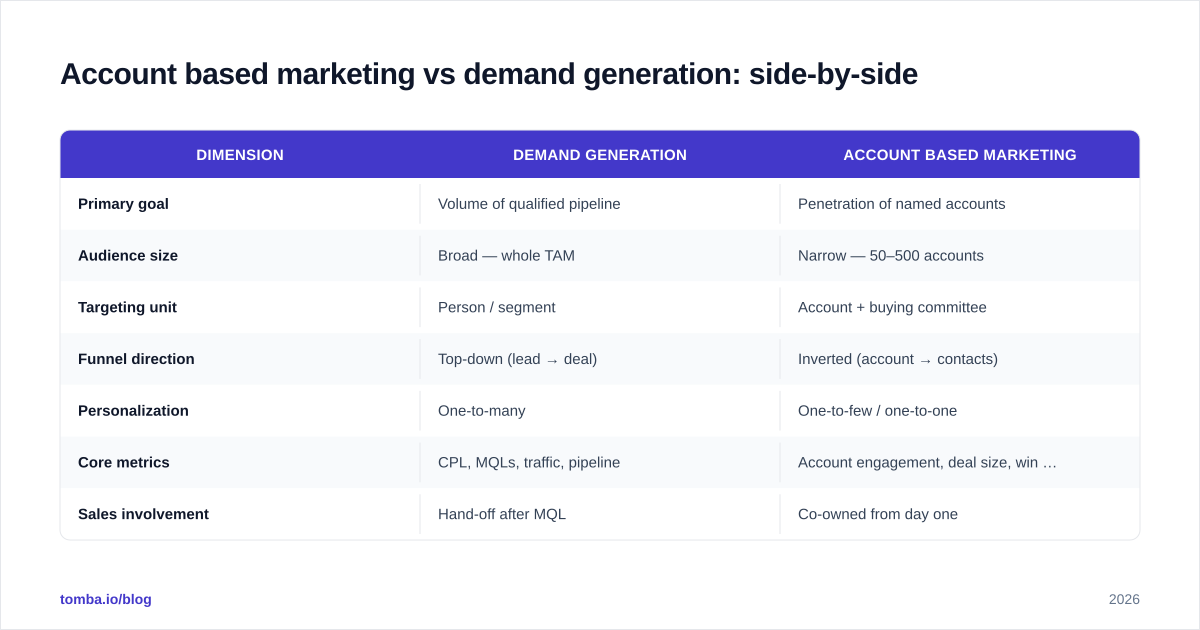
| Dimension | Demand Generation | Account Based Marketing |
|---|---|---|
| Primary goal | Volume of qualified pipeline | Penetration of named accounts |
| Audience size | Broad — whole TAM | Narrow — 50–500 accounts |
| Targeting unit | Person / segment | Account + buying committee |
| Funnel direction | Top-down (lead → deal) | Inverted (account → contacts) |
| Personalization | One-to-many | One-to-few / one-to-one |
| Core metrics | CPL, MQLs, traffic, pipeline | Account engagement, deal size, win rate |
| Sales involvement | Hand-off after MQL | Co-owned from day one |
| Best for ACV | Low to mid | Mid to high |
| Sales cycle fit | Short, self-serve | Long, committee-driven |
| Time to ROI | Weeks to months | Months to quarters |
| Data dependency | Moderate | High — accuracy is critical |
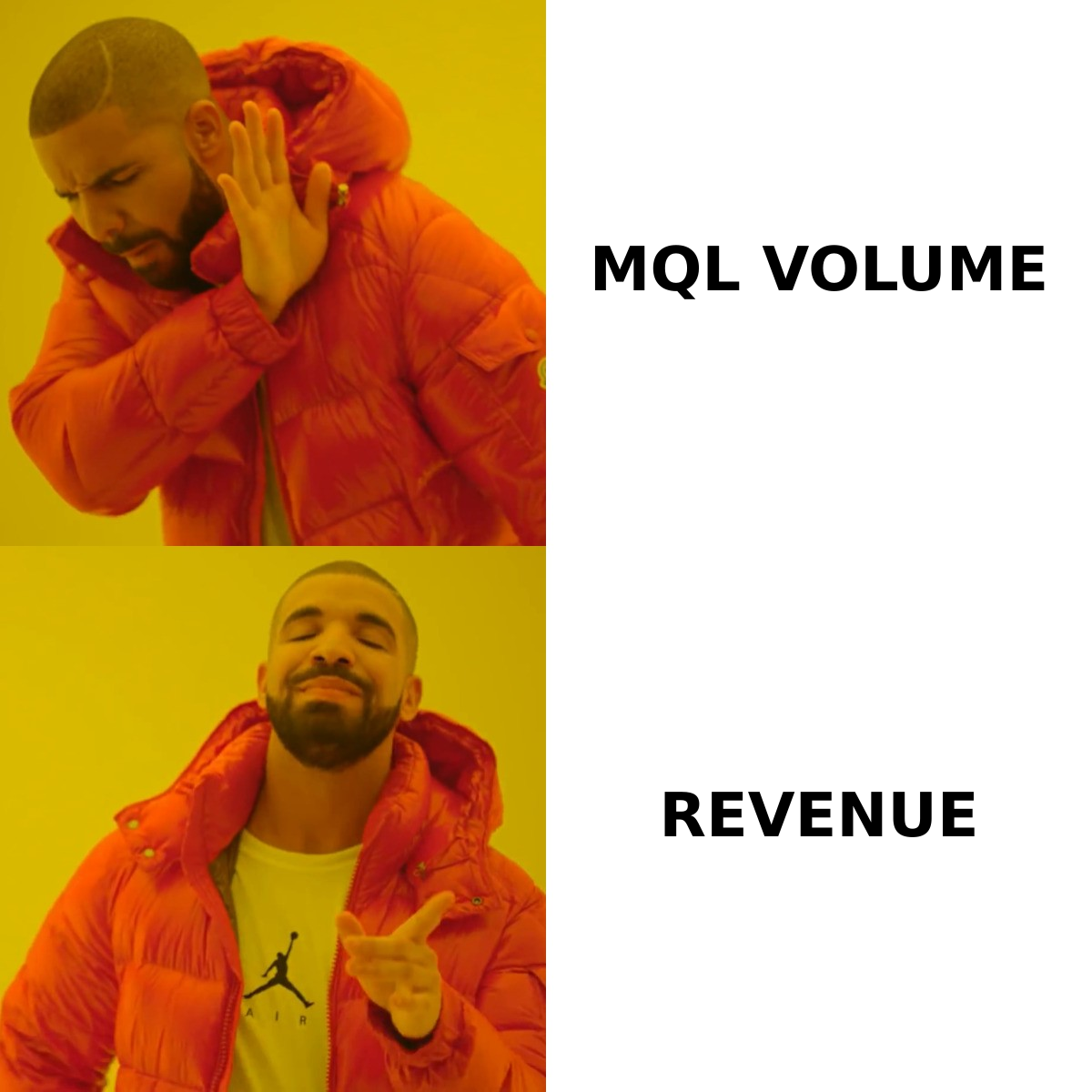
Notice the metrics row. A demand gen team that reports MQL volume and an ABM team that reports win rate on target accounts can both be "winning" — or both be hiding problems. Aligning on revenue, not activity, is the only way to compare them fairly.
Which one is better for your business?#
There is no universal winner. The right choice is a function of your deal economics and market size. Use this rule of thumb:
Lean demand generation when:
- Your average contract value is under roughly $10K and the math can't justify bespoke campaigns per account.
- Sales cycles are short and often self-serve.
- Your TAM is large and you still have plenty of unaware buyers to reach.
- You need predictable, scalable top-of-funnel volume now.
Lean ABM when:
- Deals are large, with five or more people on the buying committee.
- Your TAM is small enough to name — sometimes a few hundred companies make up most of your revenue potential.
- Customer acquisition cost is high and you can't afford to waste spend on poor-fit leads.
- Expansion and retention within strategic accounts drive most of your growth.
Most companies don't sit cleanly on one side. A mid-market SaaS company might run demand gen for its self-serve tier and ABM for enterprise. That's not indecision — it's portfolio thinking. For a deeper look at how these motions sit inside the broader go-to-market engine, revenue operations is the discipline that keeps both pointed at the same number.
Can you run ABM and demand generation together?#
Yes — and in 2026 the best teams treat this as the default, not a trade-off. The two motions feed each other when you sequence them deliberately.
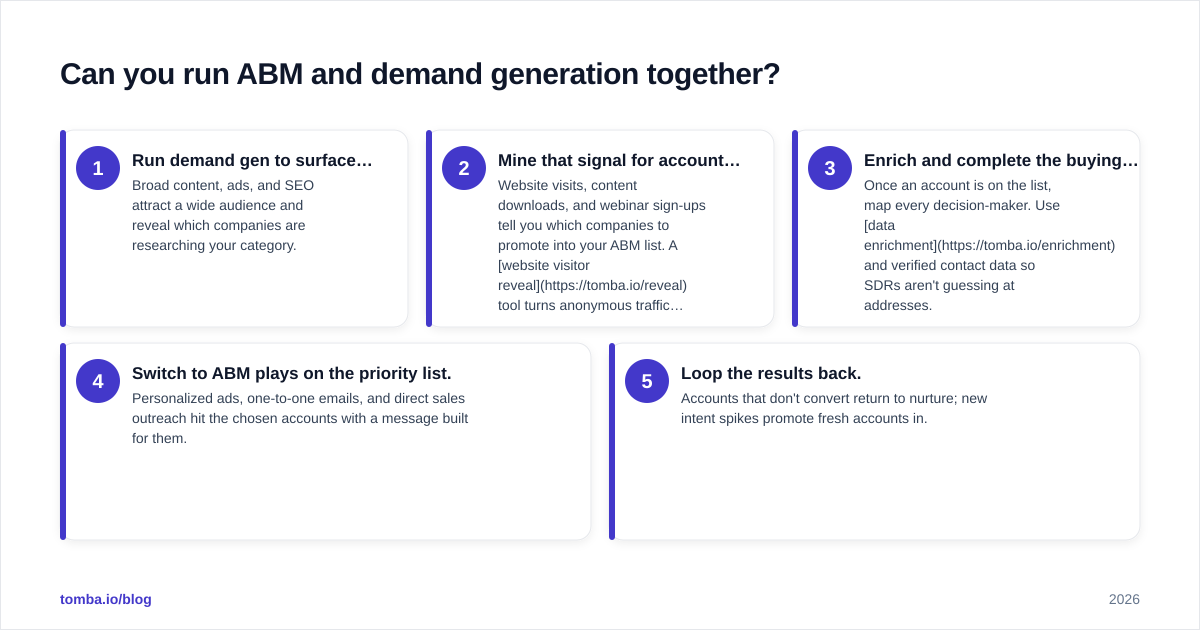
A practical blended workflow looks like this:
- Run demand gen to surface intent. Broad content, ads, and SEO attract a wide audience and reveal which companies are researching your category.
- Mine that signal for account selection. Website visits, content downloads, and webinar sign-ups tell you which companies to promote into your ABM list. A website visitor reveal tool turns anonymous traffic into named accounts.
- Enrich and complete the buying committee. Once an account is on the list, map every decision-maker. Use data enrichment and verified contact data so SDRs aren't guessing at addresses.
- Switch to ABM plays on the priority list. Personalized ads, one-to-one emails, and direct sales outreach hit the chosen accounts with a message built for them.
- Loop the results back. Accounts that don't convert return to nurture; new intent spikes promote fresh accounts in.
This is where data quality decides everything. Every handoff between demand gen and ABM depends on accurate records. A blended motion built on stale emails leaks at each step — bounced sends hurt your sender reputation, and SDRs waste hours chasing contacts who left months ago. Running your list through an email verifier before any campaign keeps both engines clean.
What metrics should you track for each motion?#
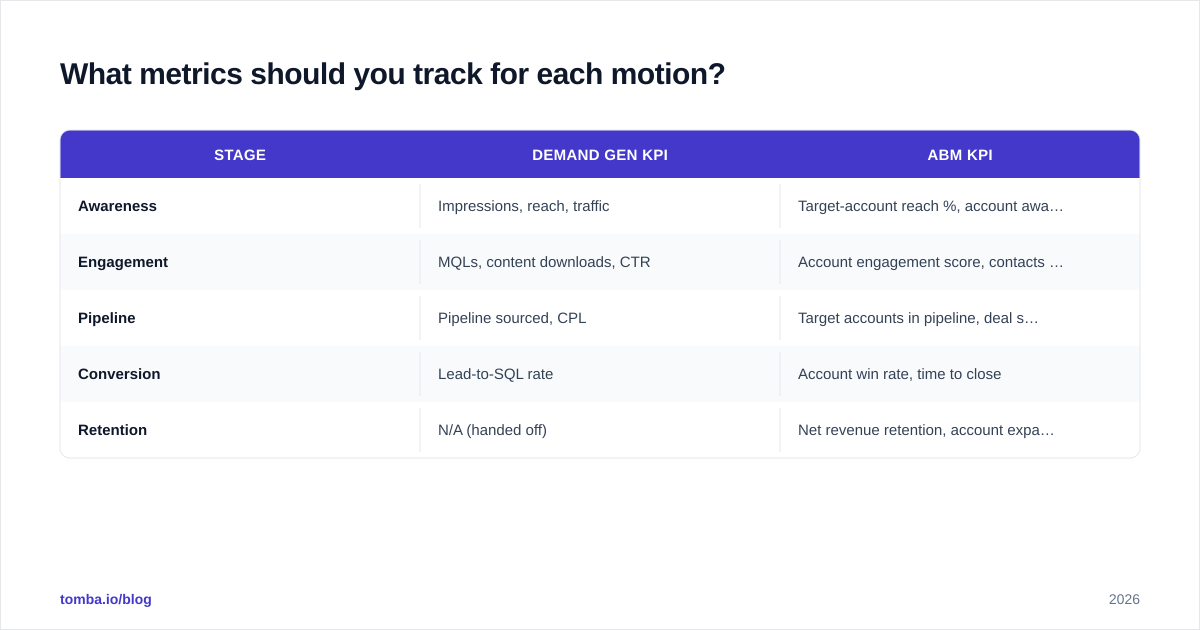
Measuring ABM with demand gen metrics (or vice versa) is the most common reason leadership thinks one "isn't working." Keep the scorecards separate.
| Stage | Demand Gen KPI | ABM KPI |
|---|---|---|
| Awareness | Impressions, reach, traffic | Target-account reach %, account awareness lift |
| Engagement | MQLs, content downloads, CTR | Account engagement score, contacts engaged per account |
| Pipeline | Pipeline sourced, CPL | Target accounts in pipeline, deal size |
| Conversion | Lead-to-SQL rate | Account win rate, time to close |
| Retention | N/A (handed off) | Net revenue retention, account expansion |
For ABM, the unit of measurement is always the account, not the lead. Five engaged contacts at one target company is worth more than fifty scattered MQLs across companies you'll never close. For demand gen, efficiency at scale matters most — cost per lead and the rate at which leads progress.
What tools and data do you need to execute either motion?#
Both motions share a foundation — accurate, complete contact data — and then diverge on the orchestration layer.
Shared foundation (non-negotiable for both):
- A reliable email finder to find and complete contact records by name or company.
- An email verifier to scrub lists before sending and protect email deliverability.
- A B2B database and bulk lead generation capability for building target lists at scale.
- CRM integration so both motions write to a single source of truth — Tomba connects directly to HubSpot and Salesforce.
Demand-gen-specific: marketing automation, paid media platforms, SEO tooling, and a content engine.
ABM-specific: intent data providers, account orchestration platforms, and personalization tools. Independent reviews on G2's ABM category are a sober place to compare the orchestration vendors before you commit budget.
The point worth repeating: tooling is downstream of data. The slickest ABM platform can't personalize to a buying committee it can't see, and the best demand gen ads waste spend if the captured emails bounce. Whichever motion you pick, fix the data layer first. You can compare what fits your volume on the Tomba pricing page — the Free tier gives you 25 searches a month to test, and paid plans start at $49/mo.
How do industry leaders frame this debate?#
The analyst consensus has shifted. Where ABM was once positioned as a replacement for demand gen, firms like Gartner and practitioners across the field now describe a converged model — "ABM-everywhere" or "account based experience" — where account thinking informs all marketing, including broad demand programs. HubSpot's own marketing research repeatedly shows that alignment between sales and marketing, not the choice of motion, is the strongest predictor of revenue growth.
In other words, the smarter question isn't "ABM or demand gen?" It's "how do we sequence both so every dollar of demand gen makes our ABM sharper, and every ABM win teaches our demand gen who to target next?"
The bottom line#
Demand generation builds the market's awareness and fills the top of your funnel with volume. Account based marketing concentrates firepower on the specific companies that will move your number. They optimize for different things, they're measured differently, and the best 2026 GTM teams run them as one connected system rather than picking a side.
Whichever way your mix leans, both motions sit on the same foundation: accurate, complete, verified contact data. If your ABM list is missing half the buying committee, or your demand gen sends are bouncing, the strategy debate is moot.
Start by fixing the data layer. The Tomba Email Finder finds professional email addresses by domain, name, or company — and pairs with built-in verification so your ABM account lists and your demand gen nurture flows both run on contacts that actually exist. Spin up the free tier, build one clean target-account list, and see which motion your data tells you to double down on.
// get started
Find, verify and enrich your first contacts today
Start on the free plan with 25 searches a month, then scale when your team is ready.
Free plan · No credit card required · GDPR & CCPA
// about the author