Account Based Sales Intelligence: The Complete 2026 Guide
Account based sales intelligence turns a flat target list into a ranked, signal-driven pipeline. Here is how the data, signals, and tools fit together in 2026.
Account based sales intelligence is the difference between a rep who works 500 random accounts and a rep who works the 40 that are actually in-market this quarter. One burns the year guessing. The other lets data point the way.
If you sell into named accounts, this is the discipline that decides whether your outbound lands or gets ignored. Below is how the pieces fit together in 2026 — the data layers, the signals, the scoring, and the tools that make it run.
TL;DR#
- Account based sales intelligence is the practice of collecting, scoring, and acting on data about target accounts (not just individual leads) so reps focus on companies most likely to buy now.
- It sits on three data layers: firmographics (who they are), technographics (what they run), and intent/engagement signals (what they're doing right now).
- The payoff is prioritization: a ranked account list beats an alphabetical one every time. Teams that score accounts on fit + intent consistently lift win rates.
- You don't need a six-figure platform to start. A clean ICP, an enrichment source, and contact data from a tool like Tomba Email Finder cover the core loop.
- The hard part isn't buying data — it's keeping it fresh and routing the right signal to the right rep at the right time.
What is account based sales intelligence?#
Account based sales intelligence is the system that tells you which companies to chase, why, and when — backed by data instead of gut feel.
Think of it like a weather forecast for your pipeline. A forecast doesn't tell you it will rain; it tells you the probability based on pressure, humidity, and wind. Account intelligence works the same way: it combines firmographic fit, technology footprint, and buying signals to estimate how "ready" an account is, so your team packs an umbrella for the accounts that are about to pour.
The shift here is the unit of analysis. Traditional lead-based selling treats every contact as an island. Account-based selling treats the company as the buyer — because in B2B, deals close when a buying committee of 6 to 10 people agrees, not when one form-fill says yes. That committee reality is well documented by Gartner's B2B buying research, and it's why intelligence has to roll up to the account, not scatter across leads.
Why does account intelligence beat a flat lead list?#
Because attention is your scarcest resource, and a flat list spends it evenly on accounts that deserve wildly different effort.
Picture two reps. Rep A exports 1,000 companies and works them top to bottom. Rep B scores the same 1,000 on fit and intent, then works the top 80 first. Rep B talks to more buyers who are actually evaluating, books more meetings per hour, and looks like a genius. Same list, different intelligence layer.
The flat list also hides the timing problem. An account can be a perfect fit and completely uninterested for 11 months of the year. Without signal data, you call them in month three, get a polite no, and never circle back for the one month they were ready. Account based sales intelligence catches that window.
What data powers account based sales intelligence?#
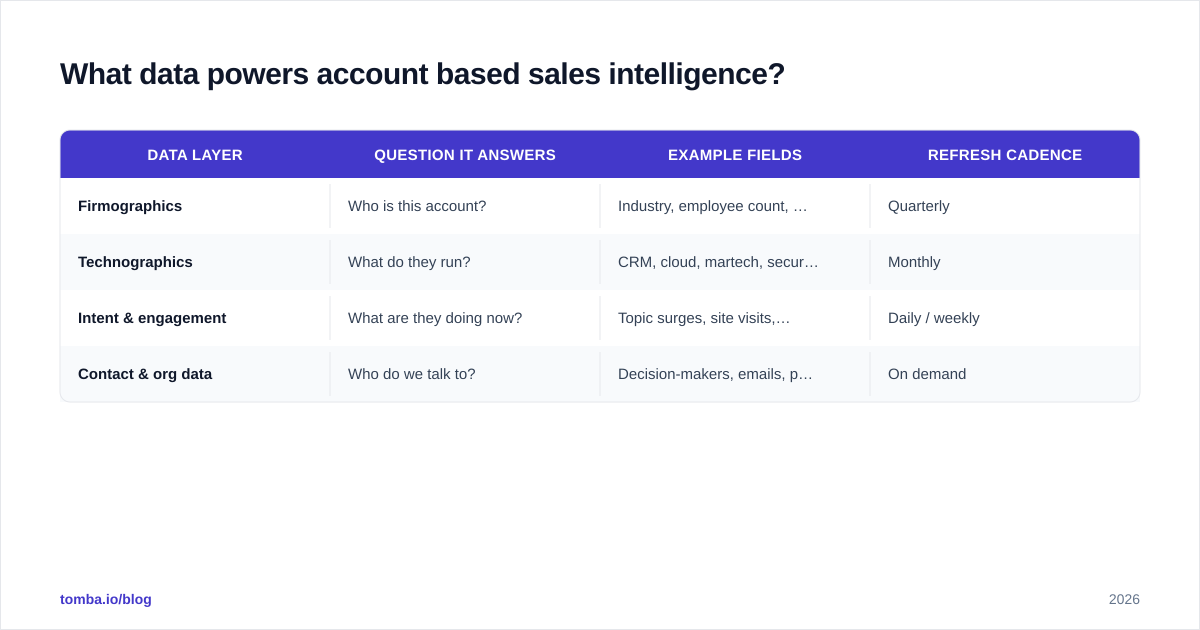
Three layers, stacked. Each answers a different question.
| Data layer | Question it answers | Example fields | Refresh cadence |
|---|---|---|---|
| Firmographics | Who is this account? | Industry, employee count, revenue, HQ, growth | Quarterly |
| Technographics | What do they run? | CRM, cloud, martech, security stack | Monthly |
| Intent & engagement | What are they doing now? | Topic surges, site visits, job posts, funding | Daily / weekly |
| Contact & org data | Who do we talk to? | Decision-makers, emails, phones, reporting lines | On demand |
The first three layers tell you which accounts matter. The fourth — contact data — is what turns a hot account into an actual conversation. You can know a company is in-market, but without verified emails and direct dials, you're knocking on a locked door. That's where data enrichment and an accurate email finder close the loop between "this account is interesting" and "I just emailed the VP of Ops."
A note on accuracy: stale data is worse than no data, because it feels trustworthy while quietly sending reps to people who left 18 months ago. Whatever sources you use, check how they're collected and how often — Tomba documents its data sources for exactly this reason.
How do intent signals actually work?#
Intent signals are behavioral breadcrumbs that suggest an account is researching a solution like yours — before they ever fill out your form.
They come in two flavors:
- Third-party intent — aggregated content consumption across the web. When a spike of people at one company suddenly read about "data warehouse migration," a provider like Bombora flags the surge. You didn't see the activity; the network did.
- First-party intent — behavior on your properties. Pricing-page visits, repeat sessions, demo replays, and webinar attendance. This is your highest-quality signal because it's about you specifically.
A third category is worth calling out: website visitor identification. Most of your site traffic is anonymous, but reverse-IP and de-anonymization tools can tell you which companies are browsing even when nobody fills out a form. That's a first-party intent goldmine — Tomba's visitor reveal surfaces those anonymous companies so they go into your scoring instead of vanishing.
The mistake teams make is treating every signal as equal. A funding round is a slow, strategic signal. A pricing-page visit at 11pm is a fast, tactical one. Your playbook should route them differently — the funding signal goes to a quarterly territory plan, the pricing visit goes to a rep's task list today.
How do you score and prioritize accounts?#
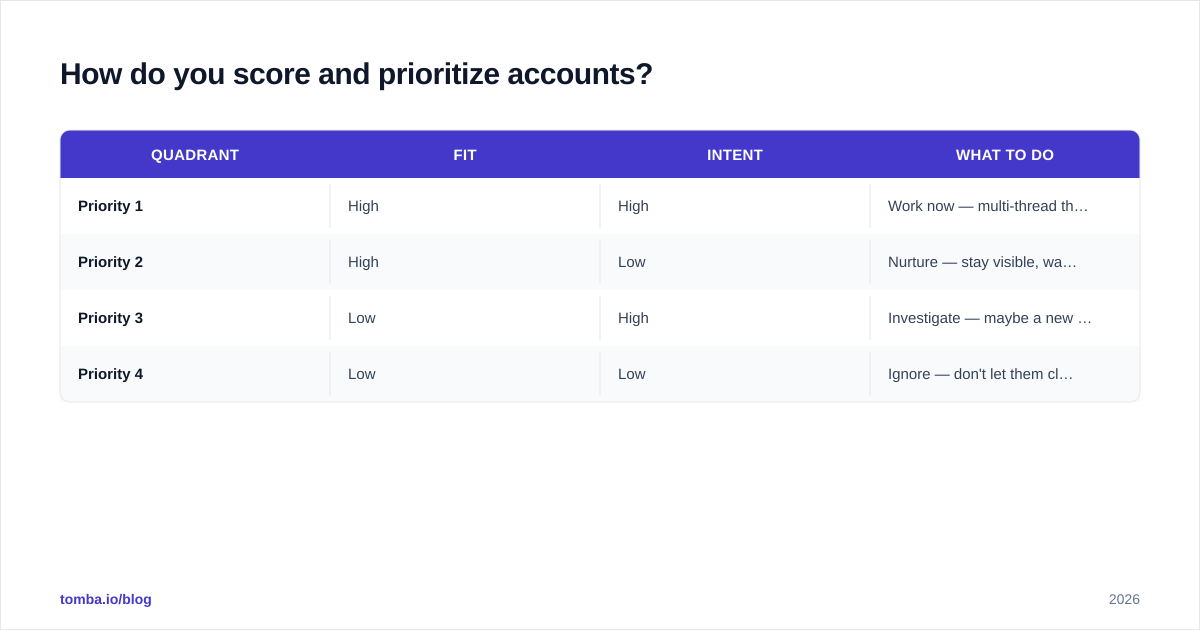
Combine fit and intent into a simple two-axis grid, then work the quadrants in order.
- Fit = how closely the account matches your ICP (firmographics + technographics).
- Intent = how much buying behavior they're showing right now.
| Quadrant | Fit | Intent | What to do |
|---|---|---|---|
| Priority 1 | High | High | Work now — multi-thread the committee today |
| Priority 2 | High | Low | Nurture — stay visible, wait for the signal |
| Priority 3 | Low | High | Investigate — maybe a new segment is emerging |
| Priority 4 | Low | Low | Ignore — don't let them clog the pipeline |
Keep the model embarrassingly simple at first. A weighted score of five or six fields will outperform a 40-variable model that nobody trusts or maintains. You can always add inputs once reps believe the top quadrant is genuinely hotter than the bottom one. For the broader operational picture of how scoring ties into routing and handoffs, the revenue operations function usually owns this model.
What tools make up an account intelligence stack?#
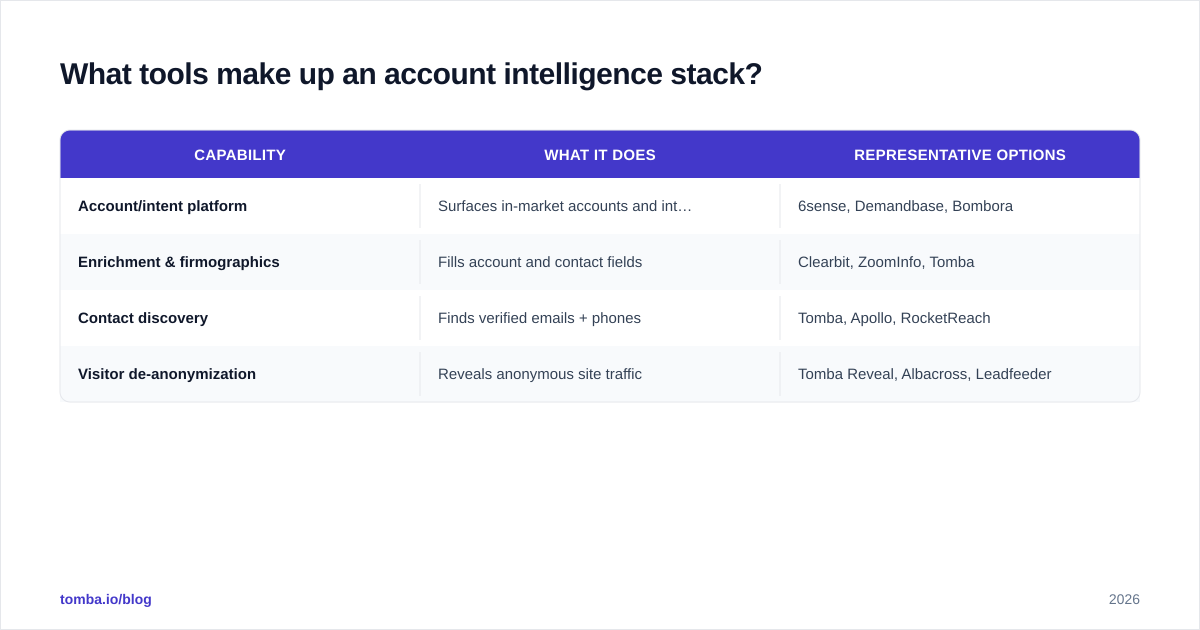
You're assembling four capabilities. Sometimes one platform covers several; often you stitch best-of-breed pieces together.
| Capability | What it does | Representative options |
|---|---|---|
| Account/intent platform | Surfaces in-market accounts and intent surges | 6sense, Demandbase, Bombora |
| Enrichment & firmographics | Fills account and contact fields | Clearbit,ZoomInfo, Tomba |
| Contact discovery | Finds verified emails + phones | Tomba, Apollo, RocketReach |
| Visitor de-anonymization | Reveals anonymous site traffic | Tomba Reveal, Albacross, Leadfeeder |
A common 2026 setup for a lean team: an intent platform (or even free first-party signals) feeds a ranked list, domain search pulls the right people at each target company, the email verifier keeps bounce rates low, and a phone finder adds direct dials for the priority-one accounts. No nine-month implementation required.
Before you buy anything heavy, check independent reviews on G2 — category leaders and scrappy challengers both live there, and the gap between marketing claims and real coverage shows up fast in user reviews. HubSpot also publishes a solid primer on account-based marketing alignment if you need to get sales and marketing rowing in the same direction first.
How do you operationalize it without drowning in data?#
Start with one workflow, prove it, then expand. The teams that fail try to boil the ocean on day one.
A pragmatic rollout:
- Define the ICP in writing. Three to five firmographic must-haves and one or two disqualifiers. If you can't name them, no amount of data will save you.
- Pick one signal you trust. Visitor reveal or pricing-page visits are great first-party starting points — no vendor contract needed.
- Enrich and find contacts. For every account that clears the bar, pull decision-makers and verified contact details. A bulk email finder handles this in batches so reps aren't hand-googling.
- Route by score, not by alphabet. Priority-one accounts hit a rep's queue same-day. Everything else waits.
- Close the loop. Feed outcomes back — which scored accounts actually converted — and adjust the weights monthly.
Keep the contact database clean as you go. The single biggest reason account intelligence programs stall isn't bad strategy; it's data decay. People change jobs, companies get acquired, and last quarter's perfect list quietly rots. Schedule re-verification the way you'd schedule oil changes — boring, regular, and non-negotiable.
What does good look like in 2026?#
Three shifts separate the teams winning with this from the ones just buying data.
First, intelligence is shared, not hoarded. Marketing's intent data, sales' call notes, and product's usage signals all roll up to the same account record. When a rep opens an account, they see the funding news, the three pricing visits, and the support ticket — one view, one truth.
Second, signals trigger plays, not dashboards. A dashboard nobody opens is a museum. The mature version wires each signal to an action: high intent fires an outreach sequence, a competitor's tech in the stack fires a displacement play, a job posting for a role you serve fires a tailored note.
Third, the human still writes the message. Data tells you who and when. It does not write a relevant first line. The reps who win pair sharp targeting with a genuinely researched, specific opener — the kind of message that proves you understand their world, not just their industry code.
That's the whole game: precise targeting plus a human touch. The intelligence layer earns the rep the right to be relevant. What they do with it still matters.
Getting started#
Account based sales intelligence rewards focus, and focus starts with knowing exactly who to contact at each account you've prioritized. Once your ICP and signals point at the right companies, you still need verified, current email addresses to turn a target into a conversation.
That's the gap Tomba Email Finder closes. Feed it a target company and a name, and it returns a verified professional email — at scale, with bulk lookups and an API when you're ready to wire it into your scoring workflow. Pair it with the free tier (25 searches a month) to test coverage on your real account list before committing, and review the full Tomba pricing when you scale: Starter is $49/mo, Growth $99/mo, and Pro $249/mo. Build the targeting layer first, then let accurate contact data do the rest.
// get started
Find, verify and enrich your first contacts today
Start on the free plan with 25 searches a month, then scale when your team is ready.
Free plan · No credit card required · GDPR & CCPA
// about the author