Account Scoring in 2026: The Complete B2B Playbook
Most teams chase every account equally and burn pipeline on bad fits. Account scoring fixes that—here's how to build a model that points sales at revenue.
Your reps have a finite number of hours this quarter. If they spend them on accounts that will never close, no amount of clever sequencing or follow-up saves the number. Account scoring is how you decide—before anyone picks up the phone—which accounts deserve that time.
This guide breaks down what account scoring is, how it differs from lead scoring, the models that actually work in 2026, and a step-by-step way to build a model your sales team will trust.
TL;DR#
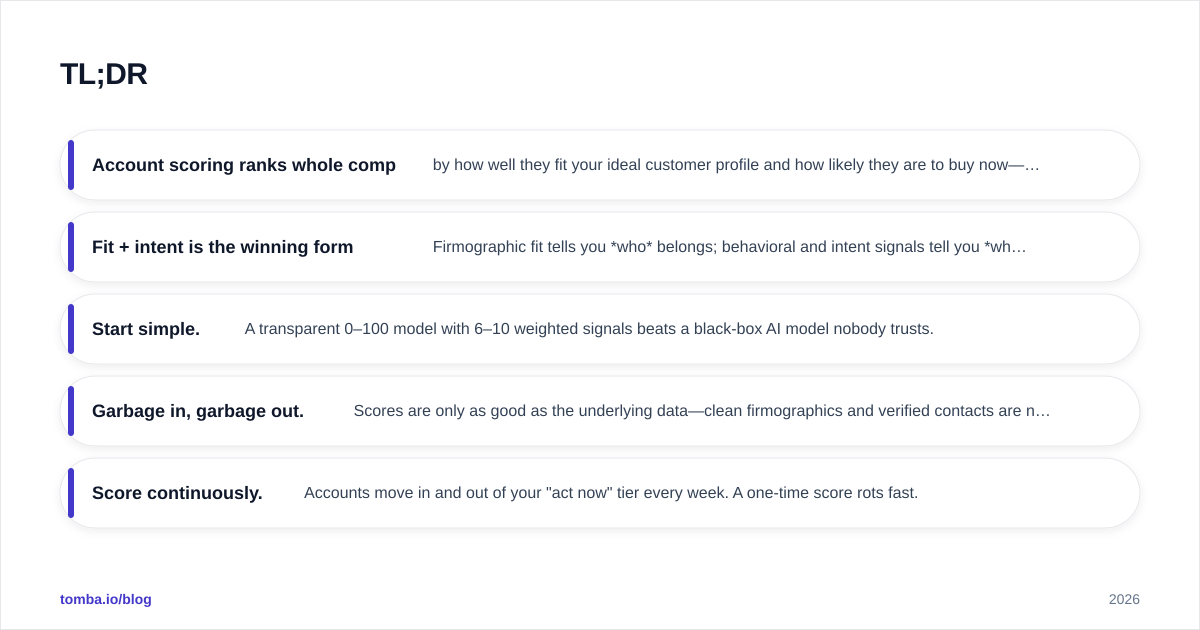
- Account scoring ranks whole companies by how well they fit your ideal customer profile and how likely they are to buy now—not individual contacts.
- Fit + intent is the winning formula. Firmographic fit tells you who belongs; behavioral and intent signals tell you when to act.
- Start simple. A transparent 0–100 model with 6–10 weighted signals beats a black-box AI model nobody trusts.
- Garbage in, garbage out. Scores are only as good as the underlying data—clean firmographics and verified contacts are non-negotiable.
- Score continuously. Accounts move in and out of your "act now" tier every week. A one-time score rots fast.
What is account scoring?#
Account scoring is the practice of assigning a numeric rank to a company (an account) based on how closely it matches your ideal customer profile and how likely it is to convert into revenue. The output is usually a number (0–100) or a grade (A/B/C/D) that tells sales and marketing where to spend effort.
Think of it like a restaurant deciding which reservations to prioritize on a packed Friday night. A party of eight that orders the tasting menu every month gets the prime table; a walk-in solo diner who wants tap water gets seated when there's room. You're not being rude—you're matching limited capacity to expected value. Account scoring does the same thing for your pipeline.
Technically, an account score blends two categories of signal:
- Fit signals (firmographic, technographic): industry, company size, revenue, region, tech stack, funding stage.
- Intent signals (behavioral, engagement): site visits, content downloads, demo requests, third-party intent data, hiring patterns, and product usage.
In an account-based go-to-market motion, this is the spine of the whole operation. It is closely tied to revenue operations because the score becomes the shared definition of "good" that marketing, SDRs, and AEs all work against.
How is account scoring different from lead scoring?#
They sound similar and people use the terms loosely, but they answer different questions.
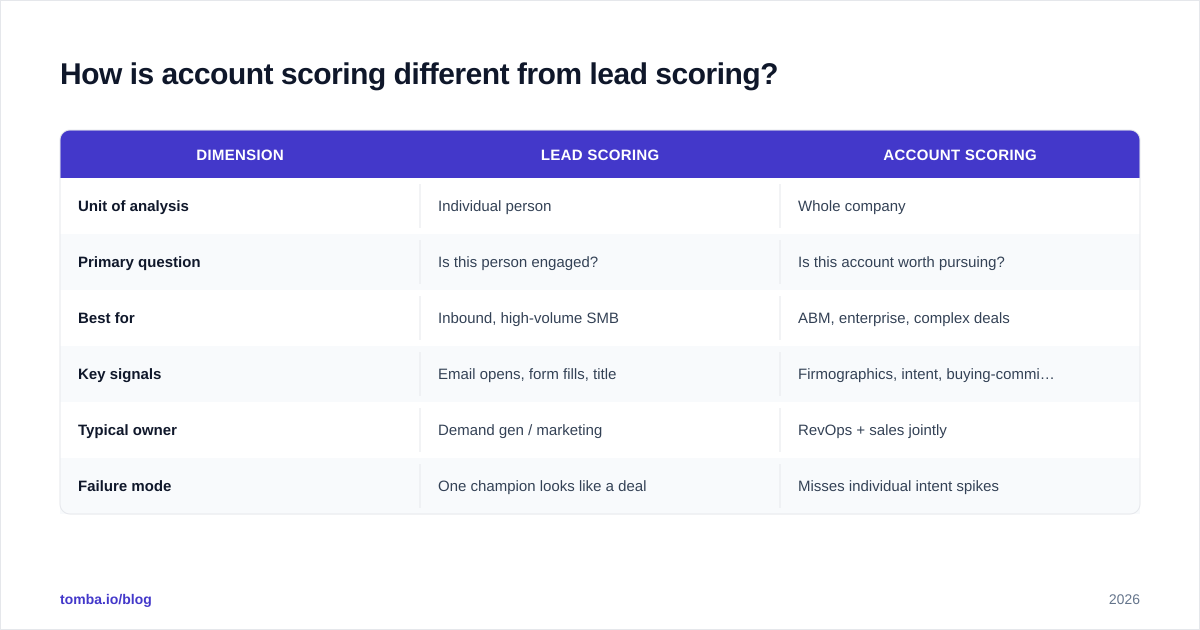
Lead scoring evaluates a single person—their title, their email engagement, whether they downloaded your whitepaper. Account scoring evaluates the organization those people belong to. In B2B, deals are won or lost at the account level because buying committees average six to ten people. Scoring one contact in isolation misses the other nine.
The two are complementary, not competing. The cleanest setups roll individual lead scores up into an account score, so a company with three engaged champions outranks one with a single curious intern. If you need a refresher on the contact-level side, our take on the marketing qualified lead is a good companion read.
| Dimension | Lead scoring | Account scoring |
|---|---|---|
| Unit of analysis | Individual person | Whole company |
| Primary question | Is this person engaged? | Is this account worth pursuing? |
| Best for | Inbound, high-volume SMB | ABM, enterprise, complex deals |
| Key signals | Email opens, form fills, title | Firmographics, intent, buying-committee depth |
| Typical owner | Demand gen / marketing | RevOps + sales jointly |
| Failure mode | One champion looks like a deal | Misses individual intent spikes |
What signals should feed an account score?#
The signals fall into four buckets. Most strong models pull from all four, then weight them based on what historically predicted closed-won deals in your data—not a generic template.
Firmographic fit#
The baseline. Company size, industry, annual revenue, headcount growth, and geography. If you sell compliance software to mid-market US banks, a 40-person design agency in another country scores near zero on fit no matter how engaged they are.
Technographic fit#
What's in their stack. If your product integrates with Salesforce, accounts already running Salesforce convert faster and cheaper. Technographic data is one of the most underused fit signals in B2B.
Intent and engagement#
The "act now" layer. First-party intent (visits to your pricing page, repeated demo views) is gold. Third-party intent—via providers like Bombora's surge data—tells you an account is researching your category across the open web even before they hit your site.
Data quality and reachability#
A frequently ignored signal: can you actually reach the buying committee? An account with a perfect fit score is worthless if every contact email bounces. This is where enrichment and verification feed the model directly—clean, deliverable contact data is a prerequisite for the score to mean anything. Tomba's data enrichment and verified contact coverage exist precisely to keep this layer honest.
What does a good account scoring model look like?#
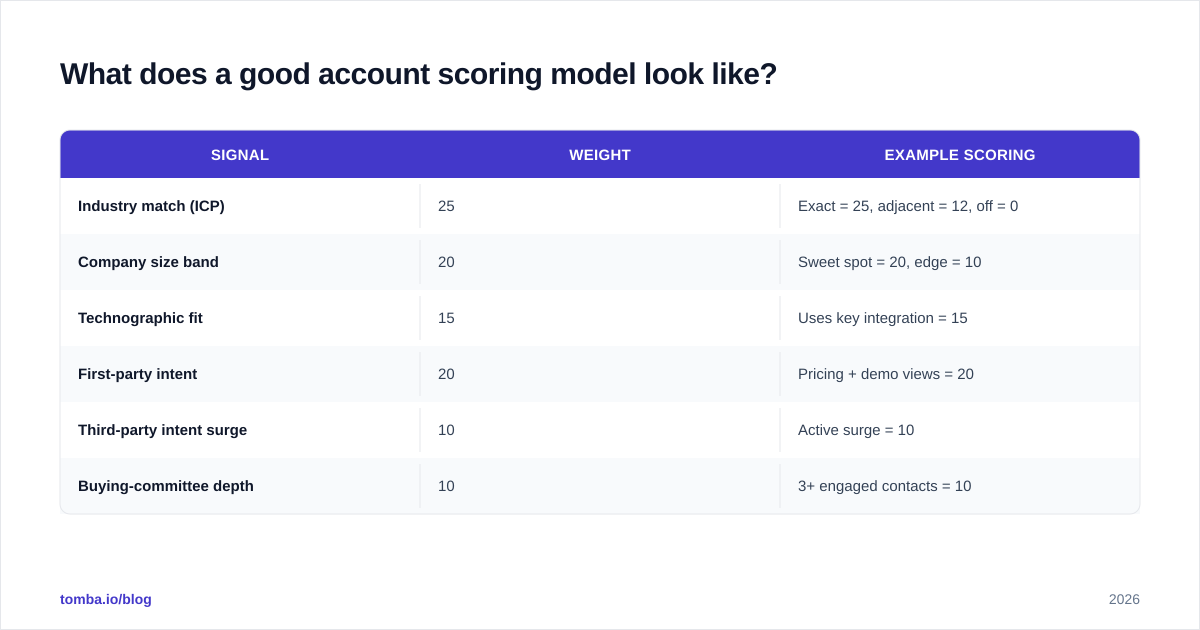
Here's a practical, transparent weighting you can adapt. The point isn't these exact numbers—it's that every input is explainable to a skeptical AE.
| Signal | Weight | Example scoring |
|---|---|---|
| Industry match (ICP) | 25 | Exact = 25, adjacent = 12, off = 0 |
| Company size band | 20 | Sweet spot = 20, edge = 10 |
| Technographic fit | 15 | Uses key integration = 15 |
| First-party intent | 20 | Pricing + demo views = 20 |
| Third-party intent surge | 10 | Active surge = 10 |
| Buying-committee depth | 10 | 3+ engaged contacts = 10 |
Sum to a 0–100 score, then bucket: 80–100 = A (act now), 60–79 = B (nurture actively), 40–59 = C (long-term), below 40 = D (suppress). Sales works the A and B tiers; marketing nurtures C; you stop spending entirely on D.
A note on AI models. Predictive scoring that learns weights from your closed-won history can outperform a manual model—once you have enough deals to train on. But per Gartner's research on B2B buying, the biggest gains come from data quality and process discipline, not model sophistication. If your team doesn't trust the score, they ignore it, and a perfect black-box model that gets ignored is worth less than a rough transparent one that gets used.
How do you build an account scoring model step by step?#
1. Define your ICP from won deals, not opinions. Pull your last 50–100 closed-won accounts. Find the firmographic and technographic patterns they share. That's your fit baseline—evidence, not a workshop guess.
2. Inventory your signals. List every data point you can reliably capture for every account. A signal you can only fill for 30% of accounts will distort the model. Reliability beats richness.
3. Assign weights and validate against history. Apply your draft weights to last year's accounts. Did the deals you actually won score high? If your top-tier closed-won accounts land in tier C, your weights are wrong. Iterate.
4. Fix the data layer first. Enrich missing firmographics and verify contact reachability before you trust a single score. You can't score buying-committee depth if you don't have the contacts. Pull verified company contacts with a domain search and confirm they're deliverable up front.
5. Operationalize the tiers. Write explicit plays per tier: A-tier gets a 1:1 AE sequence within 24 hours, B-tier gets a marketing nurture track, D-tier gets suppressed from paid spend. A score with no attached action is a vanity metric.
6. Re-score continuously and review monthly. Intent decays. An account that surged last month may have bought from a competitor. Refresh scores on a schedule and review model accuracy against closed-won every month.
What are the most common account scoring mistakes?#
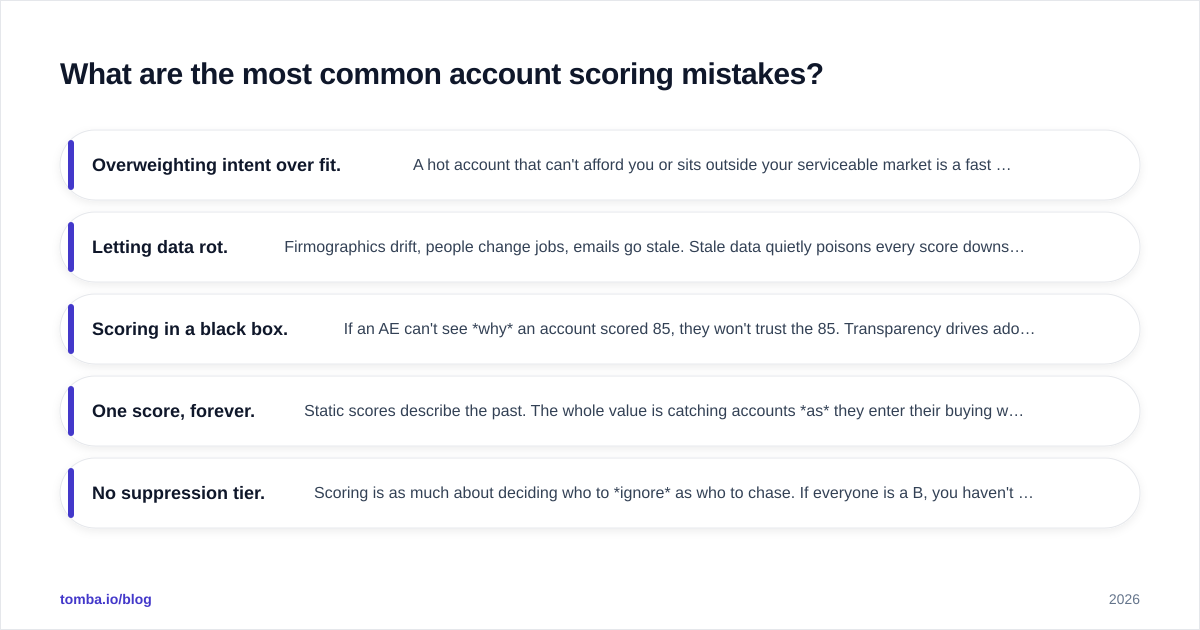
- Overweighting intent over fit. A hot account that can't afford you or sits outside your serviceable market is a fast no, not a fast yes. Fit gates intent, not the other way around.
- Letting data rot. Firmographics drift, people change jobs, emails go stale. Stale data quietly poisons every score downstream. Treat enrichment and verification as a recurring job, not a one-time import.
- Scoring in a black box. If an AE can't see why an account scored 85, they won't trust the 85. Transparency drives adoption.
- One score, forever. Static scores describe the past. The whole value is catching accounts as they enter their buying window.
- No suppression tier. Scoring is as much about deciding who to ignore as who to chase. If everyone is a B, you haven't scored anything.
According to user reviews aggregated on G2's sales intelligence category, data accuracy and freshness are the top differentiators buyers cite—which maps exactly to why the data layer, not the algorithm, makes or breaks a scoring program.
How does data quality make or break account scoring?#
Everything above assumes the inputs are real. They often aren't. A model fed bad firmographics and dead email addresses produces confident, precise, completely wrong scores—the worst kind, because they look trustworthy.
Three data jobs underpin a working model:
- Enrich sparse account records with accurate firmographic and technographic data, so fit signals are based on facts. Tomba's B2B database and data sources feed this layer.
- Find the right buying-committee contacts so you can measure committee depth and actually act on a high score.
- Verify that those contacts are deliverable, so reachability is a real signal and your outreach doesn't tank your sender reputation.
Skip any one and the score degrades. This is why high-performing RevOps teams wire enrichment and verification into the scoring pipeline rather than treating them as separate cleanup chores.
Start with the data layer#
A scoring model is only as good as the accounts and contacts feeding it. Before you tune a single weight, make sure you can find and reach the buying committee at every account that matters. The Tomba Email Finder pulls verified, deliverable email addresses by company and domain—so your committee-depth and reachability signals are based on real, confirmed contacts instead of guesses. Pair it with Tomba's enrichment to keep firmographics fresh, and your account scores will finally point your reps at the revenue. Start free with 25 searches a month and scale up on the Tomba pricing plan that fits your pipeline.
// get started
Find, verify and enrich your first contacts today
Start on the free plan with 25 searches a month, then scale when your team is ready.
Free plan · No credit card required · GDPR & CCPA
// about the author