Accurate Sales Forecasting in 2026: Methods, Models & Tools
Most sales forecasts miss by 20% or more. Here's how to build accurate sales forecasting your CFO actually trusts — methods, models, and the data hygiene behind them.
Accurate sales forecasting is less about predicting the future and more about building a repeatable system that turns messy pipeline data into a number your CFO will actually sign off on. Most teams treat the forecast as a monthly guessing ritual. The ones that hit plan treat it as an operating discipline.
TL;DR#
- Accuracy beats optimism. A forecast within 5–10% of actuals every quarter is worth more than a high number you miss by 30%.
- Method matters less than discipline. Pick one primary method (pipeline, historical, or weighted), then enforce clean stage definitions and exit criteria.
- Garbage in, garbage out. 60–80% of forecast error traces back to dirty CRM data — stale deals, wrong contacts, and phantom pipeline.
- Combine top-down and bottom-up. Rep commits validated against historical conversion rates catch sandbagging in both directions.
- Forecast cadence is weekly, not quarterly. Small corrections beat one big end-of-quarter scramble.
What is accurate sales forecasting?#
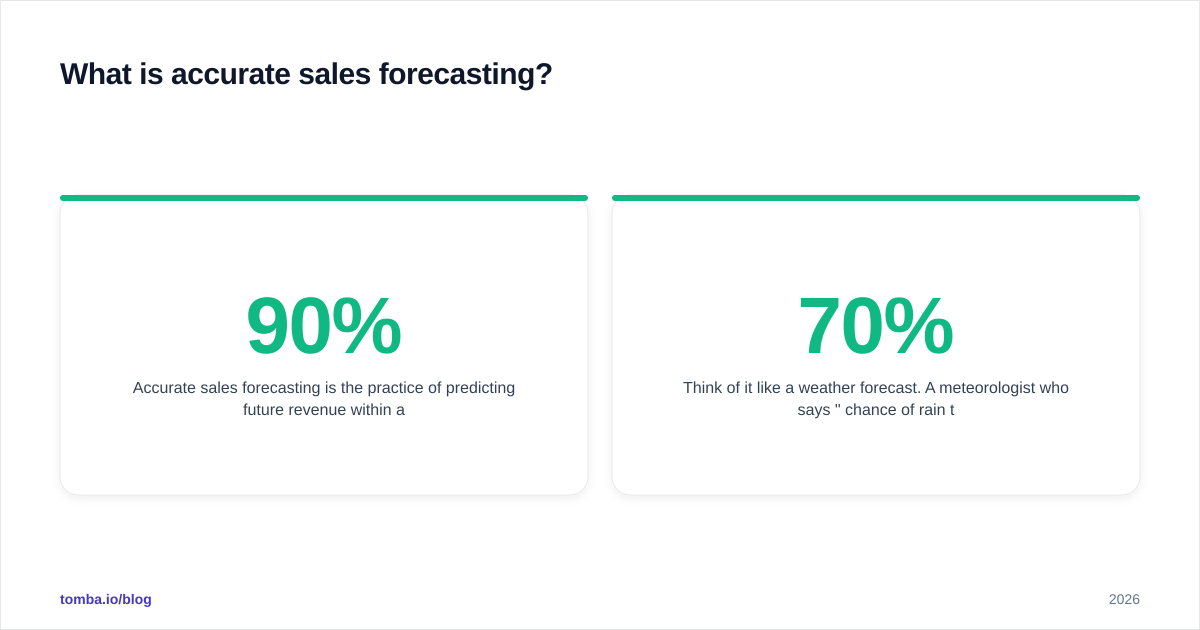
Accurate sales forecasting is the practice of predicting future revenue within a tight, consistent margin of error — typically 90% or better against actuals — using a defined method, clean data, and a fixed cadence.
Think of it like a weather forecast. A meteorologist who says "70% chance of rain tomorrow" and is right 70% of the time is far more useful than one who confidently promises sunshine and is wrong half the time. The goal isn't a bigger number. It's a calibrated number — one where your stated confidence matches reality over time.
In B2B sales, the forecast feeds hiring plans, board commitments, inventory, and cash management. When it's wrong, the damage cascades: you over-hire into a soft quarter, or you starve a hot one. That's why revenue operations teams now own forecasting accuracy as a core metric, not just a finance afterthought.
Why are most sales forecasts so inaccurate?#
Forecasts miss for predictable reasons. According to Gartner research, fewer than half of sales leaders have high confidence in their own forecast accuracy. The usual culprits:
- Happy ears. Reps hear "this looks good" and log it as a 90% commit.
- Stale pipeline. Deals sit in "negotiation" for 90 days with no activity but still count toward the number.
- Inconsistent stage definitions. "Qualified" means something different to every rep.
- Sandbagging and pull-forward. Reps hide deals to beat next quarter or yank them in to save this one.
- Bad contact data. You're forecasting a deal against a champion who left the company three weeks ago.
That last point is underrated. If your CRM is full of bounced emails and wrong titles, every downstream probability is built on sand. Clean contact enrichment and verified decision-maker data are forecasting inputs, not just prospecting nice-to-haves.
What are the main sales forecasting methods?#
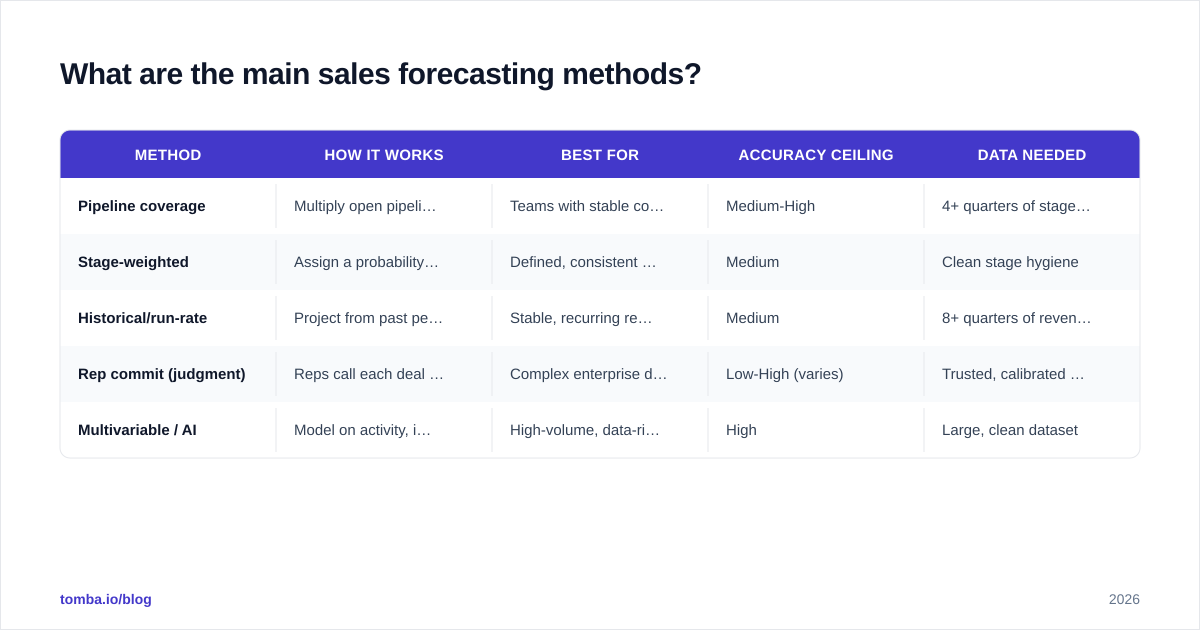
There's no single "best" method — there's the best method for your data maturity and deal motion. Here's how the main approaches compare.
| Method | How it works | Best for | Accuracy ceiling | Data needed |
|---|---|---|---|---|
| Pipeline coverage | Multiply open pipeline by historical close rate | Teams with stable conversion data | Medium-High | 4+ quarters of stage history |
| Stage-weighted | Assign a probability to each stage, sum the weighted values | Defined, consistent sales stages | Medium | Clean stage hygiene |
| Historical/run-rate | Project from past periods + growth factor | Stable, recurring revenue | Medium | 8+ quarters of revenue |
| Rep commit (judgment) | Reps call each deal commit/best-case/pipeline | Complex enterprise deals | Low-High (varies) | Trusted, calibrated reps |
| Multivariable / AI | Model on activity, intent, deal age, engagement signals | High-volume, data-rich orgs | High | Large, clean dataset |
The teams with the most reliable win rates rarely rely on one method. They run a bottom-up rep commit and a top-down historical model in parallel, then investigate the gap. When the two disagree by more than ~10%, that's your signal to dig into specific deals.
How do you build an accurate sales forecast step by step?#
Accuracy comes from process, not from a smarter spreadsheet formula. Here's the operating loop.
1. Lock your stage definitions and exit criteria#
Every stage needs a verifiable exit criterion — something that either happened or didn't. "Customer is interested" is not a criterion. "Economic buyer confirmed budget in writing" is. Document these and make them non-negotiable.
2. Clean the inputs before you forecast#
Before any number gets calculated, scrub the pipeline. Kill deals with no activity in 30+ days. Verify the contacts on every committed deal are still real, still employed, and still the decision-maker. A quick pass with an email verifier on your top contacts surfaces champions who've quietly left — a leading indicator of deals that are about to slip.
3. Apply your method consistently#
Pick your primary method and apply it the same way every period. Consistency is what makes the error measurable. A method that's wrong in a predictable direction is fixable; a method that's randomly wrong is not.
4. Calibrate against actuals#
After each quarter, compare forecast to actual at the stage and rep level. Which stages over-convert? Which reps consistently sandbag? Feed those adjustments back into your weights. This calibration loop is the single highest-leverage habit in forecasting.
5. Forecast weekly, commit monthly#
Run a lightweight weekly pipeline review so corrections are small and continuous. The end-of-quarter "where are we?" panic is a symptom of infrequent forecasting, not bad luck.
How accurate should a sales forecast be?#
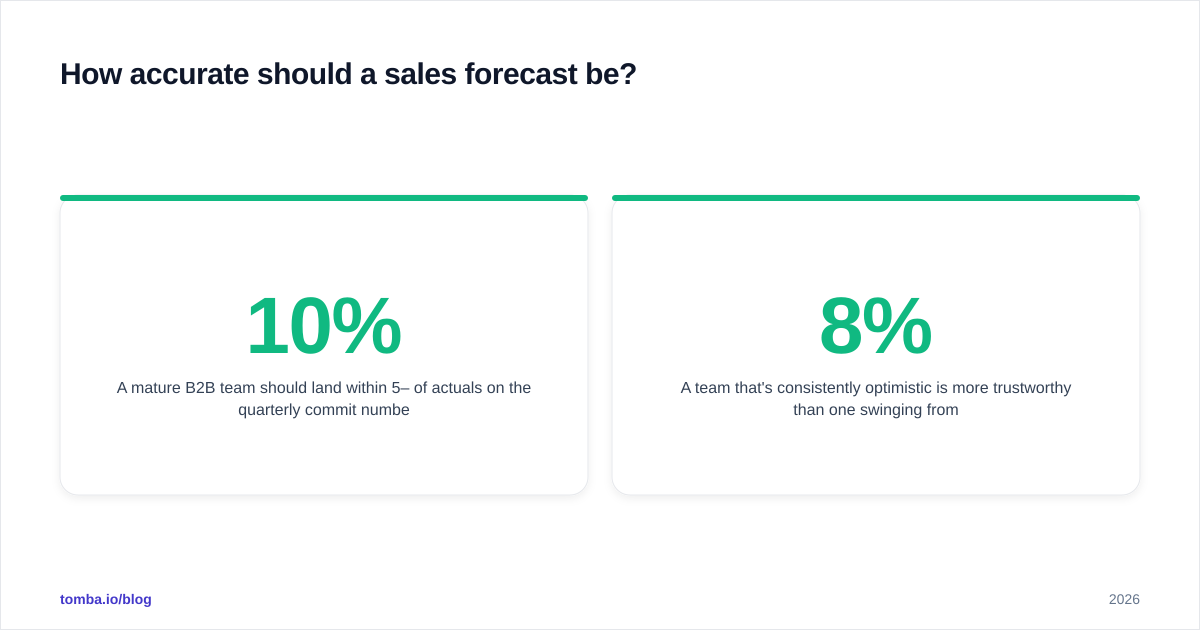
A mature B2B team should land within 5–10% of actuals on the quarterly commit number. Early-stage or high-variance teams may run 15–20% until they accumulate enough historical data to calibrate.
What matters more than the absolute percentage is the trend and the bias. Track two things every quarter:
- Mean absolute error — how far off you are, regardless of direction.
- Forecast bias — whether you're consistently high (optimistic) or low (sandbagging).
A team that's consistently 8% optimistic is more trustworthy than one swinging from +20% to −15%, because you can correct a known bias. HubSpot's sales benchmarks and your own response rate and conversion data give you the baselines to set realistic targets per stage.
What tools and data improve forecasting accuracy?#
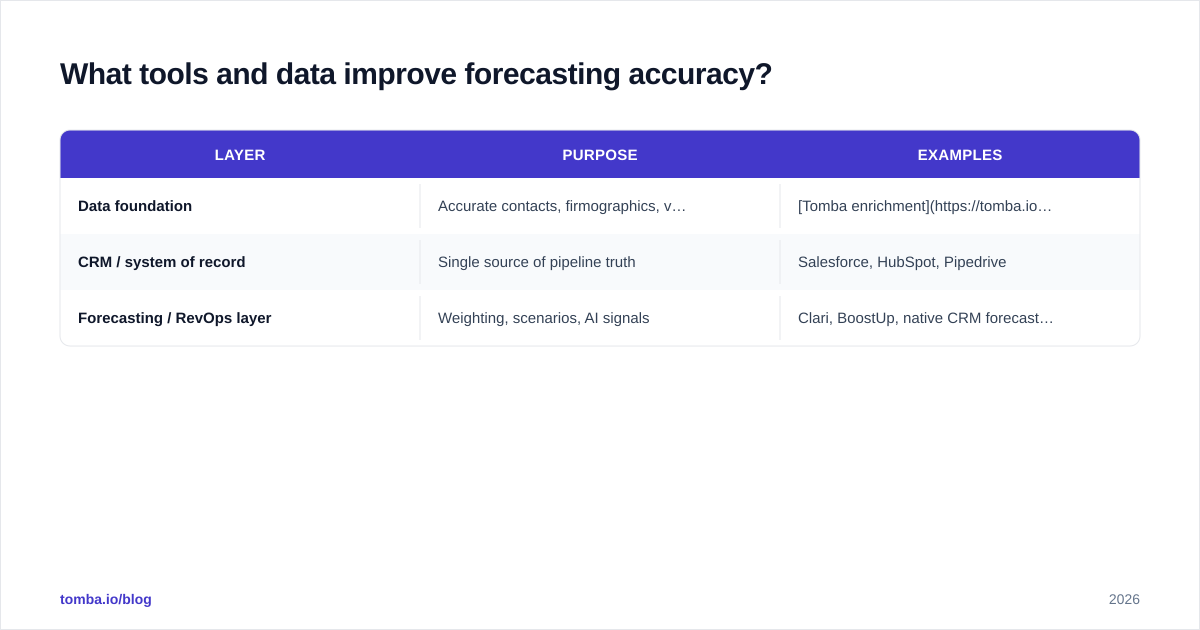
Tooling falls into three layers, and skipping the bottom layer is why expensive forecasting software still produces bad numbers.
| Layer | Purpose | Examples |
|---|---|---|
| Data foundation | Accurate contacts, firmographics, verified emails | Tomba enrichment, email verification |
| CRM / system of record | Single source of pipeline truth | Salesforce, HubSpot, Pipedrive |
| Forecasting / RevOps layer | Weighting, scenarios, AI signals | Clari, BoostUp, native CRM forecasting |
The mistake teams make is buying the top layer first. A Salesforce or AI forecasting tool can only weight the data you give it. If 30% of your committed deals point at contacts who no longer work at the account, no model will save you. That's why data hygiene — verified emails, current titles, deduplicated records — is the foundation, not a luxury. Tools like the data enrichment API let you keep CRM contact records fresh automatically, so the deal data your forecast rests on stays true.
Top-down vs bottom-up: which forecast should you trust?#
Trust neither alone — trust the gap between them. A bottom-up forecast (sum of rep commits) captures deal-specific intelligence your model can't see. A top-down forecast (historical close rate × pipeline) catches the optimism bias baked into rep judgment.
When they agree, your confidence is high. When they diverge, you've found exactly where to spend your review time. This is the discipline that separates a forecast from a wish: you don't pick the number you like, you reconcile the two numbers you have.
Common forecasting mistakes to avoid#
- Treating probability as static. A deal's close probability should change with activity and engagement, not sit frozen at the stage default.
- Counting zombie deals. If there's been no two-way activity in 30 days, it's not a forecasted deal.
- Ignoring deal age. A deal stuck 3x longer than your average sales cycle is far less likely to close, regardless of stage.
- Forecasting on dirty contacts. Verify your committed-deal contacts. A bounced champion email is a slipping deal in disguise.
- No post-mortem. If you don't compare forecast to actual and adjust, you're not forecasting — you're just announcing.
Conclusion: forecasting accuracy starts with clean data#
Accurate sales forecasting is a discipline built on three things: consistent method, weekly cadence, and clean underlying data. You can buy the fanciest AI forecasting layer on the market, but if the contacts behind your committed deals are stale or wrong, every prediction inherits that error.
Start at the foundation. Keep your pipeline contacts verified, current, and complete so the deals you forecast are real. Tomba's Email Finder helps you find and verify the decision-makers on every account, and its enrichment and verification tools keep your CRM data honest — so the number you commit is the number you can defend. Explore Tomba pricing to see which plan fits your team, starting free with 25 searches a month and scaling from $49/mo. Build the data foundation first, and the forecast accuracy follows.
// get started
Find, verify and enrich your first contacts today
Start on the free plan with 25 searches a month, then scale when your team is ready.
Free plan · No credit card required · GDPR & CCPA
// about the author