7 Best Accutrend Alternatives for B2B Data in 2026
Accutrend's static business lists still close deals, but live, verified data wins more often. Here are the 7 best Accutrend alternatives for 2026, compared on accuracy, coverage, and price.

TL;DR
- Accutrend Data sells pre-built business lists and data-append services — solid for direct mail and bulk records, weaker for fresh, self-serve B2B email and contact data.
- The best Accutrend alternatives in 2026 trade static lists for live lookups: you search a domain or name and get verified contacts on demand instead of buying a file that decays.
- For accuracy-first email and contact discovery on a self-serve budget, Tomba is the closest fit. For enterprise intent data, ZoomInfo and Cognism lead; for all-in-one prospecting, Apollo.
- Data decay is the real enemy: B2B records go stale at roughly 22–30% per year, so any tool that re-verifies at the point of use beats a list bought six months ago.
- Match the tool to the job — list refresh, real-time enrichment, or outbound prospecting — rather than chasing the biggest database.
What is Accutrend and what does it actually do?#
Accutrend Data Corporation is a business data and direct-marketing company. Its core offering is pre-compiled business lists, sales leads, data appending (filling gaps in your existing records), and list hygiene services. You tell Accutrend the firmographics you want — industry, geography, company size, title — and you receive a file of matching business records, often used for direct mail, telemarketing, and bulk email campaigns. You can see their positioning on the Accutrend Data homepage.
That model has been around for decades and still works for certain plays. If you need 10,000 mailing addresses for a regional postcard campaign, a compiled list is a reasonable purchase. The trouble starts when you need current email addresses, direct dials, and job titles for a modern outbound or RevOps motion — because the moment a list is exported, it begins to rot.
That single fact drives most searches for Accutrend alternatives, so it is worth understanding before you compare vendors.
Why do teams look for an Accutrend alternative?#
The short answer: static lists decay, and self-serve buyers want live data they can verify on demand.
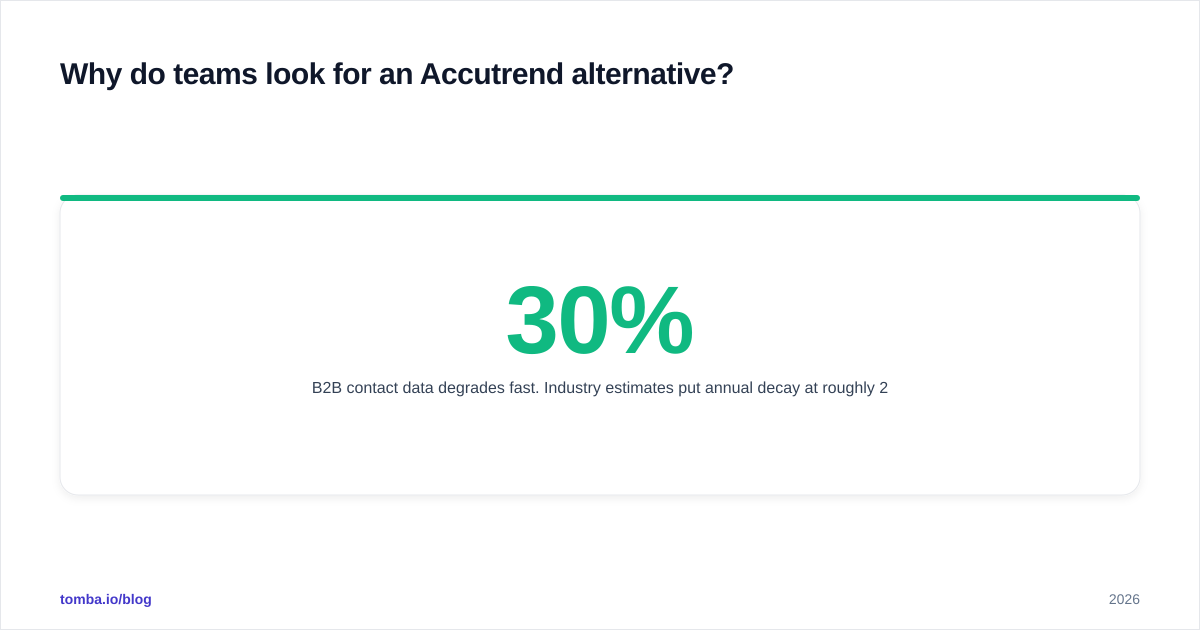
B2B contact data degrades fast. Industry estimates put annual decay at roughly 22–30% — people change jobs, companies rebrand, domains migrate, and inboxes get deactivated. A compiled list that was 95% accurate at delivery can drift below 70% within a year. If you are sending cold email against a decayed file, you pay for it twice: once for the list, and again in bounces that wreck your sender reputation.
Here is the progression most data buyers go through as they outgrow compiled lists:

The other common reasons:
- You want self-serve, not a sales call. Compiled-list vendors often quote per project. Modern tools let you sign up, search, and export in minutes.
- You need verification at the point of use. A good email verifier checks deliverability now, not when the file was built.
- You need API and CRM enrichment. RevOps teams want data flowing into HubSpot or Salesforce automatically, not a CSV someone has to import.
- You care about deliverability. Sending to unverified, aged addresses raises bounce rates and spam complaints.
If any of those apply, a real-time email and contact platform will serve you better than a periodic list buy.
What should you look for in an Accutrend alternative?#
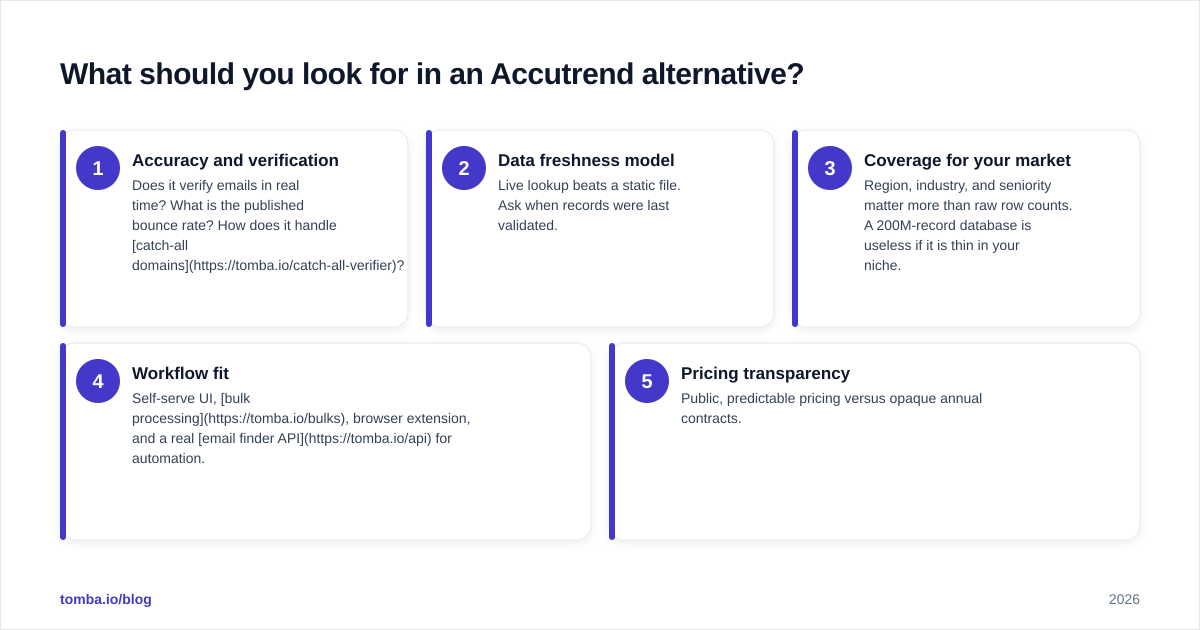
Score each candidate on five dimensions instead of database size alone:
- Accuracy and verification — Does it verify emails in real time? What is the published bounce rate? How does it handle catch-all domains?
- Data freshness model — Live lookup beats a static file. Ask when records were last validated.
- Coverage for your market — Region, industry, and seniority matter more than raw row counts. A 200M-record database is useless if it is thin in your niche.
- Workflow fit — Self-serve UI, bulk processing, browser extension, and a real email finder API for automation.
- Pricing transparency — Public, predictable pricing versus opaque annual contracts.
Keep this rubric handy while you read the comparison below.
What are the 7 best Accutrend alternatives in 2026?#
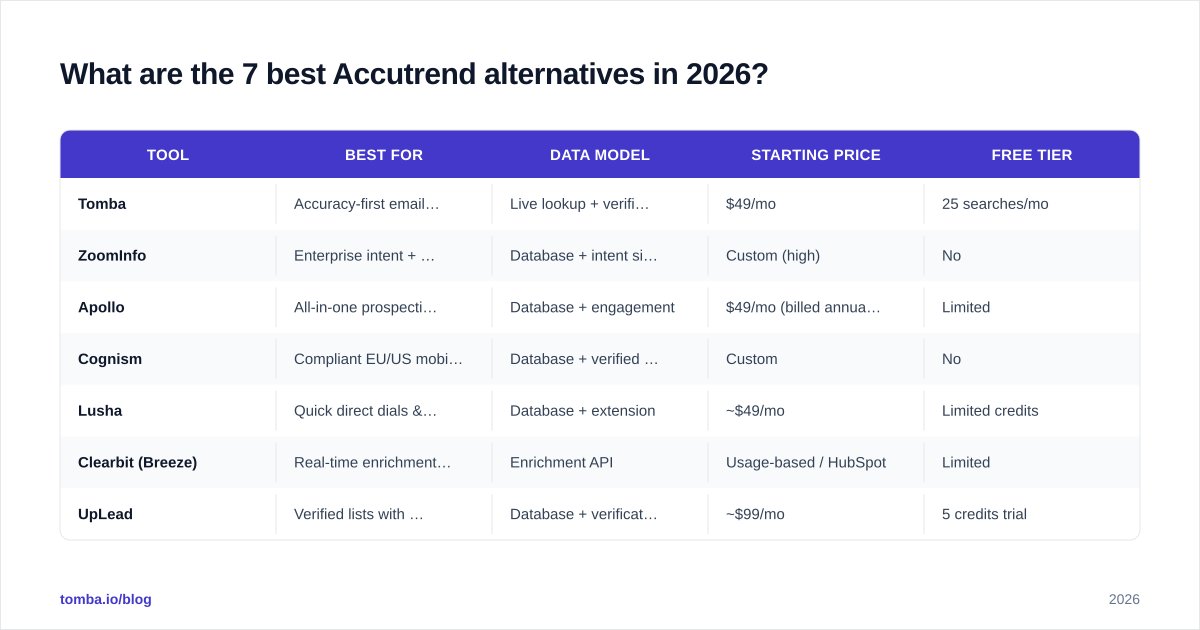
Here is a quick-look table, followed by detail on each tool.
| Tool | Best for | Data model | Starting price | Free tier |
|---|---|---|---|---|
| Tomba | Accuracy-first email & contact discovery | Live lookup + verification | $49/mo | 25 searches/mo |
| ZoomInfo | Enterprise intent + firmographics | Database + intent signals | Custom (high) | No |
| Apollo | All-in-one prospecting + sequencing | Database + engagement | $49/mo (billed annually) | Limited |
| Cognism | Compliant EU/US mobile data | Database + verified mobiles | Custom | No |
| Lusha | Quick direct dials & emails | Database + extension | ~$49/mo | Limited credits |
| Clearbit (Breeze) | Real-time enrichment & forms | Enrichment API | Usage-based / HubSpot | Limited |
| UpLead | Verified lists with real-time check | Database + verification | ~$99/mo | 5 credits trial |
1. Tomba — best for accuracy-first email and contact discovery#
Tomba replaces the compiled-list model with on-demand lookup. You can run a domain search to pull every public email pattern at a company, find a specific person by name and domain, or enrich a list in bulk — and every result passes through verification before you export it.
What makes it a strong Accutrend alternative is the order of operations: find, then verify, then deliver. Instead of buying a file and hoping, you get addresses validated at the moment you need them, plus supporting tools like a phone finder, data enrichment, and integrations with HubSpot, Salesforce, Sheets, and Zapier.
Pricing is public and self-serve: a Free tier with 25 searches/month, Starter at $49/mo, Growth at $99/mo, and Pro at $249/mo. See full Tomba pricing for credit allotments.
Pros: real-time verification, transparent pricing, strong API, generous free tier. Cons: less focused on intent signals than enterprise suites.
2. ZoomInfo — best for enterprise intent and firmographics#
ZoomInfo is the heavyweight. Beyond contact data, it layers buyer intent, org charts, technographics, and workflow automation. If you run a large outbound org and can justify the spend, the depth is hard to match.
Pros: vast database, intent data, deep integrations. Cons: expensive, annual contracts, steep for small teams.
3. Apollo — best all-in-one prospecting platform#
Apollo combines a contact database with sequencing, dialing, and engagement analytics. It is popular with SMB and mid-market sales teams who want prospecting and outreach in one tab. If you are weighing it specifically, see this Apollo alternative breakdown.
Pros: database plus outreach in one tool, affordable entry tier. Cons: data accuracy varies by region; the platform can feel sprawling.
4. Cognism — best for compliant EU and US mobile data#
Cognism is known for phone-verified mobile numbers and a compliance-first posture (GDPR/CCPA), making it a favorite for teams selling into Europe. Diamond-verified mobiles are its signature feature.
Pros: strong mobile coverage, compliance focus, good EU data. Cons: custom pricing, enterprise-oriented onboarding.

5. Lusha — best for quick direct dials and emails#
Lusha is a lightweight, extension-first tool for grabbing a contact's email and phone while you browse LinkedIn or a company site. It is fast for one-off prospecting but thinner for bulk database work.
Pros: simple, fast, good browser extension. Cons: credit limits add up; less suited to large enrichment jobs.
6. Clearbit (now Breeze Intelligence) — best for real-time enrichment#
Clearbit, now part of HubSpot as Breeze Intelligence, shines at enriching records and forms in real time rather than handing you a list. It is an API-and-workflow play more than a search tool. Comparing options? See this Clearbit alternative overview.
Pros: excellent real-time enrichment, tight HubSpot fit. Cons: less of a standalone prospecting finder; pricing tied to ecosystem.
7. UpLead — best for verified lists with a real-time check#
UpLead sits between the old and new models: you build a list from a database, but it verifies emails in real time before download, so you avoid the worst of list decay.
Pros: real-time verification, straightforward UI. Cons: smaller database than the giants; per-credit costs rise at volume.
How do the alternatives compare on price and accuracy?#
Database size is a vanity metric. What matters is whether the addresses you actually export are deliverable. Here is a sharper comparison on the dimensions that drive ROI.
| Factor | Accutrend | Tomba | ZoomInfo | Apollo |
|---|---|---|---|---|
| Data model | Compiled lists | Live lookup + verify | Database + intent | Database + outreach |
| Real-time verification | Limited | Yes (built in) | Partial | Partial |
| Self-serve signup | No | Yes | No | Yes |
| Public pricing | No | Yes ($49–$249/mo) | No | Partial |
| Best fit | Direct mail / bulk | Accuracy-first email/contacts | Enterprise outbound | SMB all-in-one |
| API / CRM enrichment | Append service | Full API + integrations | Yes | Yes |
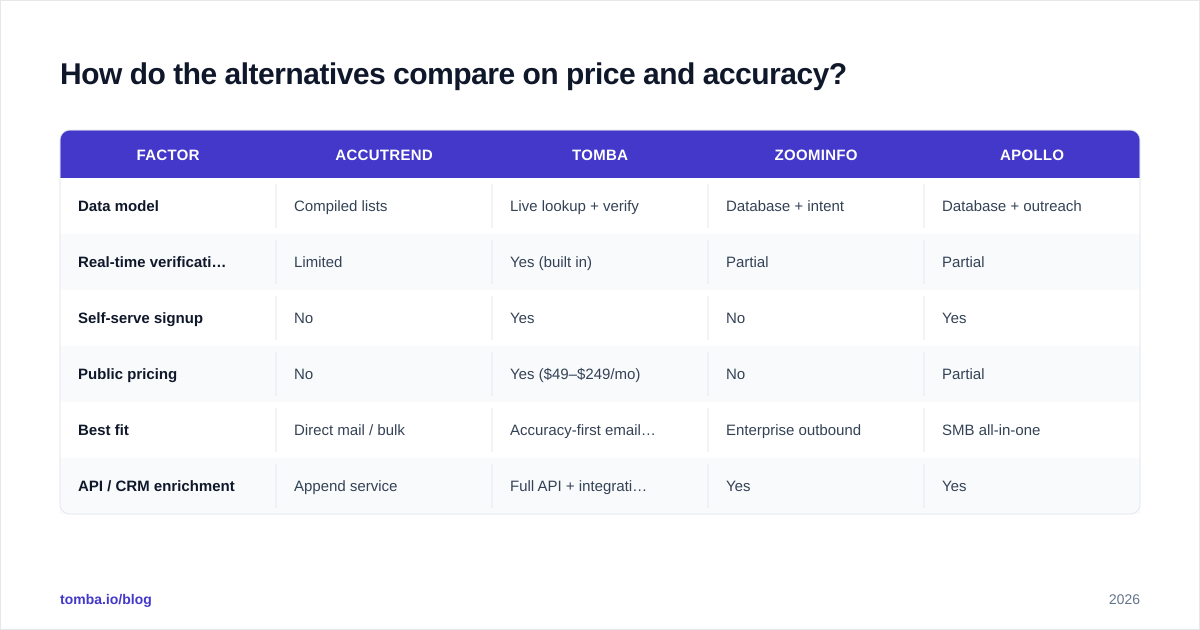
The pattern is clear: Accutrend's strength is bulk compiled data for offline channels, while the modern alternatives win on freshness, verification, and self-serve workflow. For email-led outbound, freshness and verification are what protect your sender reputation and keep bounce rates low.
Which Accutrend alternative is right for you?#
Pick by the job, not the logo:
- You send cold email and live or die by deliverability → Tomba. Find-then-verify keeps your bounce rate low, and the email verifier doubles as list hygiene for records you already own.
- You run a large enterprise outbound team and want intent signals → ZoomInfo or Cognism (Cognism if EU mobile data and compliance lead your requirements).
- You want prospecting plus sequencing in one tool on a budget → Apollo.
- You mainly need to enrich inbound leads and CRM records automatically → Clearbit/Breeze or Tomba's data enrichment.
- You still need bulk records for direct mail → Accutrend may genuinely remain the right tool for that one channel. There is no rule against using two providers for two different jobs.
If you read user reviews before deciding, cross-reference categories on G2 rather than trusting any single vendor's claims — including this article's.
Frequently asked questions#
Is Accutrend bad? No. It is a capable compiled-list and data-append provider, especially for direct mail and bulk records. It is simply built for a different era and channel than real-time, self-serve email discovery.
What is the cheapest Accutrend alternative? Tomba's Free tier (25 searches/month) lets you start at zero, with paid plans from $49/mo. Most database-heavy enterprise tools require custom annual contracts.
Do these tools replace a CRM? No. They feed your CRM. Use the integrations or API to push verified contacts into HubSpot, Salesforce, or Pipedrive automatically.
How do I avoid buying decayed data again? Choose a tool that verifies at the point of export and re-check any list older than a quarter. Live lookup plus verification is the structural fix for data decay.
Ready to switch from static lists to verified contacts?#
If the reason you are reading this is bounce rates, stale records, or opaque pricing, the fix is a tool that finds and verifies in the same step. Start free with the Tomba Email Finder: search any domain or name, get contacts that are validated before you export them, and push them straight into your CRM. Twenty-five searches a month cost nothing, and you will know within minutes whether find-then-verify beats the list you used to buy. When you are ready to scale, the pricing is public and the API is waiting.
// get started
Find, verify and enrich your first contacts today
Start on the free plan with 25 searches a month, then scale when your team is ready.
Free plan · No credit card required · GDPR & CCPA
// about the author