Accutrend vs Apolloio 2026: B2B Data & Email Finder Compared
Accutrend vs Apolloio for 2026: data accuracy, pricing, email finding, and coverage compared side by side so you pick the right B2B data engine for your sales team.
Choosing between Accutrend and Apollo.io comes down to one question: do you need a bulk list of business records, or a live prospecting engine that finds and verifies contacts on demand? They sit on opposite ends of the B2B data spectrum, and picking the wrong one wastes both budget and rep hours.
This guide breaks down how the two compare on coverage, accuracy, email finding, pricing, and real-world fit — and where a focused tool like Tomba slots in when your main need is reliable, fresh contact data.
TL;DR — Accutrend vs Apolloio at a glance#
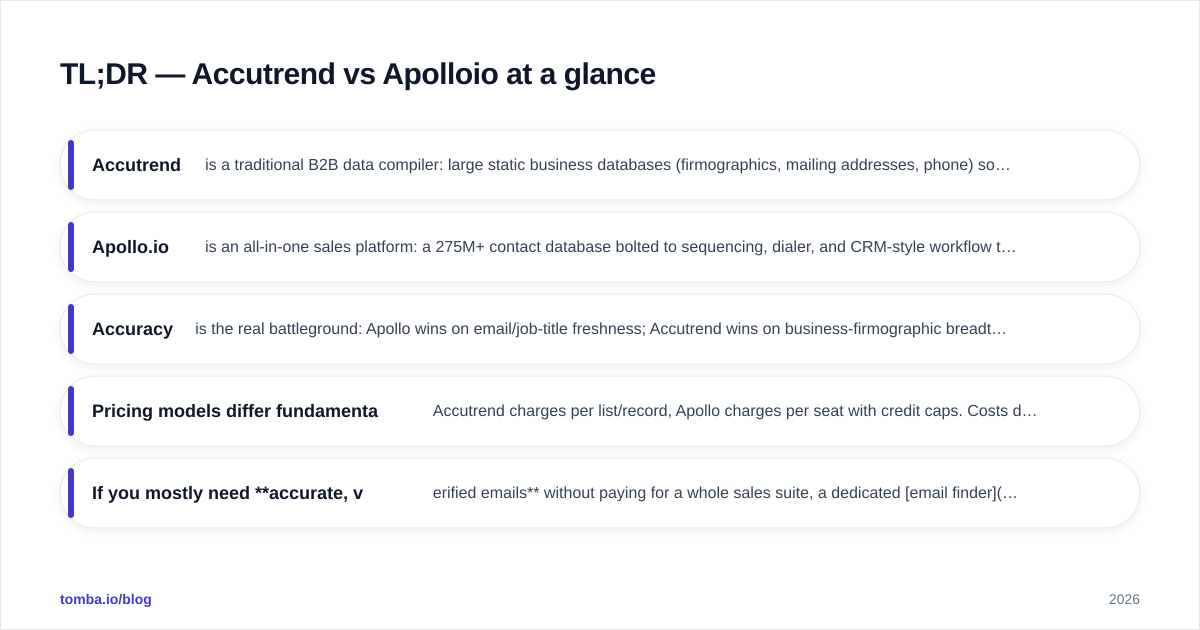
- Accutrend is a traditional B2B data compiler: large static business databases (firmographics, mailing addresses, phone) sold as licensed lists, strongest for direct mail and broad market sizing.
- Apollo.io is an all-in-one sales platform: a 275M+ contact database bolted to sequencing, dialer, and CRM-style workflow tools — built for outbound SDR motion.
- Accuracy is the real battleground: Apollo wins on email/job-title freshness; Accutrend wins on business-firmographic breadth and offline contactability.
- Pricing models differ fundamentally — Accutrend charges per list/record, Apollo charges per seat with credit caps. Costs diverge fast at scale.
- If you mostly need accurate, verified emails without paying for a whole sales suite, a dedicated email finder like Tomba is often the cheaper, cleaner third option.
What is Accutrend?#
Accutrend (Accutrend Data Corporation) is a long-established U.S. business data compiler. Think of it as a wholesale warehouse of company records: it aggregates firmographic data — company name, SIC/NAICS codes, employee count, revenue ranges, physical addresses, and main-line phone numbers — and licenses that data as targeted lists for marketing campaigns.
Its heritage is direct marketing. If you're running a postal mail drop to 50,000 manufacturing firms in three states, or you need a one-time count of dental practices by ZIP code, Accutrend's model fits. You define selects (industry, geography, size), get a count, and buy the file. You can review their offering on the Accutrend Data Corporation site.
The trade-off is freshness and channel. Compiled list data ages — people change jobs, companies close, direct-dial numbers churn — and Accutrend's strength is firm-level data, not the individual, verified work email that modern cold email demands.
What is Apollo.io?#
Apollo.io is a sales intelligence and engagement platform. It pairs a large contact database (Apollo cites 275M+ contacts and 73M+ companies) with the tooling to act on it: email sequences, a built-in dialer, LinkedIn integration, deal tracking, and enrichment. You can see how users rate it on G2 or browse the product on the official Apollo.io site.
Where Accutrend hands you a file, Apollo hands you a workflow. An SDR can filter for "VP of Marketing at SaaS companies, 50–200 employees, using HubSpot," pull verified emails and direct dials, drop them into a sequence, and start dialing — all in one tab.
That breadth is also the catch. You pay per seat, email-credit and mobile-credit limits gate how much data you actually pull, and accuracy varies by segment. Many teams use Apollo for workflow but supplement its data when bounce rates climb.
How do Accutrend and Apolloio compare head to head?#
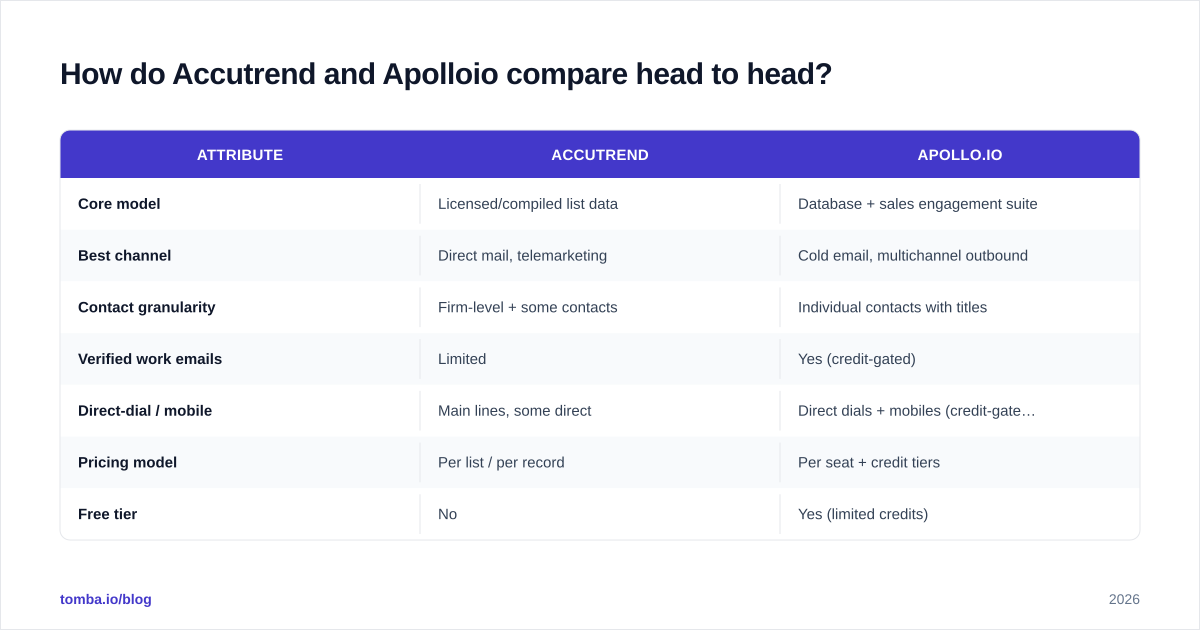
The two tools optimize for different jobs. Accutrend optimizes for breadth of business records at the firm level; Apollo optimizes for individual, actionable contacts inside an outbound motion.
| Attribute | Accutrend | Apollo.io |
|---|---|---|
| Core model | Licensed/compiled list data | Database + sales engagement suite |
| Best channel | Direct mail, telemarketing | Cold email, multichannel outbound |
| Contact granularity | Firm-level + some contacts | Individual contacts with titles |
| Verified work emails | Limited | Yes (credit-gated) |
| Direct-dial / mobile | Main lines, some direct | Direct dials + mobiles (credit-gated) |
| Pricing model | Per list / per record | Per seat + credit tiers |
| Free tier | No | Yes (limited credits) |
| Workflow tools | None (data only) | Sequences, dialer, CRM sync |
| Ideal user | Marketers, list buyers | SDR / outbound sales teams |
| Data freshness | Periodic compile | Continuous + community-sourced |
The honest read: these aren't really competitors for the same buyer. If someone is comparing them, they're usually a sales or RevOps lead deciding which data philosophy to build on — buy static lists, or rent a live prospecting engine.

Which has better data accuracy?#
It depends on what you're measuring. For firmographic accuracy — does this company exist, what's its industry, how big is it — Accutrend's compiled approach is solid; that data changes slowly and is well-maintained for offline use. For contact accuracy — is this the right person, in this role, at this verified email today — Apollo generally pulls ahead because its data is continuously updated and community-sourced.
But Apollo's accuracy is uneven across segments. Public benchmarks and user reports consistently show that no single provider verifies every email correctly, and bounce rates spike on catch-all domains and smaller companies. That's why a verification layer matters regardless of which platform you choose.
The practical move is to treat any provider's email as a candidate, then verify before you send. Running addresses through a dedicated email verifier — and using a catch-all verifier for risky domains — does more to protect your sender reputation than arguing over whose database is "95% accurate" on the box.

How does pricing compare?#
This is where the two models diverge hardest, and where buyers get surprised.
Accutrend prices per list or per record. A targeted file might cost a few cents to a couple of dollars per record depending on selects and licensing (one-time vs. multi-use). There's no monthly seat fee — you pay for the data you take. Great for occasional campaigns, expensive if you need fresh data every week.
Apollo.io prices per seat with credit tiers. There's a free plan with limited credits, then Basic, Professional, and Organization tiers that scale roughly from the low tens to over a hundred dollars per user per month, with email and mobile credits capped per tier. Costs climb as you add reps and unlock more data exports.
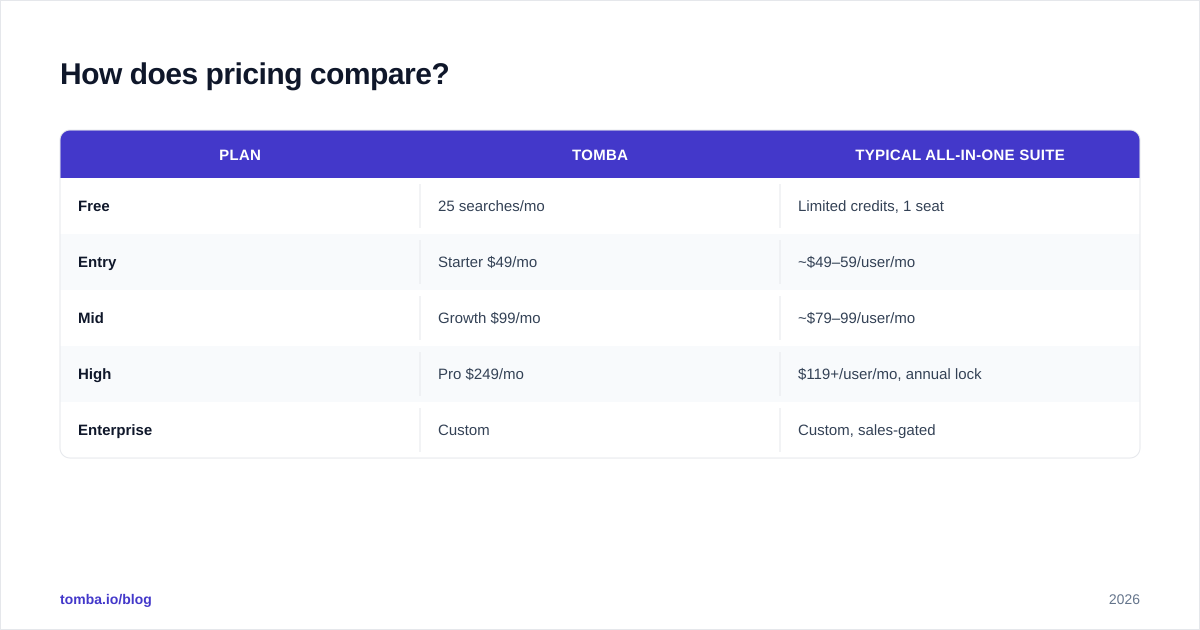
For comparison, a dedicated email-finding tool prices differently again. Here's how Tomba's straightforward, no-seat-minimum model looks against the typical all-in-one structure:
| Plan | Tomba | Typical all-in-one suite |
|---|---|---|
| Free | 25 searches/mo | Limited credits, 1 seat |
| Entry | Starter $49/mo | ~$49–59/user/mo |
| Mid | Growth $99/mo | ~$79–99/user/mo |
| High | Pro $249/mo | $119+/user/mo, annual lock |
| Enterprise | Custom | Custom, sales-gated |
See full Tomba pricing for credit details. The key structural difference: Tomba doesn't charge per seat, so a small team isn't penalized for adding logins, and you're paying for finding and verifying contacts rather than a bundled dialer and sequencer you may not use.
When should you choose Accutrend?#
Pick Accutrend when your use case is offline, firm-level, and list-based:
- You're running direct mail and need accurate postal addresses at volume.
- You need market sizing or TAM counts by industry, geography, and company size.
- You're doing telemarketing to main business lines, not individual mobiles.
- You want a one-time licensed file rather than an ongoing subscription.
Accutrend is a poor fit if your motion is modern cold email, because compiled list data rarely gives you the verified, individual work emails that keep bounce rates low and inboxes happy.

When should you choose Apollo.io?#
Pick Apollo when you want an all-in-one outbound engine and are willing to live inside one platform:
- You run a dedicated SDR team doing high-volume multichannel outbound.
- You want prospecting, sequencing, and dialing in one tool to reduce tab-switching.
- You value filtering by intent, technographics, and buying signals built into the database.
- You're okay managing credit limits and occasionally supplementing data when accuracy dips.
Apollo struggles when you only need clean data, not the whole suite — you end up paying per seat for sequencing and dialer features you won't touch. It can also get expensive fast as headcount grows, and heavy exporters routinely hit credit ceilings mid-month.
Where does a dedicated email finder fit in?#
There's a third path that the Accutrend-vs-Apollo framing hides: you may not need a list compiler or a full sales suite. If your actual need is "find and verify the right work emails for the prospects I already know," a focused tool is faster and cheaper.
This is the gap Tomba fills. Instead of buying a static file or renting a seat-based platform, you:
- Use domain search to pull every known email pattern at a target company.
- Run the email finder by name + domain for specific decision-makers.
- Verify in bulk with the bulk email finder before any send.
- Push results into your stack through the Tomba API or native integrations.
Because pricing isn't per seat, a two-person team and a ten-person team both pay for the same thing: searches and verifications. And because verification is built in, you sidestep the deliverability damage that compiled lists and stale database records cause. For teams that already own a CRM and a sequencer, layering Tomba in as the data layer is often more cost-effective than paying Apollo for tools they duplicate elsewhere.
Accutrend vs Apolloio: the verdict#
There's no universal winner — there's a right tool for your motion:
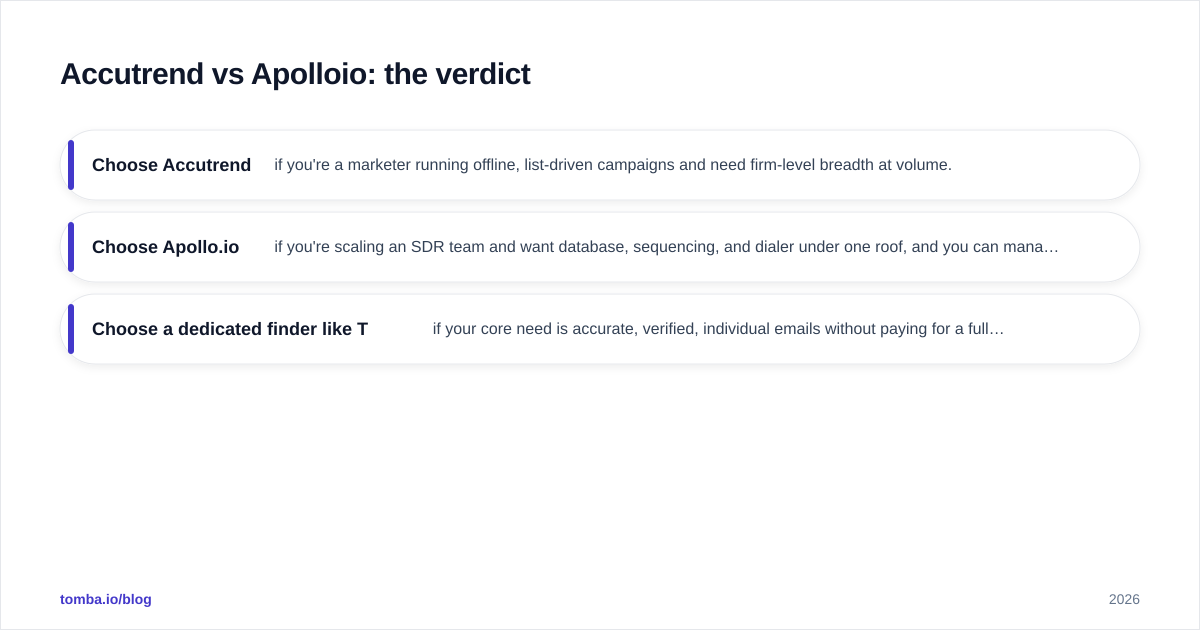
- Choose Accutrend if you're a marketer running offline, list-driven campaigns and need firm-level breadth at volume.
- Choose Apollo.io if you're scaling an SDR team and want database, sequencing, and dialer under one roof, and you can manage credit limits.
- Choose a dedicated finder like Tomba if your core need is accurate, verified, individual emails without paying for a full suite or licensing a static file.
Match the tool to the job and you stop overpaying for capabilities you don't use — and stop sending to addresses that bounce.
Ready to fix the data layer first?#
Before you commit to a seat-based suite or a one-time list buy, test how much you actually need beyond clean contact data. Start free with the Tomba Email Finder — 25 searches a month, no credit card, with verification built in — and find verified work emails by name, domain, or company in seconds. If it covers your prospecting need on its own, you've just saved the cost of a platform you'd only half-use. Scale up to Starter at $49/mo whenever your volume grows.
// get started
Find, verify and enrich your first contacts today
Start on the free plan with 25 searches a month, then scale when your team is ready.
Free plan · No credit card required · GDPR & CCPA
// about the author