Accutrend vs Arounddeal: B2B Data Tools Compared (2026)
Accutrend sells static marketing lists; Arounddeal sells live contact data with email finding. Here's which one actually fits a modern outbound motion in 2026.
Picking between Accutrend and Arounddeal is really a choice between two different eras of B2B data. One sells you a list. The other sells you a living database with self-serve lookup tools on top. If you buy the wrong model, you either drown in bounced emails or pay for coverage you never touch.
This breakdown compares both on the things that actually move pipeline: data freshness, accuracy, coverage, workflow fit, and total cost. No vendor spin — just where each one earns its keep and where it falls down.
TL;DR#
- Accutrend is a traditional list and marketing-data provider. You buy records in bulk, often as a one-time file or a managed campaign. Good for broad direct-mail and audience targeting, weak for real-time, verified email outreach.
- Arounddeal is a self-serve B2B contact platform — Chrome extension, prospecting search, email finding, and enrichment with a credit-based model. Built for sales and SDR teams running outbound now.
- Freshness is the real divide. Static purchased lists decay 20–30% a year; live-lookup platforms re-verify on request, so bounce rates stay lower.
- Neither is the cheapest accurate option. If verified email accuracy and pay-as-you-grow pricing are the priority, a focused email finder like Tomba usually beats both on cost-per-valid-contact.
- Pick by motion: broad brand/mail campaigns lean Accutrend; precision outbound and SDR prospecting lean Arounddeal (or a dedicated finder).
What is Accutrend?#
Accutrend (AccuTrend Data) is a data and marketing services company in the traditional mold. Its core offering is curated business and consumer lists — think industry-segmented files you license for email, direct mail, or telemarketing campaigns, frequently bundled with managed campaign execution.
The mental model is the list broker. You define an audience (industry, geography, company size, job role), Accutrend assembles or pulls matching records, and you receive a dataset to load into your CRM or email platform. It suits marketing teams running volume campaigns where reach matters more than per-record precision.
The tradeoff is baked into the model. A list is a snapshot. The moment you receive it, people start changing jobs, companies rebrand, and domains lapse. According to widely cited B2B data research, contact records decay roughly 20–30% per year. A list bought in January is materially worse by summer, and you usually pay again to refresh it.
What is Arounddeal?#
Arounddeal is a self-serve B2B contact-data platform aimed at sales teams. It pairs a prospecting database with a Chrome extension that surfaces emails and phone numbers on LinkedIn and company sites, plus enrichment and basic list-building. You can review the product directly on the Arounddeal homepage.
The model is credits, not files. You search or look up a contact, and the platform reveals — and ideally verifies — the data on demand. Because lookups happen in real time, the data you pull reflects the database's current state rather than a six-month-old export. That alone tends to keep bounce rates lower than a static list.
Arounddeal slots into the SDR workflow: find a prospect on LinkedIn, reveal their work email, push it to your sequencer or CRM. It competes in the same lane as Apollo, Lusha, and RocketReach, and it's a reasonable mid-market pick when you want browser-based prospecting without enterprise pricing.
Accutrend vs Arounddeal: how do they compare?#
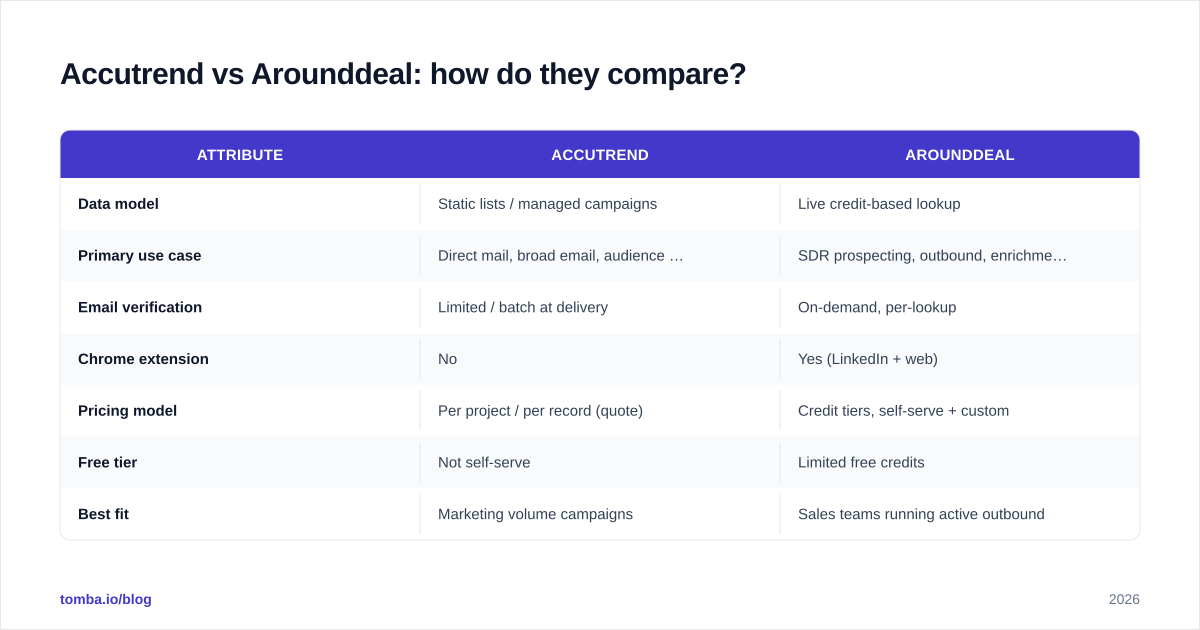
Here's the head-to-head on the attributes that decide outcomes. Treat pricing as directional — Accutrend quotes per project or per record, and Arounddeal runs credit tiers that shift over time, so confirm current numbers before you commit.
| Attribute | Accutrend | Arounddeal |
|---|---|---|
| Data model | Static lists / managed campaigns | Live credit-based lookup |
| Primary use case | Direct mail, broad email, audience reach | SDR prospecting, outbound, enrichment |
| Email verification | Limited / batch at delivery | On-demand, per-lookup |
| Chrome extension | No | Yes (LinkedIn + web) |
| Pricing model | Per project / per record (quote) | Credit tiers, self-serve + custom |
| Free tier | Not self-serve | Limited free credits |
| Best fit | Marketing volume campaigns | Sales teams running active outbound |
| Biggest weakness | Data decays after purchase | Coverage varies by region/role |
The pattern is clear. Accutrend optimizes for breadth and one-shot reach; Arounddeal optimizes for freshness and fitting into a live sales motion. If your KPI is "emails delivered to inboxes that still exist," the live model wins almost every time.

Which has more accurate data?#
Accuracy is not one number — it's the product of coverage (do they have the contact?) and validity (is the data still correct?). The two tools win on different halves.
Accutrend can show strong raw coverage for broad consumer and business segments because list compilers aggregate from many sources. But validity erodes the instant the file ships. Unless you pay for frequent refreshes, you're emailing a decaying dataset, and your bounce rate climbs with every passing month — which then drags down sender reputation and inbox placement.
Arounddeal's on-demand verification is structurally better for validity. When you reveal an email at the moment you need it, you're getting the database's freshest view, not a frozen snapshot. Real-world accuracy still varies by geography and seniority — North American senior roles tend to resolve better than long-tail EMEA or APAC contacts — but the live model avoids the slow rot that kills purchased lists.
If accuracy is your top criterion, benchmark before you buy. Run the same 100 target contacts through any tool and measure valid-hit rate with an independent email verifier. Vendor-reported accuracy and your actual list rarely match.

Which is better for cold outreach and deliverability?#
For active cold outreach, Arounddeal's model is the safer base — but neither tool replaces a real deliverability discipline.
Cold email lives and dies on email deliverability. Two inputs matter most: list hygiene and sending behavior. A stale Accutrend file fails the first test out of the gate — you'll hit spam traps and dead mailboxes, spike your bounce rate, and torch your domain reputation before a single reply lands. That's the worst-case start for an outbound program.
Arounddeal's fresher data reduces that risk, but you still need to verify before you send, warm your sending domain, and keep daily volume sane. No data vendor protects you from blasting 2,000 cold emails off a cold domain. Pair whatever tool you choose with a verification pass and a warmup routine — our email warmup calculator and spam checker are free places to start.
A quick gut check by motion:
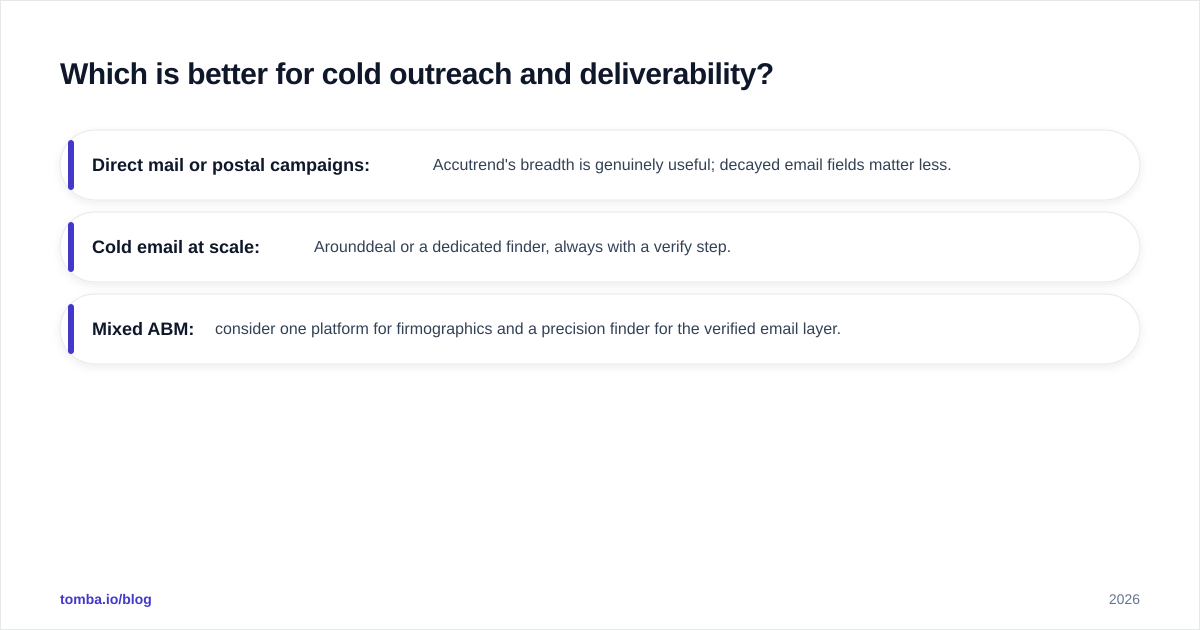
- Direct mail or postal campaigns: Accutrend's breadth is genuinely useful; decayed email fields matter less.
- Cold email at scale: Arounddeal or a dedicated finder, always with a verify step.
- Mixed ABM: consider one platform for firmographics and a precision finder for the verified email layer.
What about pricing and value?#
Value comes down to cost per valid contact, not sticker price — and that reframes the whole comparison.
Accutrend's quote-based pricing makes apples-to-apples comparison hard. A list might look cheap per record, but factor in decay and re-purchase, and the effective cost per contact that's still valid in month six climbs fast. You're also often buying volume you won't fully use.
Arounddeal's credit model is more transparent and forgiving — you pay for lookups you actually make, and a limited free tier lets you test before committing. The risk is the usual credit-economy trap: burning credits on low-value or unverifiable contacts. Watch your cost-per-valid-reveal, not your cost-per-credit.
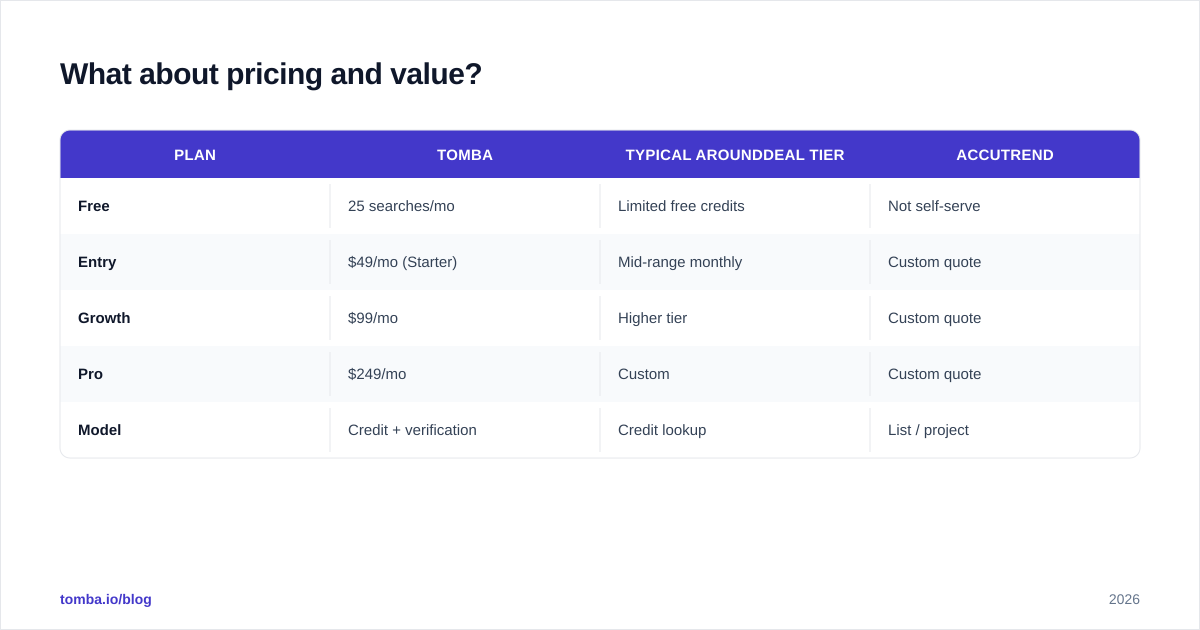
Here's how a focused alternative stacks up on price, since cost is usually the tiebreaker:
| Plan | Tomba | Typical Arounddeal tier | Accutrend |
|---|---|---|---|
| Free | 25 searches/mo | Limited free credits | Not self-serve |
| Entry | $49/mo (Starter) | Mid-range monthly | Custom quote |
| Growth | $99/mo | Higher tier | Custom quote |
| Pro | $249/mo | Custom | Custom quote |
| Model | Credit + verification | Credit lookup | List / project |
See full Tomba pricing for current limits. The point isn't that one tool is universally cheapest — it's that a self-serve, verification-first finder gives you a predictable cost-per-valid-contact that a quote-based list rarely matches.
When should you choose each one?#
Match the tool to the motion, not the marketing.
Choose Accutrend if you run high-volume marketing campaigns — direct mail, postal, broad audience email — where reach beats per-record precision, you want a managed-service relationship, and you're comfortable refreshing data on a schedule. Legacy list buying still has a place in brand and demand-gen programs that aren't dependent on every email being live today.
Choose Arounddeal if you run active outbound, your SDRs prospect on LinkedIn daily, and you need fresh, on-demand contact data that flows into a sequencer or CRM. The browser-first workflow and credit model fit a modern sales team far better than a static file.
Choose a dedicated email finder if verified email accuracy and predictable cost are your top two priorities. This is where Tomba fits: built specifically to find and verify professional emails, with a domain search for company-wide lookups, a bulk email finder for list building, and an email finder API to wire it into your own stack. If you're already evaluating browser-based tools, the comparison below is worth a look.

For a broader sanity check on any vendor's reputation and feature claims, cross-reference verified user reviews on G2 before you sign anything — both tools have public profiles, and patterns in recent reviews tell you more than a sales deck.
How should you actually decide?#
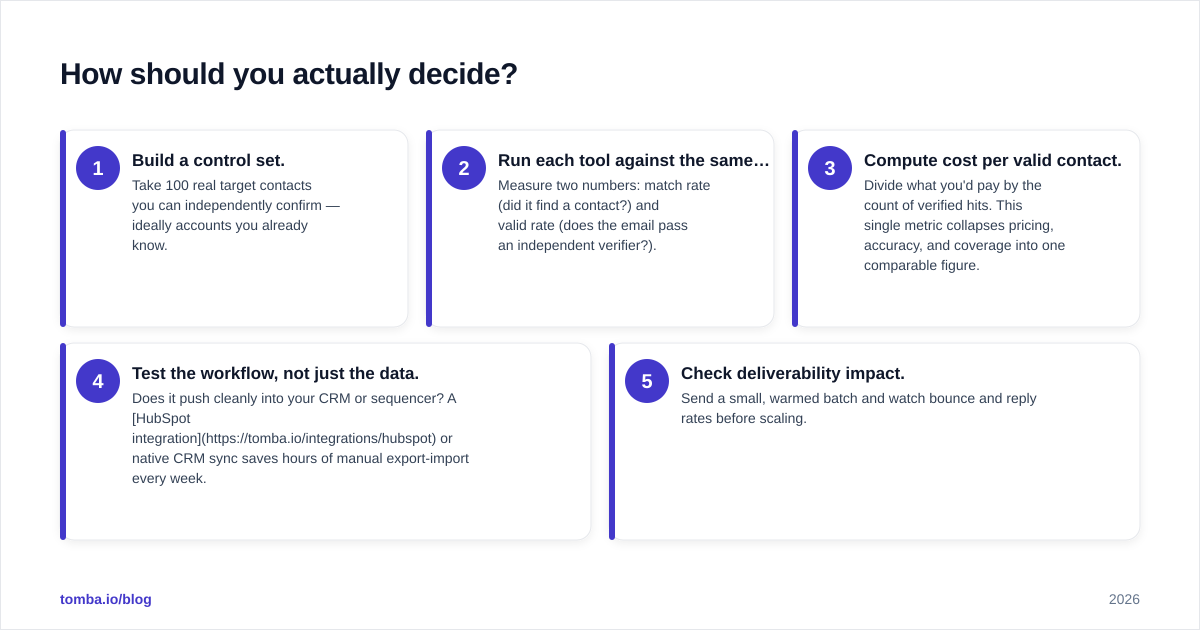
Run a structured 30-minute bake-off instead of trusting any comparison post, including this one.
- Build a control set. Take 100 real target contacts you can independently confirm — ideally accounts you already know.
- Run each tool against the same list. Measure two numbers: match rate (did it find a contact?) and valid rate (does the email pass an independent verifier?).
- Compute cost per valid contact. Divide what you'd pay by the count of verified hits. This single metric collapses pricing, accuracy, and coverage into one comparable figure.
- Test the workflow, not just the data. Does it push cleanly into your CRM or sequencer? A HubSpot integration or native CRM sync saves hours of manual export-import every week.
- Check deliverability impact. Send a small, warmed batch and watch bounce and reply rates before scaling.
Whatever wins your bake-off is your answer — your geography, target roles, and CRM matter more than any aggregate benchmark.
The bottom line#
Accutrend and Arounddeal solve different problems. Accutrend is a capable legacy list and campaign provider for broad marketing reach. Arounddeal is the better fit for live, sales-led outbound thanks to fresh data and a workflow-friendly extension. The decade-long trend is unmistakable: static purchased lists keep losing ground to verification-first, on-demand data.
If your real goal is verified emails at a predictable cost — the foundation of any outbound program that survives contact with the inbox — start with a tool built for exactly that. Try the Tomba Email Finder free with 25 searches a month: find professional emails by name, company, or domain, verify them on the spot, and skip the bounce-rate tax that kills cold campaigns before they start. Run it head-to-head against your shortlist and let cost-per-valid-contact pick the winner.
// get started
Find, verify and enrich your first contacts today
Start on the free plan with 25 searches a month, then scale when your team is ready.
Free plan · No credit card required · GDPR & CCPA
// about the author