Accutrend vs Tami AI (2026): Which AI Sales Tool Wins?
A neutral, hands-on breakdown of Accutrend vs Tami AI in 2026 — where each AI sales tool fits, what they cost, and the data layer both depend on.
Choosing between two AI-first sales platforms usually comes down to one question that neither vendor's homepage answers cleanly: what does this tool actually do for my pipeline next quarter? This guide compares Accutrend vs Tami AI the way a buyer should — by motion, data quality, pricing model, and the unglamorous plumbing both depend on.
TL;DR#
- Accutrend leans toward AI-assisted market and account intelligence — surfacing signals, scoring fit, and helping reps prioritize who to work next.
- Tami AI leans toward AI-driven outreach execution — conversational drafting, sequencing, and reply handling that compresses the rep's manual workload.
- Neither tool is a magic bullet: both are only as good as the contact data and email accuracy feeding them. Garbage in, garbage out.
- For most teams, the real decision is intelligence-first vs execution-first, not "which brand is better."
- Whichever you pick, pair it with a dedicated data layer (like a verified email finder) so your AI isn't automating bounces.
What are Accutrend and Tami AI?#
Both Accutrend and Tami AI sit in the broader AI sales technology category — software that uses machine learning and large language models to do work that SDRs and AEs used to do by hand. But they emphasize different parts of the funnel.
Accutrend positions itself around intelligence: ingesting account signals, scoring accounts and leads for fit and intent, and giving reps a prioritized view of where to spend time. Think of it as a co-pilot that reads the market for you and points at the doors most likely to open.
Tami AI positions itself around execution: drafting personalized messaging, running multi-step sequences, and using AI to triage and respond to inbound replies. If Accutrend tells you who to talk to, Tami AI is more concerned with what to say and when.
That distinction matters because buying the wrong category is the most expensive mistake here. An execution tool won't fix a targeting problem, and an intelligence tool won't write your emails for you.
Vendor positioning changes fast in this space. Before you commit, verify current capabilities on each vendor's site and on third-party review platforms like G2 and Capterra — feature sets in 2026 may differ from what's described here.
Accutrend vs Tami AI: feature comparison#
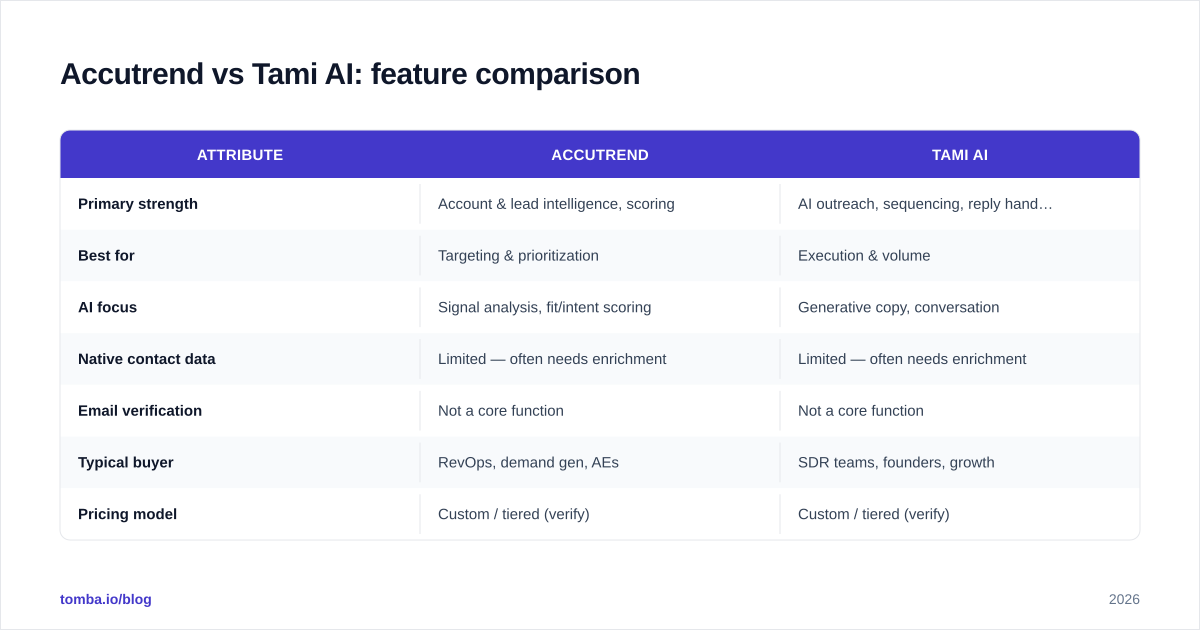
Here's the head-to-head on the dimensions that actually move a sales number. Treat pricing rows as directional — both vendors use custom/quote-based tiers for larger teams, so always confirm current numbers directly.
| Attribute | Accutrend | Tami AI |
|---|---|---|
| Primary strength | Account & lead intelligence, scoring | AI outreach, sequencing, reply handling |
| Best for | Targeting & prioritization | Execution & volume |
| AI focus | Signal analysis, fit/intent scoring | Generative copy, conversation |
| Native contact data | Limited — often needs enrichment | Limited — often needs enrichment |
| Email verification | Not a core function | Not a core function |
| Typical buyer | RevOps, demand gen, AEs | SDR teams, founders, growth |
| Pricing model | Custom / tiered (verify) | Custom / tiered (verify) |
| Learning curve | Moderate (data setup) | Low–moderate (templating) |
The pattern across both rows worth circling: neither tool is a data vendor. They consume contact data; they don't guarantee it. That's the gap most buyers discover three weeks after signing.
Is Accutrend better than Tami AI?#
Conclusion first: neither is universally "better" — it depends on which problem is bleeding.
Pick Accutrend if your reps are busy but working the wrong accounts. Symptoms: high activity, low conversion; AEs complaining that leads are "junk"; no shared definition of an ideal customer profile. An intelligence layer that scores and prioritizes will recover more pipeline than faster emails to bad-fit accounts ever could. This is a revenue operations problem at heart.
Pick Tami AI if your targeting is fine but your team can't physically produce enough quality touches. Symptoms: small SDR headcount, founders doing their own outbound, sequences that stall because nobody has time to personalize. Generative execution buys back hours.
If both are true, sequence your spend: fix targeting first, then scale execution. Automating outreach on top of a broken ICP just helps you miss faster.
How accurate is the data behind AI sales tools?#
This is the question that decides whether either tool earns its subscription — and it's the one vendors are quietest about.
AI sales platforms are reasoning engines, not data foundries. When Accutrend scores an account or Tami AI drafts a message to "jane@acme.com," something else had to find and validate that address first. If the underlying contact record is stale, mistyped, or a catch-all that silently swallows mail, your beautiful AI sequence is sending personalized messages into a void — and quietly torching your sender reputation while it does.
Independent benchmarks consistently show wide accuracy gaps between data providers, which is why serious teams treat the data layer as a separate purchasing decision from the AI layer. A few practical guardrails:
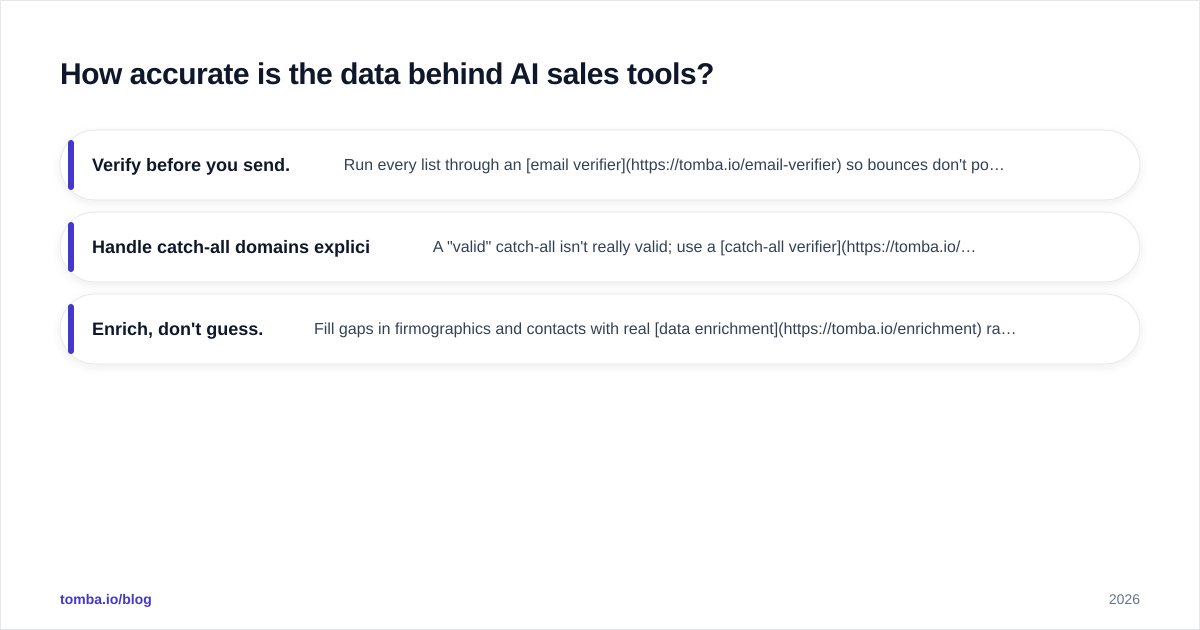
- Verify before you send. Run every list through an email verifier so bounces don't poison deliverability.
- Handle catch-all domains explicitly. A "valid" catch-all isn't really valid; use a catch-all verifier to grade risk.
- Enrich, don't guess. Fill gaps in firmographics and contacts with real data enrichment rather than letting the AI improvise.
The takeaway: the smartest model in the world still can't out-think a wrong email address.
What does Accutrend vs Tami AI cost?#
Both vendors lean on custom pricing once you pass a small-team threshold, so the honest answer is get a quote and a trial. What you can control is your evaluation framework. Here's a simple cost-of-ownership lens:
| Cost factor | What to ask |
|---|---|
| Seat pricing | Per-user, or platform fee + seats? |
| Data included | Are contacts/credits bundled or extra? |
| Overage | What happens when you exceed limits? |
| Contract | Monthly vs annual lock-in? |
| Hidden data spend | Will you need a separate enrichment/verification tool? |
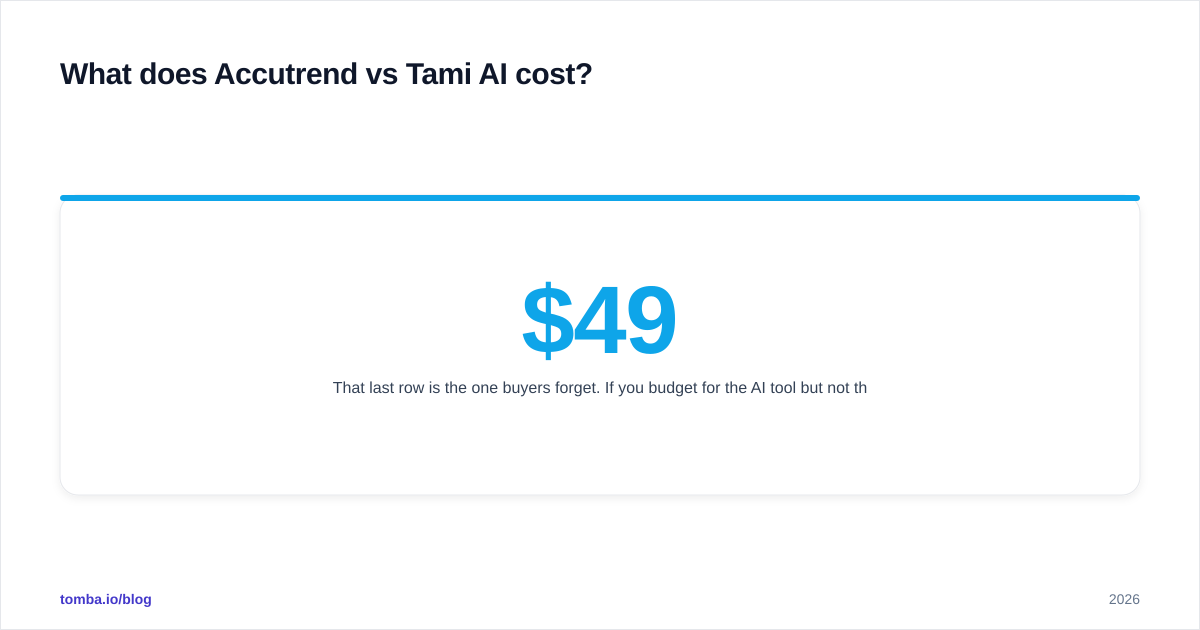
That last row is the one buyers forget. If you budget for the AI tool but not the data that feeds it, you'll either overpay for a bundled data add-on or watch results underperform. For reference on what transparent, predictable data pricing looks like, compare against published Tomba pricing — Free (25 searches/mo), Starter $49/mo, Growth $99/mo, Pro $249/mo, and Enterprise.
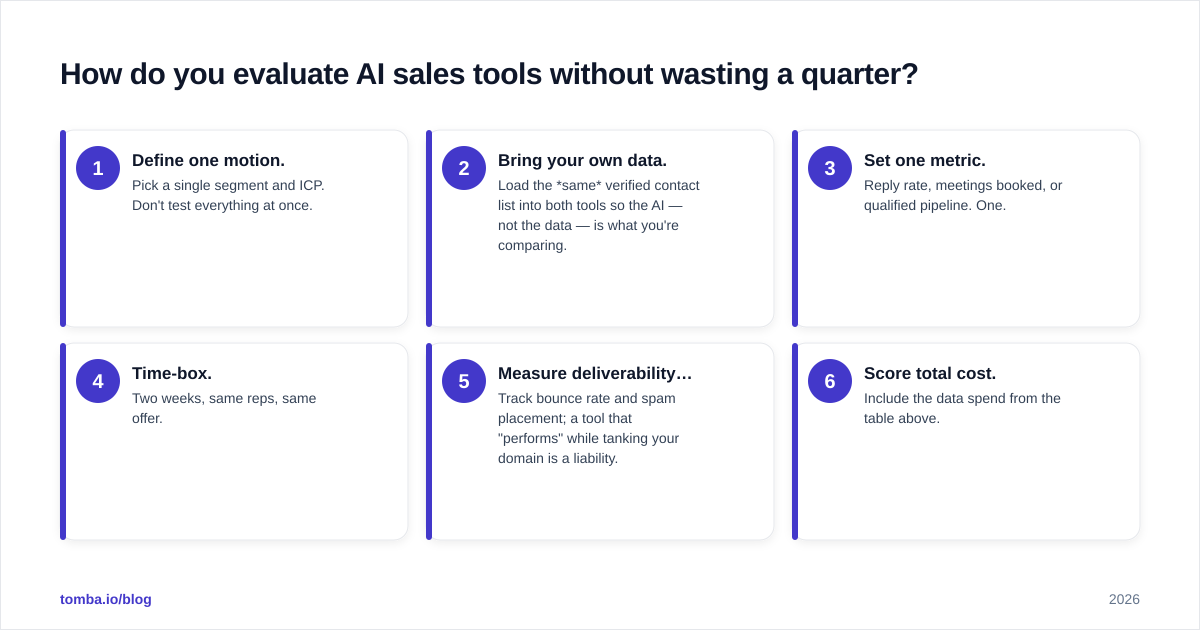
How do you evaluate AI sales tools without wasting a quarter?#
Run a structured 14-day bake-off instead of a vibes-based demo. A tight evaluation looks like this:
- Define one motion. Pick a single segment and ICP. Don't test everything at once.
- Bring your own data. Load the same verified contact list into both tools so the AI — not the data — is what you're comparing.
- Set one metric. Reply rate, meetings booked, or qualified pipeline. One.
- Time-box. Two weeks, same reps, same offer.
- Measure deliverability separately. Track bounce rate and spam placement; a tool that "performs" while tanking your domain is a liability.
- Score total cost. Include the data spend from the table above.
This approach exposes the difference between a tool that genuinely lifts your numbers and one that just has a slicker dashboard.
Where does a data layer fit alongside Accutrend or Tami AI?#
Think of your stack as three layers: data (who exists and how to reach them), intelligence (who's worth reaching), and execution (reaching them well). Accutrend mostly plays in the intelligence layer; Tami AI mostly in execution. The data layer underneath both is where many teams under-invest.
A robust workflow looks like:
- Source and validate contacts with an email finder and bulk verification.
- Feed clean, enriched records into your intelligence tool for scoring.
- Hand the prioritized, verified list to your execution tool for outreach.
- Push everything back to your CRM via your existing integrations so attribution stays intact.
When the data is clean, both Accutrend and Tami AI get noticeably better — because you've removed the variable that quietly caps every AI sales tool's ceiling. Developers building custom workflows can wire this directly through the Tomba API rather than maintaining yet another data scraper.
For broader context on category options beyond these two, vendor-neutral directories like Gartner Peer Insights are useful for seeing how buyers in your segment actually rate these platforms over time.
Accutrend vs Tami AI: which should you choose?#
- Choose Accutrend when prioritization is the bottleneck — you have reach but poor aim.
- Choose Tami AI when execution is the bottleneck — you have aim but not enough hands.
- Choose neither first if your contact data is unverified. Fix that, and both tools perform better and cost less to run.
There's no universal winner here, and any guide that declares one is selling something. The winner is whichever tool closes the specific gap in your funnel — built on a data foundation you can trust.
Start with data that makes any AI tool smarter#
Before you sign with Accutrend, Tami AI, or any AI sales platform, make sure you're not automating outreach to addresses that don't exist. The Tomba Email Finder finds and verifies professional email addresses by domain, name, or company — so the leads flowing into your AI layer are real, reachable, and safe to send to. Start free with 25 searches a month, then scale on a transparent plan as your pipeline grows. Clean data first, smart automation second — that order is what actually moves the number.
Ready to find emails that actually work?
Join 150,000+ professionals who stopped guessing and started sending. Free credits on signup — no credit card required.
Get the Tomba newsletter
Practical outbound tactics and product updates — once every two weeks.
About the author