ActiveCampaign vs Brevo (2026): Features, Pricing & Winner
ActiveCampaign vs Brevo, compared head-to-head for 2026: automation depth, deliverability, pricing tiers, and which platform fits your team. A neutral breakdown with a clear verdict.
Choosing between ActiveCampaign and Brevo usually comes down to one trade-off: how much automation horsepower you actually need versus how much you want to pay as your contact list grows. Both platforms send email, run automations, and bolt on a CRM — but they price, scale, and specialize very differently.
This guide breaks down where each one wins, where each one frustrates real users, and which profile of business should pick which.
TL;DR — ActiveCampaign vs Brevo at a glance#
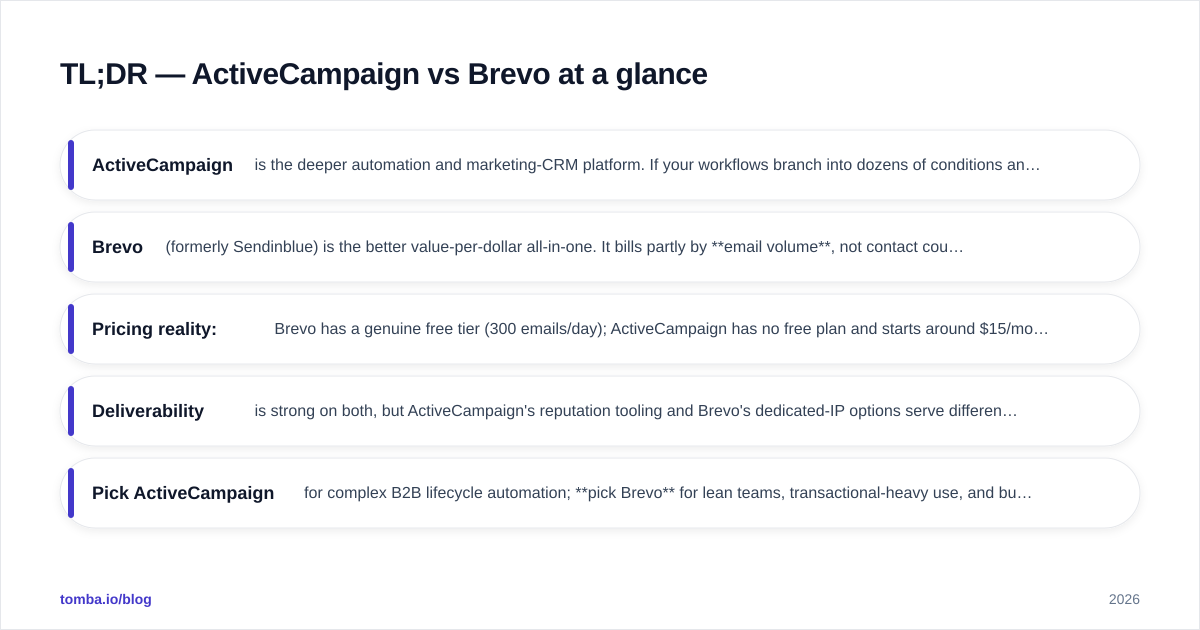
- ActiveCampaign is the deeper automation and marketing-CRM platform. If your workflows branch into dozens of conditions and your revenue depends on behavioral targeting, it earns its higher price.
- Brevo (formerly Sendinblue) is the better value-per-dollar all-in-one. It bills partly by email volume, not contact count, so big lists with occasional sends stay cheap. It also bundles SMS and transactional email natively.
- Pricing reality: Brevo has a genuine free tier (300 emails/day); ActiveCampaign has no free plan and starts around $15/mo for tiny lists, climbing fast with contacts and features.
- Deliverability is strong on both, but ActiveCampaign's reputation tooling and Brevo's dedicated-IP options serve different scales.
- Pick ActiveCampaign for complex B2B lifecycle automation; pick Brevo for lean teams, transactional-heavy use, and budget-sensitive scaling.
What is ActiveCampaign?#
ActiveCampaign is a marketing automation platform with a built-in sales CRM. Its calling card is the visual automation builder — a canvas where you chain triggers, conditions, goals, and actions into workflows that react to how each contact behaves across email, site visits, and pipeline stage.
It markets itself as "customer experience automation," and in practice that means depth: lead scoring, predictive sending, split automations, attribution reporting, and a CRM that sales reps can actually live in. That depth is the reason teams tolerate its steeper learning curve and per-contact pricing.
You can read more on the official ActiveCampaign site, and user sentiment is well documented on G2.
What is Brevo (formerly Sendinblue)?#
Brevo is an all-in-one marketing and transactional communication platform. It rolled email campaigns, marketing automation, SMS, WhatsApp, a CRM, and a transactional email/SMS API into one product — and rebranded from Sendinblue in 2023.
Its defining feature is the volume-based pricing model. Instead of charging mainly by how many contacts you store, Brevo's paid plans are built around how many emails you send per month. For a business sitting on a large but lightly emailed list, that flips the economics in your favor. See the official Brevo site for current packaging.
How do ActiveCampaign and Brevo compare feature by feature?#
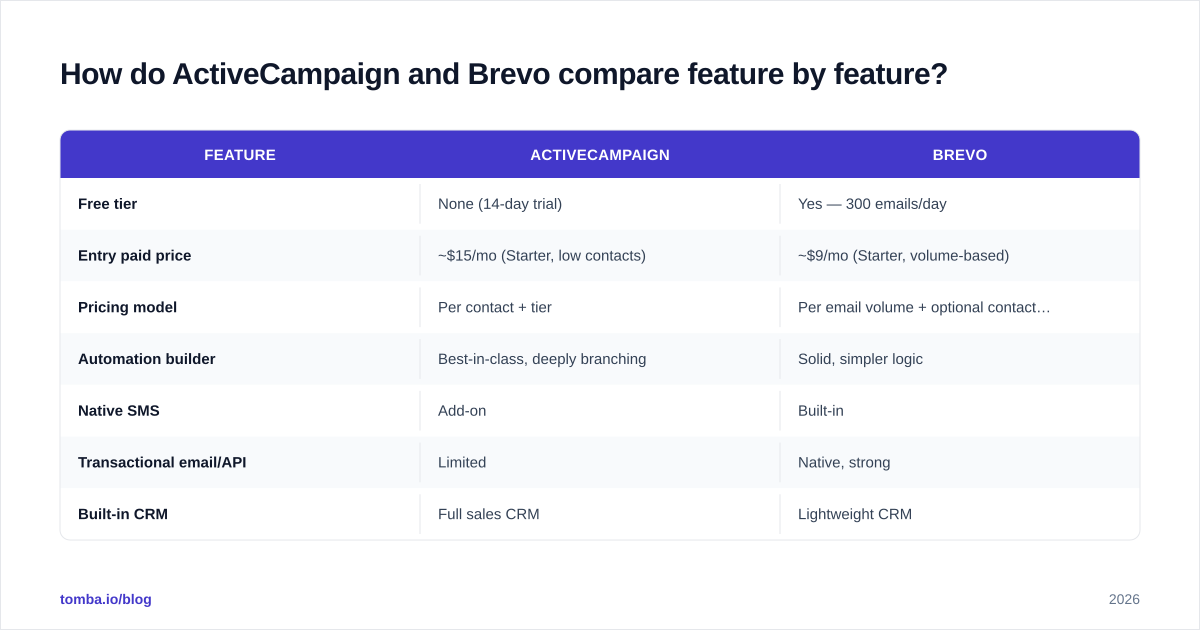
Here is the head-to-head on the attributes that actually move a buying decision.
| Feature | ActiveCampaign | Brevo |
|---|---|---|
| Free tier | None (14-day trial) | Yes — 300 emails/day |
| Entry paid price | ~$15/mo (Starter, low contacts) | ~$9/mo (Starter, volume-based) |
| Pricing model | Per contact + tier | Per email volume + optional contact add-ons |
| Automation builder | Best-in-class, deeply branching | Solid, simpler logic |
| Native SMS | Add-on | Built-in |
| Transactional email/API | Limited | Native, strong |
| Built-in CRM | Full sales CRM | Lightweight CRM |
| Lead scoring | Advanced | Basic (higher tiers) |
| Predictive sending | Yes (higher tiers) | No |
| Learning curve | Steeper | Gentler |
| Best for | Complex lifecycle automation | All-in-one value, transactional + marketing |
The short read: ActiveCampaign wins on automation sophistication and CRM depth; Brevo wins on bundled channels, transactional sending, and price predictability for large lists.
Which has better marketing automation?#
ActiveCampaign, decisively — if you need depth. Its builder supports conditional branching, wait-for-event steps, goal tracking that lets contacts skip ahead when they convert, and inter-automation triggers that let one workflow start another. You can score leads on dozens of signals and route them based on those scores.
Brevo's automation is capable and noticeably easier to learn, but it tops out sooner. You get the common workflows — welcome series, abandoned cart, date-based, and basic if/else — which covers most small-business needs. What you won't find is the layered, multi-condition orchestration that ActiveCampaign power users rely on.
A useful rule of thumb: if you can sketch your entire automation on a napkin, Brevo handles it fine. If your napkin needs a second napkin, you want ActiveCampaign.
ActiveCampaign vs Brevo: which is better for deliverability?#
Both land in the inbox reliably when you follow basics, but they give you different levers.
ActiveCampaign offers strong shared-IP reputation management plus engagement-based sending controls, and it nudges you toward list hygiene. Brevo offers dedicated IP options and a transactional infrastructure that's been hardened by high-volume API senders — an edge if transactional mail is core to your product.
Neither platform fixes a dirty list for you. The single biggest deliverability variable is the quality of the addresses you import, which is why teams clean lists before they ever hit "send." Run new contacts through an email verifier to strip invalid and risky addresses, and understand the fundamentals of email deliverability and sender reputation before scaling volume on either tool. If you're spinning up a new sending domain, an email warmup plan matters more than which vendor you chose.
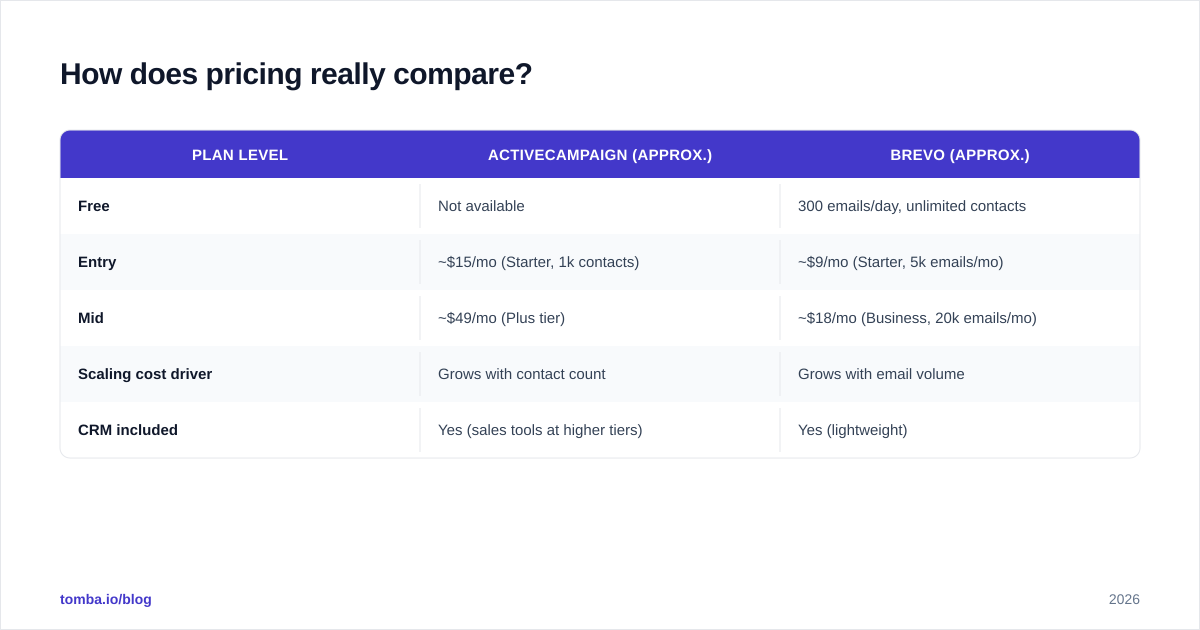
How does pricing really compare?#
This is where most decisions are won or lost, so let's be concrete.
| Plan level | ActiveCampaign (approx.) | Brevo (approx.) |
|---|---|---|
| Free | Not available | 300 emails/day, unlimited contacts |
| Entry | ~$15/mo (Starter, 1k contacts) | ~$9/mo (Starter, 5k emails/mo) |
| Mid | ~$49/mo (Plus tier) | ~$18/mo (Business, 20k emails/mo) |
| Scaling cost driver | Grows with contact count | Grows with email volume |
| CRM included | Yes (sales tools at higher tiers) | Yes (lightweight) |
The structural difference matters more than any single number. ActiveCampaign charges primarily by how many contacts you store, so a 50,000-contact list costs real money even if you email it twice a month. Brevo charges primarily by how many emails you send, so that same lightly-emailed list stays cheap.
Flip the scenario — a small 2,000-contact list you email daily — and the gap narrows or reverses. Model your own contact-count-times-send-frequency before trusting either headline price.
Which platform should you choose?#
Match the tool to your profile rather than to its feature list.
Choose ActiveCampaign if you:
- Run multi-step B2B lifecycle campaigns with behavioral branching
- Want a real sales CRM your reps will use daily
- Need lead scoring, attribution, and predictive sending
- Have budget that scales with revenue, not just headcount
Choose Brevo if you:
- Want a true free tier to start and predictable, volume-based scaling
- Send a lot of transactional email (receipts, alerts) via API
- Need SMS and WhatsApp in the same tool, natively
- Sit on a large list you email occasionally
Consider neither (yet) if your real bottleneck is not having enough qualified contacts to email in the first place. No automation platform generates pipeline from an empty list.
How do you feed either platform with quality contacts?#
Both ActiveCampaign and Brevo are activation tools — they nurture and convert contacts you already have. Neither one finds new prospects for you. That's a separate job in your stack.
To fill the top of the funnel, you pair your email platform with a prospecting layer: an email finder to source verified work addresses by name or company, domain search to pull every reachable contact at a target account, and a HubSpot integration-style connection to sync those contacts into your CRM of record. Clean, verified contacts flow in; ActiveCampaign or Brevo handles the nurture.
This is the practical workflow most growth teams run: find and verify upstream, automate downstream. Skipping the verification step is the fastest way to torch the sender reputation you're paying either vendor to protect.
Frequently asked questions#
Is Brevo the same as Sendinblue? Yes. Sendinblue rebranded to Brevo in 2023. The product lineage, infrastructure, and most features carried over under the new name.
Does ActiveCampaign have a free plan? No. ActiveCampaign offers a 14-day free trial but no permanent free tier. Brevo does offer a free plan capped at 300 emails per day.
Can I migrate from one to the other? Yes — both support contact and list imports via CSV and native migration helpers. The harder part to migrate is automations, since the builders model logic differently; expect to rebuild complex workflows by hand.
Which is better for a small business on a tight budget? Brevo, in most cases, thanks to its free tier and volume-based pricing. ActiveCampaign becomes worth the premium once your automation and CRM needs outgrow the basics.
The verdict#
There's no universal winner — there's a winner for your situation. ActiveCampaign is the stronger automation and marketing-CRM engine and is worth its price when complexity pays you back. Brevo is the better-value all-in-one, especially for transactional-heavy sending and large, lightly-emailed lists.
Whichever you choose, the platform only performs as well as the contacts you load into it. Before your next campaign, make sure those contacts are real and reachable: use the Tomba Email Finder to source verified B2B email addresses by name, company, or domain, then push clean, deliverable contacts straight into ActiveCampaign or Brevo. Better data in means better deliverability, higher reply rates, and a sender reputation that survives scale. Check Tomba pricing to start free with 25 searches a month.
Ready to find emails that actually work?
Join 150,000+ professionals who stopped guessing and started sending. Free credits on signup — no credit card required.
Get the Tomba newsletter
Practical outbound tactics and product updates — once every two weeks.
About the author