Adaptio vs Apollo.io 2026: Which B2B Data Tool Wins?
Adaptio and Apollo.io both promise accurate B2B contact data, but they win at different jobs. Here's an honest 2026 breakdown of accuracy, pricing, and fit.
TL;DR
- Adapt.io is a lean B2B contact database built for fast list-building and Chrome-based prospecting. Apollo.io is a heavier all-in-one platform that bundles data with sequences, dialer, and CRM features.
- If you want a sequencing engine plus data in one seat, Apollo wins. If you want clean contact records to push into your own stack, Adapt is simpler and often cheaper.
- Neither tool guarantees deliverable emails. Both ship a meaningful share of stale or catch-all addresses, so you still need a dedicated verification step before you send.
- Pricing diverges fast at scale: Apollo's credit model gets expensive for export-heavy teams; Adapt's seat-based tiers are flatter but thinner on features.
- The smartest 2026 stack is often "data platform + independent verifier." Pairing either tool with a focused email verifier protects your sender reputation more than trusting one vendor's internal score.
What are Adaptio and Apollo.io?#
Adapt.io (often typed "adaptio") and Apollo.io (often typed "apolloio") are both B2B sales-intelligence platforms. They sell the same core promise — find the right people at the right companies and get their contact details — but they pursue it with very different product philosophies.
Apollo.io is the bigger, louder product. It pairs a 270M+ contact database with an outbound engine: email sequences, a built-in dialer, LinkedIn tasks, deal stages, and analytics. Apollo wants to be the only tool an SDR opens all day. You can find a prospect, enroll them in a cadence, and log the reply without leaving the tab.
Adapt.io is the focused specialist. Its center of gravity is the database and the Chrome extension ("Lead Builder"), which surfaces contact and company data while you browse LinkedIn or a company site. Adapt leans toward feeding clean records into the tools you already run — your CRM, your sequencer, your enrichment flow — rather than replacing them.
That difference in scope drives almost every trade-off below. One tool is a Swiss Army knife; the other is a sharp paring knife.
How accurate is the data in Adaptio vs Apolloio?#
Accuracy is the only metric that matters, because a cheap record that bounces costs you more than an expensive one that lands. The honest answer for 2026: both platforms are good at finding contacts and inconsistent at guaranteeing those contacts are still reachable.
Apollo's strength is breadth. Its crowd-sourced and scraped dataset is enormous, which means high match rates on common roles at mid-market and enterprise companies. The weakness is freshness — large databases drift as people change jobs, and Apollo's "verified" label is generous. You will still see catch-all domains and role-based addresses slip through.
Adapt's dataset is smaller but tends to be tightly curated around its strongest verticals (tech, SaaS, services). On its home turf, match quality is competitive with Apollo. Outside those verticals, coverage thins out and you'll find more blanks.

The practical takeaway: treat any "verified" badge from a bundled data tool as a hint, not a guarantee. The vendor that found the email has an incentive to mark it usable. An independent check — ideally one that flags catch-all domains separately — is what keeps your bounce rate under the 2% line that inbox providers punish.

Adaptio vs Apolloio: feature and pricing comparison#
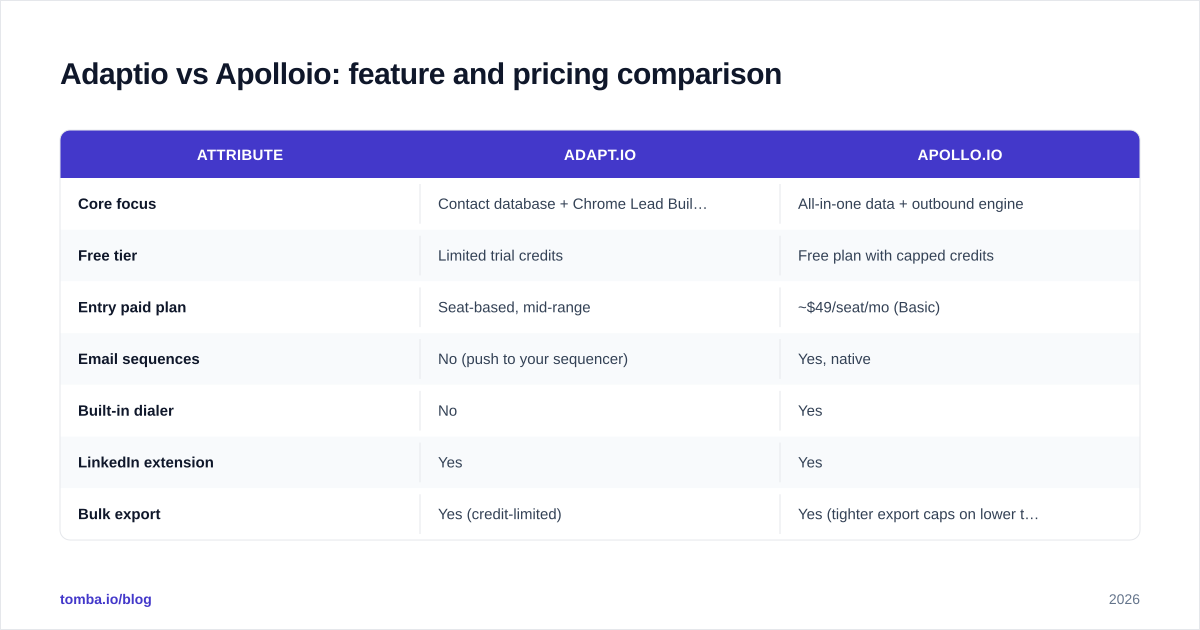
Here is the side-by-side that most "adaptio vs apolloio" searches are actually looking for. Prices reflect publicly listed 2026 plans and shift often, so confirm on each vendor's site before you buy.
| Attribute | Adapt.io | Apollo.io |
|---|---|---|
| Core focus | Contact database + Chrome Lead Builder | All-in-one data + outbound engine |
| Free tier | Limited trial credits | Free plan with capped credits |
| Entry paid plan | Seat-based, mid-range | ~$49/seat/mo (Basic) |
| Email sequences | No (push to your sequencer) | Yes, native |
| Built-in dialer | No | Yes |
| LinkedIn extension | Yes | Yes |
| Bulk export | Yes (credit-limited) | Yes (tighter export caps on lower tiers) |
| Built-in verification | Basic | Basic, "verified" labeling |
| Best for | Clean lists into an existing stack | Teams wanting one tool for data + outreach |
The pattern is clear. Apollo gives you more surface area per dollar — data plus the machinery to act on it. Adapt gives you a cleaner, narrower job done with less overhead. Neither replaces a dedicated verification layer, and Apollo's export limits on lower tiers frustrate teams that just want raw records to enrich elsewhere.
If you're evaluating Apollo specifically because of those export caps and credit math, it's worth reading how a focused finder compares as an Apollo alternative before committing a full team to seats.
Is Apollo.io better than Adaptio for outbound teams?#
Yes — if you want one login to run the whole motion. Apollo's native sequences, dialer, and analytics mean a small team can prospect and send without stitching tools together. For a two-person startup sales team with no existing sequencer, that consolidation is genuinely valuable.
But "all-in-one" cuts both ways. Apollo's sending and data live under the same roof, so when deliverability dips you have fewer independent signals to diagnose why. You're also locked into Apollo's cadence logic and reporting, which are fine but rarely best-in-class against dedicated platforms like Outreach or Salesloft.
Adapt makes the opposite bet: do data well, then get out of the way. If you already pay for a sequencer you like, Adapt's records drop into it cleanly and you don't pay twice for outreach features you won't use.
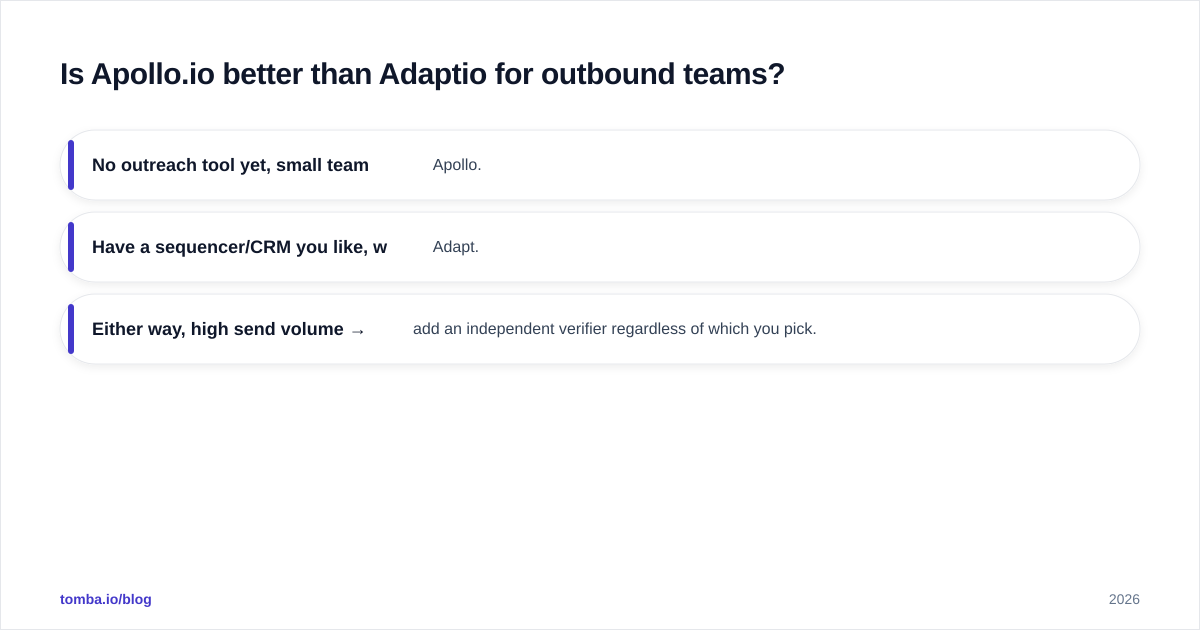
A simple decision rule:
- No outreach tool yet, small team, want fast setup → Apollo.
- Have a sequencer/CRM you like, want clean data to feed it → Adapt.
- Either way, high send volume → add an independent verifier regardless of which you pick.
What do Adaptio and Apolloio get wrong about verification?#
Both treat verification as a feature, not a discipline — and that's the gap that burns outbound teams.
When a data platform marks an email "verified," it usually means the address passed a syntax check and an SMTP ping at some point, possibly months ago. It rarely means the mailbox is active today, and it almost never distinguishes a real inbox from a catch-all domain that accepts everything and bounces silently later. Send to enough of those and your sender reputation erodes before you notice.
This is why experienced teams decouple "find" from "verify." You let Apollo or Adapt do what they're good at — surfacing contacts at scale — and then you run those addresses through a tool whose only job is to confirm deliverability. A dedicated bulk email finder and verifier will re-check the list in real time, separate catch-alls, and hand back a clean send-safe segment.
The cost math favors this split. Verification is cheap relative to a damaged domain. One reputation hit can knock weeks off your pipeline while you warm a new sending domain — far more expensive than the per-email cost of checking first. Apollo and Adapt won't tell you that, because verification isn't where they make their margin.
How do Adaptio and Apolloio compare on data coverage and export?#
Coverage and export rights are where the two tools quietly diverge the most.
Apollo wins raw coverage. Its database is one of the largest on the market, so for broad, multi-industry prospecting you'll find more matches. The catch is export economics: lower tiers cap how many records you can pull out per month, and heavy exporters hit those ceilings fast. Apollo is engineered to keep you working inside Apollo.
Adapt offers fewer total records but more predictable export behavior within its credit allotment, which suits teams that build a list and immediately move it into their own enrichment or CRM flow. The trade-off is vertical concentration — strong in tech and services, thinner elsewhere.

For either tool, the workflow that holds up is: pull the records, then enrich and verify outside the source platform. Pushing exports through a data enrichment and verification pass fills gaps (missing phone numbers, outdated titles) and strips the dead addresses before they touch your sequencer. That single habit does more for reply rates than switching between Adapt and Apollo ever will.
If you compare both against third-party review data on G2, you'll see the same theme in user feedback: people love the volume, and complain about bounce rates and "verified" emails that weren't. That's not a knock on either vendor specifically — it's the structural limit of bundling data and verification in one product.
Which should you choose in 2026?#
Conclusion first: pick the platform by your workflow, then add an independent verifier no matter which you chose.
- Choose Apollo.io if you're a small or early team that wants data and outreach in one seat, you don't already own a sequencer, and you're comfortable with credit-based export limits. Apollo's breadth and consolidation are its real advantages.
- Choose Adapt.io if you already run a sequencer and CRM you like, your targets cluster in tech/SaaS/services, and you want clean records to feed your own stack without paying for outreach features twice.
- Choose neither as your verification source. Whichever you adopt, route the output through a dedicated checker so catch-alls and stale addresses never reach your send queue.
The deeper point: the "adaptio vs apolloio" question frames this as picking a winner, but the platforms aren't really competing on the thing that decides your campaign — deliverability. They compete on coverage and workflow. Deliverability is decided downstream, by whether the emails you send actually land.
That's where a focused finder-plus-verifier earns its place in the stack. Tomba's email finder returns sourced, confidence-scored addresses, and its verifier separates valid inboxes from catch-alls in real time — so you can keep Adapt or Apollo for discovery and stop trusting a bundled "verified" badge with your domain reputation. You can run a small list through the free tier (25 searches/month) to compare results against your current tool before you change anything, then scale on the Starter plan at $49/mo when the accuracy difference shows up in your bounce report. Find the contacts where you like — verify them where it counts.
// get started
Find, verify and enrich your first contacts today
Start on the free plan with 25 searches a month, then scale when your team is ready.
Free plan · No credit card required · GDPR & CCPA
// about the author