Adaptio vs AroundDeal 2026: B2B Data Platform Comparison
Adaptio vs AroundDeal compared on data accuracy, coverage, pricing, and workflow fit — plus where a verification-first stack beats both for cold outreach in 2026.
Choosing between Adaptio and AroundDeal usually comes down to one question: which platform actually puts deliverable contact data in front of your reps without burning a quarter's budget? Both promise B2B emails, phone numbers, and company intelligence. They differ in coverage philosophy, pricing structure, and how much verification they do before you hit send.
This guide breaks down the real trade-offs so you can pick the right tool — and shows where pairing either one with a dedicated verification layer protects your sender reputation.
TL;DR#
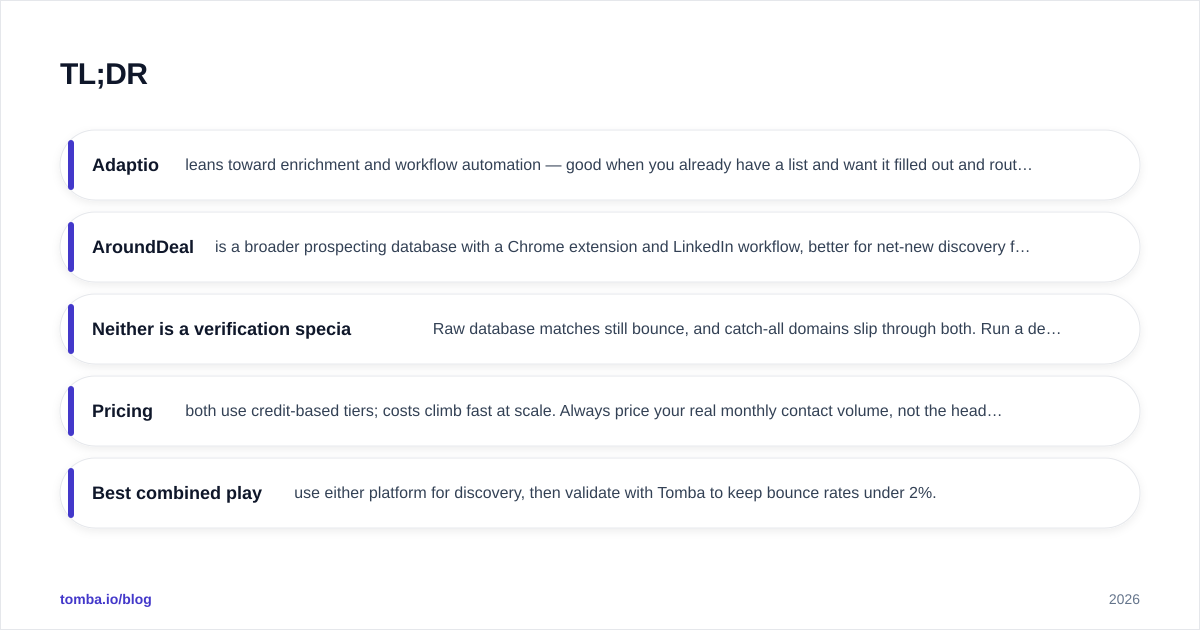
- Adaptio leans toward enrichment and workflow automation — good when you already have a list and want it filled out and routed.
- AroundDeal is a broader prospecting database with a Chrome extension and LinkedIn workflow, better for net-new discovery from scratch.
- Neither is a verification specialist. Raw database matches still bounce, and catch-all domains slip through both. Run a dedicated email verifier before any cold send.
- Pricing: both use credit-based tiers; costs climb fast at scale. Always price your real monthly contact volume, not the headline plan.
- Best combined play: use either platform for discovery, then validate with Tomba to keep bounce rates under 2%.
What are Adaptio and AroundDeal?#
Both sit in the B2B data intelligence category — software that maps companies and the people inside them, then exposes contact details for outbound sales and marketing.
Adaptio positions itself around enrichment and go-to-market automation: take a thin record (a name, a domain, a LinkedIn URL) and return a fuller profile with firmographics, role, and contact points, often wired directly into your CRM or sequencing tool. The pitch is "clean, routed, ready-to-action data" rather than a sprawling searchable directory.
AroundDeal is closer to a classic prospecting database. You search by company, title, industry, or geography, build lists, and pull contacts — frequently through a browser extension that overlays LinkedIn. Its appeal is net-new discovery: finding people you don't already know exist.
That distinction — enrichment-first vs discovery-first — is the single most useful lens for this decision. If you're confused about the broader category, the B2B data and intelligence space covers the underlying concepts.

How accurate is the data?#
Accuracy is where comparisons get uncomfortable, because no B2B database is static. People change jobs every few years, companies rebrand, and email formats shift after acquisitions. A "95% accuracy" badge on a marketing page describes a lab condition, not your specific list on the day you send.
Two failure modes matter most for cold outreach:
- Stale records — the contact left 14 months ago and the email now hard-bounces.
- Catch-all domains — the mail server accepts everything, so a database "valid" flag means nothing. You need a catch-all verifier to resolve these, and most prospecting databases don't do it well.
Adaptio's enrichment model can refresh records when you re-run them, which helps with staleness if your workflow re-enriches regularly. AroundDeal's larger crawl-and-search index gives you more raw matches, but breadth and freshness trade off against each other — bigger databases are harder to keep current.
The practical takeaway: treat the accuracy claims from either vendor as a starting point, not a guarantee. The only number that matters is your live bounce rate, and the only way to protect it is verification at send time.

Adaptio vs AroundDeal: feature comparison#
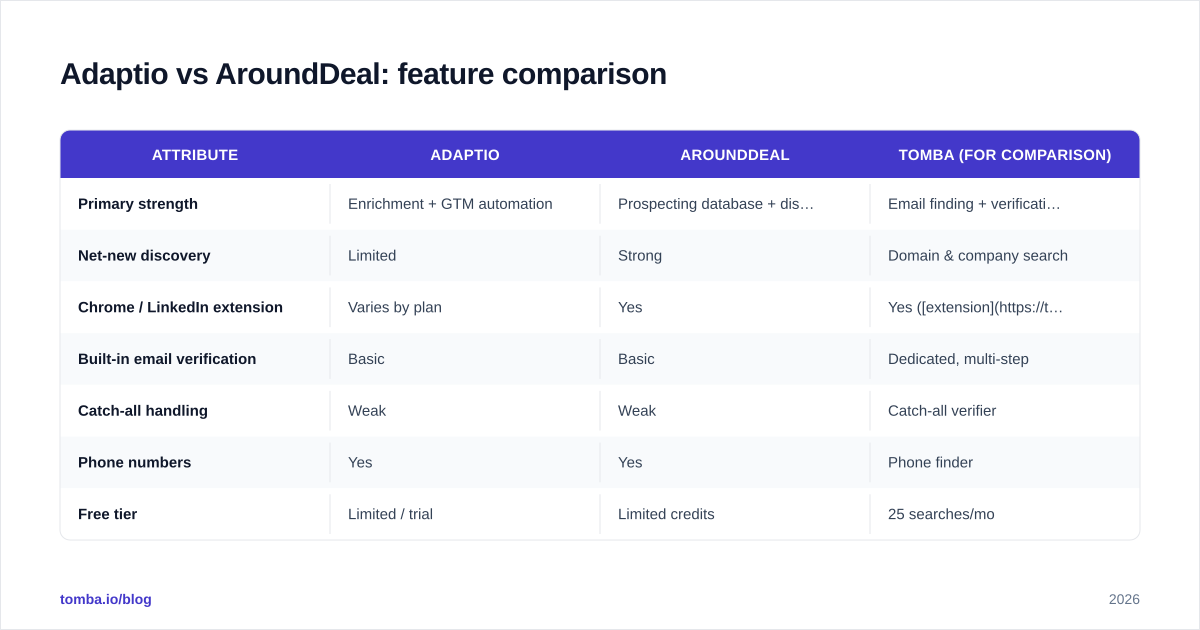
Here's how the two stack up on the attributes that actually drive a buying decision. Where a vendor publishes no fixed public number, it's marked accordingly — don't anchor on a screenshot you saw last year.
| Attribute | Adaptio | AroundDeal | Tomba (for comparison) |
|---|---|---|---|
| Primary strength | Enrichment + GTM automation | Prospecting database + discovery | Email finding + verification |
| Net-new discovery | Limited | Strong | Domain & company search |
| Chrome / LinkedIn extension | Varies by plan | Yes | Yes (extension) |
| Built-in email verification | Basic | Basic | Dedicated, multi-step |
| Catch-all handling | Weak | Weak | Catch-all verifier |
| Phone numbers | Yes | Yes | Phone finder |
| Free tier | Limited / trial | Limited credits | 25 searches/mo |
| Entry paid price | Custom / quote-led | Credit tiers | $49/mo Starter |
| API access | Yes | Yes | Full API |
A few honest caveats. Adaptio's pricing is frequently quote-led, which makes apples-to-apples cost comparison hard until you talk to sales. AroundDeal's credit tiers are more transparent but, like most databases, the per-contact cost drops only at higher commitments. For published, predictable numbers you can model today, see Tomba pricing.

Which one fits your workflow?#
The right answer depends less on raw feature counts and more on where your pipeline starts.
Choose Adaptio if:
- You already have inbound leads or a target account list and need them enriched and routed automatically.
- Your team lives in the CRM and wants data appended without manual exports.
- You value clean, deduplicated records over sheer volume.
Choose AroundDeal if:
- You're building outbound from zero and need to discover net-new accounts and contacts.
- Your reps prospect heavily on LinkedIn and want an overlay extension.
- You want a searchable directory you can slice by title, geo, and industry.
Choose neither alone if your top priority is deliverability. This is the gap both products share: they're acquisition tools, not validation tools. A database can hand you a perfectly formatted address that still bounces because the person left or the mailbox was retired. That's not a knock on either vendor — it's the nature of crawled and inferred data.
How do you protect deliverability with either tool?#
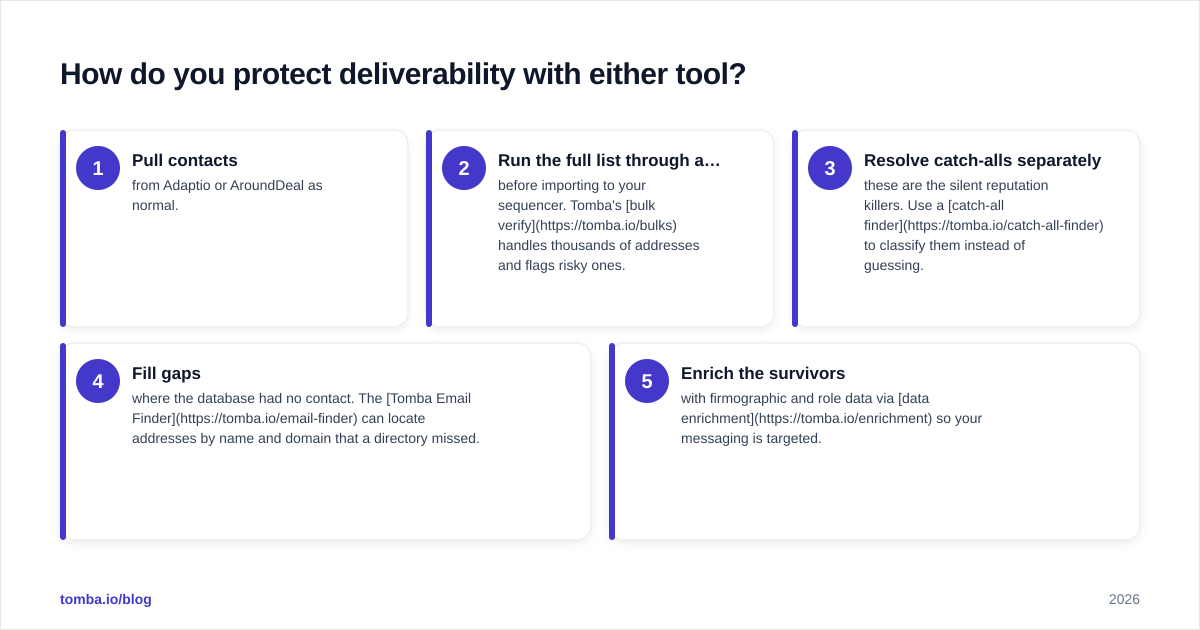
Here's the workflow that works regardless of which platform you pick. Think of it like buying produce: the supplier gives you a crate, but you still wash and inspect each piece before serving it. Your "washing" step is verification.
- Pull contacts from Adaptio or AroundDeal as normal.
- Run the full list through a verifier before importing to your sequencer. Tomba's bulk verify handles thousands of addresses and flags risky ones.
- Resolve catch-alls separately — these are the silent reputation killers. Use a catch-all finder to classify them instead of guessing.
- Fill gaps where the database had no contact. The Tomba Email Finder can locate addresses by name and domain that a directory missed.
- Enrich the survivors with firmographic and role data via data enrichment so your messaging is targeted.
This two-stage model — discover with one tool, verify with a specialist — consistently beats trusting any single platform's internal "valid" flag. Industry deliverability guidance from sources like HubSpot and broad vendor reviews on G2 repeatedly land on the same point: list hygiene, not list size, determines whether your campaigns reach the inbox. You can read more on the mechanics in our breakdown of email deliverability.
What about pricing at scale?#
Credit-based pricing hides a trap: the headline plan looks cheap, but real prospecting consumes credits faster than you expect. Every search, every enrichment, and sometimes every reveal burns budget. A team pulling 5,000 contacts a month can pay very differently across these tools depending on how each meters usage.
| Cost factor | What to check |
|---|---|
| Credit definition | Does one credit = one contact, or one field? |
| Verification cost | Is validation included or billed separately? |
| Rollover | Do unused credits expire monthly? |
| Seat fees | Per-user charges on top of credits? |
| API metering | Are programmatic calls billed at the same rate? |
AroundDeal's tiers are reasonably transparent, but the per-contact rate only improves with annual commitment. Adaptio's enterprise-leaning, quote-based model can be cost-effective for high-volume enrichment but opaque for smaller teams trying to budget. Tomba publishes flat tiers — Free (25 searches/mo), Starter $49/mo, Growth $99/mo, Pro $249/mo, and Enterprise — so you can forecast spend without a sales call. Compare the full Tomba plans before committing to any annual contract elsewhere.
Check current verified reviews on Capterra and the vendor's own AroundDeal site for the latest published numbers, since credit pricing changes more often than feature sets.
Frequently asked questions#
Is Adaptio better than AroundDeal? Neither is universally better. Adaptio wins for enrichment and CRM-routed automation; AroundDeal wins for net-new prospecting and LinkedIn-led discovery. Match the tool to where your pipeline begins.
Do Adaptio and AroundDeal verify emails? Both offer basic validation, but neither is a verification specialist, and both struggle with catch-all domains. Run a dedicated email verification pass before sending cold email.
Can I use one of these with Tomba? Yes, and it's the recommended setup. Use Adaptio or AroundDeal for discovery and enrichment, then verify and gap-fill with Tomba. The Tomba API plugs into the same automation stack.
Which is cheaper? It depends on volume. AroundDeal's tiers are more transparent for small teams; Adaptio's quote model can suit high-volume enrichment. Always model your real monthly contact count.
The bottom line#
Adaptio and AroundDeal solve different halves of the same problem — Adaptio enriches what you have, AroundDeal finds what you don't. Pick based on whether your bottleneck is discovery or data completeness. But whichever you choose, the deliverability gap is identical: raw database matches bounce, and catch-alls slip through.
That's where Tomba fits. Run your Adaptio or AroundDeal exports through the Tomba Email Finder and verifier to find missing addresses, validate every contact, and resolve catch-alls before they touch your sender reputation. Start free with 25 searches a month, then scale on flat, predictable pricing — no quote required. Your inbox placement will thank you.
Ready to find emails that actually work?
Join 150,000+ professionals who stopped guessing and started sending. Free credits on signup — no credit card required.
Get the Tomba newsletter
Practical outbound tactics and product updates — once every two weeks.
About the author