Adaptio vs Clodura.ai 2026: Which B2B Sales Platform Wins?
A neutral, hands-on breakdown of Adaptio vs Clodura.ai for 2026 — data coverage, accuracy, sales engagement, and pricing — so you pick the right B2B prospecting stack.
The choice in Adaptio vs Clodura.ai comes down to one question. Do you want an established B2B database with built-in sales engagement? Or an AI-first platform that acts on buying signals for you? This guide compares both on what actually moves pipeline: data coverage, contact accuracy, engagement features, and price. No marketing gloss.
TL;DR#
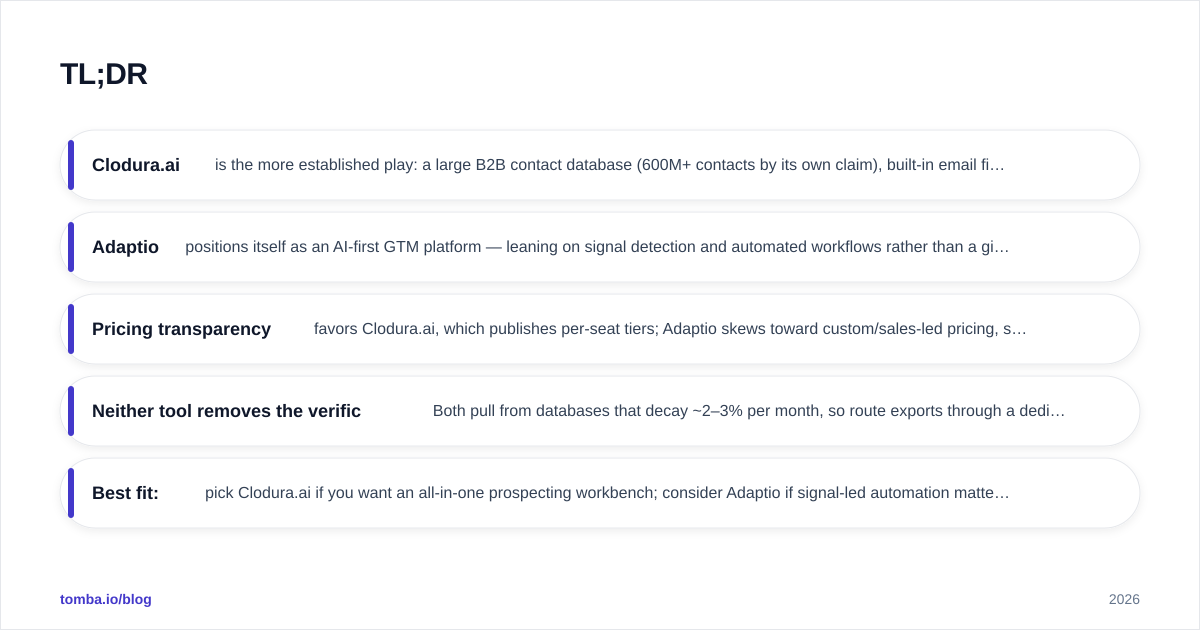
- Clodura.ai is the more established play: a large B2B contact database (600M+ contacts by its own claim), built-in email finder, cadences, intent data, and org charts in one subscription.
- Adaptio positions itself as an AI-first GTM platform. It leans on signal detection and automated workflows rather than a giant static database you query by hand.
- Pricing transparency favors Clodura.ai, which publishes per-seat tiers. Adaptio skews toward custom, sales-led pricing, so budget predictability is harder.
- Neither tool removes the verification step. Both pull from databases that decay 2–3% per month. Route exports through a dedicated email verifier before you send.
- Best fit: pick Clodura.ai if you want an all-in-one prospecting workbench. Consider Adaptio if signal-led automation matters more than database breadth. Use a specialist finder like Tomba to fill data gaps either way.
What are Adaptio and Clodura.ai?#
Clodura.ai is a sales prospecting and engagement platform. It is built around a self-reported database of 600M+ B2B contacts and 18M+ companies. The pitch is consolidation. Instead of stitching together a database tool, an email finder, and a cadence tool, you get it all under one login: contact discovery, verified-email lookup, direct dials, technographics, buying-intent signals, and email sequencing. It has been around since the mid-2010s. It is widely listed on review sites like G2 and Capterra.
Adaptio is the newer, AI-first entrant. It does not position itself as a database you search by hand. Instead, it frames the product around automated go-to-market workflows. It detects buying signals, enriches accounts, and triggers outreach with less manual assembly. Because it is earlier in its lifecycle, public detail is thinner and pricing is mostly sales-led. So a lot of the evaluation happens in a live demo rather than from a published spec sheet.
The honest framing: Clodura.ai competes on breadth and maturity; Adaptio competes on automation and signal intelligence. That difference shapes everything below.
Adaptio vs Clodura.ai: how do they compare at a glance?#
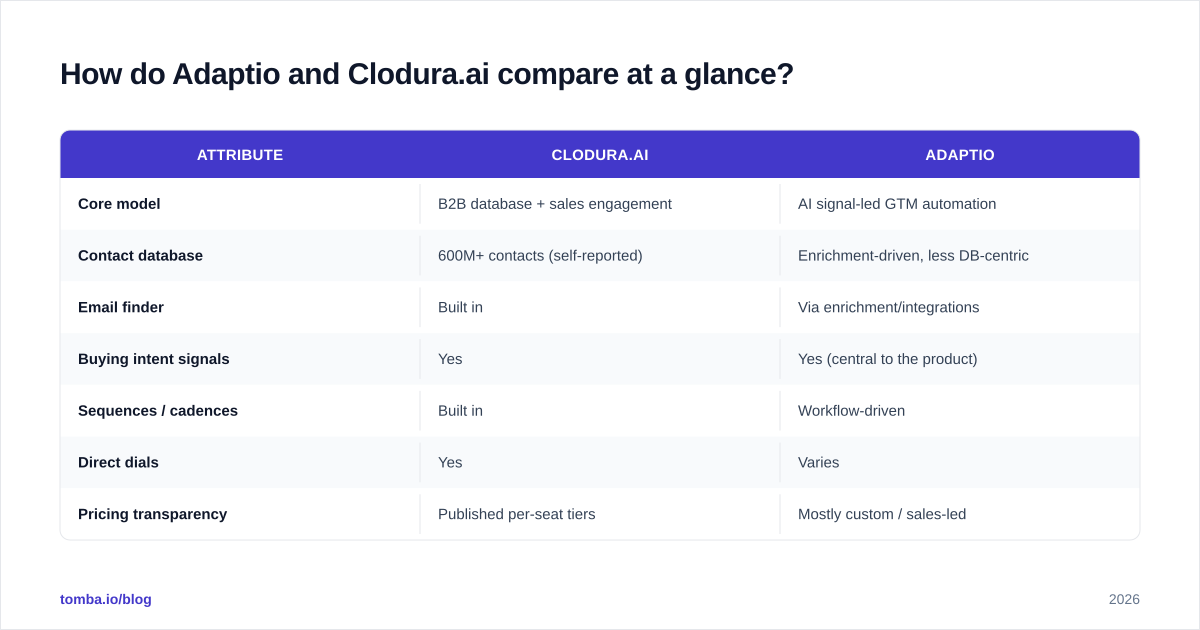
| Attribute | Clodura.ai | Adaptio |
|---|---|---|
| Core model | B2B database + sales engagement | AI signal-led GTM automation |
| Contact database | 600M+ contacts (self-reported) | Enrichment-driven, less DB-centric |
| Email finder | Built in | Via enrichment/integrations |
| Buying intent signals | Yes | Yes (central to the product) |
| Sequences / cadences | Built in | Workflow-driven |
| Direct dials | Yes | Varies |
| Pricing transparency | Published per-seat tiers | Mostly custom / sales-led |
| Maturity | Established | Newer entrant |
| Best for | All-in-one prospecting | Automation-heavy GTM teams |
Treat self-reported database sizes as marketing ceilings. They are not the count you will actually reach in your niche. The number that matters is valid, reachable contacts in your ICP. That figure is always smaller than the headline.
How accurate is the contact data?#
Accuracy is where most platform comparisons get decided. A cheap seat turns expensive once you factor in bounces, burned domains, and reps chasing dead numbers.
Both platforms aggregate data from public web crawling, partnerships, and user contributions. Then they run internal validation. The catch is that all aggregated B2B data decays. People change jobs. Companies rebrand. Catch-all domains hide whether a mailbox actually exists. Industry estimates put B2B data decay at roughly 22–30% per year. So even a freshly exported list is partly stale on arrival.
Clodura.ai verifies emails in real time at lookup, which helps. But no single vendor checks every record against a live mail server on every pull. Adaptio's signal-led model can surface fresher accounts, because it reacts to recent activity. Even so, the underlying contact still needs validation before you hit send.
This is the practical reality, whichever platform you choose:
- A "verified" badge inside a database tool is a probability score, not a guarantee.
- Catch-all domains (common in mid-market and enterprise) return "accept-all" and defeat naive verification. You need a catch-all verifier to resolve them.
- Running every export through an independent email verifier is the single highest-ROI habit in outbound.
Want to understand where contact data comes from and why two vendors disagree on the same person? Our breakdown of data sources explains the aggregation-and-decay cycle in plain terms.
Which platform has better sales engagement features?#
Clodura.ai bundles engagement directly. You can build email sequences, schedule follow-ups, track opens and clicks, and pull direct dials without leaving the tool. For a small team that wants "find them and email them" in one place, that consolidation is the main selling point.
Adaptio approaches engagement from the automation side. A rep does not build a cadence per persona by hand. Instead, the platform runs workflows that fire on detected signals: an account showing intent, a trigger event, a role change. In theory, that means fewer manual steps and more "right message, right time." In practice, the quality depends on signal accuracy and how well the workflows are set up during onboarding.
A fair way to think about it:
- Choose Clodura.ai's engagement if you want manual control, clear cadence editing, and an all-in-one workbench.
- Choose Adaptio's engagement if you trust automation to cut busywork and your team is comfortable running signal-triggered workflows.
Neither replaces a real CRM. Both work best as the top-of-funnel discovery and first-touch layer that feeds HubSpot, Salesforce, or Pipedrive.
How do Adaptio and Clodura.ai pricing compare?#
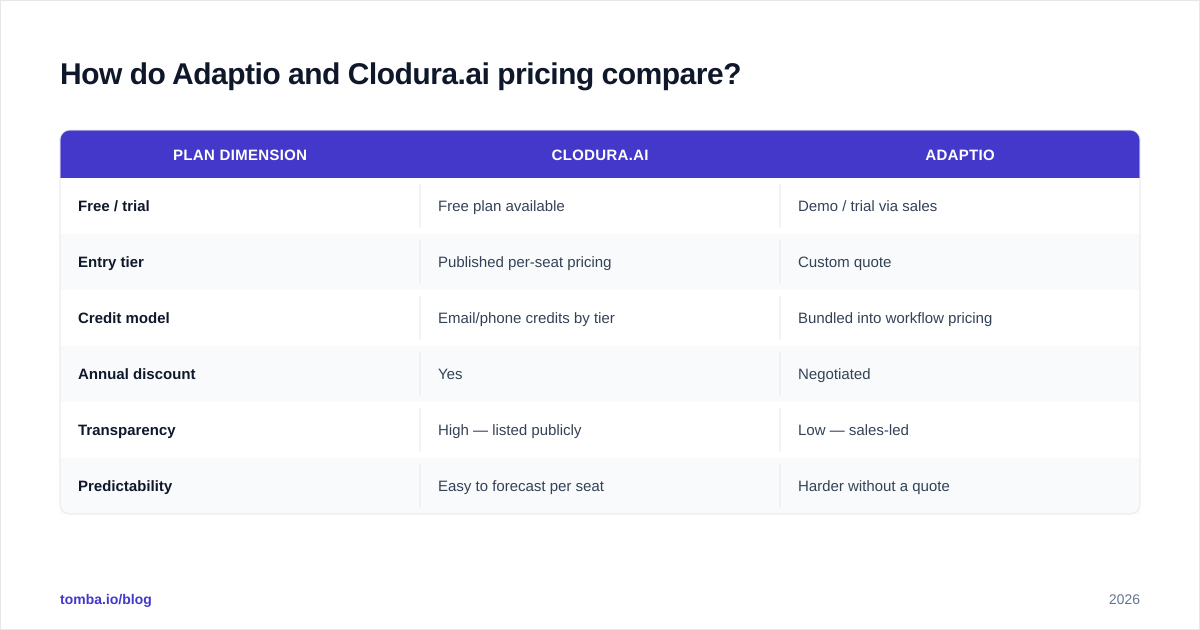
| Plan dimension | Clodura.ai | Adaptio |
|---|---|---|
| Free / trial | Free plan available | Demo / trial via sales |
| Entry tier | Published per-seat pricing | Custom quote |
| Credit model | Email/phone credits by tier | Bundled into workflow pricing |
| Annual discount | Yes | Negotiated |
| Transparency | High — listed publicly | Low — sales-led |
| Predictability | Easy to forecast per seat | Harder without a quote |
Clodura.ai's published tiers make it easy to estimate annual cost per rep before you ever talk to sales. Adaptio's sales-led model can be a better deal at scale, since custom pricing often is. But it forces every evaluation through a demo, and you can't comparison-shop on a spec sheet alone.
Avoid one pricing trap with any database platform. Don't pay for a huge credit allowance you can't use because the records in your niche are thin or stale. Buy for the contacts you can actually reach, not the headline database size. If you only need accurate emails on demand, a focused tool with clear Tomba pricing — a free tier of 25 searches, then $49/mo Starter — can be cheaper than a full platform seat you half-use.
Is Adaptio or Clodura.ai better for your team?#
There's no universal winner. Map the choice to how your team actually works.
Pick Clodura.ai if you:
- Want an established, all-in-one prospecting and engagement tool.
- Prefer searching a large database by hand and building your own cadences.
- Need transparent, forecastable per-seat pricing.
- Value direct dials and technographics inside the same subscription.
Pick Adaptio if you:
- Believe signal-led automation will beat manual list-building for your motion.
- Have a GTM team comfortable running triggered workflows.
- Can budget for sales-led, custom pricing.
- Care more about reacting to fresh intent than querying the biggest possible database.
Consider a specialist finder alongside either if you:
- Hit data gaps in a specific vertical or region.
- Want to verify and enrich what a platform exports before you send.
- Need a bulk email finder or API to plug discovery into your own systems rather than a closed UI.
Most high-performing teams don't run a single tool. They run a primary platform plus a verification-and-enrichment layer that keeps the data honest.
What about data accuracy and deliverability?#
Here's the part both vendor marketing pages skip: your sender reputation doesn't care which platform sourced the address. A bounce from a Clodura.ai record and a bounce from an Adaptio record damage your domain the same way.
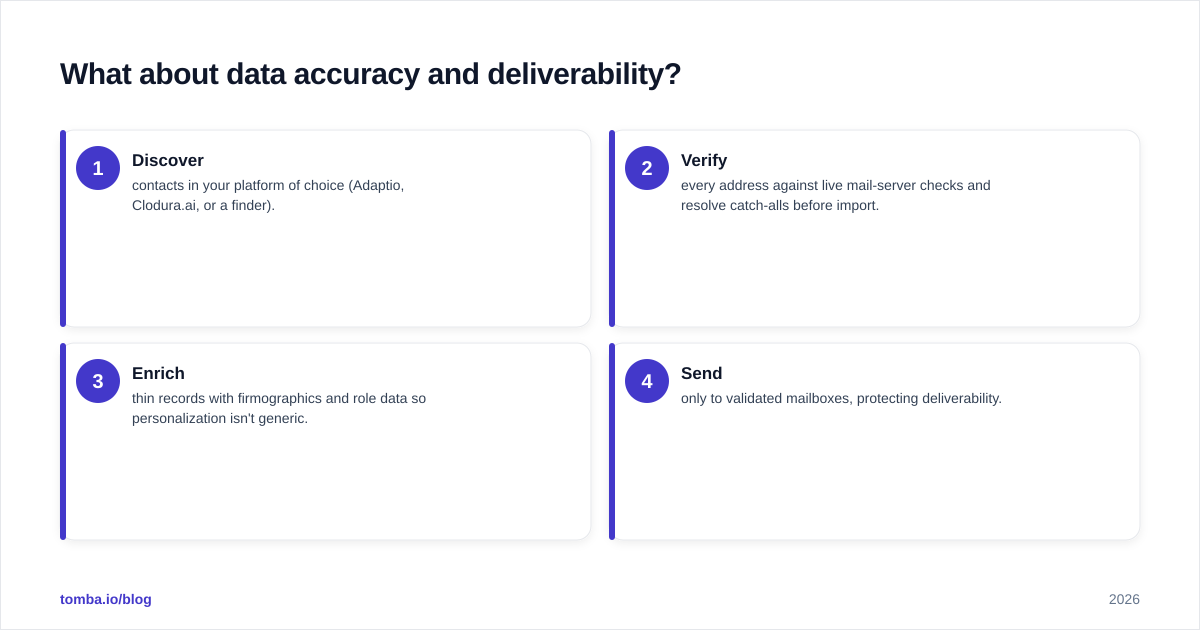
That's why the smartest stack separates discovery from verification:
- Discover contacts in your platform of choice (Adaptio, Clodura.ai, or a finder).
- Verify every address against live mail-server checks and resolve catch-alls before import.
- Enrich thin records with firmographics and role data so personalization isn't generic.
- Send only to validated mailboxes, protecting deliverability.
This is exactly where a dedicated layer earns its keep. Tomba's email finder finds professional addresses by domain or name. Data enrichment fills the missing fields. The verification suite catches the records a general platform marks "valid" but a live SMTP check rejects. Whether your primary tool is Adaptio or Clodura.ai, putting a verification gate before your sending tool is the difference between a 1% bounce rate and a blacklisted domain.
Frequently asked questions#
Is Adaptio or Clodura.ai more accurate? Neither publishes independently audited accuracy you can fully trust at face value. Clodura.ai verifies at lookup. Adaptio surfaces fresher signal-driven accounts. In both cases, an independent verification pass before sending is what actually protects your bounce rate.
Which is cheaper, Adaptio or Clodura.ai? Clodura.ai is easier to budget because it publishes per-seat tiers. Adaptio is sales-led, so it may be cheaper or pricier depending on your negotiated scope. You'll need a quote.
Can I use Tomba with Adaptio or Clodura.ai? Yes. Many teams use a primary platform for discovery and engagement. Then they route exports through Tomba's verifier and enrichment via the Tomba API or integrations to keep data clean before outreach.
Do I still need to verify emails if the platform says they're verified? Yes. Platform "verified" labels are probability scores. B2B data decays 22–30% per year and catch-all domains hide invalid mailboxes. So a final verification pass remains the highest-ROI step in outbound.
The bottom line#
In the Adaptio vs Clodura.ai decision, Clodura.ai wins on database breadth, transparent pricing, and all-in-one convenience. Adaptio is the bet on AI-driven, signal-led automation for teams that prefer reacting to intent over mining a database by hand. Choose based on whether you value a mature workbench or automation-first workflows. Price predictability matters a lot if budget approval is tight.
Whichever you land on, accuracy is the line item that actually decides ROI. Start with Tomba's email finder and verification suite to find and confirm the contacts your platform misses — free for your first 25 searches, then $49/mo when you're ready to scale. Find the email, verify it once, and send with confidence regardless of which prospecting platform sits upstream.
Ready to find emails that actually work?
Join 150,000+ professionals who stopped guessing and started sending. Free credits on signup — no credit card required.
Get the Tomba newsletter
Practical outbound tactics and product updates — once every two weeks.
About the author