Adaptio vs Coresignal 2026: B2B Data Provider Showdown
Adaptio and Coresignal both sell B2B data at scale, but they solve different problems. Here's an honest 2026 breakdown of coverage, freshness, pricing, and which one belongs in your GTM stack.
Choosing a B2B data provider is one of those decisions that looks simple on the demo call and gets complicated the moment real records hit your CRM. Adaptio and Coresignal both promise large-scale company and people data, but they are built for different buyers and different jobs. This guide breaks down what each one actually does, where they overlap, and how to decide without a three-month pilot.
TL;DR#
- Coresignal is a mature data-as-a-service provider best known for firmographic, employee, and job-posting datasets delivered as bulk files or API — built for data teams, analysts, and product builders.
- Adaptio positions itself as a go-to-market intelligence layer aimed at revenue teams who want enriched, signal-ready records rather than raw dumps they have to model themselves.
- The real split is raw data infrastructure (Coresignal) vs. packaged GTM workflows (Adaptio) — not "which has more records."
- Pricing models differ: Coresignal sells by dataset/credit volume for engineering use; Adaptio leans toward seat- and workflow-based plans for sales and marketing teams.
- If you only need verified contact emails to start outbound, a focused tool like Tomba's email finder is cheaper and faster than either platform.
What is Adaptio?#
Adaptio is a B2B go-to-market data and intelligence platform. Its pitch is that revenue teams shouldn't have to stitch together raw datasets — they want company records, contacts, and buying signals already cleaned, scored, and ready to action inside a sales workflow.
In practice that means Adaptio leans toward the "last mile" of data: account selection, enrichment, intent or activity signals, and pushing those into a CRM or sequencing tool. The buyer is usually a RevOps lead, a head of growth, or an SDR manager who measures success in pipeline, not in rows of JSON.
The trade-off is control. Packaged platforms decide a lot for you — how records are matched, how a company is canonicalized, what counts as a "signal." That is great when the defaults fit and frustrating when they don't.
What is Coresignal?#
Coresignal is a data-as-a-service company that has been selling large-scale firmographic, employee, and job-posting data for years. Its core product is access to fresh, structured datasets — company profiles, employee records, job postings, technographics — delivered through bulk data feeds, a search API, or scraped-and-cleaned datasets you can model yourself.
Coresignal's natural buyer is technical: a data engineering team building an investment-signals product, a startup training models, a market-intelligence team running analysis, or a platform that resells enriched data downstream. You get closer to the raw material, which means more flexibility and more responsibility.
If Adaptio is a meal kit, Coresignal is the wholesale grocery supplier. One hands you a recipe; the other hands you ingredients at scale.

Adaptio vs Coresignal: how do they actually differ?#
The headline comparison most people search for is "who has more data," but that's the wrong first question. Both vendors operate at meaningful scale. The decision that matters is what shape you want the data in and who is going to consume it.
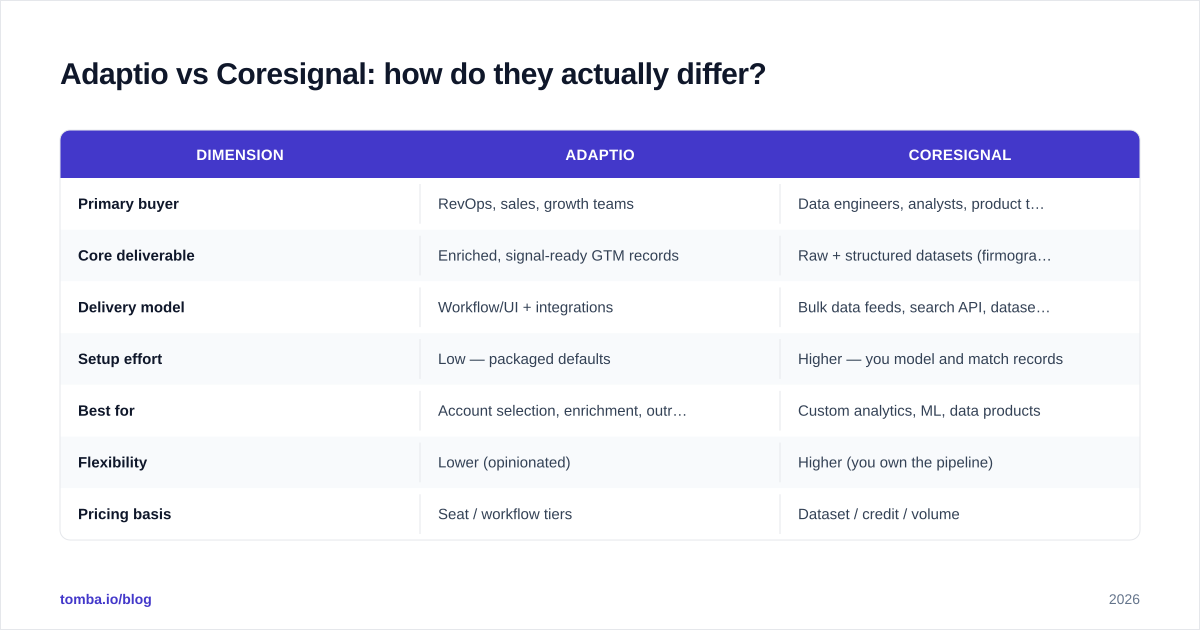
Here's the practical breakdown:
| Dimension | Adaptio | Coresignal |
|---|---|---|
| Primary buyer | RevOps, sales, growth teams | Data engineers, analysts, product teams |
| Core deliverable | Enriched, signal-ready GTM records | Raw + structured datasets (firmographic, employee, jobs) |
| Delivery model | Workflow/UI + integrations | Bulk data feeds, search API, datasets |
| Setup effort | Low — packaged defaults | Higher — you model and match records |
| Best for | Account selection, enrichment, outreach | Custom analytics, ML, data products |
| Flexibility | Lower (opinionated) | Higher (you own the pipeline) |
| Pricing basis | Seat / workflow tiers | Dataset / credit / volume |
A few things worth calling out beyond the table.
Data freshness. Coresignal publishes refresh cadences for its datasets, which matters enormously if you're tracking job changes, hiring spikes, or headcount growth as signals. Adaptio abstracts freshness behind its workflows, so you trust the platform's update logic rather than scheduling your own pulls. Engineers usually prefer the transparency of the former; sales teams usually prefer not thinking about it.
Matching and identity resolution. This is where packaged platforms earn their keep. Adaptio does entity resolution for you — deduping companies, linking contacts to accounts, normalizing job titles. With Coresignal you often do that yourself, which is more work but lets you tune matching to your own taxonomy.
Compliance posture. Any serious B2B data evaluation in 2026 has to include where the data comes from and how it's processed. Ask both vendors directly about sourcing, GDPR/CCPA handling, and data subject request workflows. Don't take a slide's word for it — get it in the contract.
Which one is better for sales and outbound teams?#
For pure outbound — building a target list and reaching out — Adaptio is the more natural fit because the data arrives action-ready. You're not writing transformation scripts before your SDRs can send a single email.
But "better fit" isn't the same as "best value." Most outbound teams need three things: accurate company targeting, verified contact details, and a way to load them into a sequencer. You do not necessarily need a full GTM intelligence platform to get those, and the all-in-one platforms charge accordingly.
This is the classic build-vs-buy-vs-stack question. A lean stack often looks like:
- A firmographic source for account selection.
- A contact + email layer for reaching humans.
- A verification step so you don't burn your domain reputation on bounces.
You can assemble that for a fraction of an enterprise data contract. For step two and three specifically, a dedicated email verifier plus an email finder covers the part that actually gets your message delivered. If you want to understand where contact data originates before you trust it, both Coresignal and Tomba publish their data sources — read them.
Which one is better for data and product teams?#
Coresignal, clearly. If you're building a product on top of B2B data — investment signals, recruiting intelligence, market mapping, an enrichment feature inside your own SaaS — you want raw, well-structured datasets and an API you can build against, not a closed workflow.
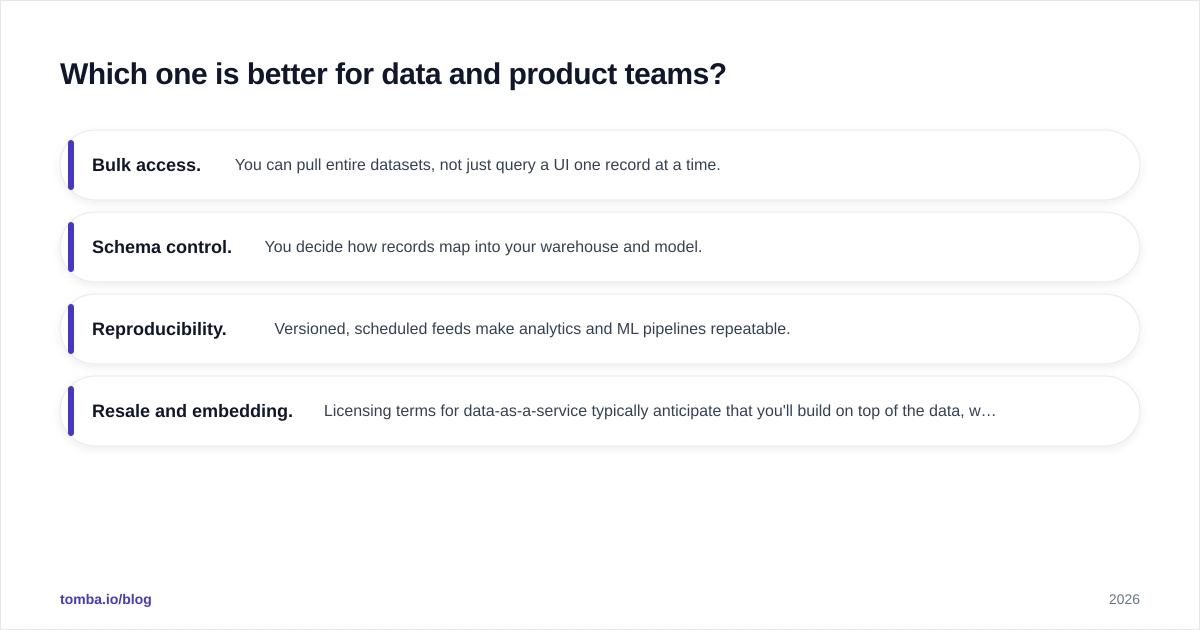
The reasons data teams choose Coresignal-style providers over packaged platforms:
- Bulk access. You can pull entire datasets, not just query a UI one record at a time.
- Schema control. You decide how records map into your warehouse and model.
- Reproducibility. Versioned, scheduled feeds make analytics and ML pipelines repeatable.
- Resale and embedding. Licensing terms for data-as-a-service typically anticipate that you'll build on top of the data, whereas seat-based GTM tools often don't.
The cost is engineering time. Someone has to own the pipeline, the matching, the dedup, and the monitoring. If you don't have that person, a packaged platform like Adaptio will get you to value faster even if you pay more per record.
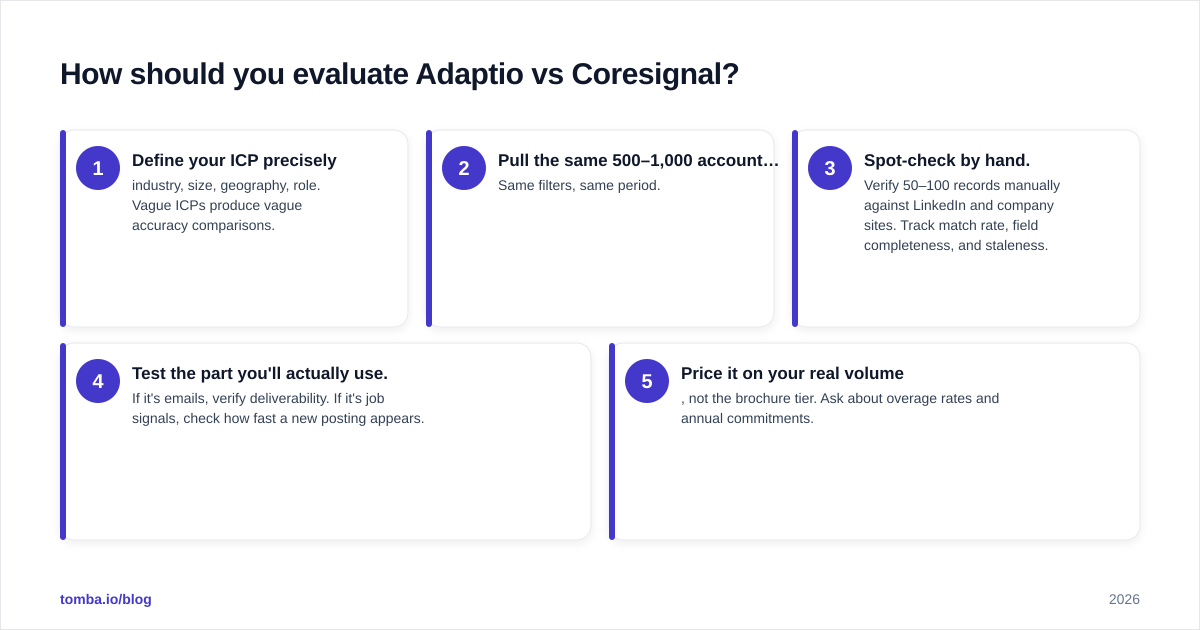
How should you evaluate Adaptio vs Coresignal?#
Run a structured trial instead of trusting marketing benchmarks. Vendor-published accuracy numbers are measured on the vendor's own favorable sample. Yours will differ.
A fair evaluation looks like this:
- Define your ICP precisely — industry, size, geography, role. Vague ICPs produce vague accuracy comparisons.
- Pull the same 500–1,000 accounts from each vendor. Same filters, same period.
- Spot-check by hand. Verify 50–100 records manually against LinkedIn and company sites. Track match rate, field completeness, and staleness.
- Test the part you'll actually use. If it's emails, verify deliverability. If it's job signals, check how fast a new posting appears.
- Price it on your real volume, not the brochure tier. Ask about overage rates and annual commitments.
Cross-reference vendor claims with independent review sites like G2 before you sign — pay attention to reviews from buyers who match your company size and use case, since enterprise and SMB experiences diverge sharply.
For teams whose evaluation is really just "can I get good emails into my sequencer," you can shortcut a lot of this. Tools like Tomba's bulk email finder let you upload a list and measure real-world hit rate in an afternoon, and the Tomba API plugs the same verification into your own pipeline if you'd rather build than buy.
What about pricing?#
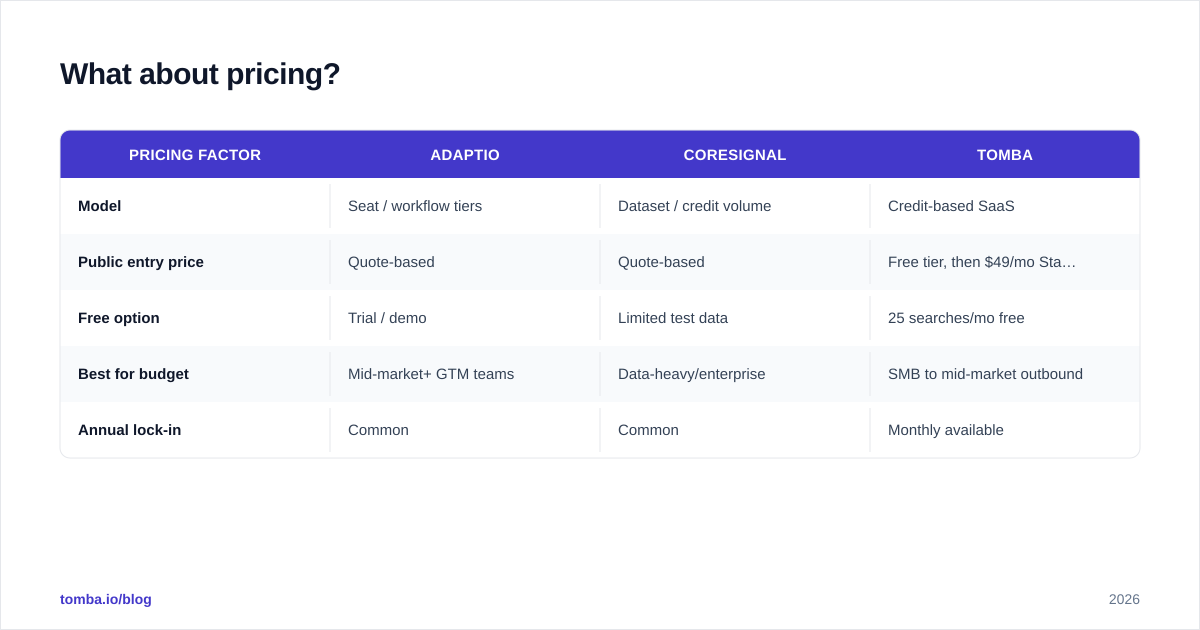
Neither vendor publishes a simple public price for enterprise data, which is normal in this category — both quote based on volume, datasets, and use case. That makes direct dollar comparison hard, so compare on structure instead.
| Pricing factor | Adaptio | Coresignal | Tomba |
|---|---|---|---|
| Model | Seat / workflow tiers | Dataset / credit volume | Credit-based SaaS |
| Public entry price | Quote-based | Quote-based | Free tier, then $49/mo Starter |
| Free option | Trial / demo | Limited test data | 25 searches/mo free |
| Best for budget | Mid-market+ GTM teams | Data-heavy/enterprise | SMB to mid-market outbound |
| Annual lock-in | Common | Common | Monthly available |
The strategic point: enterprise data platforms are priced for teams that will extract enterprise-scale value. If you're a 5-person sales team that needs a few thousand verified contacts a month, that pricing math rarely works. A transparent, credit-based tool — see Tomba pricing, which starts free and moves to $49/mo — covers that need without a procurement cycle.
When should you skip both?#
Skip the heavy platforms entirely if your job-to-be-done is narrow: you know who you want to reach, you just need their verified work email and maybe a phone number.
That's a contact-discovery problem, not a data-infrastructure problem. Layering a full GTM intelligence suite or a wholesale data feed on top of "find me the VP of Engineering's email" is overkill — you'll pay for breadth you never touch.
In that case, point a focused finder at a company domain, pull the people and patterns you need, verify them, and start sending. You can always graduate to Adaptio or Coresignal later when your data needs outgrow a single tool. Many teams run exactly this way for years and never feel the ceiling, especially when they pair an email finder with light data enrichment to fill in titles and company fields.
The bottom line#
Choose Coresignal if you're building on data — analytics, ML, a data product — and you want raw, structured, refreshable datasets with API and bulk access. You're buying ingredients and you have a cook.
Choose Adaptio if you're a revenue team that wants enriched, signal-ready records inside a workflow and you'd rather pay for convenience than maintain a pipeline. You're buying the meal kit.
Choose neither — yet if your actual need is verified contact emails to start outbound. Prove the channel with a lightweight finder first, then scale into a heavier data platform once volume and use cases justify the spend.
Most teams overbuy data tooling because the enterprise demo is impressive and the narrow tool feels "too simple." But the narrow tool is often the one that gets messages delivered this week. Start with the Tomba Email Finder — free for your first 25 searches, $49/mo when you scale — get accurate emails into your sequencer today, and let your data stack grow only when your pipeline actually demands it. Match the tool to the job, not to the size of the logo on the sales deck.
// get started
Find, verify and enrich your first contacts today
Start on the free plan with 25 searches a month, then scale when your team is ready.
Free plan · No credit card required · GDPR & CCPA
// about the author