Adaptio vs Finderio 2026: Email Finder Accuracy Compared
Choosing between Adaptio and Finderio? We break down accuracy, pricing, deliverability, and real-world fit so you can pick the email finder that actually lands in inboxes.
You have a prospecting list, a quota, and two tools on the shortlist: Adaptio and Finderio. Both promise verified B2B emails. Only one should get your budget. This breakdown cuts through the marketing copy so you can decide on accuracy, pricing, and deliverability — not on which homepage looks slicker.
TL;DR — Adaptio vs Finderio in 30 seconds#
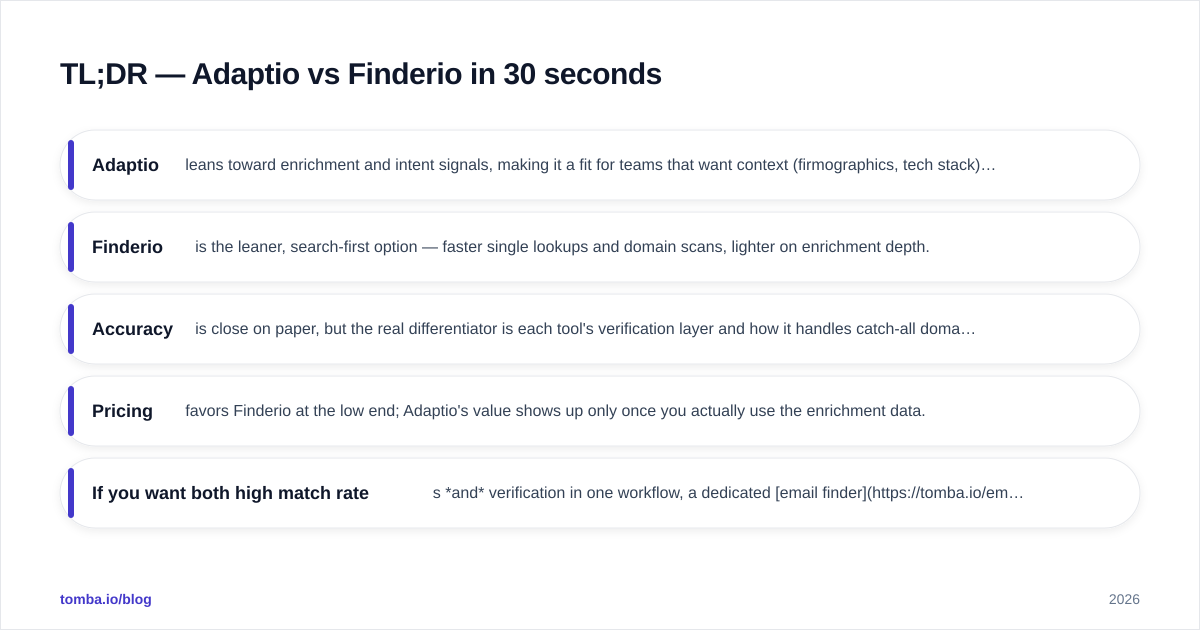
- Adaptio leans toward enrichment and intent signals, making it a fit for teams that want context (firmographics, tech stack) bundled with the email.
- Finderio is the leaner, search-first option — faster single lookups and domain scans, lighter on enrichment depth.
- Accuracy is close on paper, but the real differentiator is each tool's verification layer and how it handles catch-all domains.
- Pricing favors Finderio at the low end; Adaptio's value shows up only once you actually use the enrichment data.
- If you want both high match rates and verification in one workflow, a dedicated email finder like Tomba is worth pricing against both before you commit.
What are Adaptio and Finderio?#
Think of these two as different tools in the same drawer. Both find professional email addresses from a name and a company domain. The difference is what they wrap around that core job.
Adaptio positions itself as a data-and-intent platform. You don't just get an email — you get the surrounding context: company size, industry, technologies in use, and signals that a prospect might be in-market. That's useful if your sales motion depends on prioritization and segmentation, not just raw volume.
Finderio is built around speed and simplicity. Drop in a domain, get a list of contacts. Paste a name and company, get the most likely address with a confidence score. It's the kind of tool a solo SDR or a small agency reaches for when the job is "find the email, move on."
Neither is wrong. The question is which one matches your workflow — and whether either beats a purpose-built email verifier paired with a finder.

How do you actually compare an email finder?#
Most "X vs Y" posts compare feature checklists. That's the wrong altitude. A feature you never use is worth zero. Score these tools on the four things that move pipeline:
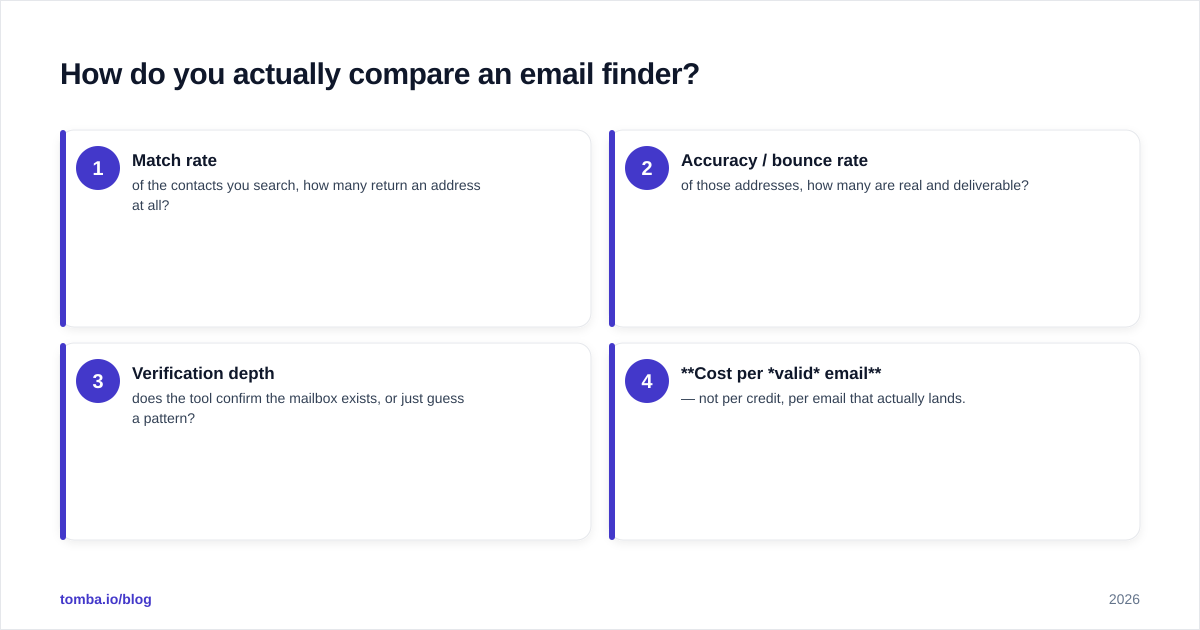
- Match rate — of the contacts you search, how many return an address at all?
- Accuracy / bounce rate — of those addresses, how many are real and deliverable?
- Verification depth — does the tool confirm the mailbox exists, or just guess a pattern?
- Cost per valid email — not per credit, per email that actually lands.
That last metric is the one that exposes weak tools. A finder that returns 90% of searches but only 60% of those are deliverable is more expensive than it looks, because you pay for the misses with bounced sends and a damaged sender reputation.
Run both tools against the same 200-row test list — ideally one where you already know the correct emails — and measure all four. Vendor-published accuracy numbers are marketing; your own bounce log is truth.
Adaptio vs Finderio: side-by-side comparison#
Here's how the two stack up across the attributes that matter for a buying decision. Treat the pricing as directional — both vendors revise tiers, so confirm on their current pages before you sign.
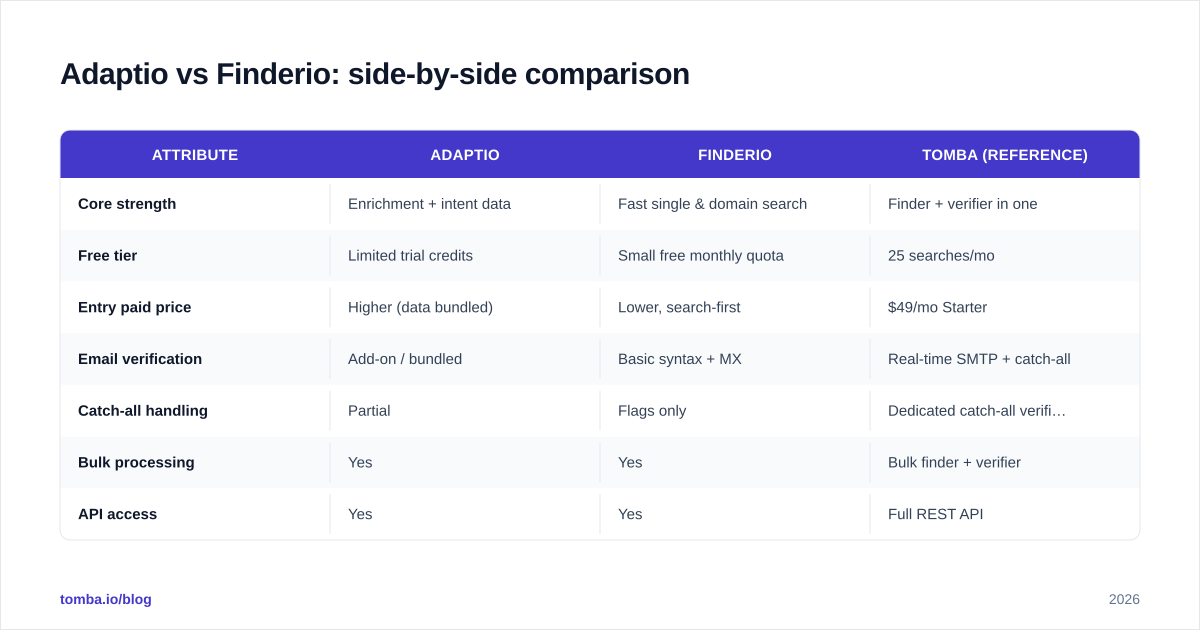
| Attribute | Adaptio | Finderio | Tomba (reference) |
|---|---|---|---|
| Core strength | Enrichment + intent data | Fast single & domain search | Finder + verifier in one |
| Free tier | Limited trial credits | Small free monthly quota | 25 searches/mo |
| Entry paid price | Higher (data bundled) | Lower, search-first | $49/mo Starter |
| Email verification | Add-on / bundled | Basic syntax + MX | Real-time SMTP + catch-all |
| Catch-all handling | Partial | Flags only | Dedicated catch-all verifier |
| Bulk processing | Yes | Yes | Bulk finder + verifier |
| API access | Yes | Yes | Full REST API |
| Best for | RevOps & segmentation | Solo SDRs, agencies | Teams needing accuracy + scale |
The pattern is clear: Adaptio charges more because it sells data around the email; Finderio is cheaper because it sells the email alone. Whether that trade is worth it depends entirely on whether your team uses enrichment fields or lets them rot in a CRM column.
Which tool is more accurate?#
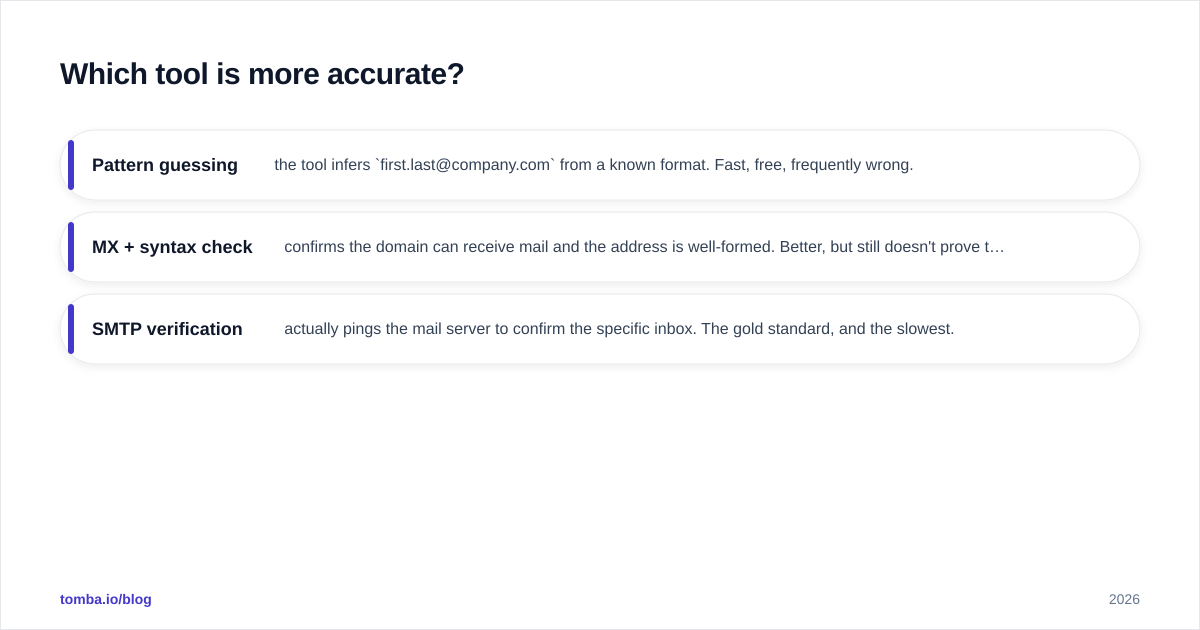
Accuracy comes down to verification, and verification is where most finders quietly cut corners. There are three levels:
- Pattern guessing — the tool infers
first.last@company.comfrom a known format. Fast, free, frequently wrong. - MX + syntax check — confirms the domain can receive mail and the address is well-formed. Better, but still doesn't prove the mailbox exists.
- SMTP verification — actually pings the mail server to confirm the specific inbox. The gold standard, and the slowest.
Finderio's verification is solid for syntax and domain-level checks but leans lighter on per-mailbox SMTP confirmation, which is why its confidence scores deserve a second pass before a big send. Adaptio bundles a verification step, but the catch-all problem trips it up — and catch-all domains are where most "verified" emails secretly bounce.
A catch-all domain accepts every address at the domain, real or not, so a naive verifier marks all of them "valid." You only learn the truth when the message bounces. This is exactly why a catch-all verifier exists as a separate discipline. If your target accounts skew enterprise (where catch-all is common), weight this factor heavily.

For more on where match rates actually come from, it's worth understanding where the underlying data is sourced — a finder is only as good as the corpus behind it. You can sanity-check any vendor's reputation against real user reviews on G2 and Capterra before trusting their own benchmark slides.
Which is better for pricing and value?#
Conclusion first: Finderio wins on sticker price, Adaptio wins on value-per-dollar only if you use the enrichment. If you're a two-person team firing cold emails, paying for intent data you'll never read is just a more expensive way to find emails.
The honest way to compare cost is per valid email, not per credit:
- If Finderio costs less per credit but returns more unverifiable catch-alls, your effective cost climbs once you filter for deliverability.
- If Adaptio costs more but its bundled verification trims your bounce rate, the premium can pay for itself in protected sender reputation.
This is also where it pays to look outside the two-horse race. Tomba pricing starts at $49/mo for the Starter plan (with a free tier of 25 searches a month), and bundles the finder and verifier together — so you're not paying twice to find an address and then confirm it's real. Run the per-valid-email math across all three and the cheapest sticker rarely wins.

What about deliverability and sender reputation?#
Finding the email is half the job. Sending to a bad one is actively harmful. Every hard bounce signals to mailbox providers that you don't manage your list — and that drags down email deliverability for every message you send afterward, including to good addresses.
So the deliverability question is really a verification question. Between Adaptio and Finderio:
- Adaptio protects you better if you enable its verification layer and accept the catch-all blind spot.
- Finderio puts more of the verification burden on you, which means budgeting for a second tool to scrub the list before send.
Either way, build a verification step into your workflow before the first email leaves the building. A clean list of 500 is worth more than a raw list of 2,000.
When should you pick a third option instead?#
You should look past both tools when your requirement is "find and verify at scale, without stitching two products together." That's a common need, and it's the gap a combined platform fills.
Consider an alternative when:
- You're regularly hitting catch-all domains and need real per-mailbox confirmation, not a flag.
- You want domain search to pull every contact at an account plus verification in the same pass.
- You need an email finder API to wire results straight into your own enrichment or outreach stack.
- Your bounce rate is creeping up and you can't tell whether it's the finder or the verifier failing.
This isn't a knock on Adaptio or Finderio — both are reasonable for the jobs they're built for. It's a reminder that "Adaptio vs Finderio" is a false binary if neither fully covers your accuracy-plus-scale requirement.
Adaptio vs Finderio: the verdict#
- Pick Adaptio if enrichment and intent data are core to how you prioritize accounts, and you'll genuinely use the firmographic fields. Pay the premium for the data, not the email.
- Pick Finderio if you want fast, cheap, search-first lookups and you're comfortable running your own verification pass before sending.
- Pick a combined finder-plus-verifier if accuracy on catch-all domains, cost-per-valid-email, and protecting your sender reputation are non-negotiable.
Whatever you choose, validate it with your own test list. The tool that wins on a vendor's slide deck often loses on your bounce log.
Try Tomba before you decide#
Before you lock in Adaptio or Finderio, run the same test list through the Tomba Email Finder. You get domain search, real-time SMTP verification, and dedicated catch-all checking in one workflow — so the address you find is the address that lands. Start free with 25 searches a month, then scale to the $49/mo Starter plan only once the match rates prove themselves on your own data. Find the email, confirm it's real, and protect your sender reputation in a single pass — that's the bar both Adaptio and Finderio are really competing against.
Ready to find emails that actually work?
Join 150,000+ professionals who stopped guessing and started sending. Free credits on signup — no credit card required.
Get the Tomba newsletter
Practical outbound tactics and product updates — once every two weeks.
About the author