Adaptio vs Generect 2026: LinkedIn Lead Tools Compared
Adaptio automates LinkedIn outreach with an AI agent; Generect ships fresh B2B lead data via API. Here's which one fits your 2026 pipeline — and where each falls short.
You're comparing Adaptio and Generect because both promise to fill your LinkedIn pipeline — but they solve different halves of the problem. One drives the conversation; the other supplies the contacts. Picking wrong means paying for automation you can't feed, or data you have no way to action.
TL;DR — Adaptio vs Generect at a glance#
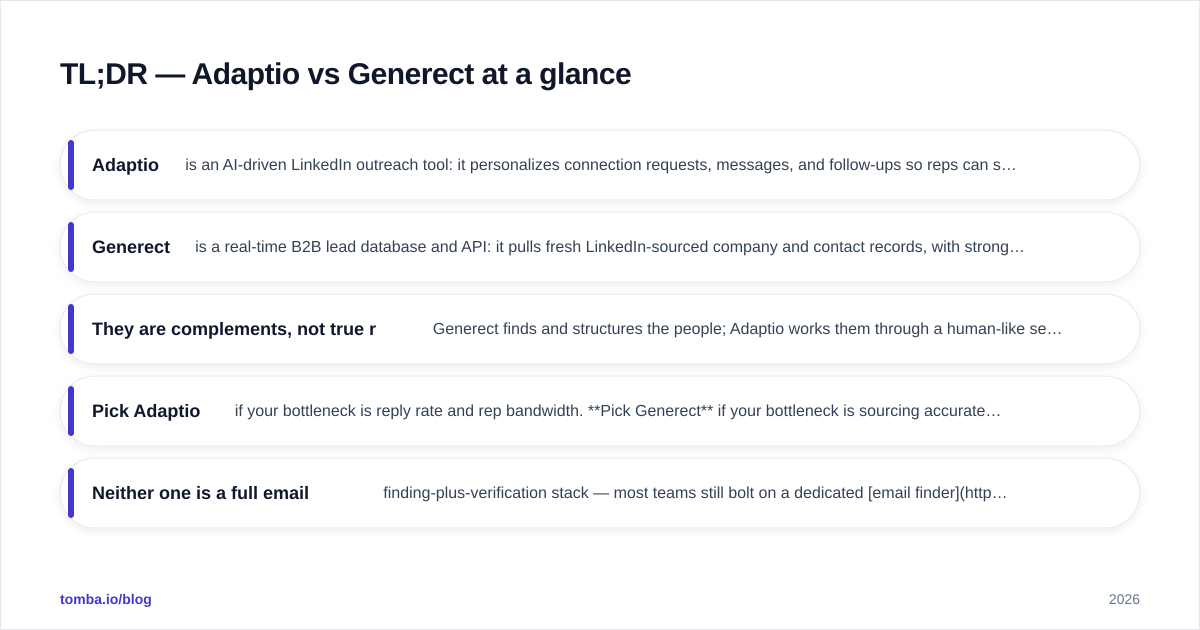
- Adaptio is an AI-driven LinkedIn outreach tool: it personalizes connection requests, messages, and follow-ups so reps can scale 1:1 conversations without sounding robotic.
- Generect is a real-time B2B lead database and API: it pulls fresh LinkedIn-sourced company and contact records, with strong filtering for ICP-matched lists.
- They are complements, not true rivals. Generect finds and structures the people; Adaptio works them through a human-like sequence.
- Pick Adaptio if your bottleneck is reply rate and rep bandwidth. Pick Generect if your bottleneck is sourcing accurate, current contact data at volume.
- Neither one is a full email-finding-plus-verification stack — most teams still bolt on a dedicated email finder and email verifier to keep bounce rates low.
What is Adaptio?#
Adaptio is a LinkedIn automation and AI-assistant layer built for sales reps and founders who run outbound through their personal profiles. Instead of treating LinkedIn as a spray channel, it leans on AI to draft context-aware messages — referencing a prospect's role, recent activity, or company — then schedules connection requests and multi-step follow-ups inside safe daily limits.
Think of Adaptio as a very disciplined SDR who never forgets a follow-up and never copy-pastes the same opener twice. The value is in the conversation layer: higher acceptance rates, replies that feel written by a person, and sequences that pause automatically when someone responds.
What Adaptio does not do well is act as a system of record for raw data. It assumes you already know who you want to reach. If you point it at a thin or stale list, the smartest AI copy in the world still lands in empty inboxes.
What is Generect?#
Generect is a B2B data platform and lead-generation API. Its core promise is freshness: rather than serving a static, months-old database, it queries LinkedIn-sourced records closer to real time, so the title, company, and headcount you see are more likely to be current. You filter by industry, geography, company size, seniority, and keywords, then export structured lists or call the API directly into your stack.
Generect is the sourcing engine. It answers "who are the 4,000 people who match my ICP, and how do I reach them?" — including emails and company firmographics. It is popular with teams who want to feed CRMs, enrichment pipelines, or outreach tools programmatically instead of scraping by hand.
Where Generect stops is engagement. It will hand you a clean, filtered list, but it won't write the message, manage the cadence, or warm up the relationship. That's deliberate — it's data infrastructure, not a sending tool.
Adaptio vs Generect: the core difference#
Here's the one-line conclusion: Adaptio is an action tool, Generect is a data tool. Most "which is better" debates dissolve once you see that they sit at opposite ends of the same workflow.

The cleanest way to reason about it is the classic outbound stack — source, enrich, verify, engage:
Generect owns "source." Adaptio owns "engage." The two stages in the middle — enrichment and verification — are where neither tool is a complete answer, and where a dedicated provider usually earns its keep. If you're running cold email alongside LinkedIn, getting LinkedIn finder coverage and clean email verification right is what keeps your domain out of spam folders.
How do Adaptio and Generect compare on features?#
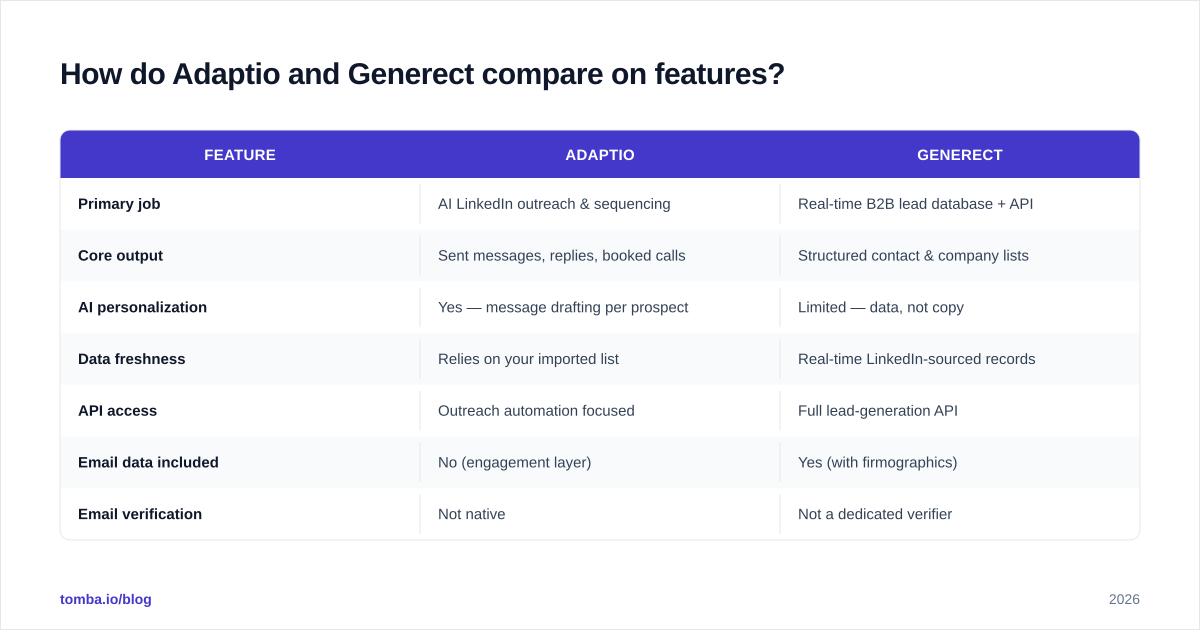
| Feature | Adaptio | Generect |
|---|---|---|
| Primary job | AI LinkedIn outreach & sequencing | Real-time B2B lead database + API |
| Core output | Sent messages, replies, booked calls | Structured contact & company lists |
| AI personalization | Yes — message drafting per prospect | Limited — data, not copy |
| Data freshness | Relies on your imported list | Real-time LinkedIn-sourced records |
| API access | Outreach automation focused | Full lead-generation API |
| Email data included | No (engagement layer) | Yes (with firmographics) |
| Email verification | Not native | Not a dedicated verifier |
| Best for | Reps scaling 1:1 conversations | RevOps feeding CRM/enrichment |
| Learning curve | Low — rep-friendly | Medium — API/list ops |
The table makes the split obvious. If you tried to run outbound with only Generect, you'd have great lists and no system to work them. With only Adaptio, you'd have a beautiful sending machine and nothing accurate to load into it.
Which one is better for cold email vs LinkedIn?#
It depends on your primary channel, and the honest answer is that most teams run both channels at once.
If LinkedIn is your main motion, Adaptio is the stronger single pick. Its entire design assumes you live in connection requests and DMs, and the AI copy genuinely lifts acceptance and reply rates. You'll still need a source for the right profiles, but you can start with manual targeting or a small Generect feed.
If cold email is your main motion, Generect is more useful out of the gate because it hands you actual email addresses and firmographics you can sequence. But — and this matters — Generect is not a verification engine. B2B email data decays fast, and sending to unverified addresses tanks your sender reputation. You'll want to run any list through dedicated verification before the first send.
This is the gap a lot of buyers miss. Neither Adaptio nor Generect is built to guarantee deliverable addresses, so teams serious about cold email pair them with a tool that does. Running exports through a real email verifier before they hit your sequence is the difference between a 2% bounce rate and a blocked domain.
Pricing: Adaptio vs Generect#
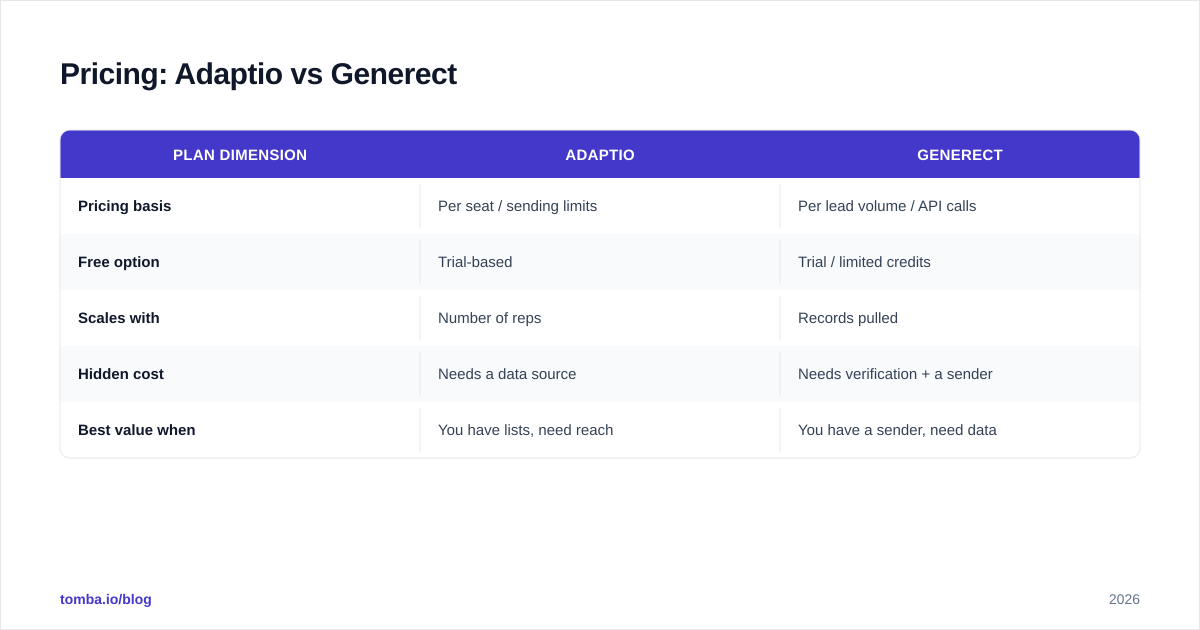
Both vendors gate detailed pricing behind sales or trials, and tiers shift over time, so confirm current numbers on their sites before committing. The structural difference is what you're paying for: Adaptio prices by seats and sending capacity, while Generect prices by data volume and API usage.
| Plan dimension | Adaptio | Generect |
|---|---|---|
| Pricing basis | Per seat / sending limits | Per lead volume / API calls |
| Free option | Trial-based | Trial / limited credits |
| Scales with | Number of reps | Records pulled |
| Hidden cost | Needs a data source | Needs verification + a sender |
| Best value when | You have lists, need reach | You have a sender, need data |
The "hidden cost" row is the one to internalize. Whichever you buy, you are buying half a pipeline. Budget for the other half — sourcing if you choose Adaptio, verification and sending if you choose Generect. Compare that total against an all-in-one data stack like Tomba pricing, where finding, verifying, and enriching live under one roof (Free at 25 searches/mo, Starter at $49/mo, Growth at $99/mo, Pro at $249/mo).
Data accuracy and compliance — what to watch#
Generect's main selling point is real-time freshness, and in practice it does tend to surface more current titles than static databases. But "real-time LinkedIn-sourced" data carries the usual caveats: scraping-adjacent collection can break, coverage varies by region, and email fields still need independent verification because a correct person doesn't guarantee a deliverable address.
Adaptio's risk profile is different — it's about platform safety. Automating actions on LinkedIn always carries account-restriction risk, which is why Adaptio emphasizes human-like limits and randomized timing. Push the volume too hard and no amount of AI copy saves a flagged profile.
For either tool, do your own diligence on data sourcing and GDPR/CCPA posture. Reading vendor data sources documentation and checking independent reviews on G2 and Capterra tells you more than any landing page. And remember that LinkedIn's own terms govern what automation is permitted on the platform — that's the constraint that ultimately bounds any tool in this category.
Who should choose which?#
Choose Adaptio if:
- LinkedIn is your dominant outbound channel.
- Your bottleneck is reply rate and rep time, not finding people.
- You want AI to handle personalization at scale without sounding canned.
- You already have a way to source target profiles.
Choose Generect if:
- You need accurate, current B2B contact data at volume.
- You feed a CRM, enrichment pipeline, or outreach tool via API.
- Cold email is part of your motion and you want emails plus firmographics.
- You have (or will add) verification and a sending tool downstream.
Choose both if: you're building a serious multi-channel outbound engine — Generect sources and structures, Adaptio engages on LinkedIn, and a verification/enrichment layer sits between them. For the email side of that motion, layering in data enrichment closes the gaps neither tool fills natively.
The honest verdict#
Stop framing this as a duel. Adaptio and Generect win at different jobs, and the teams that get the most from either are the ones who acknowledge the missing piece instead of pretending one tool does everything.
If forced to pick a single starting point: early-stage founders running founder-led LinkedIn sales should start with Adaptio, because conversations are the constraint. Data-hungry outbound teams feeding a CRM should start with Generect, because accurate sourcing is theirs. Both should plan for verification before any email leaves the building.
Close the data-and-deliverability gap with Tomba#
Whichever side of the Adaptio-vs-Generect line you land on, you'll hit the same two gaps: finding reliable email addresses and proving they're deliverable. That's exactly what the Tomba Email Finder is built for — find verified professional emails by domain, name, or company, run them through built-in verification, and enrich the record before it ever reaches your sequence. Start free with 25 searches a month, then scale on the Starter plan at $49/mo once your pipeline proves out. Pair it with your automation or data tool of choice and you've got the complete source → verify → engage loop instead of just one slice of it.
Ready to find emails that actually work?
Join 150,000+ professionals who stopped guessing and started sending. Free credits on signup — no credit card required.
Get the Tomba newsletter
Practical outbound tactics and product updates — once every two weeks.
About the author