Adaptio vs Getemailio: Which Email Finder Wins in 2026?
A neutral, hands-on breakdown of Adaptio vs Getemailio in 2026 — accuracy, pricing, verification, and which email finder actually fits your outbound stack.
TL;DR
- Adaptio leans into AI-assisted prospecting and signal-based targeting, while Getemailio is built around fast, lightweight email lookups — they solve overlapping problems from different angles.
- Neither tool wins on every axis. Adaptio is stronger for workflow automation; Getemailio is cheaper for simple, one-off email discovery.
- The deciding factor for most teams is verified deliverability, not raw match rate — a tool that returns 1,000 emails at 60% validity costs you more than one returning 700 at 95%.
- If your priority is accuracy plus a full verification stack (catch-all detection, SMTP checks, bulk processing), a dedicated finder like Tomba is worth benchmarking against both.
- Use the framework below to score each tool against your actual ICP, sending volume, and budget before committing to an annual plan.
What are Adaptio and Getemailio?#
Adaptio and Getemailio are both B2B contact-data tools, but they target different jobs.
Adaptio positions itself as an AI-driven prospecting layer: you describe an ideal customer, and it surfaces matching companies and contacts, often enriched with intent or activity signals. The pitch is less "look up one email" and more "build and prioritize a list automatically."
Getemailio is closer to a classic email finder. You give it a name and a company (or a domain), and it returns the most likely professional email address, usually with a confidence score. It's lightweight, fast, and priced for individual reps and small teams who just need addresses.
Think of it like the difference between a personal shopper and a vending machine. Adaptio tries to assemble the whole basket for you based on what it thinks you want; Getemailio gives you exactly the one item you punched in. Both are useful — but only if you know which job you're hiring them for.
If you're new to this category, our B2B glossary breaks down terms like enrichment, catch-all, and sender reputation that show up throughout this comparison.
How does the Adaptio vs Getemailio core workflow differ?#
The workflow gap is the first thing you'll feel in daily use.
With Adaptio, the typical flow is top-down:
- Define an ICP (industry, headcount, role, region, sometimes signals).
- Let the platform generate a target list.
- Enrich and export contacts into your sequencer or CRM.
With Getemailio, the flow is bottom-up:
- You already have a name and company (from LinkedIn, a webinar list, an event).
- You query the finder for that person's email.
- You drop the result into your outreach tool.
This matters because it changes who the tool is for. Adaptio rewards teams that don't yet have a list and want the software to build one. Getemailio rewards teams that already know who they want and just need contact details fast.
A common mistake is buying the heavier platform when you only need the vending machine — you pay for list-building you never use. The reverse also happens: teams outgrow a single-lookup tool and bolt on three more subscriptions to cover enrichment and verification.
Is Adaptio better than Getemailio for accuracy?#
Accuracy is where most email-finder comparisons live or die, so be precise about what "accuracy" means.
There are two numbers that matter, and tools love to blur them:
- Match rate — of the contacts you searched, how many returned any email.
- Validity rate — of the emails returned, how many actually deliver to a real inbox.
A high match rate with low validity is a trap. You feel productive, your list looks full, and then your bounce rate spikes and your sending domain reputation suffers. The industry generally treats anything above a 3–5% hard-bounce rate as a deliverability risk, and mailbox providers can throttle or filter you well before that.

Adaptio's signal-based approach tends to produce broad lists, which is great for coverage but means you should verify aggressively before sending. Getemailio's confidence score is helpful, but a score is a prediction, not a verification — it doesn't replace an SMTP check.
The practical takeaway: whichever tool you pick, run every address through an email verifier before it touches a sequencer. For domains that accept everything, a dedicated catch-all verifier is the only reliable way to avoid silent bounces. You can also see how providers source and validate records on Tomba's data sources page if you want to understand what's actually behind a match.

Adaptio vs Getemailio: feature and pricing comparison#
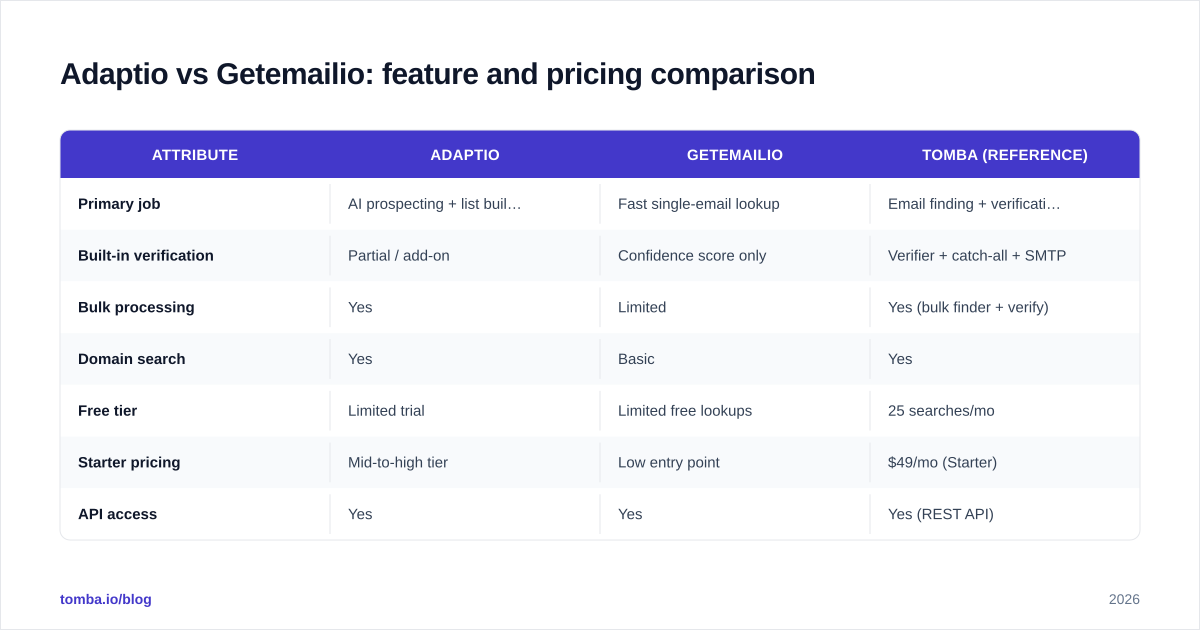
Here's a side-by-side at a glance. Treat vendor-published numbers as starting points and confirm against a live trial with your own list — match rates vary wildly by industry and region.
| Attribute | Adaptio | Getemailio | Tomba (reference) |
|---|---|---|---|
| Primary job | AI prospecting + list building | Fast single-email lookup | Email finding + verification |
| Built-in verification | Partial / add-on | Confidence score only | Verifier + catch-all + SMTP |
| Bulk processing | Yes | Limited | Yes (bulk finder + verify) |
| Domain search | Yes | Basic | Yes |
| Free tier | Limited trial | Limited free lookups | 25 searches/mo |
| Starter pricing | Mid-to-high tier | Low entry point | $49/mo (Starter) |
| API access | Yes | Yes | Yes (REST API) |
| Best for | Teams without a list | Reps with a known target | Accuracy-first outbound |
A few honest caveats:
- Pricing tiers shift. Always check the live pricing pages before budgeting. For reference, Tomba's plans run Free (25 searches), Starter $49/mo, Growth $99/mo, Pro $249/mo, and Enterprise custom — see full Tomba pricing.
- "API access" is not equal. Rate limits, credit costs per call, and verification depth differ a lot between vendors. If you're building automation, read the email finder API docs of each tool, not just the marketing page.
- Bulk matters at scale. If you process thousands of contacts a week, a bulk email finder with native dedup and verification will save more hours than a marginally cheaper per-lookup price.
You can cross-check real user sentiment on independent review sites like G2 and Capterra before trusting any single vendor's claims.
Which tool fits your use case?#
Tools don't have a universal winner; jobs do. Match the tool to your situation.
Choose Adaptio if:
- You don't have a target list yet and want software to build one from an ICP.
- Intent or activity signals are part of your prioritization.
- Your team values an integrated prospecting workflow over the lowest per-email cost.
Choose Getemailio if:
- You already source names manually (LinkedIn, events, referrals) and just need addresses.
- You're an individual rep or a small team with a tight budget.
- Your volume is low enough that a lightweight tool covers you.
Look at a dedicated finder + verifier stack if:
- Deliverability is the top priority and bounces directly cost you reputation.
- You need catch-all handling, SMTP verification, and bulk processing in one place.
- You want a single domain search to map every contact at an account, then verify in the same flow.
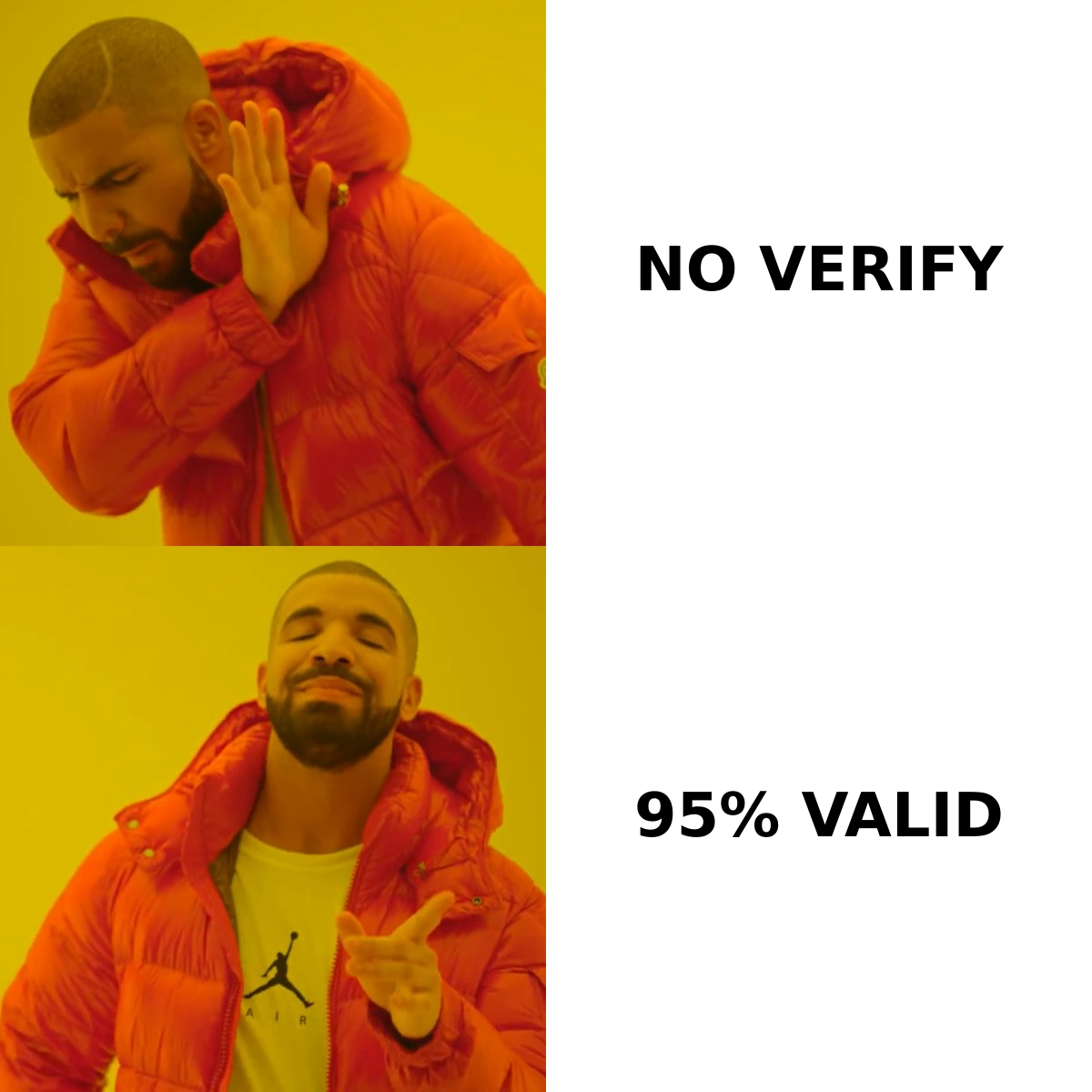
Here's the decision in meme form — the difference between sending unverified guesses and sending verified addresses:
What do Adaptio and Getemailio miss?#
Both tools have real gaps worth naming, because the cost of those gaps shows up in your metrics, not theirs.
Verification depth. A confidence score is a guess based on patterns. It doesn't ping the mail server. For high-stakes outreach, you need true email verification with SMTP-level checks and catch-all detection. Skipping this is the single most common reason cold campaigns quietly underperform — your sender reputation erodes before you notice.
Catch-all domains. Many enterprise domains accept every address at the SMTP layer, so a "valid" result can still bounce or route to a black hole. Without explicit catch-all handling, you're flying blind on exactly the large accounts you most want to reach.
Data freshness. Job changes are constant. An email that was perfect three months ago may now bounce. Enrichment tools that re-verify on a schedule beat static databases here, which is why ongoing data enrichment matters more than a one-time import.
Compliance and provenance. Where does the data come from? Reputable providers document their sourcing. If a vendor can't explain it clearly, that's a risk — especially under GDPR and CCPA. (For the underlying mechanics of how email delivery and verification actually work, the Wikipedia entry on SMTP is a solid neutral primer.)
None of this means Adaptio or Getemailio are bad tools. It means you should know what they don't do, so you can fill the gap rather than discover it in a bounce report.
How should you actually decide?#
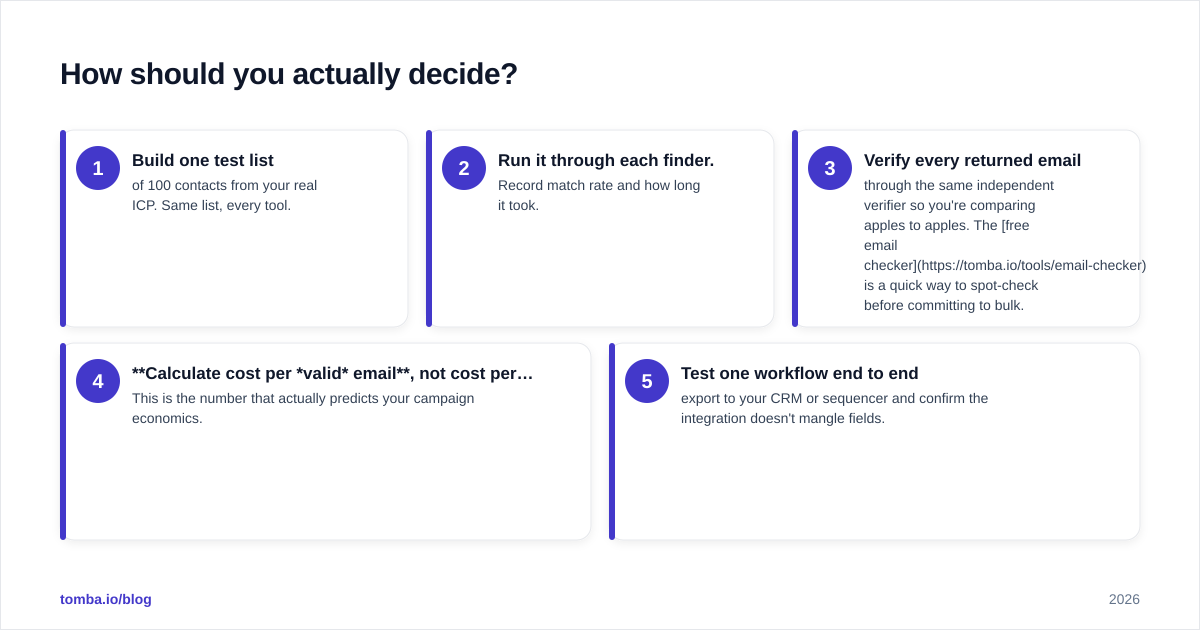
Run a 30-minute bake-off instead of trusting any comparison post — including this one.
- Build one test list of 100 contacts from your real ICP. Same list, every tool.
- Run it through each finder. Record match rate and how long it took.
- Verify every returned email through the same independent verifier so you're comparing apples to apples. The free email checker is a quick way to spot-check before committing to bulk.
- Calculate cost per valid email, not cost per lookup. This is the number that actually predicts your campaign economics.
- Test one workflow end to end — export to your CRM or sequencer and confirm the integration doesn't mangle fields.
Whichever tool wins your bake-off, the lesson holds: validity beats volume. A smaller list of verified addresses will out-deliver a bigger list of guesses every single time, and your domain reputation will thank you.
Frequently asked questions#
Is Getemailio cheaper than Adaptio? Generally yes at the entry level — Getemailio is built for low-cost single lookups, while Adaptio prices for a broader prospecting platform. But compare on cost per verified email, not sticker price, because unverified addresses cost you in bounces and reputation.
Do I still need a separate verifier? Almost always. Confidence scores predict; they don't verify. Running results through a dedicated email verifier and catch-all verifier is the cheapest insurance against deliverability damage.
Can I use these tools with my CRM? Both offer integrations and API access, but depth varies. Confirm native support for your CRM (HubSpot, Salesforce, Pipedrive) and check rate limits before committing.
Which is better for high-volume outbound? For thousands of contacts a week, prioritize bulk processing plus built-in verification in one flow. A standalone lightweight finder forces you to stitch multiple tools together, which adds cost and failure points.
The bottom line#
Adaptio and Getemailio are solving different problems: Adaptio builds lists for teams that don't have one, Getemailio retrieves emails for teams that do. Pick based on the job in front of you — and in both cases, verify before you send.
If accuracy and verified deliverability sit at the top of your list, benchmark both against a finder built around validity first. Start free with the Tomba Email Finder — find professional emails by name, domain, or company, then verify them in the same workflow so what lands in your sequencer actually reaches a human. Run the 100-contact bake-off above, compare cost per valid email, and let the numbers decide.
Ready to find emails that actually work?
Join 150,000+ professionals who stopped guessing and started sending. Free credits on signup — no credit card required.
Get the Tomba newsletter
Practical outbound tactics and product updates — once every two weeks.
About the author