Adaptio vs LeadFuze 2026: Which Lead Gen Tool Wins?
Adaptio vs LeadFuze compared on data freshness, ICP targeting, pricing, and workflow fit. See which lead generation platform earns your 2026 budget — and where a dedicated email finder beats both.
Choosing between Adaptio and LeadFuze comes down to one question: do you want an AI-driven prospecting layer that scores accounts by fit, or a list-building engine that hands you finished contact lists on a schedule? This guide breaks down both on data, targeting, pricing, and workflow so you can pick without a two-week trial spiral.
TL;DR — Adaptio vs LeadFuze in 30 seconds#
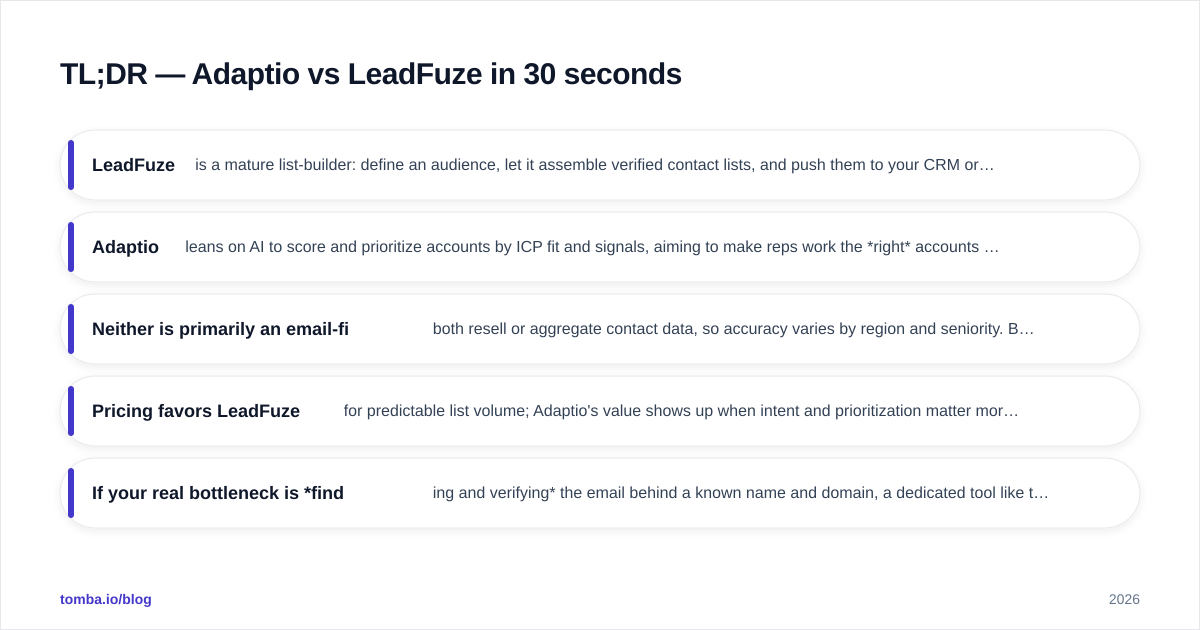
- LeadFuze is a mature list-builder: define an audience, let it assemble verified contact lists, and push them to your CRM or sequencer on autopilot. Best for teams that want volume and hands-off list delivery.
- Adaptio leans on AI to score and prioritize accounts by ICP fit and signals, aiming to make reps work the right accounts rather than the most. Best for signal-led, account-based motions.
- Neither is primarily an email-finder — both resell or aggregate contact data, so accuracy varies by region and seniority. Budget for verification regardless of which you choose.
- Pricing favors LeadFuze for predictable list volume; Adaptio's value shows up when intent and prioritization matter more than raw record counts.
- If your real bottleneck is finding and verifying the email behind a known name and domain, a dedicated tool like the Tomba Email Finder will beat the data layer of either platform.
What is Adaptio?#
Adaptio positions itself as an AI prospecting and prioritization layer. Instead of dumping a giant list on your desk, it tries to answer "which accounts should this rep touch today and why." It ingests your ideal customer profile, layers on firmographic and behavioral signals, and ranks accounts so sales effort concentrates where conversion odds are highest.
That makes Adaptio a fit for account-based and signal-led teams — the kind that already have inbound or intent data and need help deciding sequence and timing. The trade-off is that an AI-scoring layer is only as good as the signals feeding it. Thin CRM history or sparse intent data and the model has little to work with, so smaller teams early in their motion may not see the lift larger orgs do.
Think of Adaptio like a triage nurse in an ER. It doesn't generate more patients (leads); it decides who gets seen first based on symptoms (signals). Hugely valuable when you're overwhelmed — less so when the waiting room is empty.
What is LeadFuze?#
LeadFuze is a list-building and lead-generation platform built around a feature it calls Fuzebot. You define an audience — role, industry, company size, technology used, hiring signals — and Fuzebot continuously assembles fresh lists of matching contacts, deduplicates against what you already have, and pushes them into your outreach tools.
The pitch is automation of the tedious part of outbound: you stop manually searching and start receiving. LeadFuze aggregates contact and company data, including emails and some direct-dial numbers, and integrates with the usual sequencers and CRMs. It's a volume play — good when your motion is "more qualified conversations at the top of funnel" rather than "surgical account selection."
The catch with any aggregator is data freshness and verification. Aggregated B2B records decay fast — people change jobs constantly — so the email and phone fields you receive should still pass through a verification step before you hit send. We'll come back to that.
Adaptio vs LeadFuze: How do they compare head-to-head?#
Here's the side-by-side on the attributes that actually change a buying decision.
| Attribute | Adaptio | LeadFuze |
|---|---|---|
| Core job | AI account scoring & prioritization | Automated list building |
| Best motion | Account-based / signal-led | Volume outbound / SMB & mid-market |
| Data delivery | Ranked accounts + contacts | Scheduled finished lists (Fuzebot) |
| Email data | Aggregated, fit-scored | Aggregated, deduplicated |
| Phone numbers | Limited / varies | Some direct dials included |
| Intent signals | Central to the product | Hiring/tech signals as filters |
| CRM / sequencer push | Yes | Yes (native +Zapier) |
| Learning curve | Moderate (model tuning) | Low (set audience, receive) |
| Ideal team size | Mid-market to enterprise | SMB to mid-market |
| Verification built in | Partial | Partial |
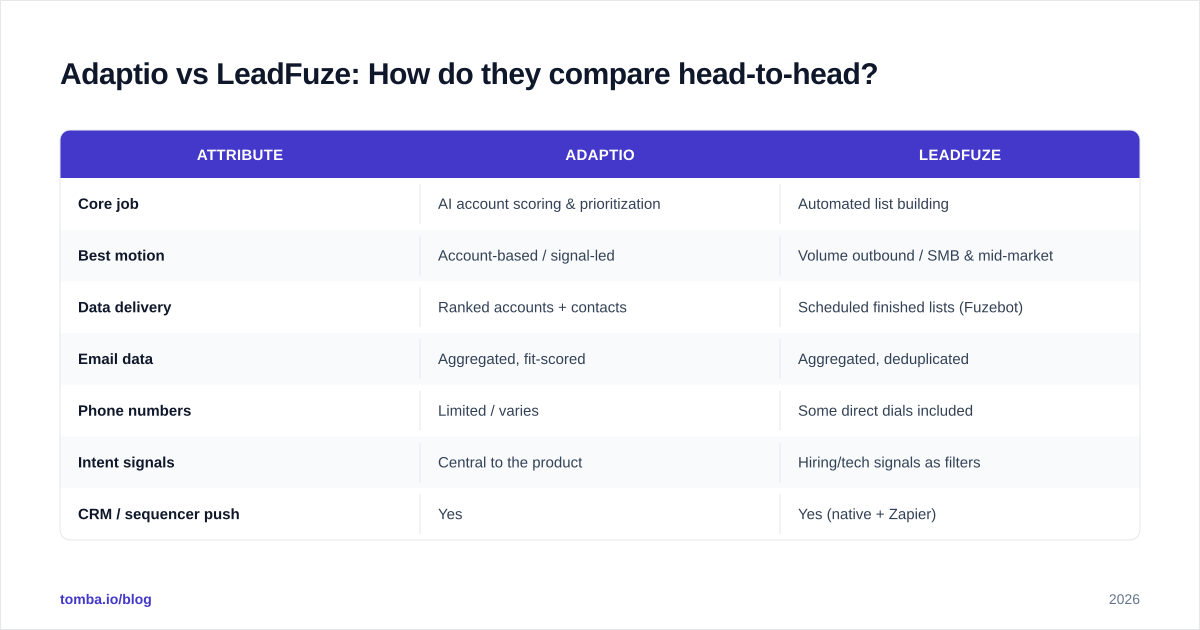
The honest summary: these tools optimize different stages. LeadFuze attacks "I don't have enough qualified contacts." Adaptio attacks "I have too many and don't know where to start." Buying one to solve the other's problem leads to the disappointment that fills G2 review sections.

Which one has better data accuracy?#
Neither vendor should be treated as a source of truth for email accuracy — and that isn't a knock, it's how the aggregator model works. Both Adaptio and LeadFuze compile data from multiple upstream providers and public sources, then apply their own cleaning. The result is "good enough to start," not "verified at send time."
Independent data on B2B contact decay is consistent: a meaningful share of records go stale every year as people switch roles. Industry analyses referenced by vendors like HubSpot put B2B database decay around 22–30% annually. That means a list pulled in January is materially worse by Q3 — regardless of which platform produced it.
So the practical question isn't "which has better data" but "what's my verification step." A clean two-stage workflow looks like this:
- Use Adaptio or LeadFuze to source and prioritize — get the right accounts and the candidate contacts.
- Run those addresses through a dedicated email verifier before they enter a sequence, and handle risky catch-all domains with a catch-all verifier.
That second step is where bounce rates and sender reputation are won or lost. Skip it and even a premium list will torch your deliverability.
How do Adaptio and LeadFuze price?#
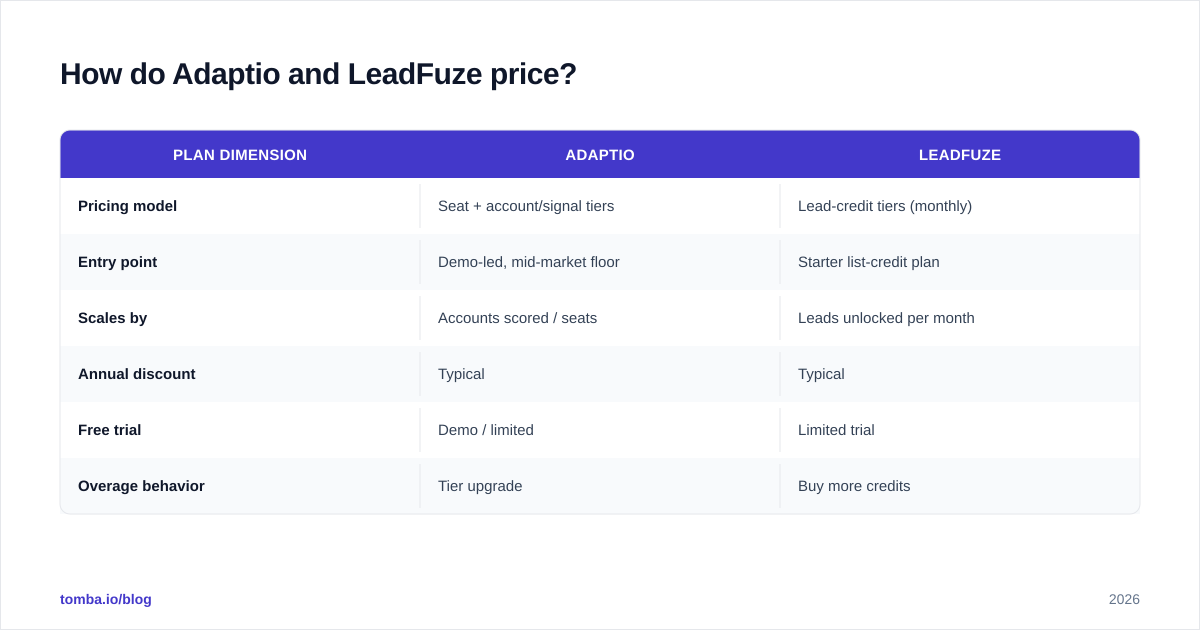
Both vendors gate detailed pricing behind sales conversations more than self-serve tools do, and both meter on records or contacts unlocked. The pattern below reflects how each is typically packaged — confirm current numbers directly, since lead-gen pricing shifts often.
| Plan dimension | Adaptio | LeadFuze |
|---|---|---|
| Pricing model | Seat + account/signal tiers | Lead-credit tiers (monthly) |
| Entry point | Demo-led, mid-market floor | Starter list-credit plan |
| Scales by | Accounts scored / seats | Leads unlocked per month |
| Annual discount | Typical | Typical |
| Free trial | Demo / limited | Limited trial |
| Overage behavior | Tier upgrade | Buy more credits |
The budgeting reality: LeadFuze costs scale with how many contacts you consume, so a high-volume SDR team can run up the bill fast. Adaptio's cost is more about seats and the value of prioritization — cheaper at low volume, justified at scale only if the scoring genuinely reallocates rep time toward closed-won.
If you're cost-comparing against a pure data layer, note that a focused tool like Tomba starts far lower — the Tomba pricing ladder runs Free (25 searches/mo), Starter at $49/mo, Growth at $99/mo, and Pro at $249/mo — because it does one job (find and verify the email) rather than bundling scoring or list automation you may not use.
When should you pick Adaptio?#
Pick Adaptio when prioritization is your bottleneck, not sourcing. Specifically:
- You already have a steady inflow of accounts (inbound, events, an existing TAM list) and reps waste time deciding who to work.
- You run an account-based motion where timing and signals matter more than raw count.
- You have enough first-party and intent data to feed an AI model — sparse data starves the scoring.
- You're mid-market or enterprise with the seat budget to justify a prioritization layer.
Adaptio is a poor fit if you're a two-person team that simply needs more contacts. You'd be paying for triage when what you need is patients in the waiting room.
When should you pick LeadFuze?#
Pick LeadFuze when you need volume and hate manual list building:
- Your outbound engine is hungry and the constraint is "not enough qualified contacts in the sequence."
- You want set-and-forget list delivery — define the audience once, let Fuzebot top up the pipeline.
- You're SMB or mid-market and value low setup friction over deep customization.
- You rely on filters like hiring signals or installed technology to define fit.
LeadFuze is a poor fit if you already drown in leads and your real problem is conversion. More volume into a leaky funnel just makes the leak louder. For a deeper look at structuring the top of funnel, our lead generation resources cover sourcing strategy beyond any single tool.

Is there a third option that beats both on email data?#
Yes — and it's not really "either/or." The most reliable outbound stacks in 2026 separate three jobs that Adaptio and LeadFuze try to bundle:
- Targeting — deciding which accounts and people to pursue (Adaptio's strength, or your CRM + intent tooling).
- Sourcing the contact — finding the actual person at the account (LeadFuze's strength, or manual research).
- Resolving and verifying the email — turning "name + company" into a deliverable, verified address.
That third job is where dedicated email-finding tools consistently outperform bundled aggregators, because it's the only thing they optimize. With the Tomba Email Finder you go from a known name and domain to a verified email with a confidence score, and you can scale it through domain search for whole companies or the Tomba API inside your own pipeline.
A common, pragmatic setup looks like this:
| Job | Tool that owns it |
|---|---|
| Account selection / scoring | Adaptio (or CRM + intent data) |
| Bulk contact discovery | LeadFuze |
| Email find + verify at send time | Tomba Email Finder + Verifier |
| Sequencing & deliverability | Your sender platform |
You don't always need all four vendors. But you should never let the targeting tool also be your final authority on email validity — that's how teams end up with a 12% bounce rate and a burned domain.
What about deliverability and bounce risk?#
Whichever platform sources your list, deliverability is downstream of verification. High bounce rates signal mailbox providers that you're sending to bad addresses, which drags down sender reputation and lands future mail in spam — even mail to valid recipients.
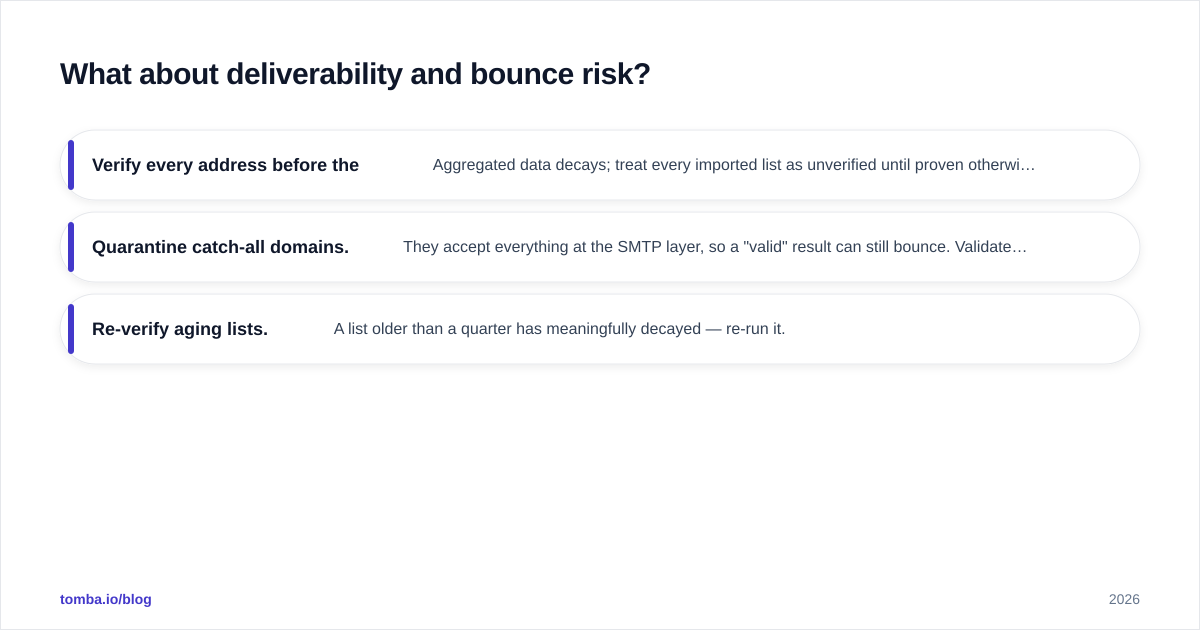
Keep three habits regardless of Adaptio vs LeadFuze:
- Verify every address before the first send. Aggregated data decays; treat every imported list as unverified until proven otherwise.
- Quarantine catch-all domains. They accept everything at the SMTP layer, so a "valid" result can still bounce. Validate them separately.
- Re-verify aging lists. A list older than a quarter has meaningfully decayed — re-run it.
You can sanity-check vendor accuracy claims against third-party reviews on G2 rather than taking marketing numbers at face value. Reviews won't give you a precise hit rate, but they'll tell you where each tool's data is weak by region and seniority.
Adaptio vs LeadFuze: final verdict#
Choose by your actual bottleneck, not by feature-list length:
- Pick LeadFuze if you need more qualified contacts with minimal manual effort and your funnel can absorb volume. It's the stronger pure list-builder.
- Pick Adaptio if you already have leads and need AI to point reps at the highest-fit accounts first. It's the stronger prioritization layer.
- Add a dedicated email finder/verifier in either case, because neither tool's primary job is guaranteeing a deliverable address — and deliverability is what ultimately determines whether any of this generates pipeline.
Get verified emails into your sequences today#
Whether you land on Adaptio, LeadFuze, or a manual research workflow, the email address is where outbound succeeds or fails. The Tomba Email Finder turns a name and company domain into a verified, confidence-scored email — and pairs with the email verifier and bulk email finder so your lists are clean before they ever hit a sequence. Start free with 25 searches a month, then scale on the Tomba pricing plan that matches your volume. Stop guessing at deliverability and send to addresses you can trust.
Ready to find emails that actually work?
Join 150,000+ professionals who stopped guessing and started sending. Free credits on signup — no credit card required.
Get the Tomba newsletter
Practical outbound tactics and product updates — once every two weeks.
About the author