Adaptio vs LeadGenius 2026: B2B Data Platform Comparison
Adaptio leans on AI-driven GTM signals; LeadGenius on human-verified managed data. Here's how the two B2B data platforms actually compare in 2026 — and where a leaner stack wins.
You are comparing two B2B data platforms that sit on opposite ends of the same spectrum. Adaptio sells AI-driven go-to-market signals and account intelligence. LeadGenius sells human-verified, managed data delivered as a service. Both promise cleaner pipeline — they just get there very differently.
This guide breaks down how Adaptio vs LeadGenius stack up on data sourcing, accuracy, coverage, workflow fit, and cost model, so you can decide which one (if either) belongs in your stack in 2026.
TL;DR#
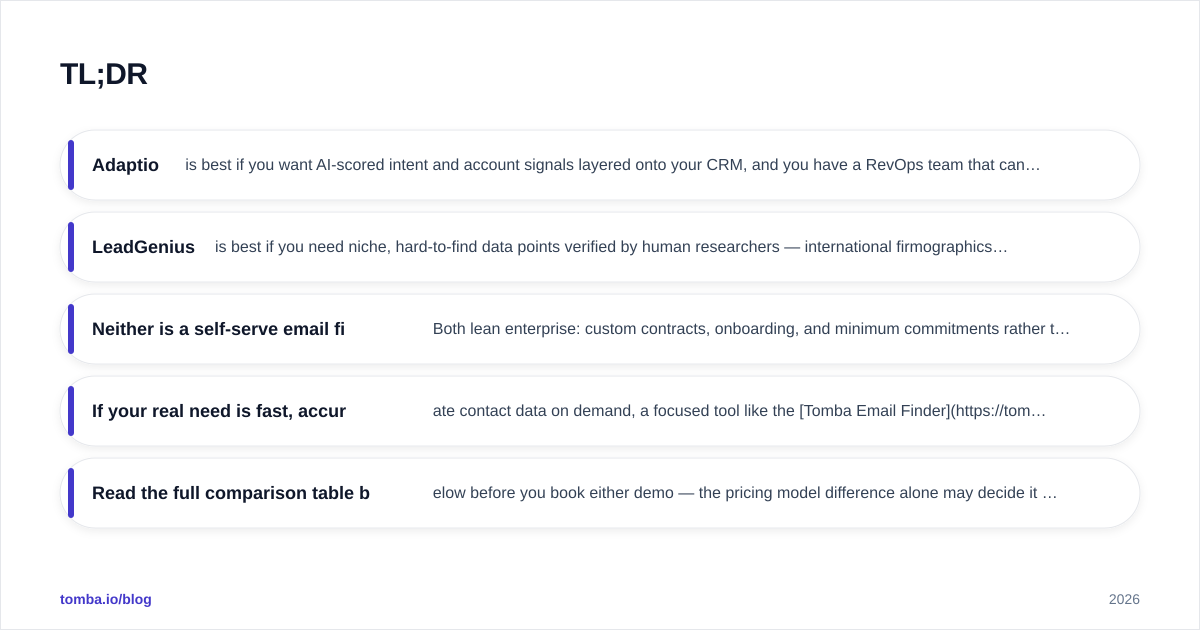
- Adaptio is best if you want AI-scored intent and account signals layered onto your CRM, and you have a RevOps team that can act on them quickly.
- LeadGenius is best if you need niche, hard-to-find data points verified by human researchers — international firmographics, custom fields, or long-tail accounts machines miss.
- Neither is a self-serve email finder. Both lean enterprise: custom contracts, onboarding, and minimum commitments rather than a credit card and a free tier.
- If your real need is fast, accurate contact data on demand, a focused tool like the Tomba Email Finder covers most of the job at a fraction of the cost.
- Read the full comparison table below before you book either demo — the pricing model difference alone may decide it for you.
What is Adaptio?#
Adaptio positions itself as an AI go-to-market platform. The core idea: ingest first-party and third-party signals — website visits, hiring trends, technographics, funding events — score them, and surface the accounts most likely to buy right now. It's built for teams that already run an account-based motion and want a model deciding who to call this week instead of a static list.
In practice that means Adaptio competes less with a raw data vendor and more with intent and ABM platforms. The value is in the scoring and prioritization layer, not just the underlying records. If you've evaluated tools like 6sense or Demandbase, Adaptio lives in that neighborhood — and many teams shortlist it next to a 6sense alternative when budget is tight.
The trade-off: AI scoring is only as good as the signals feeding it. If your ICP is narrow, international, or off the beaten path, the model has less to work with — and that's exactly where the other side of this comparison shines.
What is LeadGenius?#
LeadGenius is a managed B2B data provider. Instead of pure automation, it combines machine extraction with a global network of human researchers who verify and enrich records on demand. You tell LeadGenius the exact accounts, personas, and custom data points you need; their team sources and delivers them.
That human-in-the-loop model is the whole pitch. According to its own positioning on leadgenius.com, the platform specializes in custom datasets, international coverage, and fields that off-the-shelf databases simply don't carry — store counts, fleet sizes, niche compliance attributes, non-English-market contacts. It's data you'd otherwise pay an analyst to compile by hand.
The catch is the same as the strength: humans are slower and more expensive than an API call. LeadGenius is a considered purchase with onboarding and a project cadence, not an instant-results tool.

Adaptio vs LeadGenius: the core difference#
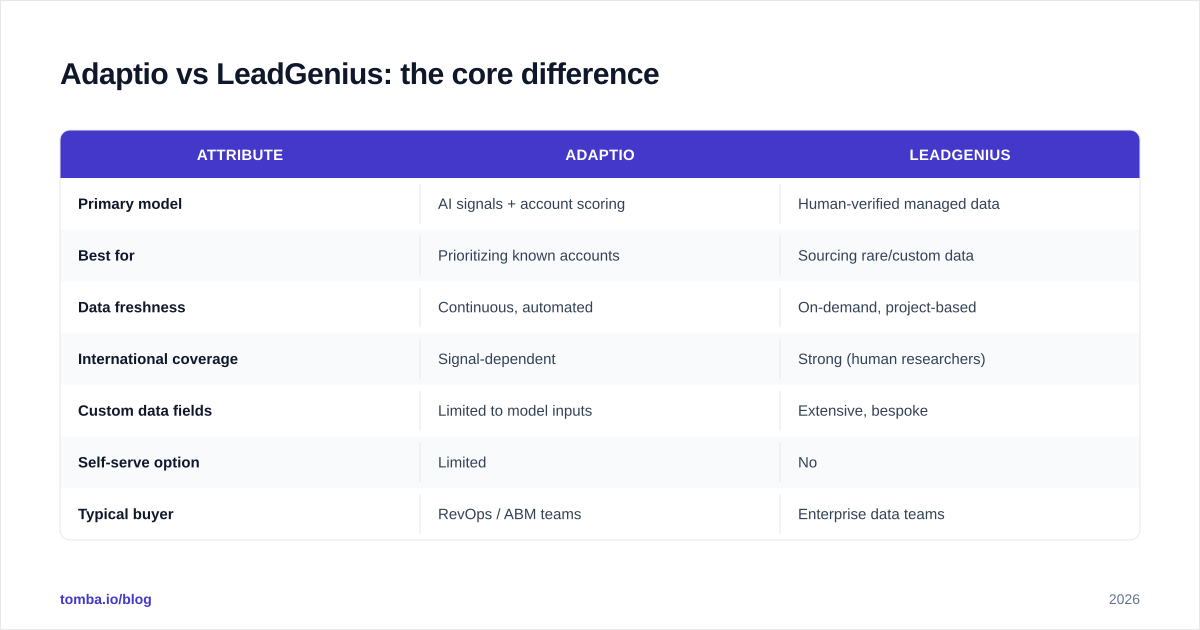
Conclusion first: Adaptio optimizes for prioritization; LeadGenius optimizes for coverage of the hard stuff. One tells you which known accounts to chase. The other finds and verifies accounts and fields you couldn't get anywhere else.
Think of it like cooking. Adaptio is a smart recipe app that ranks what to make from ingredients you already own. LeadGenius is a personal shopper who hunts down rare ingredients you can't find in any store. Both are useful — but only if they match what's actually missing from your kitchen.
Here's the head-to-head.
| Attribute | Adaptio | LeadGenius |
|---|---|---|
| Primary model | AI signals + account scoring | Human-verified managed data |
| Best for | Prioritizing known accounts | Sourcing rare/custom data |
| Data freshness | Continuous, automated | On-demand, project-based |
| International coverage | Signal-dependent | Strong (human researchers) |
| Custom data fields | Limited to model inputs | Extensive, bespoke |
| Self-serve option | Limited | No |
| Typical buyer | RevOps / ABM teams | Enterprise data teams |
| Pricing model | Custom / annual | Custom / managed-service |
| Time to first value | Fast (once connected) | Slower (research cycle) |
| Free tier | No | No |
Notice what's missing from both columns: a free tier and transparent self-serve pricing. That's the single biggest reason smaller teams bounce off both and look for a leaner option.
Which has better data accuracy?#
It depends on what "accurate" means for your use case.
For breadth and freshness on mainstream accounts, Adaptio's automated pipeline updates constantly, so signals like job changes or new funding surface quickly. The risk is the usual automation tax: stale emails, role changes the model hasn't caught, and confident-but-wrong scoring on thin signals.
For depth and correctness on hard records, LeadGenius wins. Human verification catches what scrapers miss — a contact who changed companies, a regional subsidiary's real decision-maker, a field that requires reading a PDF annual report. You pay for that accuracy in time and dollars.
A practical pattern many teams use: get the prioritization or sourcing from a platform, then re-verify every contact before you send. No data vendor's record stays accurate forever — people change jobs constantly. Running addresses through an email verifier before a campaign protects your sender reputation regardless of which platform sourced the data. If you're buying in volume, bulk verify the whole list in one pass.
How do Adaptio and LeadGenius price?#
Neither publishes standard pricing, and that's the headline. Both run custom, sales-led contracts — typically annual for Adaptio and project- or seat-based managed service for LeadGenius. Expect a demo, a scoping call, and a minimum commitment before you see a number.
That model makes sense at the enterprise tier. It's a poor fit if you're a founder, a small SDR team, or anyone who wants to test data quality this afternoon. For that buyer, the math rarely works: you're paying an annual platform fee to solve what is often a contact-data problem.
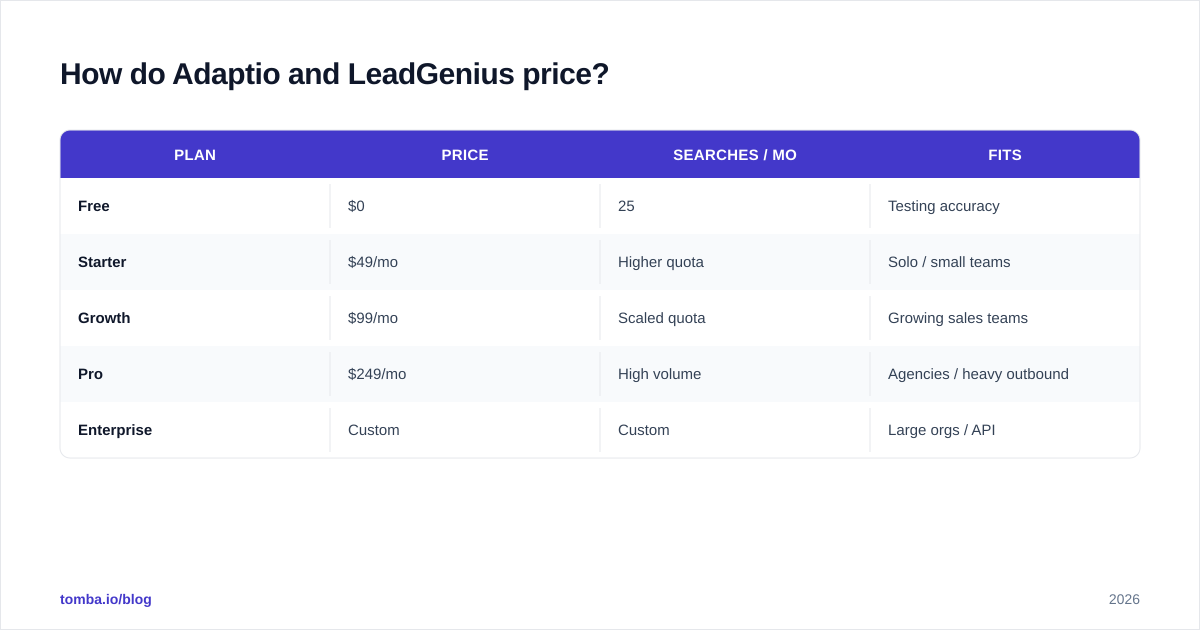
For comparison, transparent self-serve pricing looks like this — and you can start free:
| Plan | Price | Searches / mo | Fits |
|---|---|---|---|
| Free | $0 | 25 | Testing accuracy |
| Starter | $49/mo | Higher quota | Solo / small teams |
| Growth | $99/mo | Scaled quota | Growing sales teams |
| Pro | $249/mo | High volume | Agencies / heavy outbound |
| Enterprise | Custom | Custom | Large orgs / API |
You can see full Tomba pricing without a sales call. The point isn't that a $49/mo finder replaces an enterprise GTM platform feature-for-feature — it's that most teams comparing Adaptio vs LeadGenius are actually trying to solve "get me accurate contacts I can email," and that problem has a much cheaper answer.

Which one should you choose?#
Match the tool to the gap in your stack:
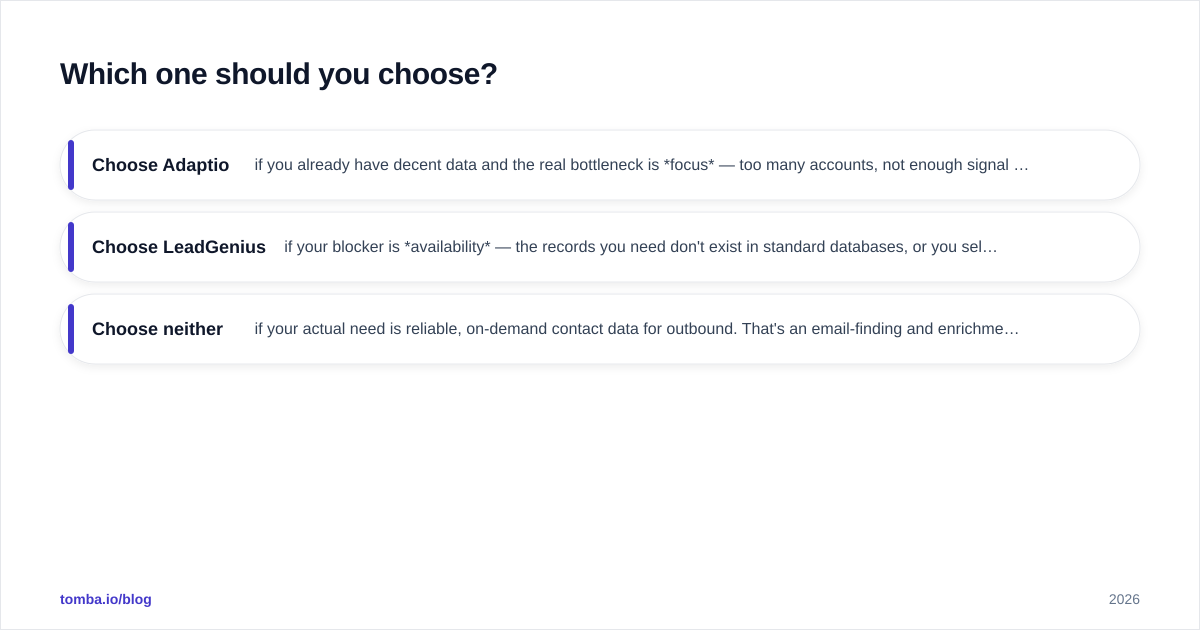
- Choose Adaptio if you already have decent data and the real bottleneck is focus — too many accounts, not enough signal on which to work first. You need a RevOps function to operationalize the scores, or the platform becomes shelfware.
- Choose LeadGenius if your blocker is availability — the records you need don't exist in standard databases, or you sell into international and niche markets where automated tools thin out. Budget for the research cadence.
- Choose neither if your actual need is reliable, on-demand contact data for outbound. That's an email-finding and enrichment problem, not a six-figure platform problem.
Cross-check both vendors on independent review sites like G2 and analyst coverage from Gartner before committing — category positioning shifts fast, and a 2024 review may not reflect the 2026 product.
Where a focused tool fits instead#
Here's the honest framing. Adaptio and LeadGenius are platforms; their value compounds when you've got the team and budget to feed and act on them. If you're not there yet, you don't need to choose between them at all.
What most outbound teams need first is the ability to find a verified work email by name and domain, enrich it with firmographics, and push it into a campaign — repeatably, without a contract. That's a tool problem with a clean answer:
- Find contacts by company with domain search.
- Layer in firmographics and titles with data enrichment.
- Wire it into your existing workflow via the Tomba API or native integrations.
You can always graduate to a signals platform like Adaptio or a managed provider like LeadGenius once you've outgrown self-serve. Plenty of teams never need to.
Frequently asked questions#
Is Adaptio a data provider or a scoring tool? Primarily a scoring and prioritization layer. It enriches and ranks accounts using AI on top of signals, rather than selling raw, human-verified records as its core product.
Does LeadGenius offer self-serve access? No. LeadGenius is a managed-service model — you scope requirements with their team and they deliver custom datasets. There's no instant self-serve dashboard or free trial in the usual sense.
Are Adaptio and LeadGenius direct competitors? Only partially. They overlap on "better B2B data" but solve different problems — Adaptio for prioritizing known accounts, LeadGenius for sourcing hard-to-find ones. Some teams run both.
What's the cheapest way to test data quality before committing? Start with a transparent self-serve tool that has a free tier, verify a known sample of contacts, and measure bounce rates yourself. That gives you a real accuracy benchmark before any enterprise demo.
The bottom line#
Adaptio and LeadGenius are both legitimate enterprise plays — Adaptio for AI-driven prioritization, LeadGenius for human-verified custom data. The right pick comes down to whether your gap is focus or availability, and whether you have the team and budget to operationalize either one.
But if you read this comparison hoping to find accurate contact data fast and affordably, you've been comparing the wrong category. Start with the Tomba Email Finder — find and verify professional emails by name, domain, or company, on a free tier with no sales call. Prove the data quality yourself, scale to a $49/mo Starter plan when you're ready, and revisit the enterprise platforms only when you've genuinely outgrown a focused tool. Find your first emails free today.
Ready to find emails that actually work?
Join 150,000+ professionals who stopped guessing and started sending. Free credits on signup — no credit card required.
Get the Tomba newsletter
Practical outbound tactics and product updates — once every two weeks.
About the author