Adaptio vs Prosperfleet Valgen: 2026 B2B Platform Showdown
A neutral, side-by-side breakdown of Adaptio vs Prosperfleet Valgen — features, pricing posture, fit, and where each B2B revenue platform wins in 2026.
Choosing between Adaptio vs Prosperfleet Valgen usually comes down to one question: do you want a platform that adapts to a messy, multi-segment motion, or one that standardizes a single high-discipline value-selling process? Both are B2B revenue platforms aimed at sales and RevOps teams, and both promise cleaner pipeline and better forecasting — but they get there in very different ways.
This is a neutral teardown. Where one tool clearly leads, we say so. Where the marketing outruns reality, we flag it. And because no platform is an island, we close with how to keep the contact data feeding either system actually accurate.
TL;DR#
- Adaptio is the better fit for teams running multiple motions (PLG + sales-led, multi-segment, multi-region) that need a flexible, configurable engagement layer.
- Prosperfleet Valgen leans into structured value selling and deal methodology — strongest for enterprise teams that want one disciplined process enforced everywhere.
- Pricing posture differs: Adaptio tends toward per-seat tiers with a usable entry plan; Valgen skews toward annual enterprise contracts with onboarding services.
- Neither tool fixes bad data. Both depend on accurate emails and enriched contacts, so pair them with a dedicated email finder.
- Always confirm current pricing and feature scope on each vendor's own site and on review platforms — figures below are directional, not quotes.
What are Adaptio and Prosperfleet Valgen?#
Adaptio positions itself as an adaptive sales-execution platform. The core idea is configurability: pipelines, playbooks, and engagement sequences bend to fit how your team already sells rather than forcing a single template. That makes it attractive to growth-stage and mid-market companies whose go-to-market motion is still evolving.
Prosperfleet Valgen is Prosperfleet's value-generation product — a structured deal and value-selling platform. Its philosophy is the opposite: codify one proven methodology (value hypotheses, mutual action plans, stakeholder mapping) and make every rep follow it. That rigor appeals to enterprise sales orgs where consistency and forecast accuracy outrank flexibility.
In short, this is a flexibility-versus-discipline comparison more than a feature-count race. The right answer depends on your team's maturity and how standardized you want your motion to be.
How do Adaptio and Prosperfleet Valgen compare feature by feature?#
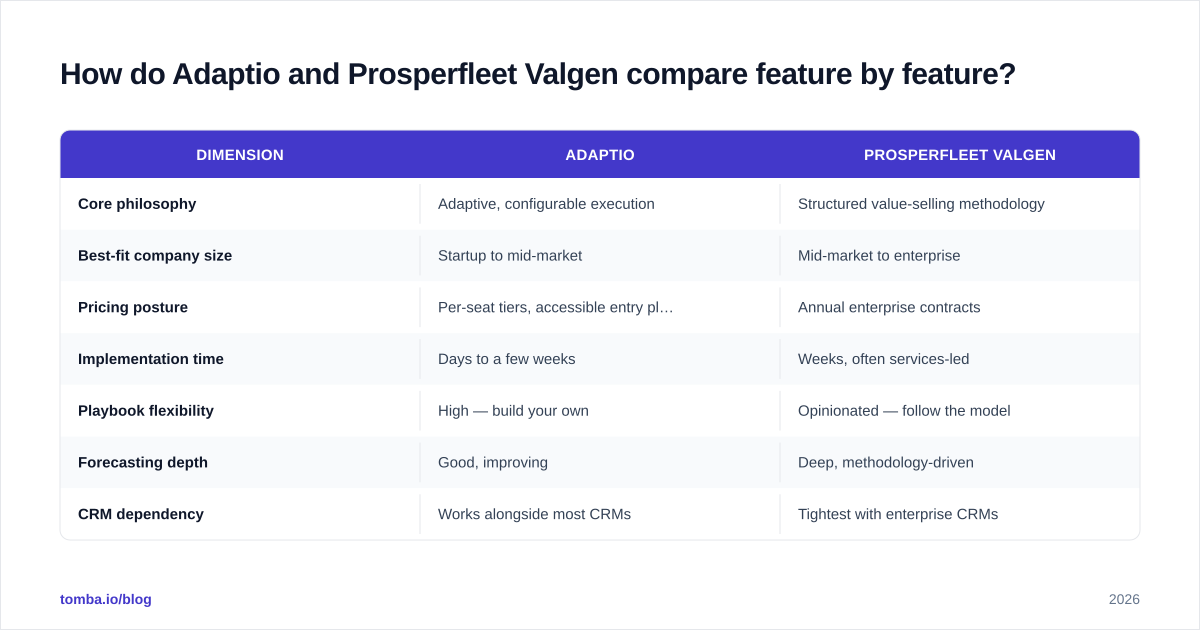
The table below maps the dimensions buyers ask about most. Treat the pricing and limits as directional indicators of each platform's posture, not as live quotes — verify on the vendor sites and on G2 or Capterra before you buy.
| Dimension | Adaptio | Prosperfleet Valgen |
|---|---|---|
| Core philosophy | Adaptive, configurable execution | Structured value-selling methodology |
| Best-fit company size | Startup to mid-market | Mid-market to enterprise |
| Pricing posture | Per-seat tiers, accessible entry plan | Annual enterprise contracts |
| Implementation time | Days to a few weeks | Weeks, often services-led |
| Playbook flexibility | High — build your own | Opinionated — follow the model |
| Forecasting depth | Good, improving | Deep, methodology-driven |
| CRM dependency | Works alongside most CRMs | Tightest with enterprise CRMs |
| Learning curve | Gentle | Steeper, training-heavy |
Read the table as a fork in the road: if your motion changes quarter to quarter, the left column will feel like relief. If you need every rep to run the same play in front of a CFO, the right column earns its keep.
Is Adaptio better than Prosperfleet Valgen?#
Neither is "better" in the abstract — they optimize for different problems.
Adaptio wins when:
- You run more than one motion (self-serve, sales-assisted, partner) and need each configured separately.
- Your process is still changing and you can't afford a months-long rollout.
- You want reps productive in days, not after a multi-week certification.
- Budget sensitivity matters and you want to start small and expand.
Prosperfleet Valgen wins when:
- Deal sizes are large enough that methodology discipline materially moves win rates.
- Leadership wants one enforced process and audit-ready deal hygiene.
- You have the appetite for services-led onboarding and ongoing enablement.
- Forecast accuracy at the board level is a top-three priority.
A useful gut check: count how many distinct sales motions you run today. One tightly controlled motion points toward Valgen. Two or more evolving motions point toward Adaptio.

How does pricing and total cost compare?#
Headline price is the smallest part of total cost of ownership. The bigger variables are implementation, training, and the admin overhead of keeping the system fed.
- Adaptio typically uses transparent per-seat tiers with a low-friction entry plan, so a team can pilot before committing. Expansion cost scales roughly with headcount.
- Prosperfleet Valgen typically lands as an annual enterprise agreement, often bundled with onboarding and enablement services. The sticker is higher, but the value math is built around lifting win rate and deal size, not minimizing seat cost.
For an apples-to-apples view, model 12-month TCO: license + implementation + training hours + the internal admin time to maintain data quality. That last line item is where most platforms quietly leak ROI — which brings us to the data layer. See how transparent, usage-based pricing reads on a tool like Tomba pricing for a sense of what accessible tiering looks like.
What about data quality and integrations?#
Here is the uncomfortable truth that applies to both Adaptio and Prosperfleet Valgen: a revenue platform is only as good as the contact data inside it. Sophisticated forecasting and value-selling workflows still collapse when reps are emailing stale addresses or chasing the wrong stakeholder.
Common failure modes regardless of which platform you pick:
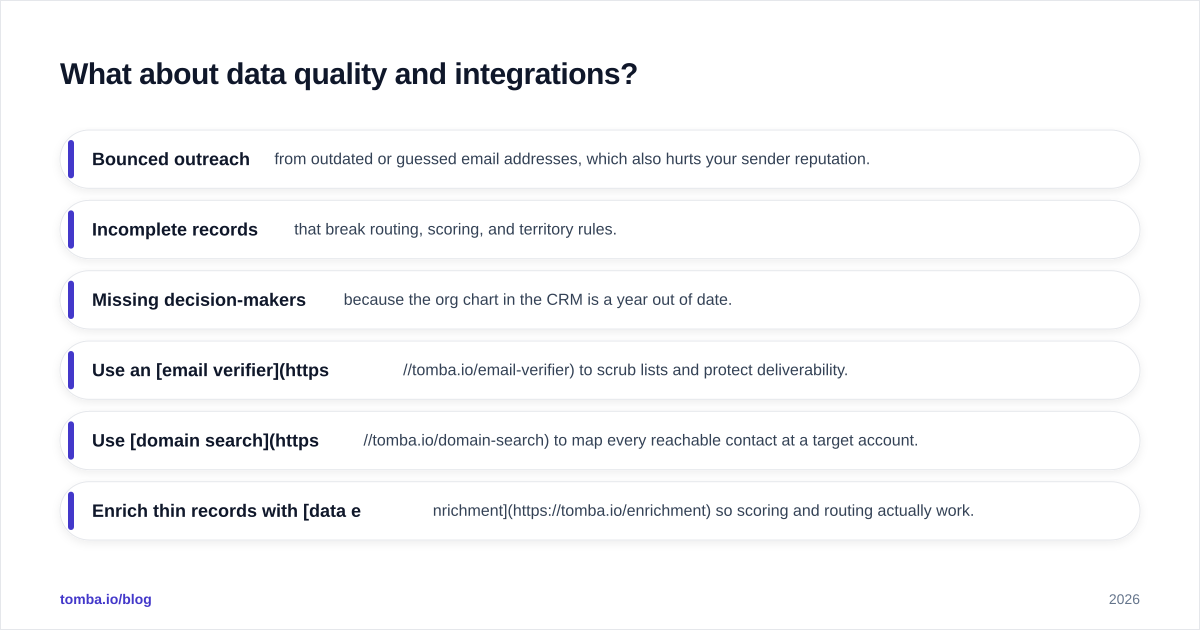
- Bounced outreach from outdated or guessed email addresses, which also hurts your sender reputation.
- Incomplete records that break routing, scoring, and territory rules.
- Missing decision-makers because the org chart in the CRM is a year out of date.
This is why the data layer should be a deliberate choice, not an afterthought. Before contacts ever reach Adaptio or Valgen, run them through a dedicated discovery-and-verification step:
- Use an email verifier to scrub lists and protect deliverability.
- Use domain search to map every reachable contact at a target account.
- Enrich thin records with data enrichment so scoring and routing actually work.
Both platforms integrate with mainstream CRMs and outreach tools; Valgen tends to bind most tightly to enterprise CRM ecosystems, while Adaptio's lighter footprint plays nicely with a broader mix. Check each vendor's integration directory against your current stack — and read independent context on sales-engagement platforms if the category itself is new to you.
Which platform fits your team in 2026?#
Map your situation to the closest profile:
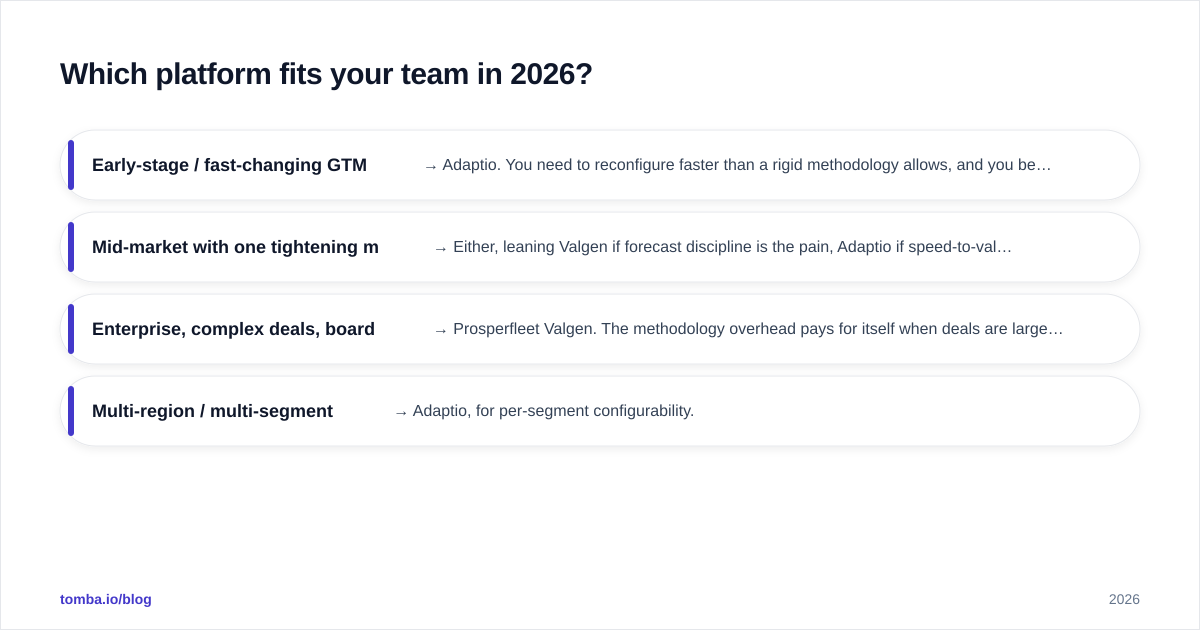
- Early-stage / fast-changing GTM → Adaptio. You need to reconfigure faster than a rigid methodology allows, and you benefit from a low-cost entry point.
- Mid-market with one tightening motion → Either, leaning Valgen if forecast discipline is the pain, Adaptio if speed-to-value is.
- Enterprise, complex deals, board-level forecasting → Prosperfleet Valgen. The methodology overhead pays for itself when deals are large and multi-threaded.
- Multi-region / multi-segment → Adaptio, for per-segment configurability.
Whichever you choose, decide your data strategy in the same breath. The platform manages the motion; it does not manufacture accurate contacts. Teams that bolt a reliable email-finding and verification layer onto either tool consistently see cleaner pipeline and fewer wasted touches than teams that trust whatever the CRM already holds.
How should you run the evaluation?#
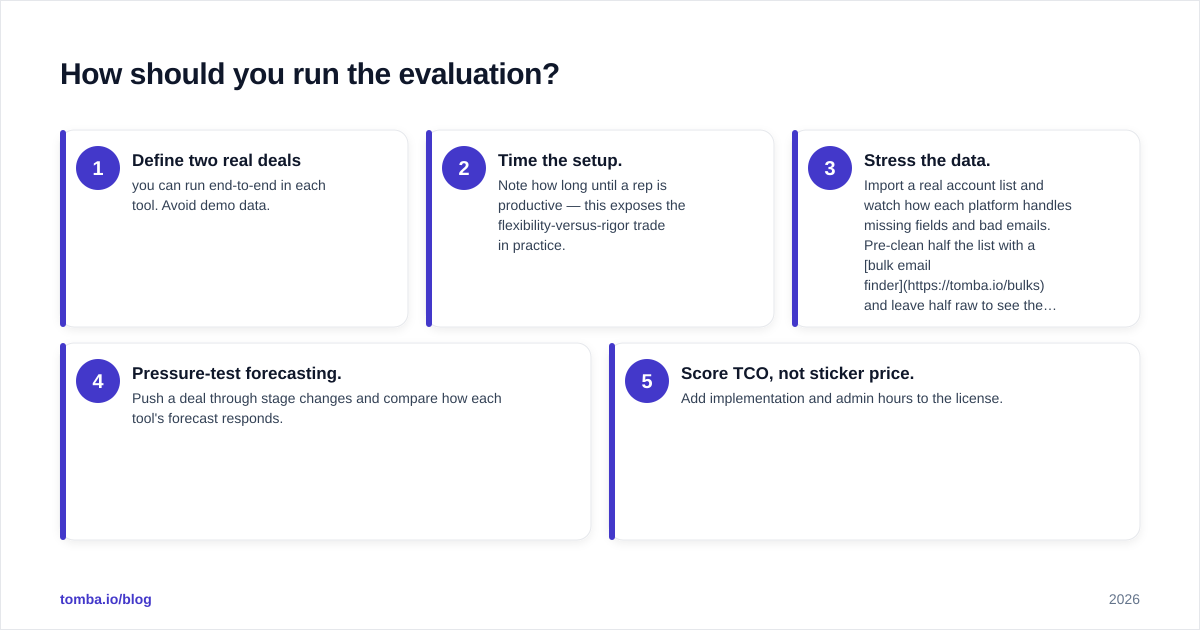
Keep the bake-off honest with a short, structured trial:
- Define two real deals you can run end-to-end in each tool. Avoid demo data.
- Time the setup. Note how long until a rep is productive — this exposes the flexibility-versus-rigor trade in practice.
- Stress the data. Import a real account list and watch how each platform handles missing fields and bad emails. Pre-clean half the list with a bulk email finder and leave half raw to see the difference.
- Pressure-test forecasting. Push a deal through stage changes and compare how each tool's forecast responds.
- Score TCO, not sticker price. Add implementation and admin hours to the license.
Document the results in a simple scorecard so the decision is evidence-based, not vibes-based.
Frequently asked questions#
Is Adaptio cheaper than Prosperfleet Valgen? Generally Adaptio has a more accessible entry point and per-seat pricing, while Valgen skews toward higher annual enterprise contracts. Confirm current numbers directly with each vendor.
Can I migrate from one to the other later? Yes, but migration cost is real — playbooks, integrations, and rep retraining all carry over poorly. Pick for the next 18–24 months, not just this quarter.
Do either of these replace my CRM? No. Both sit alongside your CRM as an execution or value-selling layer. Your CRM remains the system of record.
What's the single biggest predictor of success with either tool? Data quality. Clean, verified, enriched contacts beat fancy workflows running on stale records every time.
The bottom line#
Adaptio vs Prosperfleet Valgen is a choice between adaptability and discipline. Adaptio rewards teams that need to bend the tool to a shifting motion; Valgen rewards teams ready to commit to one rigorous value-selling process. Match the platform to your maturity, model the full 12-month cost, and run a real two-deal trial before signing.
And whichever you land on, fix the data layer first. A revenue platform amplifies whatever you feed it — so feed it accurate, verified contacts. Start with the Tomba Email Finder to source decision-maker emails by name, company, or domain, then verify and enrich them before they ever hit Adaptio or Valgen. Clean inputs are the cheapest performance upgrade either platform will ever get.
// get started
Find, verify and enrich your first contacts today
Start on the free plan with 25 searches a month, then scale when your team is ready.
Free plan · No credit card required · GDPR & CCPA
// about the author