Adaptio vs SalesRipe 2026: Which B2B Sales Data Tool Wins?
Adaptio and SalesRipe both promise pipeline-ready B2B leads, but they solve different problems. Here is a neutral, feature-by-feature breakdown for 2026.
Choosing between Adaptio and SalesRipe usually comes down to one question: do you need a clean, exportable list of companies and contacts, or do you need a dynamic data layer that keeps your CRM enriched as accounts change? The two tools sit on opposite ends of that spectrum, and picking the wrong one costs you either accuracy or speed.
This breakdown compares both platforms on data freshness, coverage, pricing posture, enrichment depth, and the realistic workflows each one fits. No vendor cheerleading — just where each tool earns its seat and where it falls short.
TL;DR#
- SalesRipe is a straightforward B2B leads database: search filters, build a list, export contacts and company records. Best for SMB teams that want fast, low-cost list-building without a heavy stack.
- Adaptio leans toward adaptive, signal-driven enrichment — keeping account and contact data current as it changes, rather than handing you a one-time snapshot. Better for RevOps teams maintaining a live CRM.
- Data freshness is the real differentiator. A static export decays ~2–3% per month; a continuously refreshed layer fights that decay but costs more.
- Neither is a deliverability tool. Both give you data; you still need separate email verification before you send, or you will torch your sender reputation.
- If your core need is simply finding and verifying accurate work emails at scale, a dedicated email finder like Tomba is often a cleaner, cheaper fit than either platform.
What is SalesRipe?#
SalesRipe is a B2B sales-intelligence and lead-generation platform aimed at small and mid-sized sales teams. You search a contact and company database using filters — industry, location, company size, title, revenue — and pull back a list you can export or push into a CRM. Think of it as a phone book with good filters: you tell it who you want, it returns matching records with names, titles, emails, and phone numbers.
Its appeal is simplicity and price. There is no steep onboarding, the interface is search-first, and the pricing has historically undercut enterprise data vendors. For a founder or a two-rep SMB team that just needs a list to start dialing and emailing, that low-friction model is the whole point.
The trade-off is that a search-and-export model produces a snapshot. The moment you export, the data starts aging — people change jobs, companies get acquired, domains migrate. SalesRipe is excellent at the initial pull; it is not designed to be your living source of truth.
What is Adaptio?#
Adaptio positions itself around adaptive data — the idea that B2B records should update themselves as the underlying signals change, rather than sitting frozen in a spreadsheet. Instead of optimizing purely for "export a list now," it optimizes for keeping the records you already care about accurate over time, often tied to intent or account-change signals.
The everyday analogy: SalesRipe is a printed map you buy once; Adaptio is the live navigation app that re-routes when the road closes. One is cheaper and instantly useful; the other costs more but stays correct while you drive.
That makes Adaptio a more natural fit for RevOps and marketing-ops teams who treat their CRM as infrastructure — they need data enrichment that runs continuously, fills gaps on inbound leads, and flags when a key contact moves. The cost is complexity: adaptive systems imply integration work, and you pay for the refresh you may not always use.
How do Adaptio and SalesRipe compare head-to-head?#
Here is the side-by-side. Treat pricing as indicative — both vendors adjust tiers, so confirm current numbers on their own sites before you commit.
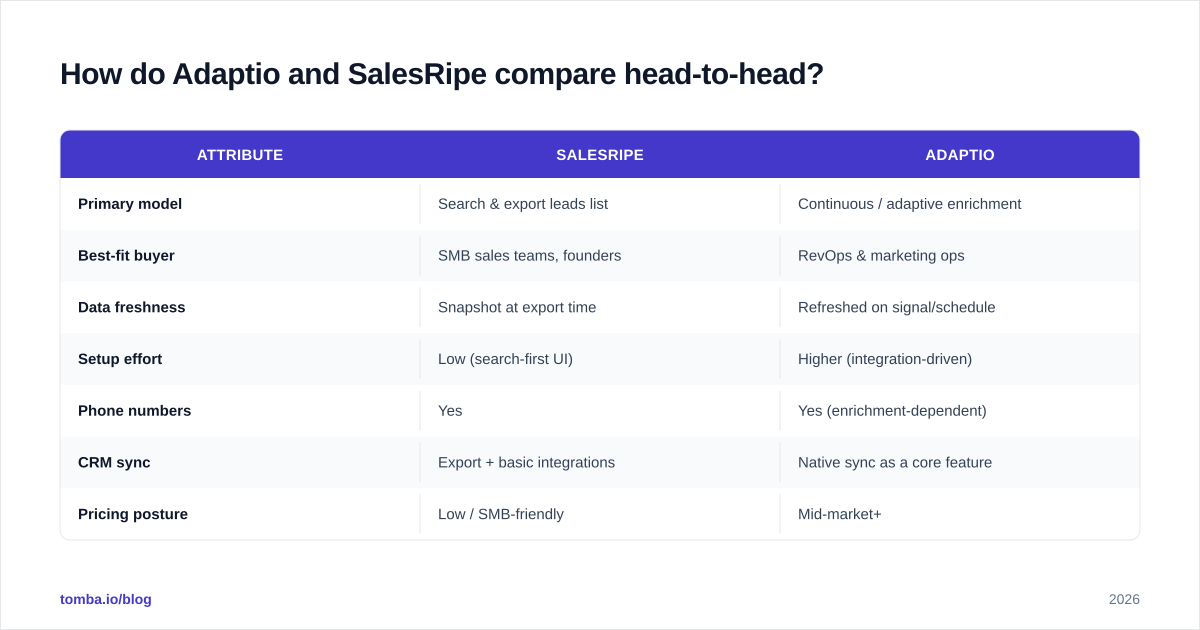
| Attribute | SalesRipe | Adaptio |
|---|---|---|
| Primary model | Search & export leads list | Continuous / adaptive enrichment |
| Best-fit buyer | SMB sales teams, founders | RevOps & marketing ops |
| Data freshness | Snapshot at export time | Refreshed on signal/schedule |
| Setup effort | Low (search-first UI) | Higher (integration-driven) |
| Phone numbers | Yes | Yes (enrichment-dependent) |
| CRM sync | Export + basic integrations | Native sync as a core feature |
| Pricing posture | Low / SMB-friendly | Mid-market+ |
| Free trial | Typically yes | Demo-led |
| Verification built in | Limited | Limited |
The pattern is consistent: SalesRipe wins on time-to-first-list and cost, Adaptio wins on staying-correct-over-time and CRM hygiene. Your choice should follow which of those problems is actually hurting you right now.
/blog/generated/memes/2026-06-03/adaptio-vs-salesripe-meme-1.png
Which has better data accuracy and freshness?#
Freshness is where most "which tool is better" arguments are actually decided, so it deserves its own answer: Adaptio's continuous model wins on freshness; SalesRipe wins on first-pull convenience.
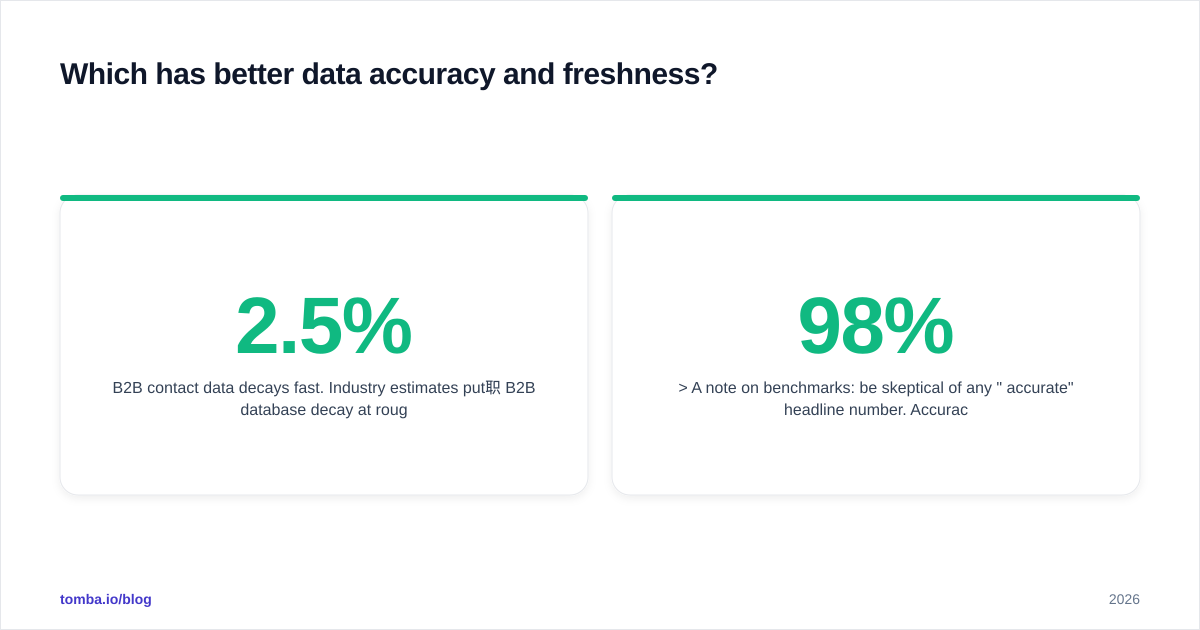
B2B contact data decays fast. Industry estimates put职 B2B database decay at roughly 2.1–2.5% per month — about 25–30% per year — driven mostly by job changes. A list you export from any static database in January is meaningfully wrong by summer. That is not a knock on SalesRipe specifically; it is physics for any snapshot model.
Adaptio's pitch is that it re-checks records against fresh signals, so a contact who switched companies gets flagged or updated instead of silently bouncing your next campaign. If your team mails the same accounts repeatedly over quarters, that compounding accuracy is worth real money.
But "fresher" is not the same as "complete." No single vendor has every contact, and adaptive refresh can still miss niche industries or smaller companies. The practical move, regardless of which platform you pick, is to run a verification pass before every send. Pipe your list through an email verifier and only mail addresses that come back valid. That single habit protects your domain more than any vendor's accuracy claim.
A note on benchmarks: be skeptical of any "98% accurate" headline number. Accuracy varies wildly by region, seniority, and company size. Test both tools on your ICP with a sample of 100–200 records and measure your own bounce rate. That is the only benchmark that matters.
Which is more affordable?#
SalesRipe is the cheaper, more predictable option for most SMB teams. Its plans are built around per-seat list access at SMB-friendly price points, and the model is easy to forecast: you know roughly how many records you'll pull and what it costs.
Adaptio's value — and cost — scales with enrichment volume and integration depth, which lands it in mid-market territory. You're not just paying for records; you're paying for the ongoing refresh and the sync infrastructure. That is justified when CRM hygiene drives revenue, and overkill when you just need a list this week.
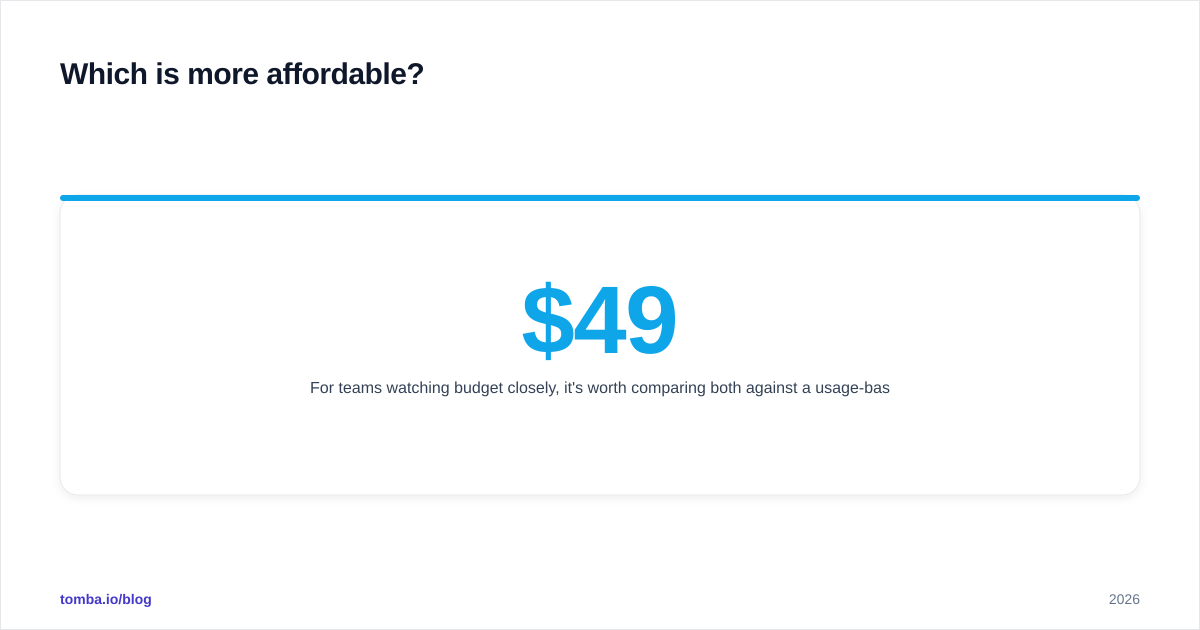
For teams watching budget closely, it's worth comparing both against a usage-based email finder pricing model. Tomba, for reference, runs a free tier (25 searches/mo), then Starter at $49/mo, Growth at $99/mo, and Pro at $249/mo — so you pay for finding and verifying contacts without buying a full sales-intelligence suite you may not use.
Do you even need a full sales-intelligence platform?#
Honest answer: often, no. Many teams buy a heavyweight data platform when their real bottleneck is just "I have a list of companies and names but no reliable emails."
If that's you, the lighter path is:
- Identify target companies (you usually already have these).
- Use domain search to pull the people and email patterns at each company.
- Run every address through verification before it enters a sequence.
- Enrich the survivors with phone numbers or firmographics only as needed.
This avoids paying mid-market platform fees for data you'll partly throw away. It also keeps your stack modular — you can swap the finder, the verifier, or the sequencer independently instead of being locked into one vendor's ecosystem. For a deeper bench of records, Tomba's B2B database covers the discovery layer without the adaptive-enrichment premium.
When should you choose SalesRipe?#
Choose SalesRipe when:
- You're an SMB or solo founder and need a usable list today, not a six-week integration.
- Budget is tight and predictable per-seat pricing matters more than continuous refresh.
- Your motion is outbound batches — pull a list, work it, pull another — rather than maintaining a permanent live database.
- You don't yet have RevOps headcount to own an enrichment pipeline.
In short: SalesRipe is the pragmatic first data tool for a growing team. It gets you from zero to dialing fast.
When should you choose Adaptio?#
Choose Adaptio when:
- You run RevOps or marketing ops and your CRM is a core asset that must stay clean.
- You mail or work the same accounts over long cycles, so decay actively costs you deals.
- You already have integrations and process to feed enrichment into routing, scoring, and lifecycle automation.
- You can justify a mid-market budget because data hygiene maps directly to pipeline.
Adaptio rewards teams that have outgrown the export-and-pray model and need data that maintains itself.
What do reviewers and the market say?#
Rather than trust either vendor's marketing, cross-check independent sources. Public review platforms like G2 and Capterra carry user feedback on data accuracy, support responsiveness, and contract flexibility — the things that don't show up on a pricing page. For SalesRipe specifically, the vendor's own site at salesripe.com is the authoritative source for current features and tier limits.
When you read reviews, weight the ones that match your company size and region. A five-star review from an enterprise team in the US tells you little about how the data performs for a 10-person agency targeting EU SMBs. Filter accordingly.
How do these tools fit a modern outbound stack?#
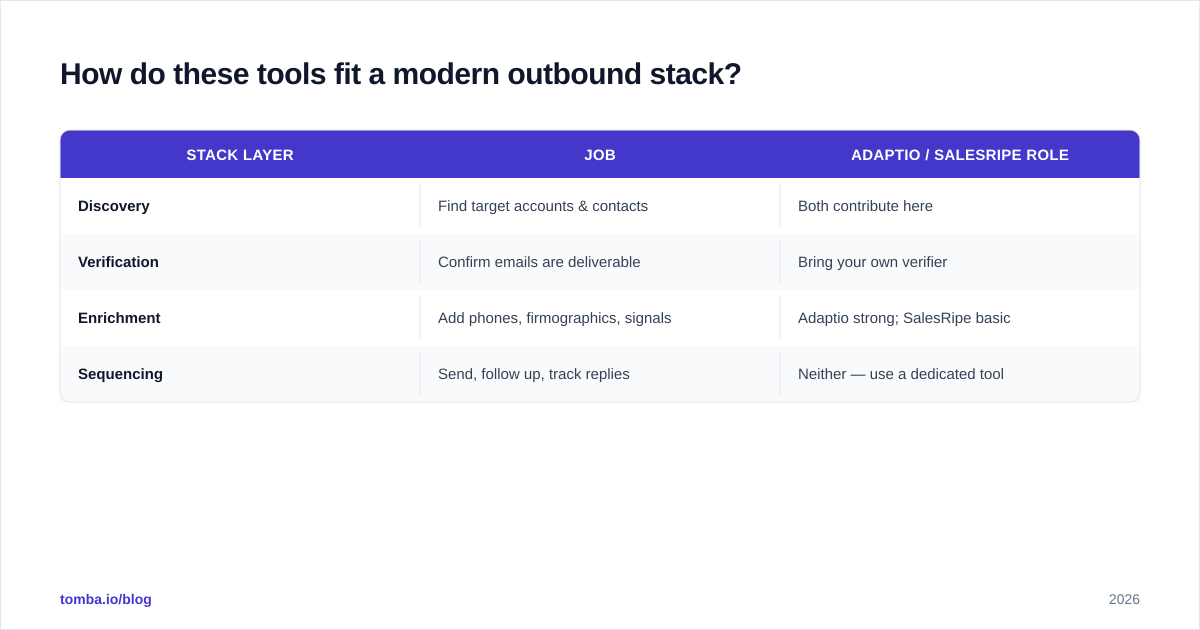
Neither Adaptio nor SalesRipe is a complete outbound system on its own. A realistic 2026 stack separates four jobs:
| Stack layer | Job | Adaptio / SalesRipe role |
|---|---|---|
| Discovery | Find target accounts & contacts | Both contribute here |
| Verification | Confirm emails are deliverable | Bring your own verifier |
| Enrichment | Add phones, firmographics, signals | Adaptio strong; SalesRipe basic |
| Sequencing | Send, follow up, track replies | Neither — use a dedicated tool |
The takeaway is to buy for the layer that's actually broken. If discovery is fine but your bounce rate is ugly, the fix is verification, not a new database. If your CRM is full of stale records, that's the enrichment layer — Adaptio's home turf. Mapping your gap to the right layer prevents the classic mistake of buying an expensive platform to solve a cheap problem.
The bottom line#
SalesRipe is the better pick for SMB teams that need an affordable, fast list; Adaptio is the better pick for RevOps teams that need data to stay current inside a live CRM. They're not really competitors so much as tools for two different maturity stages — and many teams will outgrow the first into the second.
But before you commit to either, pressure-test whether your bottleneck is really "a whole sales-intelligence platform" or just "accurate, verified emails for the accounts I already know." If it's the latter, you can skip the platform tax entirely.
That's exactly where Tomba's Email Finder fits: point it at a name and domain (or a whole company) and get verified professional emails back, with a free tier to test on your own ICP before you pay a cent. Pair it with built-in verification and you cover the two layers that actually move reply rates — discovery and deliverability — without locking yourself into a heavy contract. Run 25 free searches against your shortlist, measure the bounce rate yourself, and let the data decide.
Ready to find emails that actually work?
Join 150,000+ professionals who stopped guessing and started sending. Free credits on signup — no credit card required.
Get the Tomba newsletter
Practical outbound tactics and product updates — once every two weeks.
About the author