Adaptio vs Smarte 2026: B2B Data Platform Comparison
Adapt.io and SMARTe both promise accurate B2B contact data, but they win on different fronts. Here's a side-by-side breakdown of coverage, pricing, accuracy, and the best fit for your sales team in 2026.
Choosing between Adapt.io and SMARTe usually comes down to one question your finance team will ask: what are we actually paying for per usable contact? Both platforms sell B2B contact and company data, both claim high accuracy, and both have loyal users. But they are built for different buyers, and picking the wrong one means stale records, blown email-sending reputation, and a sales team that quietly stops trusting the CRM.
This guide breaks down Adaptio vs Smarte on the dimensions that change your pipeline — data coverage, accuracy, pricing model, integrations, and real-world use cases — then shows where a focused tool like Tomba fits if your core need is simply finding and verifying emails at a fair price.
TL;DR: Adaptio vs Smarte at a glance#
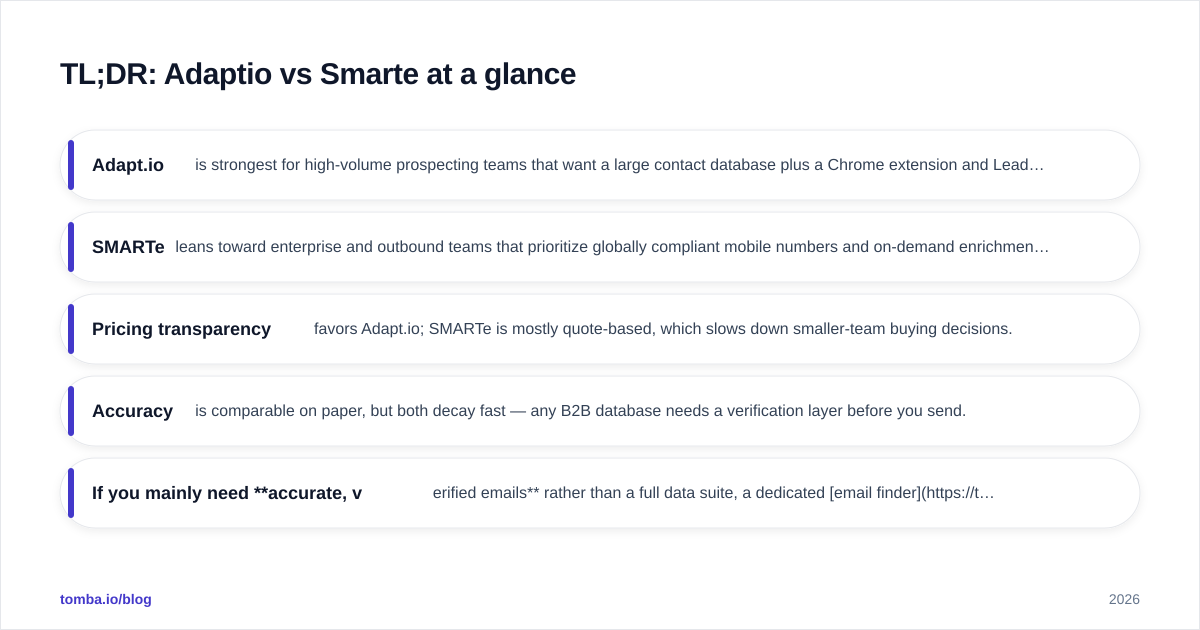
- Adapt.io is strongest for high-volume prospecting teams that want a large contact database plus a Chrome extension and Lead Builder workflow at a predictable seat price.
- SMARTe leans toward enterprise and outbound teams that prioritize globally compliant mobile numbers and on-demand enrichment, especially for EMEA and APAC coverage.
- Pricing transparency favors Adapt.io; SMARTe is mostly quote-based, which slows down smaller-team buying decisions.
- Accuracy is comparable on paper, but both decay fast — any B2B database needs a verification layer before you send.
- If you mainly need accurate, verified emails rather than a full data suite, a dedicated email finder plus an email verifier is often cheaper and cleaner than paying for a platform you half-use.
What is Adapt.io?#
Adapt.io (often typed "Adaptio") is a B2B lead intelligence platform built around a large contact and company database. Its core pitch is breadth plus speed: a searchable database, a "Lead Builder" for filtering target accounts by firmographics, and a browser extension that surfaces contact details while you browse LinkedIn or company sites.
Adapt.io tends to attract SMB and mid-market sales teams who run high-volume outbound and want per-seat pricing they can forecast. The data covers contact name, title, business email, phone, and company attributes like industry, headcount, and tech stack. You can read more about how they position the product on the official Adapt.io site.
The trade-off is the usual one for large aggregated databases: coverage is wide, but freshness varies by region and seniority. Director-and-above contacts at well-known companies are reliable; long-tail SMB records and recently job-changed prospects are where bounce rates creep up.
What is SMARTe?#
SMARTe (smarte.pro) is a B2B data and sales-intelligence provider with a heavier focus on global, compliance-first contact data — particularly accurate mobile/direct-dial numbers and international coverage across North America, EMEA, and APAC. Its positioning targets enterprise revenue teams and outbound orgs that live and die by connect rates.
SMARTe emphasizes on-demand enrichment and GDPR/CCPA-aware sourcing, and it integrates with the usual enterprise stack (Salesforce, Outreach, Salesloft). You can review its feature set on the official SMARTe site. Independent reviews on G2 are a useful sanity check on both vendors' real-world accuracy claims before you commit budget.
Where SMARTe shines is depth of phone data and international reach. Where it frustrates buyers is pricing opacity: most plans are quote-based, so a quick self-serve trial-to-purchase path is harder than with Adapt.io.
Adaptio vs Smarte: how do they compare head-to-head?#
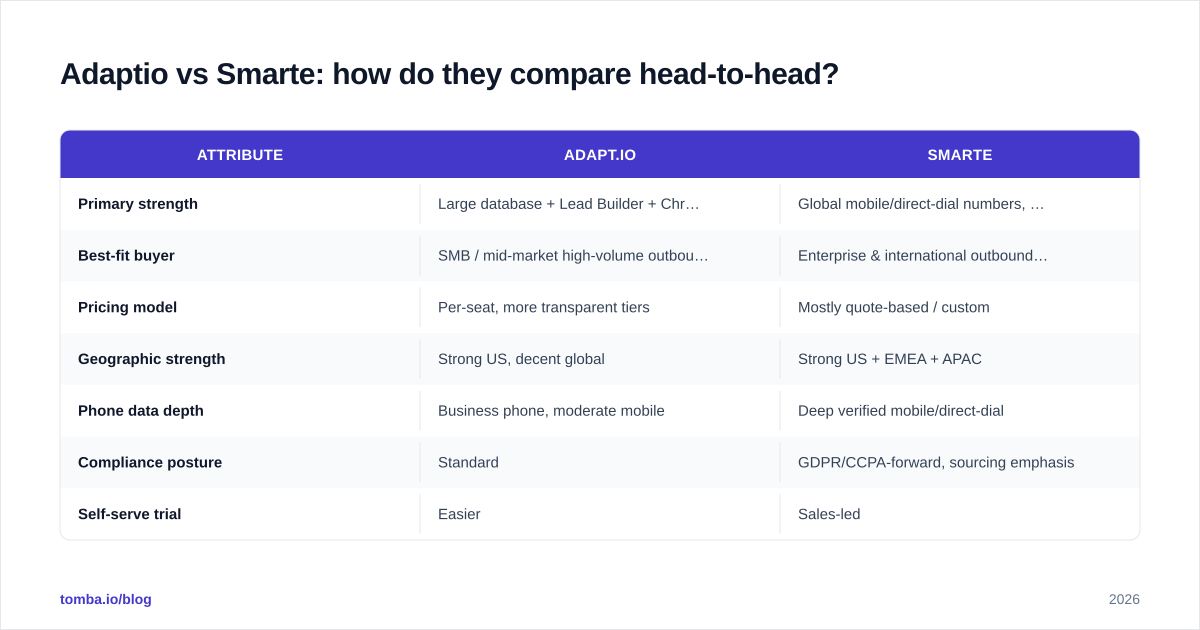
The table below summarizes the practical differences. Treat accuracy figures as vendor-reported directional claims, not guarantees — every aggregated B2B dataset decays, which is why a verification step matters regardless of which you choose.
| Attribute | Adapt.io | SMARTe |
|---|---|---|
| Primary strength | Large database + Lead Builder + Chrome extension | Global mobile/direct-dial numbers, compliance focus |
| Best-fit buyer | SMB / mid-market high-volume outbound | Enterprise & international outbound teams |
| Pricing model | Per-seat, more transparent tiers | Mostly quote-based / custom |
| Geographic strength | Strong US, decent global | Strong US + EMEA + APAC |
| Phone data depth | Business phone, moderate mobile | Deep verified mobile/direct-dial |
| Compliance posture | Standard | GDPR/CCPA-forward, sourcing emphasis |
| Self-serve trial | Easier | Sales-led |
| Email verification built in | Limited | Limited |
The headline: Adapt.io is the faster, more transparent buy for smaller teams; SMARTe is the deeper, pricier option for enterprises that need global phone reach. Neither is a verification tool, and that gap is the recurring theme of this comparison.
Which one has more accurate B2B data?#
Short answer: it depends on the segment, and both need verification before you trust them.
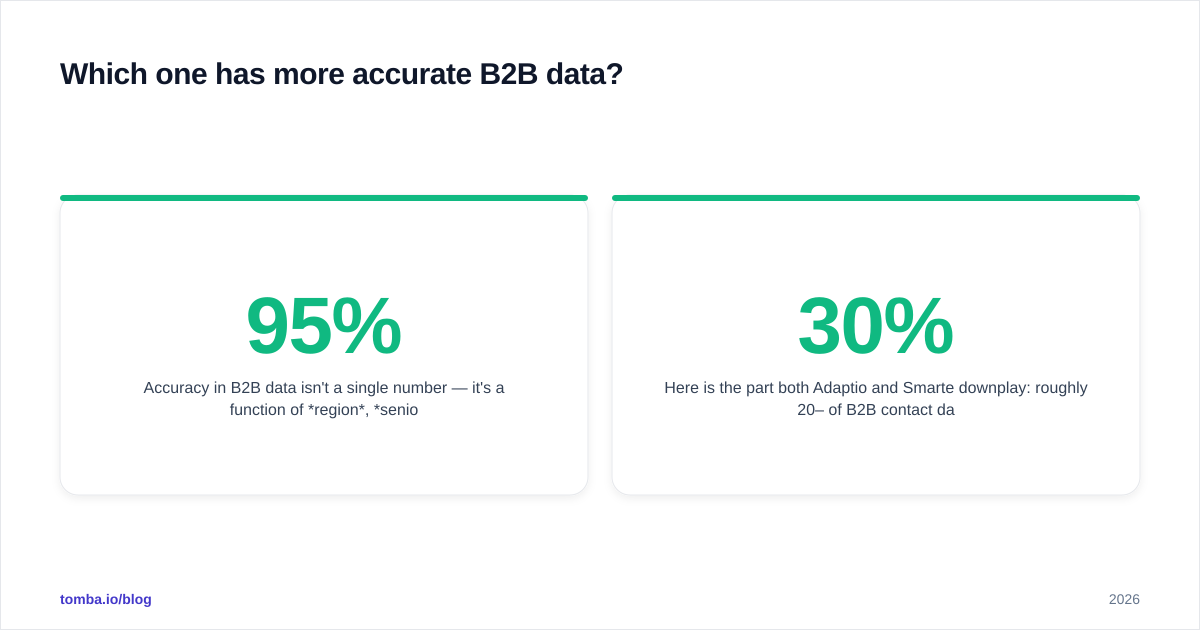
Accuracy in B2B data isn't a single number — it's a function of region, seniority, and recency. A platform can be 95% accurate on VP-level US contacts and 70% accurate on SMB contacts in a market it sources less aggressively. Vendor "accuracy" claims usually quote the best-case segment.
Here is the part both Adaptio and Smarte downplay: roughly 20–30% of B2B contact data goes stale every year as people change jobs. That means even a perfect database is wrong about a fifth of your list within twelve months. The fix isn't choosing the "more accurate" vendor — it's adding a verification layer on top of whichever you pick.
This is where a standalone verifier earns its keep. Running exported lists through an email verification pass before a campaign catches the dead records both platforms inevitably carry. If you send to unverified data, your bounce rate climbs, mailbox providers throttle you, and your sender reputation takes a hit that affects every future campaign — not just the bad list.
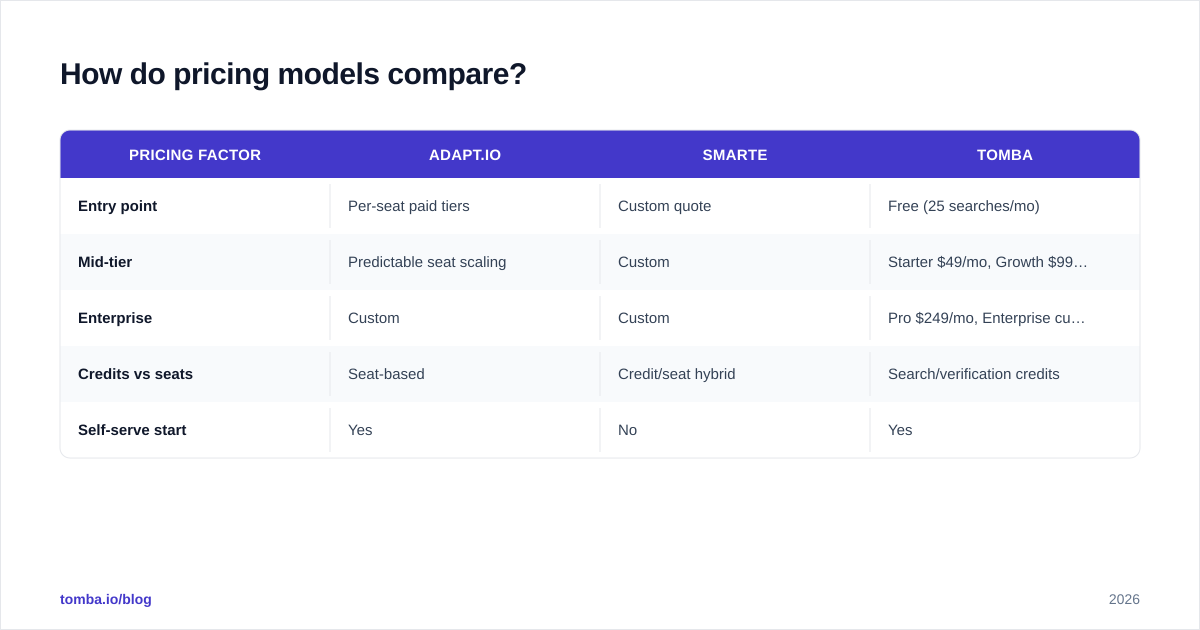
How do pricing models compare?#
Pricing is where the two diverge most clearly, and it's often the deciding factor.
Adapt.io publishes more structured, per-seat tiers, which makes it easy for a sales manager to budget and expand seat-by-seat. You generally know what you're paying before a call.
SMARTe runs a sales-led, quote-based motion. That's normal for enterprise data vendors, but it slows down smaller buyers and makes apples-to-apples comparison hard until you're deep in a demo cycle.
| Pricing factor | Adapt.io | SMARTe | Tomba |
|---|---|---|---|
| Entry point | Per-seat paid tiers | Custom quote | Free (25 searches/mo) |
| Mid-tier | Predictable seat scaling | Custom | Starter $49/mo, Growth $99/mo |
| Enterprise | Custom | Custom | Pro $249/mo, Enterprise custom |
| Credits vs seats | Seat-based | Credit/seat hybrid | Search/verification credits |
| Self-serve start | Yes | No | Yes |
The strategic point: if your real need is find and verify emails, paying enterprise data-platform prices is overkill. Tomba's transparent pricing starts free and tops out far below a full sales-intelligence suite, because it does one job well instead of bundling phone data, intent signals, and enrichment you may never use.
What about integrations and workflow?#
Both platforms cover the integrations that matter for outbound:
- Adapt.io — Chrome extension for on-page capture, CRM sync (Salesforce, HubSpot), and CSV export for sequencing tools.
- SMARTe — Salesforce, Outreach, Salesloft, and enrichment via API, oriented toward enterprise RevOps pipelines.
The workflow difference mirrors the buyer profiles. Adapt.io's extension-first flow suits reps building lists as they browse. SMARTe's API-and-enrichment flow suits ops teams enriching records in bulk inside the CRM.
If you're wiring data into your own stack, the deciding question is API quality and credit economics. A clean, well-documented API lets you enrich on demand instead of buying static exports that start decaying the moment you download them. Tomba's email finder API and data enrichment endpoints exist for exactly this pattern — pull verified contact data at the moment you need it, not in a quarterly bulk dump.
When should you pick Adapt.io, SMARTe, or neither?#
Use this decision shortcut:
- Pick Adapt.io if you're an SMB or mid-market team running high-volume US-centric outbound, you want transparent per-seat pricing, and a Chrome extension fits how your reps work.
- Pick SMARTe if you're an enterprise team that needs deep, compliant mobile/direct-dial data across EMEA and APAC, and you have budget for a sales-led, quote-based platform.
- Pick neither (use a focused tool) if your actual bottleneck is finding and verifying business emails rather than buying a full intelligence suite. A dedicated email finder, domain search, and email verifier cover that job at a fraction of platform cost.
Many teams discover after a year that they bought a platform for 10% of its features. If you only use the contact-find-and-verify slice, you're funding phone databases and intent data you never touch.
What's the smartest data stack in 2026?#
The teams with the cleanest pipelines in 2026 aren't betting everything on one mega-platform. They run a layered stack:
- Source broad contact and company data (a database like Adapt.io or SMARTe, or a leaner B2B database).
- Verify every email before sending, so bounce rates stay low and deliverability holds.
- Enrich on demand via API at the point of use, instead of relying on aging exports.
The verification layer is non-negotiable. It's the cheapest insurance you can buy against the 20–30% annual decay that affects both Adaptio and Smarte equally. A $49/mo verification habit protects the deliverability of campaigns worth far more than the data itself.
That's the honest framing of Adaptio vs Smarte: they're competing on how they source data, but the bigger lever on your results is what you do after you source it.
The bottom line#
Adapt.io wins on price transparency and ease of buying for smaller teams. SMARTe wins on global phone depth and compliance for enterprises. But both share the same blind spot — they're data sources, not verification engines, and stale data quietly erodes every campaign you run.
If your core problem is finding accurate, verified professional emails without paying for a sprawling intelligence suite, start lean. Tomba's Email Finder locates business emails by name, domain, or company, pairs natively with a built-in verifier, and starts on a free tier (25 searches/mo) that scales to a transparent $49/mo Starter plan — no sales call required. Find the emails, verify them before you send, and let your data platform (whichever you choose) handle the rest.
Ready to find emails that actually work?
Join 150,000+ professionals who stopped guessing and started sending. Free credits on signup — no credit card required.
Get the Tomba newsletter
Practical outbound tactics and product updates — once every two weeks.
About the author