Adaptio vs Spherescout: B2B Data Tools Compared (2026)
Choosing between Adaptio and Spherescout? Here's a no-spin breakdown of accuracy, pricing, data coverage, and which platform actually fits your outbound motion in 2026.
You have a budget line for one B2B data tool, two demos booked, and a sales team that wants leads yesterday. Adaptio and Spherescout keep landing on the same shortlists, and the marketing pages are nearly identical: "AI-powered," "verified contacts," "10x your pipeline." This breakdown cuts past the slogans and looks at what actually moves a number on your dashboard — match rates, data freshness, real pricing, and the failure modes nobody advertises.
TL;DR — Adaptio vs Spherescout at a glance#
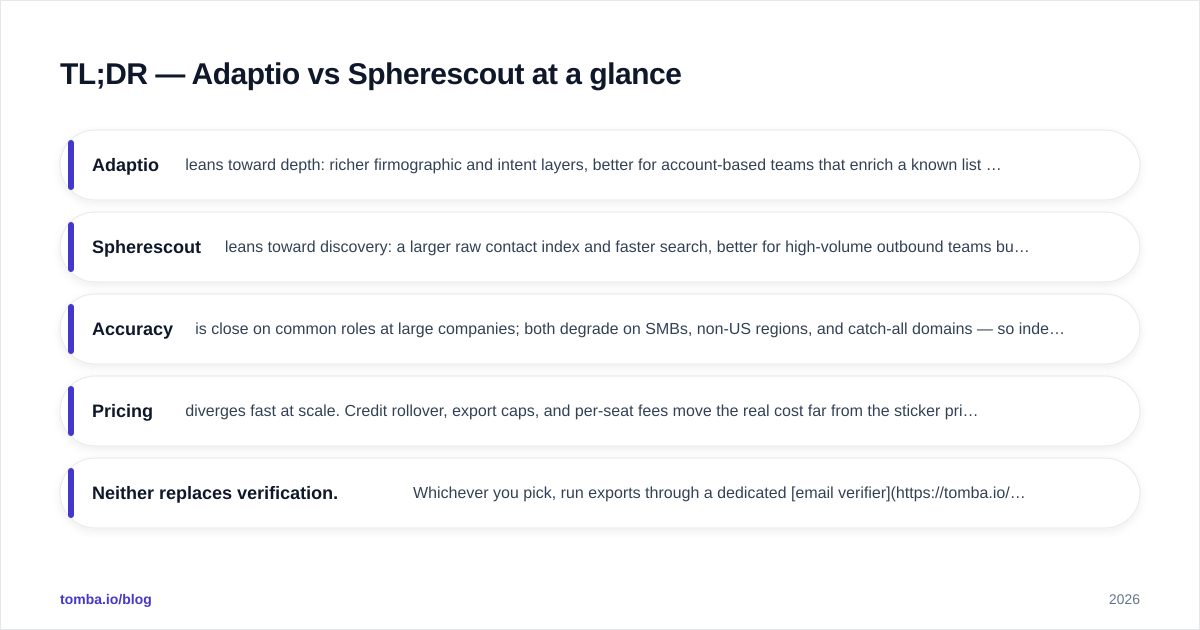
- Adaptio leans toward depth: richer firmographic and intent layers, better for account-based teams that enrich a known list and want context before the first touch.
- Spherescout leans toward discovery: a larger raw contact index and faster search, better for high-volume outbound teams building net-new lists from scratch.
- Accuracy is close on common roles at large companies; both degrade on SMBs, non-US regions, and catch-all domains — so independent verification matters more than either vendor's headline percentage.
- Pricing diverges fast at scale. Credit rollover, export caps, and per-seat fees move the real cost far from the sticker price.
- Neither replaces verification. Whichever you pick, run exports through a dedicated email verifier before you send, or your bounce rate will eat your sender reputation.
What are Adaptio and Spherescout?#
Both are B2B contact-data platforms. You give them a target — a domain, a name, a company, or a set of filters — and they return business email addresses, phone numbers, job titles, and company attributes you can push into your CRM or sequencer.
Adaptio positions itself as a sales-intelligence layer. The pitch is "know the account before you reach out": it pairs contact data with firmographics (headcount, revenue band, tech stack) and intent signals, then scores accounts so reps prioritize the warm ones. It's built for teams running an account-based motion where the list is semi-known and the goal is context.
Spherescout positions itself as a prospecting engine. The pitch is "find anyone, fast": a large searchable index, Boolean-style filtering, and bulk export designed to spin up net-new lists in minutes. It's built for outbound teams that burn through contacts and need volume with acceptable accuracy.
That difference in philosophy — enrich-what-you-know versus discover-what-you-don't — explains almost every downstream trade-off in pricing, accuracy, and workflow.
How do Adaptio and Spherescout compare on features?#
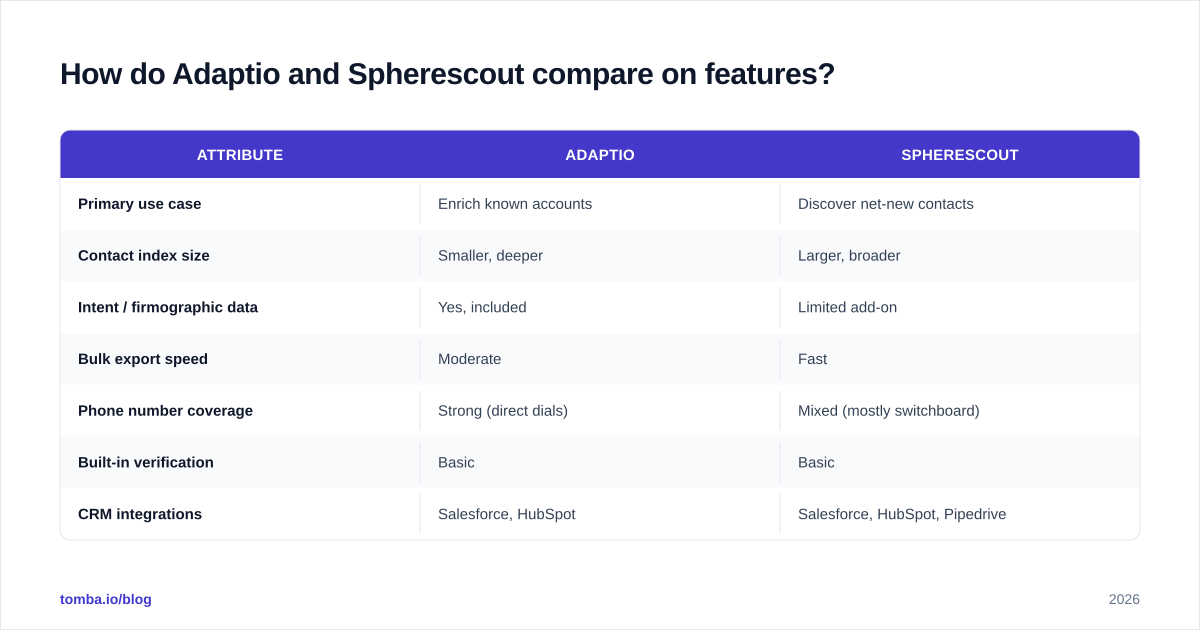
Here's the side-by-side on the attributes that actually change how a rep's day goes.
| Attribute | Adaptio | Spherescout |
|---|---|---|
| Primary use case | Enrich known accounts | Discover net-new contacts |
| Contact index size | Smaller, deeper | Larger, broader |
| Intent / firmographic data | Yes, included | Limited add-on |
| Bulk export speed | Moderate | Fast |
| Phone number coverage | Strong (direct dials) | Mixed (mostly switchboard) |
| Built-in verification | Basic | Basic |
| CRM integrations | Salesforce, HubSpot | Salesforce, HubSpot, Pipedrive |
| Chrome extension | Yes | Yes |
| API access | Higher tiers only | Mid tier and up |
| Best fit | ABM / mid-market AEs | SDR teams / high-volume outbound |
The pattern is consistent: Adaptio gives you more per contact, Spherescout gives you more contacts. Neither is "better" in the abstract — it depends on whether your bottleneck is who to call or what to say when you do.

Which tool is more accurate?#
Short answer: they're within a few points of each other on the easy cases, and both get worse on the same hard cases. Accuracy is not one number — it's a function of role seniority, company size, region, and domain type.
Where both do well: senior and mid-level roles at companies with 200+ employees in the US and UK. Where both struggle: sub-50-employee companies, generic role titles, EU contacts behind GDPR-driven opt-outs, and catch-all domains that accept every address and tell you nothing.
The honest takeaway is that a vendor's advertised "95% accuracy" is a ceiling measured on their best-case segment, not the rate you'll see on your list. The only number that matters is the one you measure on your ICP. Pull 100 contacts from each tool for your actual target segment, verify them independently, and compare. That ten-minute test beats any G2 star rating.

This is also why a verification step is non-negotiable regardless of which platform you choose. Even at 90% accuracy, one in ten sends bounces — and modern inbox providers read a high bounce rate as a spam signal that damages your email deliverability for every campaign after it. Treat the data tool and the verifier as two separate jobs, because they are.
How does pricing compare?#
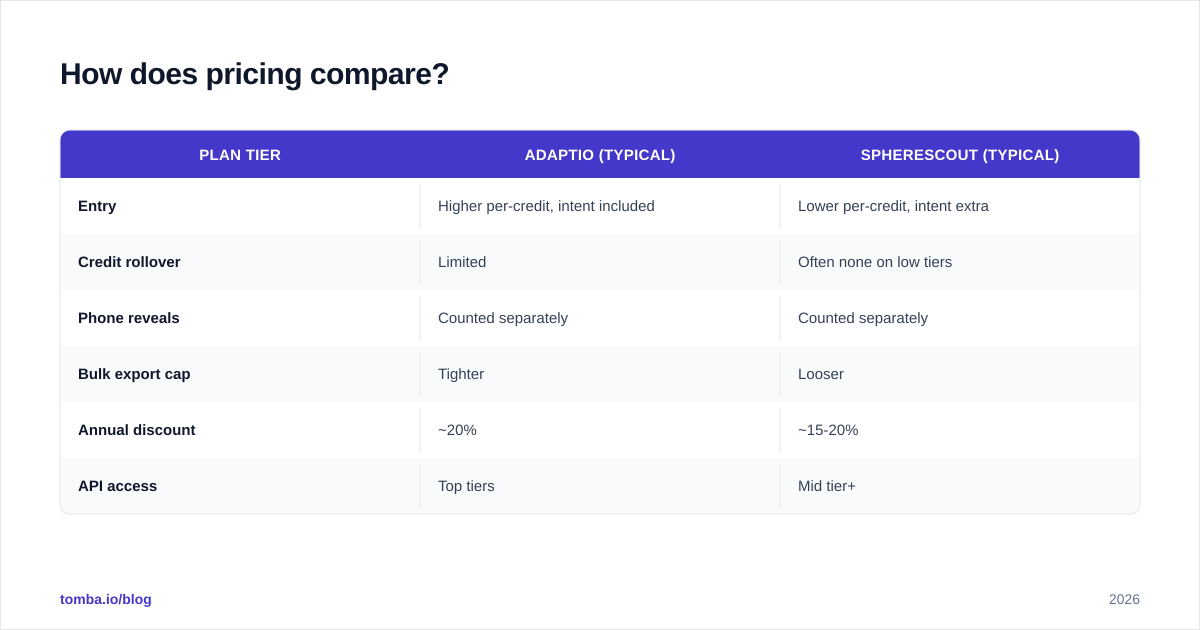
This is where the demo math and the renewal invoice diverge. Both vendors price on credits — one credit per revealed contact — plus per-seat fees, and both meter the things you don't notice until you hit them: export caps, phone-reveal surcharges, and credits that expire monthly instead of rolling over.
| Plan tier | Adaptio (typical) | Spherescout (typical) |
|---|---|---|
| Entry | Higher per-credit, intent included | Lower per-credit, intent extra |
| Credit rollover | Limited | Often none on low tiers |
| Phone reveals | Counted separately | Counted separately |
| Bulk export cap | Tighter | Looser |
| Annual discount | ~20% | ~15-20% |
| API access | Top tiers | Mid tier+ |
Two traps to check before you sign:
- Expiring credits. If unused credits vanish at month-end, a quiet month is money burned. Ask for rollover in writing.
- Phone surcharges. "Includes phone numbers" often means access to, not unlimited reveals of. Direct dials are usually metered separately and add up fast for calling teams.
For a transparent point of comparison, look at how a flat email-finder tool prices the same work — Tomba's pricing runs a free tier at 25 searches/month, Starter at $49/month, and Growth at $99/month, with the search-and-verify workflow bundled rather than nickel-and-dimed per phone reveal. The lesson isn't "Tomba is cheapest" — it's that you should normalize every quote to cost per verified, usable contact, not cost per credit.
Which one fits your sales motion?#
Match the tool to your bottleneck, not to the flashier demo.
Choose Adaptio if:
- You run account-based outbound and already have a target list.
- Reps need firmographic and intent context to personalize.
- Direct-dial phone coverage matters for a calling motion.
- You're mid-market or enterprise with longer, multi-threaded deals.
Choose Spherescout if:
- You're building net-new lists from filters every week.
- Volume and export speed matter more than per-contact depth.
- Your SDRs run high-throughput sequences.
- You want Pipedrive or a broader integration set out of the box.
Choose neither — or a lighter tool — if:
- You mostly need verified emails by domain or name, not a full intelligence suite. A focused email finder plus a verifier covers that at a fraction of the cost and complexity.

What do the data sources and compliance look like?#
Both platforms aggregate from a mix of public web crawling, partner data, user contributions, and pattern inference. That blend is industry-standard, but it has consequences worth understanding before you commit a sequence to it.
Inferred emails — generated from a company's known pattern (first.last@domain) rather than directly observed — inflate "coverage" numbers but carry higher bounce risk. Ask each vendor what share of returned emails are observed versus inferred, and whether inferred addresses are flagged. If they can't answer, assume the worst and verify everything.
On compliance, both claim GDPR and CCPA alignment, but the burden of lawful outreach sits with you, not the data vendor. Confirm there's a documented suppression and opt-out process, and that your own outreach has a legitimate-interest basis. For background on how this category works and where the data originates, third-party reviews on G2 and Capterra give you unfiltered user commentary that vendor pages won't, and the general concept is well summarized on Wikipedia's sales intelligence entry.

What does a clean evaluation process look like?#
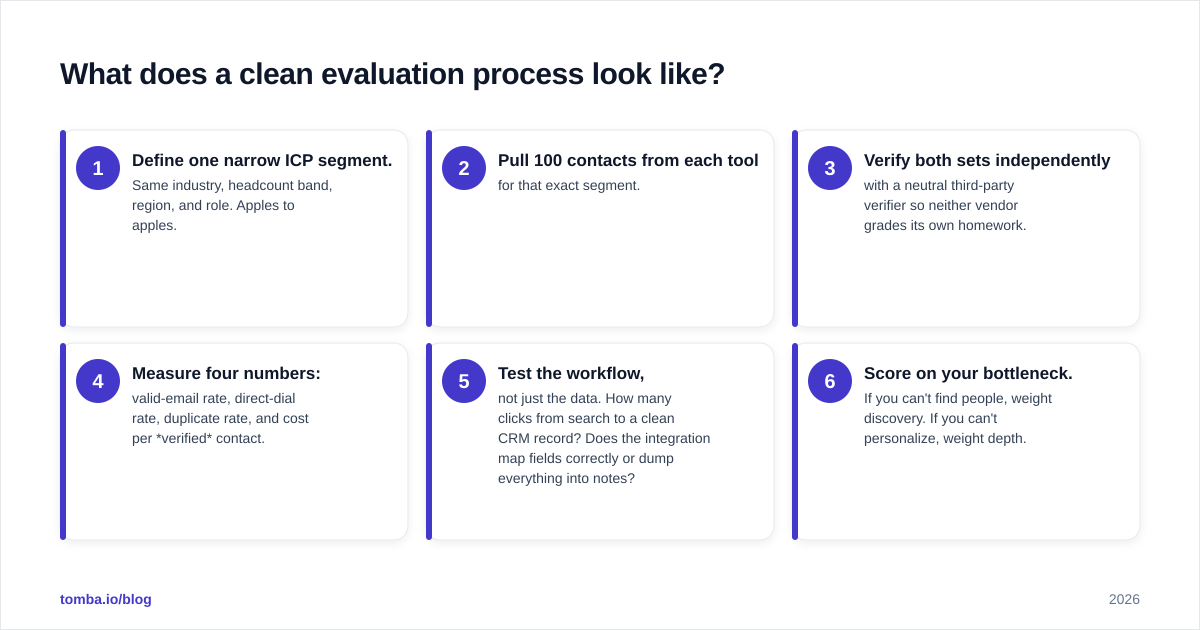
Don't pick from feature lists. Run a controlled bake-off. The process below takes a day and tells you more than a month of demos.
- Define one narrow ICP segment. Same industry, headcount band, region, and role. Apples to apples.
- Pull 100 contacts from each tool for that exact segment.
- Verify both sets independently with a neutral third-party verifier so neither vendor grades its own homework.
- Measure four numbers: valid-email rate, direct-dial rate, duplicate rate, and cost per verified contact.
- Test the workflow, not just the data. How many clicks from search to a clean CRM record? Does the integration map fields correctly or dump everything into notes?
- Score on your bottleneck. If you can't find people, weight discovery. If you can't personalize, weight depth.
This is also the moment to ask whether you need the full suite at all. Many teams discover their real need is "verified emails by domain, on demand, via API" — a job that a dedicated domain search and a programmable email finder API handle without a five-figure annual contract or a per-seat tax on every rep.
Adaptio vs Spherescout: the verdict#
There's no universal winner, and any post that declares one is selling something. Adaptio wins when context is your constraint — ABM teams enriching known accounts who need firmographics, intent, and direct dials to personalize a multi-threaded deal. Spherescout wins when volume is your constraint — SDR teams building net-new lists fast and feeding high-throughput sequences.
But the most common mistake isn't picking the wrong one of these two — it's buying a heavyweight intelligence suite when the actual job is "find and verify business emails reliably, then push them to my tools." If that's you, a focused email-finding stack will be cheaper, faster, and easier to govern than either platform.
Whichever direction you go, the verification step stays. The data tool finds candidates; verification decides what's safe to send. Skip it and your bounce rate quietly erodes the sender reputation you spent months building.
Try a focused alternative first#
Before you commit to Adaptio or Spherescout's annual contract, test whether you actually need the full suite. The Tomba Email Finder finds professional email addresses by domain, name, or company, pairs natively with a built-in verifier, and runs on a free tier (25 searches/month) so you can benchmark match rates against your own ICP before spending a dollar — then scales through a flat $49/month Starter and a clean API when you're ready to automate. Run the same 100-contact test described above against it. If a focused tool clears your bar, you've just saved your budget for the part of the funnel that actually needs the spend.
// get started
Find, verify and enrich your first contacts today
Start on the free plan with 25 searches a month, then scale when your team is ready.
Free plan · No credit card required · GDPR & CCPA
// about the author