Top 8 AdRoll Alternatives for B2B Retargeting in 2026
AdRoll pioneered retargeting, but it is no longer the obvious default. Here are 8 AdRoll alternatives compared on price, channels, and B2B fit for 2026.
TL;DR
- AdRoll is still a solid cross-channel retargeting platform, but its pricing, reporting depth, and B2B targeting now lag behind purpose-built rivals.
- For pure reach and lowest cost, native channels (Google Ads, Meta Ads) usually beat AdRoll on the same audiences.
- For B2B and account-based motions, StackAdapt, Demandbase, and LinkedIn Ads target firmographics AdRoll can't touch.
- The biggest leak in any retargeting program is anonymous traffic you never capture — pair ads with website visitor reveal and outbound email to close it.
- Use the comparison table below to match a tool to your budget, channels, and team size before you migrate.
What is AdRoll and why look for alternatives?#
AdRoll (a product of NextRoll) is a retargeting and prospecting platform that shows display, social, and email ads to people who already visited your site. It built its reputation on simple cross-channel retargeting for ecommerce and SMBs, bundling Google, Meta, and native display inventory behind one dashboard.
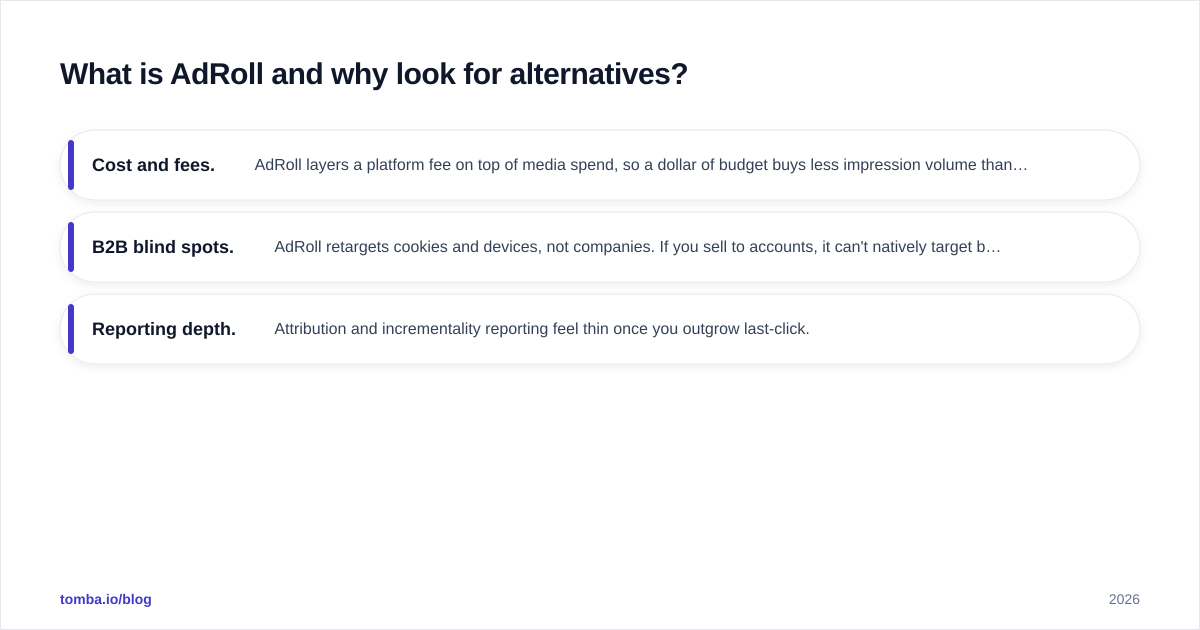
So why shop around? Three reasons keep coming up in G2 reviews and migration threads:
- Cost and fees. AdRoll layers a platform fee on top of media spend, so a dollar of budget buys less impression volume than running the same audience natively.
- B2B blind spots. AdRoll retargets cookies and devices, not companies. If you sell to accounts, it can't natively target by industry, company size, or buying committee.
- Reporting depth. Attribution and incrementality reporting feel thin once you outgrow last-click.
None of that makes AdRoll bad. It makes it one option among many. The right move is to match the platform to your funnel, not to chase the loudest brand.
How should you evaluate AdRoll alternatives?#
Before comparing logos, get honest about what you're actually buying. A retargeting tool is a bundle of four things: audience data, ad inventory, targeting controls, and reporting. AdRoll alternatives win or lose on how they stack those four layers.
Score each candidate against the criteria below:
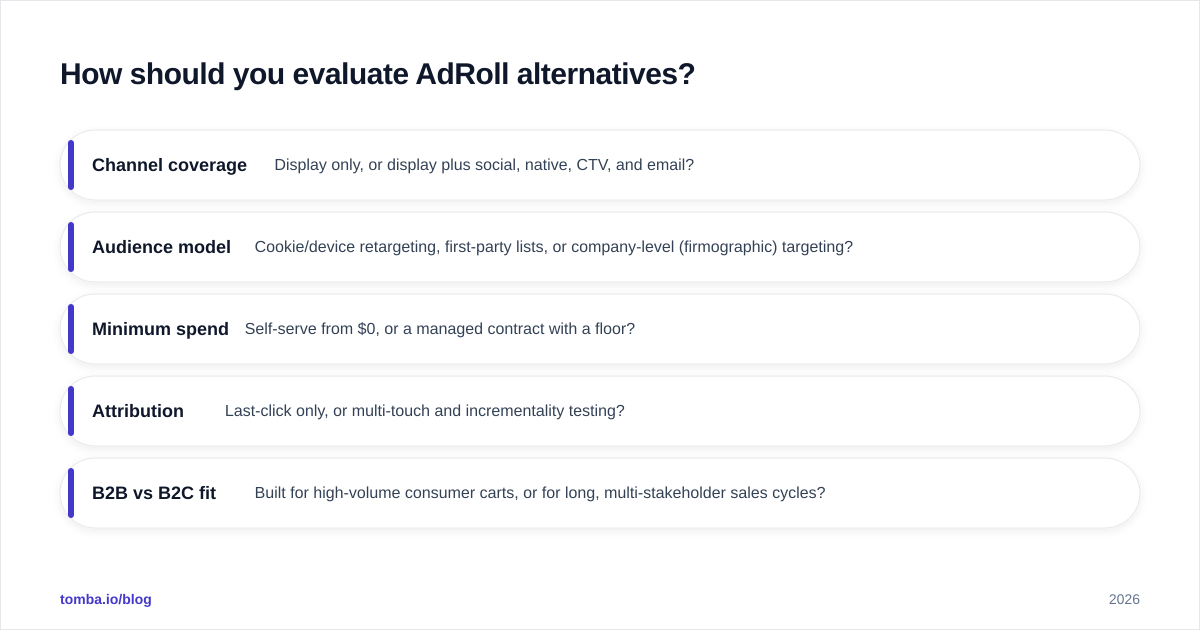
- Channel coverage — Display only, or display plus social, native, CTV, and email?
- Audience model — Cookie/device retargeting, first-party lists, or company-level (firmographic) targeting?
- Minimum spend — Self-serve from $0, or a managed contract with a floor?
- Attribution — Last-click only, or multi-touch and incrementality testing?
- B2B vs B2C fit — Built for high-volume consumer carts, or for long, multi-stakeholder sales cycles?
If you sell B2B, the audience model matters more than the channel count. A platform that retargets anonymous cookies will never tell you which company is in-market. That's a gap you close with data enrichment and outbound, not with a bigger ad budget.
What are the best AdRoll alternatives in 2026?#
Here are eight alternatives that consistently replace AdRoll, grouped by what they do best.
1. Google Ads (Display & Remarketing)#
The default for a reason. Google's Display Network reaches roughly 90% of internet users, and remarketing lists run natively with no platform markup. If AdRoll's main value to you was Google inventory, you can run the same audiences here and keep the fee. The trade-off is a steeper learning curve and no built-in cross-channel social.
2. Meta Ads (Facebook & Instagram)#
For B2C and SMB retargeting, Meta's pixel-based custom audiences are hard to beat on cost-per-impression and creative formats. AdRoll often resells Meta inventory, so going direct removes a middle layer. Weaker for B2B because targeting is interest- and behavior-based, not firmographic.
3. StackAdapt#
A programmatic powerhouse for native, display, video, and CTV. StackAdapt is the go-to AdRoll alternative for agencies and B2B teams that want premium inventory and genuinely good reporting. It supports company-level targeting through third-party data and has strong audience-building tools. Managed/self-serve hybrid with a higher entry point.
4. Criteo#
Built for commerce. Criteo's product-recommendation engine and dynamic retargeting are excellent for retail and marketplaces with large catalogs. If your retargeting is "show the exact product they viewed," Criteo's machine learning typically outperforms AdRoll. Less relevant for B2B lead gen.
5. LinkedIn Ads#
The only channel here that retargets by job title, company, seniority, and industry out of the box. For B2B, LinkedIn's website retargeting plus matched audiences turn anonymous traffic into account-aware campaigns. Expensive on a CPM basis, but the targeting precision is the whole point.
6. Demandbase#
A full account-based marketing (ABM) platform, not just a retargeter. Demandbase serves ads to target accounts whether or not they've visited your site, then ties ad exposure to pipeline. This is the enterprise B2B play — read our take on revenue operations to see where a tool like this fits in a modern GTM stack.
7. The Trade Desk#
An independent demand-side platform (DSP) with massive reach across display, CTV, audio, and the open internet. Best for sophisticated teams or agencies that want full programmatic control and data portability. Overkill for a small store; ideal if you've outgrown AdRoll's walled garden.
8. Perfect Audience#
Owned by the same parent (NextRoll) but positioned as a leaner, lower-friction retargeter for SMBs. If you like AdRoll's simplicity but want a cheaper, more focused tool, it's the closest like-for-like swap.
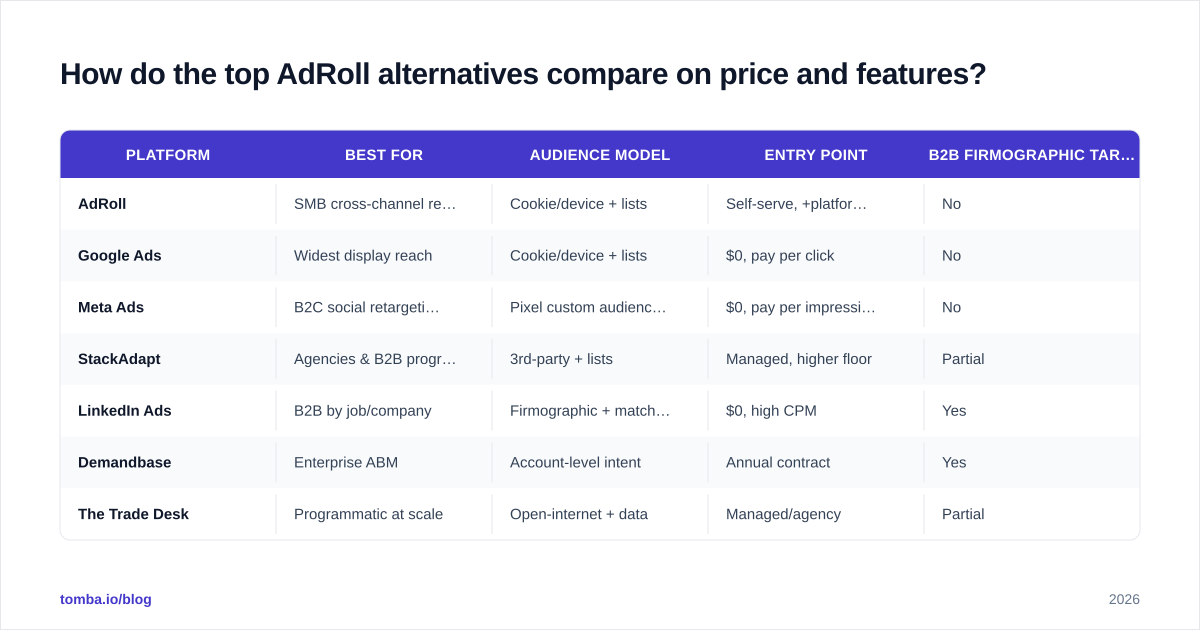
How do the top AdRoll alternatives compare on price and features?#
| Platform | Best for | Audience model | Entry point | B2B firmographic targeting |
|---|---|---|---|---|
| AdRoll | SMB cross-channel retargeting | Cookie/device + lists | Self-serve, +platform fee | No |
| Google Ads | Widest display reach | Cookie/device + lists | $0, pay per click | No |
| Meta Ads | B2C social retargeting | Pixel custom audiences | $0, pay per impression | No |
| StackAdapt | Agencies & B2B programmatic | 3rd-party + lists | Managed, higher floor | Partial |
| LinkedIn Ads | B2B by job/company | Firmographic + matched | $0, high CPM | Yes |
| Demandbase | Enterprise ABM | Account-level intent | Annual contract | Yes |
| The Trade Desk | Programmatic at scale | Open-internet + data | Managed/agency | Partial |
| Perfect Audience | Lean SMB retargeting | Cookie/device | Self-serve, low | No |
Pricing on ad platforms is mostly your media spend plus, in some cases, a platform fee or contract minimum. The real cost difference is the markup: native channels (Google, Meta, LinkedIn) take no reseller cut, while managed platforms add a layer in exchange for service and premium inventory.
Is AdRoll still worth it, or should you switch?#
Keep AdRoll if you're an SMB that values one dashboard over squeezing every dollar, and your funnel is straightforward B2C retargeting. The convenience is real.
Switch if any of these are true:
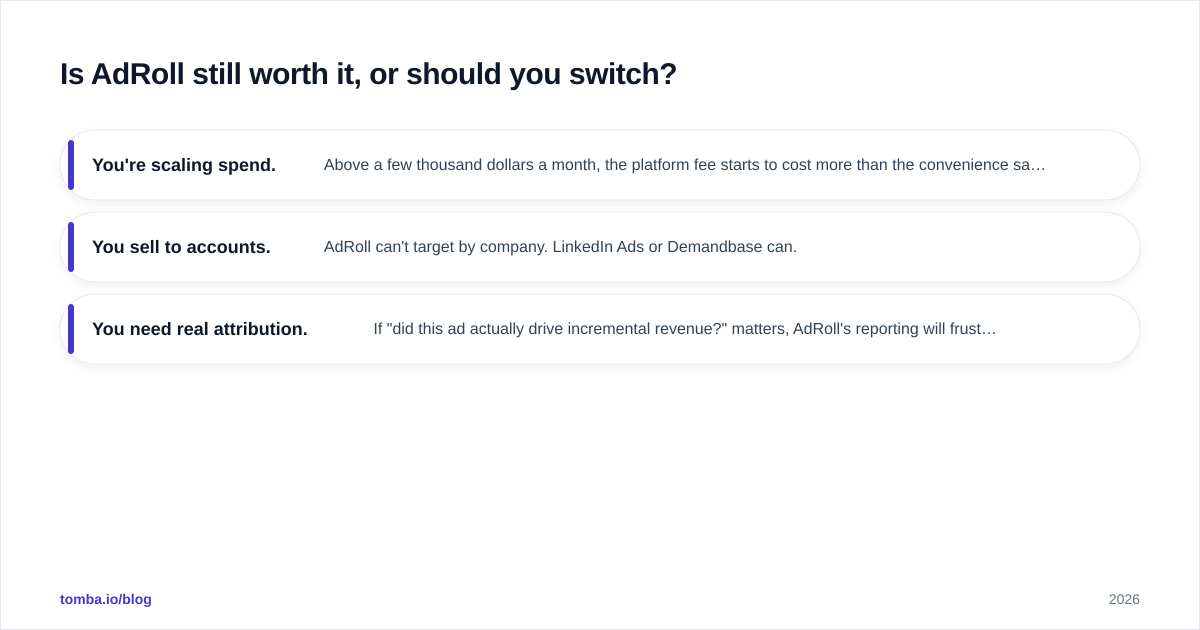
- You're scaling spend. Above a few thousand dollars a month, the platform fee starts to cost more than the convenience saves. Go native or to a DSP.
- You sell to accounts. AdRoll can't target by company. LinkedIn Ads or Demandbase can.
- You need real attribution. If "did this ad actually drive incremental revenue?" matters, AdRoll's reporting will frustrate you.
Don't migrate just to migrate. Run one audience in parallel on a candidate platform for 30 days, compare cost-per-result, and let the data decide.

What's the gap every retargeting tool leaves open?#
Here's the uncomfortable truth no ad platform advertises: retargeting only works on the small slice of visitors you can identify, and most of your traffic stays anonymous. Industry benchmarks put identifiable B2B web traffic well under 5% without extra tooling. You're paying to re-reach a fraction of the people who showed intent.
Two moves close that gap and they sit outside the ad platform:
- Identify the anonymous accounts. Use website visitor reveal to turn unknown traffic into named companies, so your retargeting and your sales team work the same list.
- Reach the buyers directly. Once you know the company, find the decision-maker's contact details and add an outbound touch. Display ads warm an account; a relevant email starts the conversation.
That's the layer AdRoll and its alternatives don't own. A retargeting pixel can't email a VP of Marketing — but you can, once you have the address. Pairing paid retargeting with first-party identification and outbound is what separates teams that "run ads" from teams that build pipeline.
How do you build the contact layer behind your ads?#
Retargeting tells you an account is interested. Outreach turns that interest into a meeting — but only if you can reach a real person. That's where an email finder comes in: feed it a company domain and a name, and you get a verified work email to follow up the ad impression with a direct message.
The workflow looks like this:
- Run retargeting on a candidate AdRoll alternative to stay top-of-mind.
- Reveal which companies are visiting and engaging.
- Find and verify the email of the right contact at each account.
- Send a personalized outbound sequence that references the value prop your ads promoted.
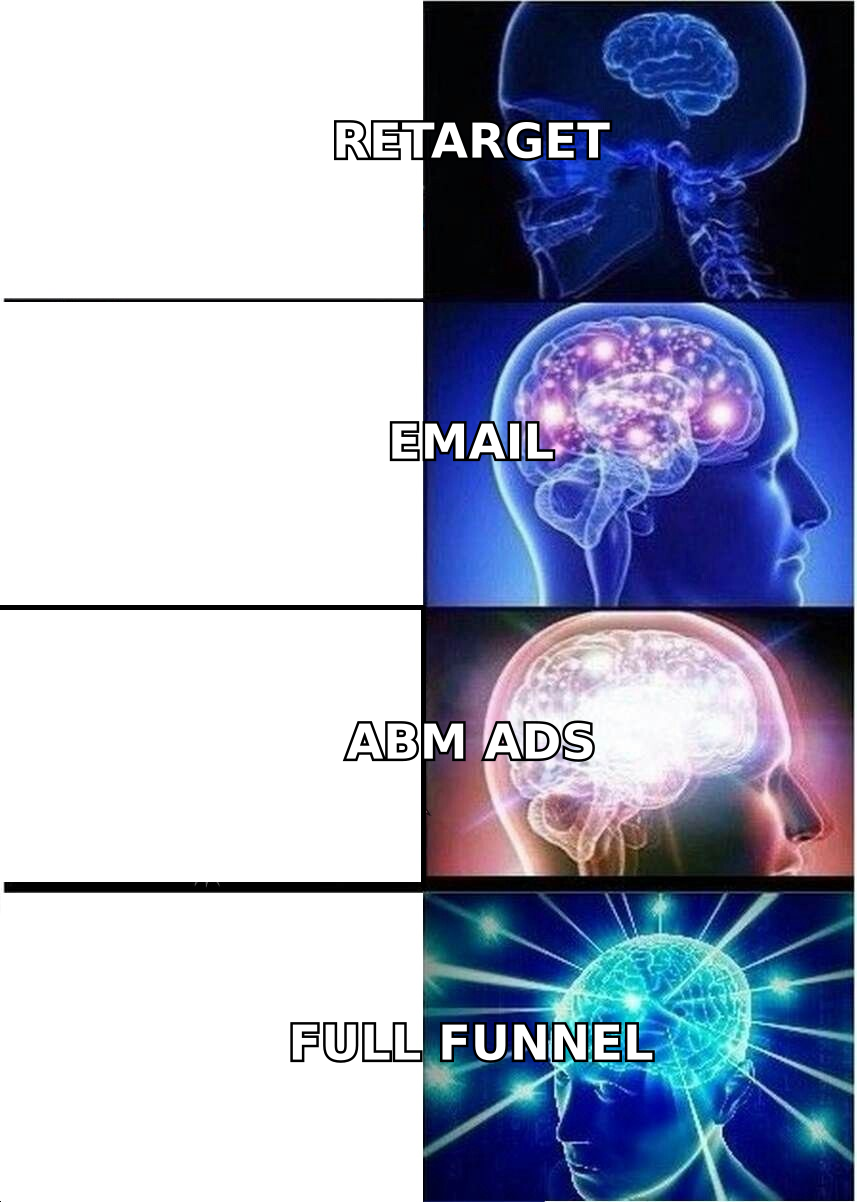
This is the full-funnel motion: ads create familiarity, identification creates a list, and verified contacts create conversations. No single ad platform does all three, which is exactly why the smartest teams treat "AdRoll vs alternative X" as only one decision in a larger stack.
If you want to benchmark the platforms themselves further, vendor docs and the official AdRoll site plus a category scan on HubSpot's marketing blog are good neutral starting points before you commit budget.
Final recommendation#
Pick your retargeting platform by funnel, not by brand: native channels for cheapest reach, StackAdapt or The Trade Desk for programmatic control, and LinkedIn Ads or Demandbase when you sell to accounts. Then plug the leak every one of them shares — anonymous, unreachable traffic.
Start by turning the companies behind your ad clicks into real, contactable people. Spin up a free Tomba account, point the Tomba Email Finder at the accounts your retargeting surfaces, and pair paid impressions with verified outbound. Check Tomba pricing — the free tier gives you 25 searches a month to test the workflow before you scale. Your ads bring them to the door; make sure you can actually reach the person inside.
Ready to find emails that actually work?
Join 150,000+ professionals who stopped guessing and started sending. Free credits on signup — no credit card required.
Get the Tomba newsletter
Practical outbound tactics and product updates — once every two weeks.
About the author