AdRoll Pricing, Reviews, Pros and Cons: 2026 Buyer Guide
A neutral 2026 breakdown of AdRoll pricing, real user reviews, and the honest pros and cons before you commit ad budget to the platform.
AdRoll has spent more than a decade selling one promise: catch the 95%-plus of visitors who leave your site without converting, and follow them across the web until they come back. That pitch still lands in 2026, but the pricing has changed, the feature set has widened into email and AI, and the reviews are more mixed than the homepage suggests. This guide weighs the real numbers so you can decide before the budget leaves your account.
TL;DR#
- AdRoll is a retargeting-first ad platform that also runs display, social, and email campaigns from one dashboard. Its core strength is cross-channel retargeting, not net-new prospecting.
- Pricing has two layers that trip up new buyers: a platform/plan fee plus the ad spend you pour into networks. The plan fee is the small number; ad spend is where budgets actually go.
- Reviews average roughly 4.0–4.4 stars on G2 and Capterra. Praise clusters around ease of setup and retargeting ROAS; complaints cluster around billing friction, support, and contract terms.
- Best fit: ecommerce and mid-market B2C brands that already have traffic to retarget. Weak fit: early-stage B2B teams that need to find contacts before they can advertise to them.
- The data gap: AdRoll retargets people who already visited. To fill the top of the funnel, pair it with a dedicated email finder and enrichment layer.
What is AdRoll and what does it actually do?#
Think of AdRoll as a follow-up engine, not a lead magnet. A lead magnet attracts strangers; a follow-up engine re-engages people who already raised their hand. AdRoll's pixel sits on your site, watches who browses, and then serves those visitors ads on display networks, Facebook, Instagram, and increasingly through email — so a shopper who abandoned a cart sees your product again on a news site an hour later.
The platform bundles four jobs that brands used to buy separately:
- Retargeting / display ads across the Google, Microsoft, and partner ad exchanges.
- Social ads managed inside the same console as your display campaigns.
- Email marketing and abandoned-cart automation, added to move AdRoll from pure ads into lifecycle marketing.
- AI optimization and audience tools that allocate spend toward the segments most likely to convert.
That consolidation is the selling point. Whether it justifies the cost depends entirely on how you read the pricing — so let's break it down.
How does AdRoll pricing work in 2026?#
The headline: AdRoll charges a plan fee and your media spend separately, and the plan fee is the part most reviews under-explain. When someone says "AdRoll is cheap" or "AdRoll is expensive," they are usually talking about different layers.
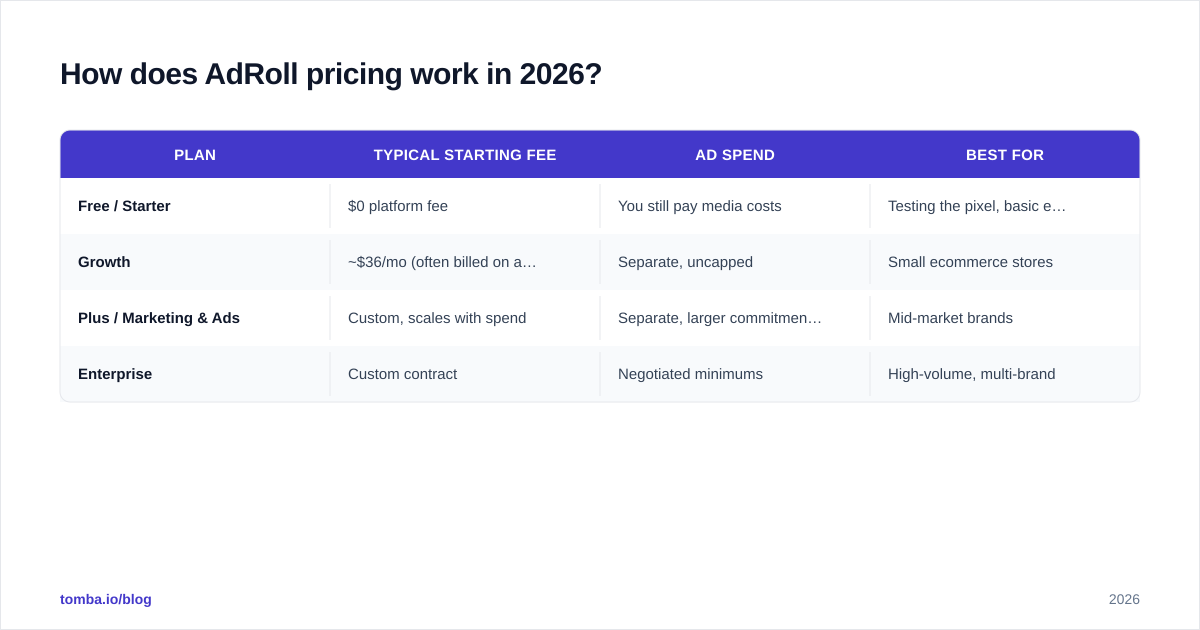
AdRoll has restructured its tiers several times, so treat any number — including the ones below — as a starting reference and confirm current rates on the official AdRoll pricing page before you sign. As of early 2026, the structure looks like this:
| Plan | Typical starting fee | Ad spend | Best for |
|---|---|---|---|
| Free / Starter | $0 platform fee | You still pay media costs | Testing the pixel, basic email |
| Growth | ~$36/mo (often billed on a spend %) | Separate, uncapped | Small ecommerce stores |
| Plus / Marketing & Ads | Custom, scales with spend | Separate, larger commitments | Mid-market brands |
| Enterprise | Custom contract | Negotiated minimums | High-volume, multi-brand |
Two things matter more than the exact tier names:
- The plan fee is a fraction of total cost. A "$36/month" plan can easily sit on top of thousands in monthly ad spend. The platform fee buys you the software; the conversions come from the media budget underneath it.
- Some plans bill as a percentage of spend rather than a flat number, which means your effective cost rises as you scale — a detail that surprises buyers who modeled a fixed line item.
If you are evaluating AdRoll purely as a software line item, you are measuring the wrong thing. Model the blended cost: plan fee + expected monthly ad spend + the management time your team spends in the dashboard.
Is AdRoll worth it? Reading the reviews honestly#
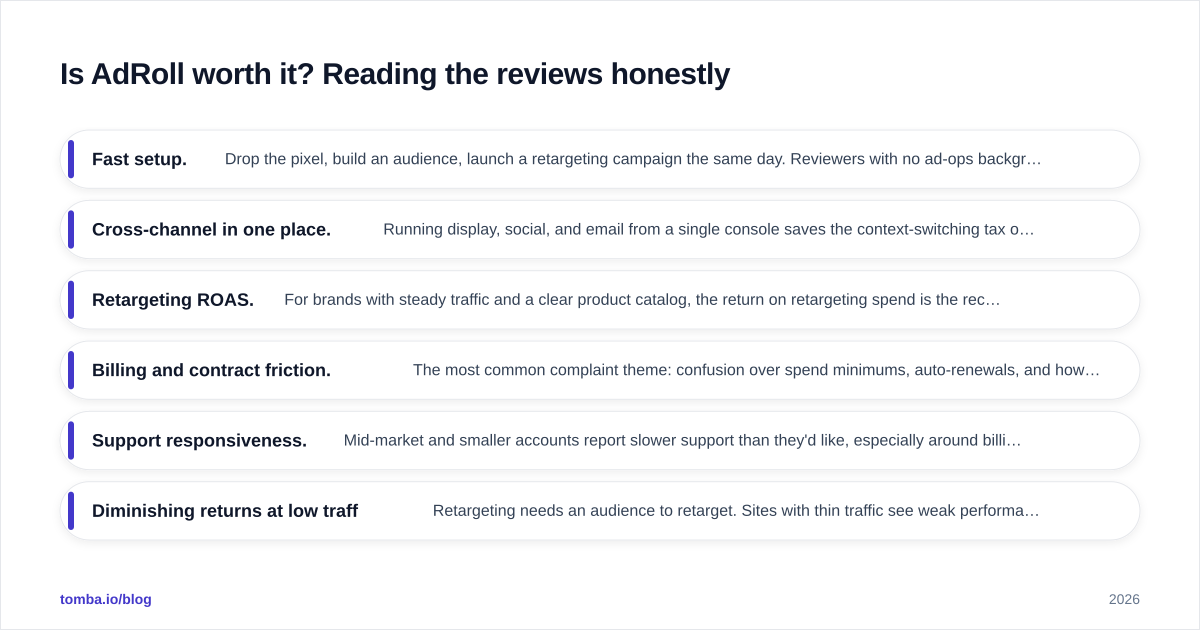
Across G2 and Capterra, AdRoll lands in the low-to-mid 4-star range — solid, not spotless. The pattern in the written reviews is more useful than the average score.
What reviewers consistently praise:
- Fast setup. Drop the pixel, build an audience, launch a retargeting campaign the same day. Reviewers with no ad-ops background repeatedly call this the platform's best quality.
- Cross-channel in one place. Running display, social, and email from a single console saves the context-switching tax of stitching together three tools.
- Retargeting ROAS. For brands with steady traffic and a clear product catalog, the return on retargeting spend is the recurring win story.
What reviewers consistently criticize:
- Billing and contract friction. The most common complaint theme: confusion over spend minimums, auto-renewals, and how plan fees interact with media costs. Read the terms before you commit.
- Support responsiveness. Mid-market and smaller accounts report slower support than they'd like, especially around billing disputes.
- Diminishing returns at low traffic. Retargeting needs an audience to retarget. Sites with thin traffic see weak performance and still pay the platform fee.
The honest read: AdRoll earns its stars when you already have an audience to chase and a catalog worth advertising. It earns its 1-star reviews when buyers expected net-new demand and got a retargeting tool with a billing model they didn't fully map.
What are the pros and cons of AdRoll?#
Here is the balanced ledger, pulled from the review patterns above and the platform's own positioning.
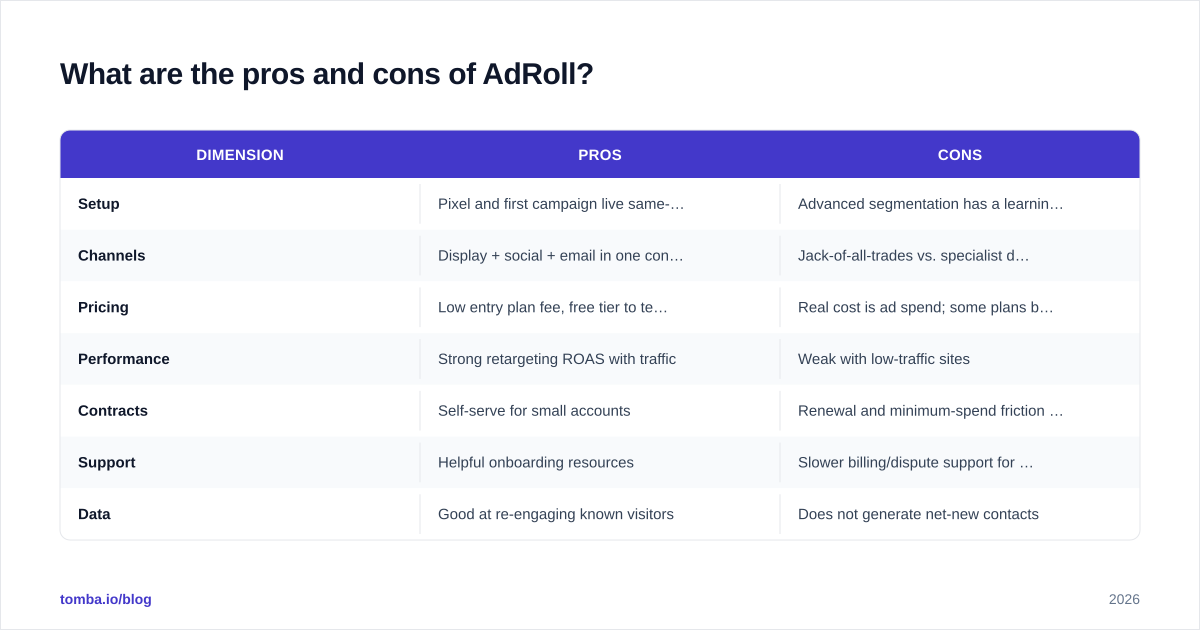
| Dimension | Pros | Cons |
|---|---|---|
| Setup | Pixel and first campaign live same-day | Advanced segmentation has a learning curve |
| Channels | Display + social + email in one console | Jack-of-all-trades vs. specialist depth |
| Pricing | Low entry plan fee, free tier to test | Real cost is ad spend; some plans bill on % |
| Performance | Strong retargeting ROAS with traffic | Weak with low-traffic sites |
| Contracts | Self-serve for small accounts | Renewal and minimum-spend friction reported |
| Support | Helpful onboarding resources | Slower billing/dispute support for SMBs |
| Data | Good at re-engaging known visitors | Does not generate net-new contacts |
That last row is the one B2B teams underrate. AdRoll is excellent at the bottom of the funnel — converting people who already know you. It does nothing for the top of the funnel, where you need names, companies, and verified email addresses to start a relationship in the first place.
How does AdRoll compare to the alternatives?#
AdRoll competes in a crowded retargeting and ad-management space. The right comparison depends on whether you want a retargeting specialist or a broader ad platform.
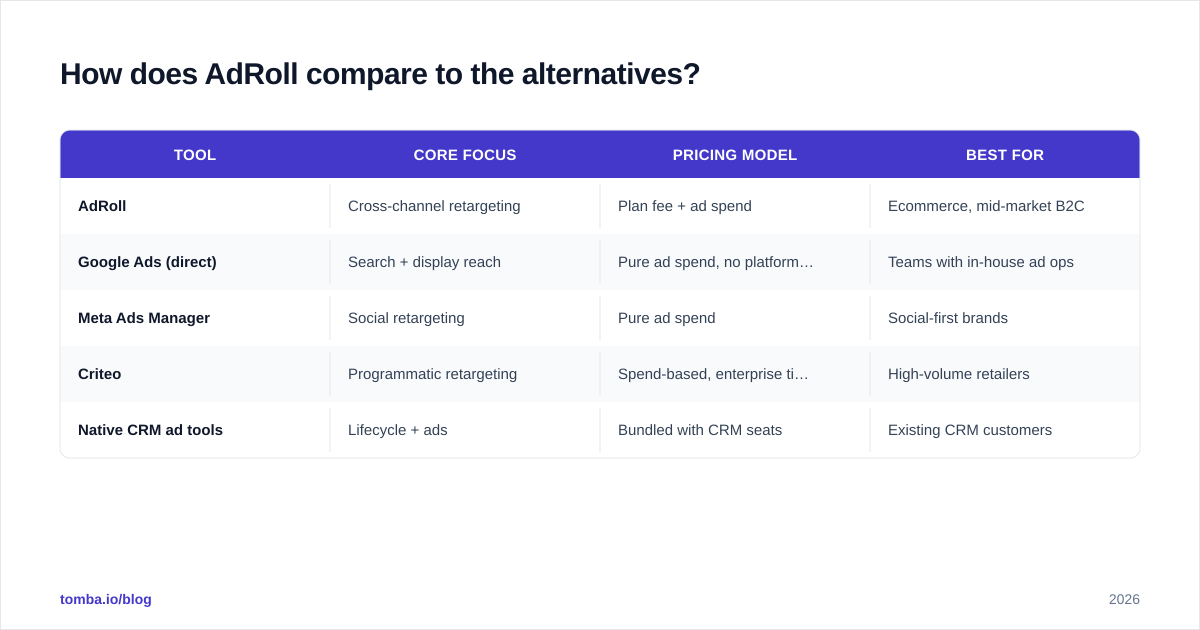
| Tool | Core focus | Pricing model | Best for |
|---|---|---|---|
| AdRoll | Cross-channel retargeting | Plan fee + ad spend | Ecommerce, mid-market B2C |
| Google Ads (direct) | Search + display reach | Pure ad spend, no platform fee | Teams with in-house ad ops |
| Meta Ads Manager | Social retargeting | Pure ad spend | Social-first brands |
| Criteo | Programmatic retargeting | Spend-based, enterprise tilt | High-volume retailers |
| Native CRM ad tools | Lifecycle + ads | Bundled with CRM seats | Existing CRM customers |
For B2C retailers, AdRoll's convenience layer over Google and Meta is often worth the fee — you trade a margin for a simpler dashboard and built-in automation. For sophisticated teams that already run ads directly, that same layer can feel like paying for a wrapper around channels you could manage yourself. There's no universal winner; there's only fit. If you want a sense of how vendors are scored in adjacent categories, Gartner and the review aggregators above are better neutral references than any single vendor's case studies.

Where AdRoll stops — and what to pair it with#
Here's the strategic gap in one sentence: AdRoll can only market to people who have already found you. It re-engages site visitors and existing audiences. It does not build a prospect list, find decision-makers at target accounts, or verify whether an address will actually receive your email.
For a B2B motion, that gap is the whole game. Before retargeting can work, you need to fill the funnel:
- Find the right contacts at companies that match your ICP, instead of waiting for them to wander onto your site. A purpose-built domain search returns the email patterns and named contacts for any company.
- Verify deliverability so your outreach and email campaigns don't tank your sender reputation. An email verifier catches invalid and risky addresses before they bounce.
- Enrich what you already have so retargeting audiences and CRM records carry firmographic context. Data enrichment turns a bare email into a usable lead profile.
A realistic 2026 stack looks like this: use an email finder and verifier to source and clean your prospect list, run outbound to open the conversation, drive interested prospects to your site, and then let AdRoll retarget the ones who didn't convert on the first visit. AdRoll is the closer at the bottom of the funnel; it needs a sourcing engine at the top. Compare your options on the Tomba pricing page — the free tier covers 25 searches a month so you can test the sourcing half of the equation before spending on ads.
Frequently asked questions#
Is AdRoll free? There's a free tier that lets you install the pixel and test basic features, but you still pay for any media you run. The free plan is a trial layer, not a free advertising program.
Why is my AdRoll bill higher than the plan price? Because the plan fee and ad spend are billed separately, and some plans scale as a percentage of spend. The platform fee is the small number; your media budget is the large one.
Is AdRoll good for B2B? It's good for retargeting B2B visitors you already have. It's a poor fit if your real need is finding and reaching net-new contacts — that's a job for an email finder and enrichment tool, not a retargeting platform.
What's the biggest complaint in AdRoll reviews? Billing and contract friction — spend minimums, renewals, and confusion over how fees stack on ad spend. Read the terms carefully before committing.
Does AdRoll find email addresses? No. It sends email campaigns to contacts you already own, but it does not source or verify new addresses.
The bottom line#
AdRoll is a capable retargeting and cross-channel ad platform that earns its mid-4-star reviews when you already have traffic and a catalog worth advertising. Weigh the pricing as a blended number — plan fee plus ad spend — not a software line item, and read the contract terms that drive most of the negative reviews. It is a closer, not a prospector.
If your funnel is starving at the top, fix that first. Use the Tomba Email Finder to source verified, ICP-matched contacts, clean them with the verifier, and enrich them into real leads — then let retargeting do what it does best on the visitors you've earned. Start free with 25 searches a month and build the sourcing engine that makes every downstream ad dollar work harder.
// get started
Find, verify and enrich your first contacts today
Start on the free plan with 25 searches a month, then scale when your team is ready.
Free plan · No credit card required · GDPR & CCPA
// about the author