Advanced Lead Generation in 2026: Strategies That Convert
Spray-and-pray is dead. This 2026 playbook breaks down advanced lead generation tactics — intent data, waterfall enrichment, and visitor reveal — that actually fill pipeline.
TL;DR
- Advanced lead generation in 2026 is about signals first, volume second — you trigger outreach on intent and fit, not on a static list you bought last quarter.
- A waterfall enrichment stack (multiple data sources cascaded) beats any single provider on coverage and keeps your cost-per-verified-contact down.
- Website visitor reveal turns anonymous traffic you already paid for into named accounts — usually the highest-converting source you're ignoring.
- Verification is non-negotiable: a 30% bounce rate quietly destroys sender reputation and torches the whole channel.
- Tooling matters, but the framework matters more. Get the operating model right, then automate it.
What is advanced lead generation in 2026?#
Advanced lead generation is the practice of generating qualified pipeline from behavioral and firmographic signals rather than from broad, static lists. The short version: you stop asking "who can I email?" and start asking "who is showing buying behavior right now, and do they match my ICP?"
Think of basic lead gen like fishing with a net dragged across the whole lake — you catch everything, most of it useless, and you exhaust yourself sorting the catch. Advanced lead gen is fishing with sonar. You see where the fish are, what kind they are, and you cast once. Technically, that "sonar" is a combination of intent data, technographic filters, engagement signals, and real-time enrichment that scores a contact before a rep ever touches it.
The shift happened because buyers changed. Gartner research has shown B2B buyers spend the majority of their journey doing independent research before they ever talk to sales. By the time someone fills out a form, they've often already shortlisted vendors. So the modern game is detecting interest earlier — before the form, before the demo request — and reaching the right person with context.
How is it different from traditional lead generation?#
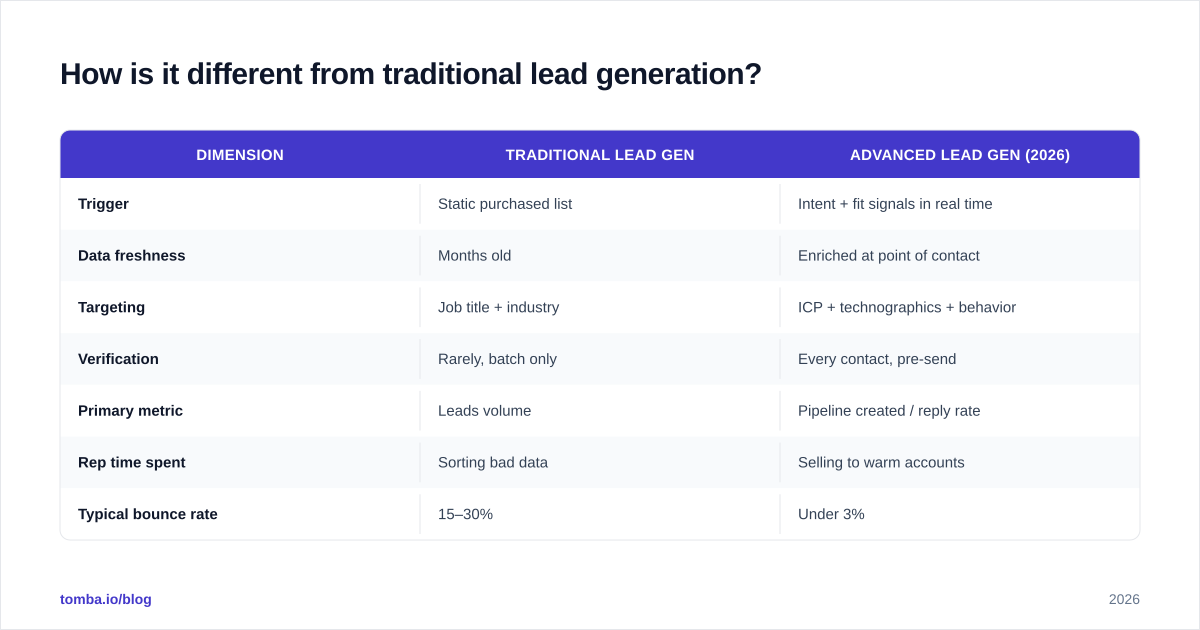
The difference is where the intelligence sits. Traditional lead gen front-loads volume and hopes conversion sorts itself out downstream. Advanced lead gen front-loads qualification so that everything downstream — outreach, nurture, sales time — is spent on accounts with a real chance of closing.
| Dimension | Traditional lead gen | Advanced lead gen (2026) |
|---|---|---|
| Trigger | Static purchased list | Intent + fit signals in real time |
| Data freshness | Months old | Enriched at point of contact |
| Targeting | Job title + industry | ICP + technographics + behavior |
| Verification | Rarely, batch only | Every contact, pre-send |
| Primary metric | Leads volume | Pipeline created / reply rate |
| Rep time spent | Sorting bad data | Selling to warm accounts |
| Typical bounce rate | 15–30% | Under 3% |
The practical consequence: a smaller, sharper list outperforms a bloated one. A team emailing 300 well-researched, verified, in-market contacts will almost always beat a team blasting 5,000 cold names — better reply rates, better email deliverability, and a sender reputation that survives to send another day.
What signals actually predict a buying intent?#
Not all signals are equal. The ones worth building workflows around fall into three buckets.
First-party signals — behavior on your own properties. Pricing-page visits, repeat sessions, demo-video completion, doc-site activity. These are the strongest because they're un-fakeable interest in your product. The problem is most of this traffic is anonymous, which is where visitor reveal comes in (more below).
Second-party signals — engagement with your content off-site: webinar sign-ups, review-site activity on G2 or Capterra, opening and clicking your sequences. A prospect comparing you against a competitor on a review platform is deep in evaluation.
Third-party intent — aggregated behavior across the wider web that suggests a topic is "hot" inside an account. Useful as a top-of-funnel prioritizer, weaker as a standalone trigger because it's account-level, not person-level.
The mistake teams make is treating any single signal as a green light. A pricing-page visit from someone who doesn't match your ICP is noise. The score that matters is signal × fit. Build your routing so that a high-fit account showing a strong first-party signal jumps the queue, and everything else waits.
How do you build an advanced lead generation stack?#
You build it in layers, and each layer feeds the next. Here's the operating model.
Layer 1 — Define and encode the ICP. Write down the firmographics (size, industry, geo), the technographics (do they run the tools your product complements?), and the trigger events (funding, hiring, leadership change). Encode this as filters, not as a vibe. If your ICP lives only in a rep's head, it doesn't scale.
Layer 2 — Capture signals. Instrument your site, connect your review-site and webinar data, and layer in intent. The goal is a single stream of "account X did thing Y at time Z."
Layer 3 — Identify the humans. A signal at the account level is useless until you have a named, reachable person. This is the enrichment and contact-discovery layer — turning "Acme Corp visited pricing" into "Jordan Lee, VP Eng at Acme, jordan@acme.com, verified." A reliable email finder is the workhorse here; pair it with data enrichment to fill in title, seniority, and LinkedIn.
Layer 4 — Verify. Run every address through an email verifier before it touches a sequence. This single step protects deliverability more than any subject-line trick.
Layer 5 — Route and personalize. High-fit + high-signal goes to a rep with full context. Lower-tiers go into automated nurture. The personalization writes itself when the context is rich — you reference the actual trigger, not a generic opener.
What is waterfall enrichment and why does it matter?#
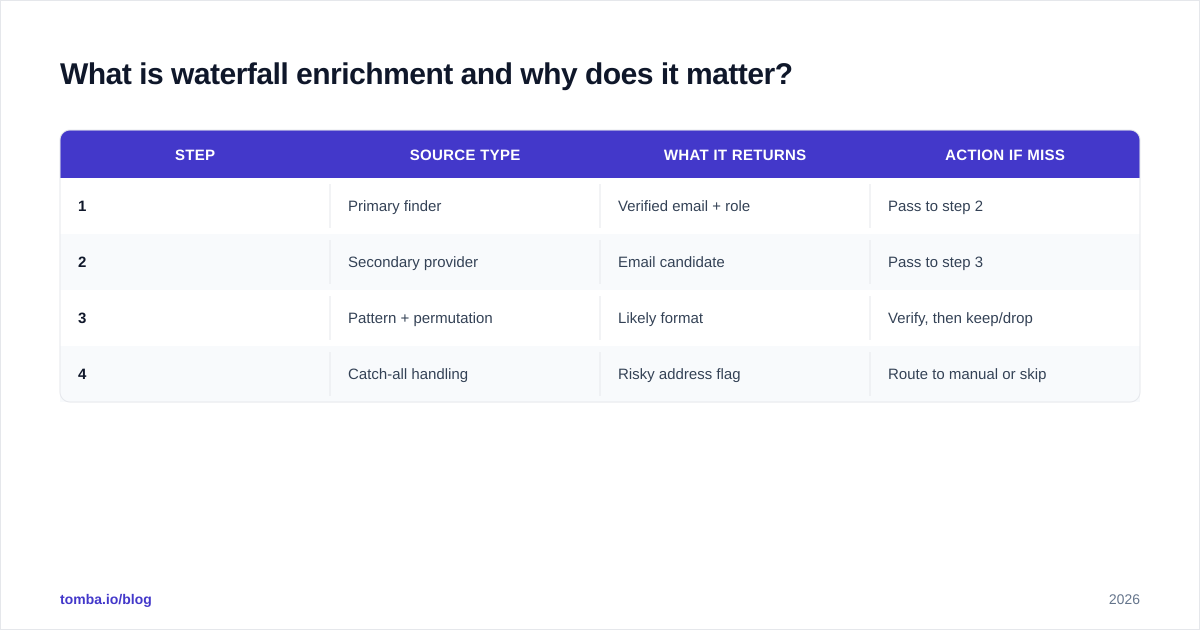
Waterfall enrichment is the practice of querying multiple data providers in sequence — when the first source can't find or verify a contact, the request "falls" to the next. The point is coverage: no single vendor has complete, accurate data for every region and role, so you cascade.
A simplified cascade looks like this:
| Step | Source type | What it returns | Action if miss |
|---|---|---|---|
| 1 | Primary finder | Verified email + role | Pass to step 2 |
| 2 | Secondary provider | Email candidate | Pass to step 3 |
| 3 | Pattern + permutation | Likely format | Verify, then keep/drop |
| 4 | Catch-all handling | Risky address flag | Route to manual or skip |
The economics are the reason this wins. You pay your cheapest, highest-accuracy source first and only spend on additional lookups for the contacts it misses. Done well, a waterfall pushes verified-contact coverage well past what any single tool delivers, while keeping blended cost-per-contact low. For volume work, a bulk email finder plus a verification pass is the backbone of the cascade.
One caveat: catch-all domains. These accept any address at the SMTP layer, so a normal verifier can't confirm them. Handle them explicitly with a catch-all verifier rather than dumping them into your main list, where they'll quietly inflate your bounce rate.
How do you turn anonymous website traffic into leads?#
You install visitor identification, and you reveal the companies — sometimes the individuals — behind sessions that never filled out a form. Most B2B sites convert 2–4% of traffic. The other 96%+ is paid-for attention walking out the door anonymously.
Website visitor reveal matches IP and device signals against a B2B database to surface the company, then you enrich to find the right contact. The workflow:
- A high-fit account visits your pricing or product page.
- Reveal names the account; enrichment names the decision-maker.
- The contact is verified and routed to a rep with the page they viewed as context.
- The rep reaches out referencing the actual interest — not a cold opener.
This is often the single highest-ROI advanced tactic because the intent is first-party and red-hot. The person was on your pricing page. You're not interrupting; you're following up. HubSpot's own research on response timing has long shown that speed-to-lead is decisive — reaching out within minutes of a signal dramatically outperforms next-day follow-up. (HubSpot on lead response time.)
What metrics tell you it's working?#
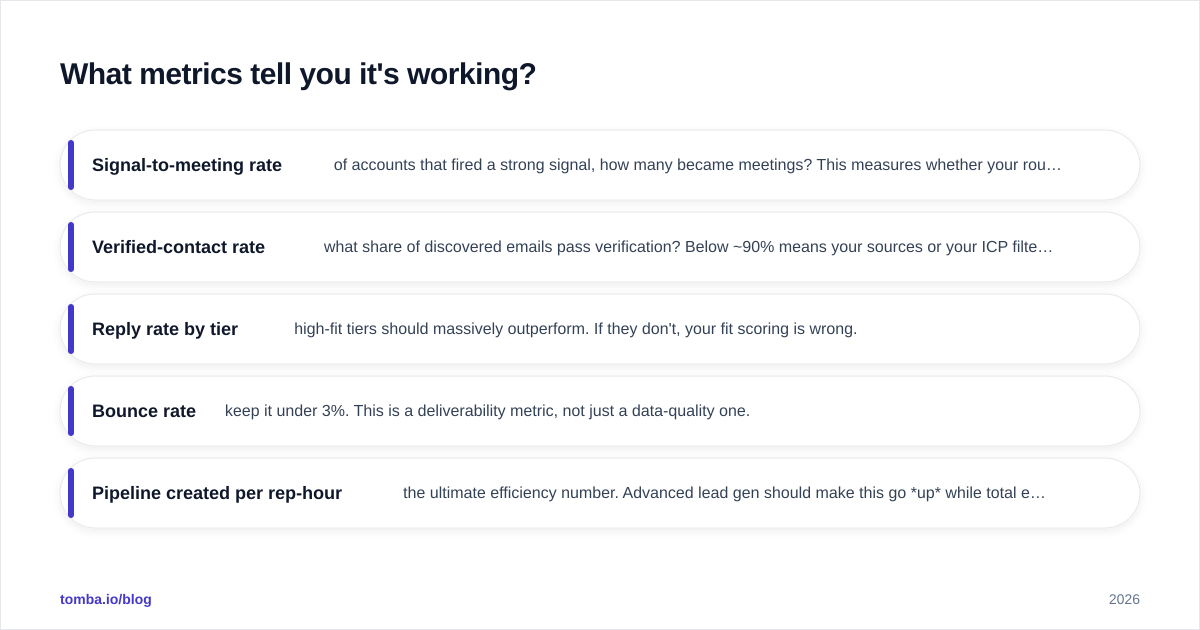
Stop reporting raw lead counts. They reward volume and hide quality problems. Track the chain from signal to revenue instead.
- Signal-to-meeting rate — of accounts that fired a strong signal, how many became meetings? This measures whether your routing and outreach are good.
- Verified-contact rate — what share of discovered emails pass verification? Below ~90% means your sources or your ICP filters need work.
- Reply rate by tier — high-fit tiers should massively outperform. If they don't, your fit scoring is wrong.
- Bounce rate — keep it under 3%. This is a deliverability metric, not just a data-quality one.
- Pipeline created per rep-hour — the ultimate efficiency number. Advanced lead gen should make this go up while total emails sent go down.
If you only watch one thing as you transition from traditional to advanced, watch response rate. When targeting and personalization improve together, replies climb before revenue does — it's your earliest leading indicator.
What are the common mistakes to avoid?#
Buying volume instead of building signal. A 100,000-row list feels productive and converts like a brick. Coverage of the right accounts beats coverage of all accounts.
Skipping verification to "save time." Unverified sends are the fastest way to land in spam folders. One bad campaign can degrade sender reputation for weeks. Verification is cheaper than recovery.
Over-automating the human layer. Automate discovery, enrichment, verification, and routing. Do not fully automate the message when the account is high-value — the whole advantage of signal-based outreach is that you can be specific, and generic automation throws that away.
Treating intent as a guarantee. Intent raises probability; it doesn't promise a deal. Keep fit filters strict even when a signal looks exciting.
Ignoring catch-all and role-based addresses. info@ and support@ aren't leads. Filter them, and handle catch-all domains deliberately.
How does this fit different team sizes?#
A two-person startup and a 50-rep org run the same framework at different intensities. The startup might manually reveal visitors and enrich the top 20 accounts a week — high-touch, low-volume, every message hand-written. The enterprise automates the cascade across thousands of signals daily and reserves human writing for the top tier.
The framework doesn't change; the throughput does. That's the point of building it as layers — you can dial each one up without re-architecting. Check Tomba pricing to match the volume tier to your stage: the Free tier (25 searches/mo) is enough to pilot the workflow, Starter at $49/mo covers a working solo motion, and Growth at $99/mo supports a small team running the full cascade.
Put the playbook to work#
Advanced lead generation isn't a tool you buy — it's an operating model where signal and fit drive every action, and clean, verified data makes the model trustworthy. Start by instrumenting one signal source, enriching the accounts it surfaces, and verifying every contact before you send. Measure signal-to-meeting, not lead count.
When you're ready to wire up the discovery-and-verification core of that stack, the Tomba Email Finder is built for exactly this: find the right contact by name, company, or domain, verify it on the spot, and push clean, deliverable records into your sequences. Pilot it on the free tier, prove the workflow on your highest-fit accounts, and scale the cascade from there. Better pipeline starts with better data — build that foundation first.
// get started
Find, verify and enrich your first contacts today
Start on the free plan with 25 searches a month, then scale when your team is ready.
Free plan · No credit card required · GDPR & CCPA
// about the author