AdvizorPro vs DealSignal 2026: B2B Data Platform Compared
AdvizorPro vs DealSignal compared on coverage, accuracy, pricing, and use cases — plus where a dedicated email finder fits your 2026 GTM stack.
Choosing between AdvizorPro and DealSignal usually comes down to one question: do you sell to financial advisors, or do you sell to everyone else? The two platforms look similar on a feature grid — both promise enriched B2B contacts, both push "verified" data — but they are built for very different buyers. This guide breaks down where each one wins, what you actually pay, and where a focused email finder fills the gaps neither tool was designed to cover.
TL;DR#
- AdvizorPro is a niche data platform purpose-built for selling into wealth management, RIAs, broker-dealers, and insurance — deep advisor profiles, AUM, licensing, and regulatory data.
- DealSignal is a broad, on-demand B2B contact and account database with human-verified records and intent signals across most industries.
- Pick AdvizorPro if your entire ICP is financial advisors; pick DealSignal if you need wide horizontal coverage with refresh-on-demand verification.
- Neither is a cheap entry point — both lean enterprise. A dedicated email finder often covers the "I just need a verified address for this person" job at a fraction of the cost.
- Best practice in 2026: use a vertical or broad database for discovery, then verify every address before you send.
What is AdvizorPro?#
AdvizorPro is a vertical B2B data provider focused entirely on the financial advice industry. Think of it as a specialist clinic rather than a general hospital: it does one thing — advisor and wealth-management data — and it does it in depth.
Its database combines regulatory filings (SEC, FINRA, state insurance records), firm data, and contact details to build profiles that include assets under management, custodian relationships, licensing, tenure, and advisor movement (who just switched firms). For a sales team selling fintech, asset-management products, insurance, or advisor recruiting services, that regulatory layer is the differentiator — you can segment by AUM band or B/D affiliation in a way a horizontal tool simply can't.
The trade-off is obvious: if your buyers aren't advisors, none of that specialization helps you.
What is DealSignal?#
DealSignal is a horizontal B2B data platform that delivers contact and account records across industries, with an emphasis on on-demand verification. Instead of serving a static list that decays the moment it's exported, DealSignal re-verifies records — emails, phone numbers, titles — at the point of delivery, and layers in firmographic, technographic, and intent data.
The pitch is freshness and breadth. You define an ICP, and DealSignal builds and verifies a targeted list rather than handing you a pre-baked database dump. That model suits teams running broad outbound across many verticals — SaaS, manufacturing, services — where coverage matters more than regulatory depth in any single industry.
AdvizorPro vs DealSignal: how do they compare?#
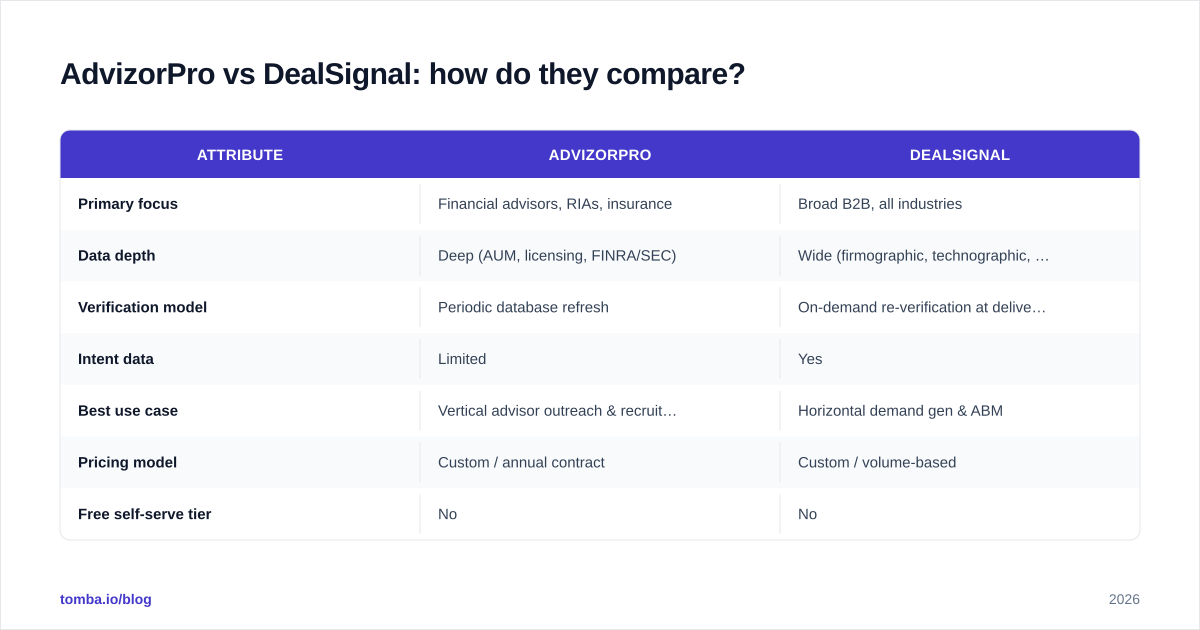
Here's the side-by-side. Treat published pricing as directional — both vendors quote based on seats, record volume, and contract length, and neither lists transparent self-serve tiers the way an email-finder tool does.
| Attribute | AdvizorPro | DealSignal |
|---|---|---|
| Primary focus | Financial advisors, RIAs, insurance | Broad B2B, all industries |
| Data depth | Deep (AUM, licensing, FINRA/SEC) | Wide (firmographic, technographic, intent) |
| Verification model | Periodic database refresh | On-demand re-verification at delivery |
| Intent data | Limited | Yes |
| Best use case | Vertical advisor outreach & recruiting | Horizontal demand gen & ABM |
| Pricing model | Custom / annual contract | Custom / volume-based |
| Free self-serve tier | No | No |
| Ideal team | Fintech, asset mgmt, insurance | SaaS, services, multi-vertical GTM |
The pattern: AdvizorPro trades breadth for depth; DealSignal trades depth for breadth. Neither is "better" in the abstract — they answer different questions.

Which platform has better data accuracy?#
Accuracy depends on what you're measuring. AdvizorPro's regulatory backbone makes its firm-level and licensing data extremely reliable — that information comes from authoritative filings, not scraped guesses. Its email and direct-dial accuracy is solid within its niche but, like any database, individual contact fields drift as people change roles.
DealSignal's bet is on the contact layer: by re-verifying at delivery, it aims to hand you records that are correct the day you receive them rather than the day they were collected. That's a meaningful advantage for cold email, where a bounced address damages your sender reputation and your domain's email deliverability.
The catch with any database — vertical or horizontal — is the verification gap between "verified in the vendor's system" and "verified against the live mail server right now." Roles change weekly. That's why mature teams run a second-pass check with an email verifier before launching a sequence, regardless of which database sourced the record. You can sanity-check both data sources against third-party reviews on G2 before committing to a contract.
How much do AdvizorPro and DealSignal cost?#
Both sit in the mid-to-enterprise band and gate pricing behind a sales call. Expect annual commitments rather than month-to-month, and expect the quote to scale with the number of records you export and the seats on your team.
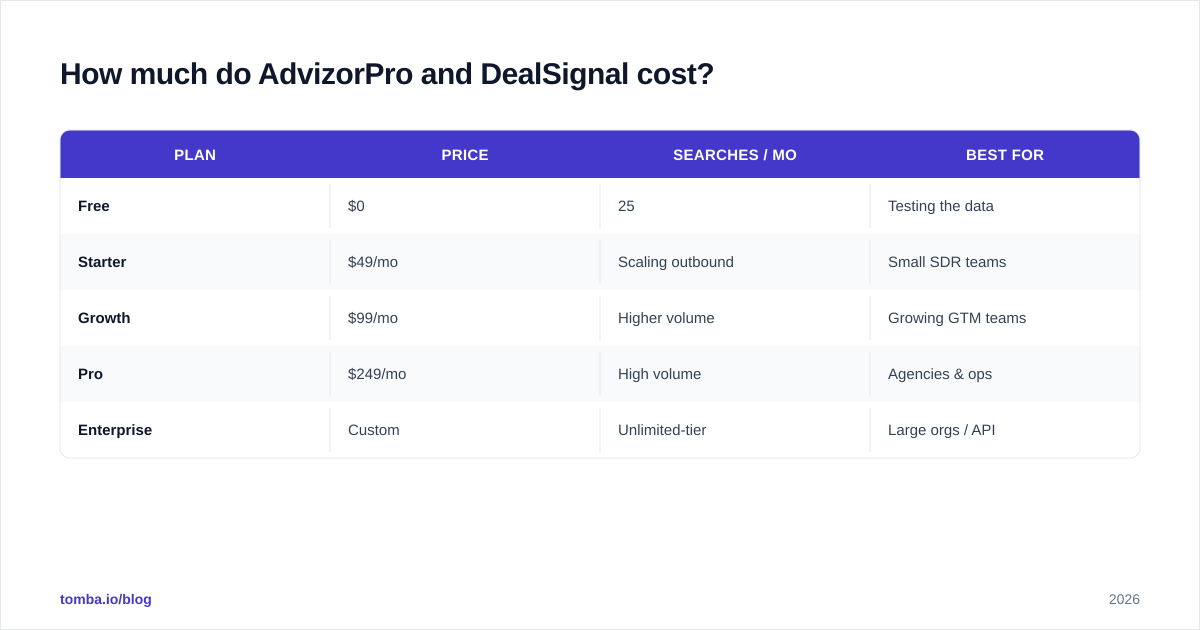
This is where many smaller teams stall. If you're a two-person SDR motion that needs a few thousand verified addresses a month — not a full data subscription — an enterprise contract is overkill. A usage-based email finder priced per search is a far better fit. For reference, transparent Tomba pricing runs:
| Plan | Price | Searches / mo | Best for |
|---|---|---|---|
| Free | $0 | 25 | Testing the data |
| Starter | $49/mo | Scaling outbound | Small SDR teams |
| Growth | $99/mo | Higher volume | Growing GTM teams |
| Pro | $249/mo | High volume | Agencies & ops |
| Enterprise | Custom | Unlimited-tier | Large orgs / API |
The point isn't that an email finder replaces a full data platform — it's that you should match the tool to the job. Buying DealSignal or AdvizorPro to occasionally look up an address is like leasing a warehouse to store one box.
When should you choose AdvizorPro?#
Choose AdvizorPro when financial advisors are your entire market. Specifically:
- You sell asset-management products, fintech, or compliance software to RIAs and broker-dealers.
- You recruit advisors and need to track movement and AUM in real time.
- You need to segment by regulatory attributes (Series licenses, custodian, firm CRD) that horizontal tools don't carry.
- Your outreach quality depends on knowing an advisor's book of business before you call.
If you've ever tried to filter a generic B2B list down to "independent RIAs managing $50M–$250M in the Midwest" and given up, AdvizorPro is built for exactly that frustration.
When should you choose DealSignal?#
Choose DealSignal when coverage and freshness across many verticals matter more than depth in one:
- You run horizontal demand generation or account-based marketing across multiple industries.
- You want intent signals layered onto contact data to prioritize accounts.
- Your team values re-verified records over a large but aging static database.
- You're feeding a CRM or sequencing tool and need clean firmographics at scale.
DealSignal fits the classic SaaS or services GTM motion where your ICP spans dozens of industries and no single vertical database covers enough of it.
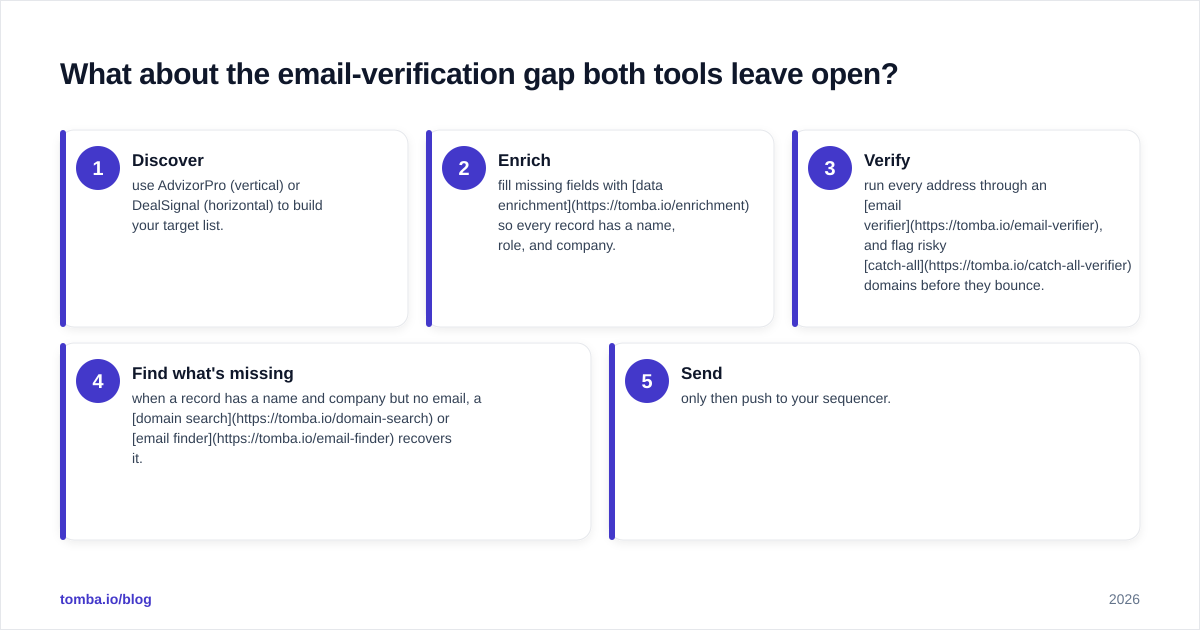
What about the email-verification gap both tools leave open?#
Here's the uncomfortable truth about every B2B database, vertical or horizontal: the moment data is exported, it starts to rot. Studies on B2B data decay routinely cite 25–30% annual degradation — people change jobs, companies rebrand, mailboxes get deactivated. HubSpot's own research on database decay has long flagged this as a structural problem you can't subscribe your way out of; see HubSpot's sales benchmark resources for the broader context.
That means the verification step is non-negotiable, no matter which platform you buy. A practical 2026 workflow looks like this:
- Discover — use AdvizorPro (vertical) or DealSignal (horizontal) to build your target list.
- Enrich — fill missing fields with data enrichment so every record has a name, role, and company.
- Verify — run every address through an email verifier, and flag risky catch-all domains before they bounce.
- Find what's missing — when a record has a name and company but no email, a domain search or email finder recovers it.
- Send — only then push to your sequencer.
Skipping step three is the single most common reason cold-email campaigns torch their domain reputation in the first month. The database gives you names; verification gives you a sendable list. Those are different jobs.
What are the alternatives to AdvizorPro and DealSignal?#
If neither fits — too niche, too broad, or too expensive — the alternatives cluster into three groups:
- Other broad databases — Apollo,
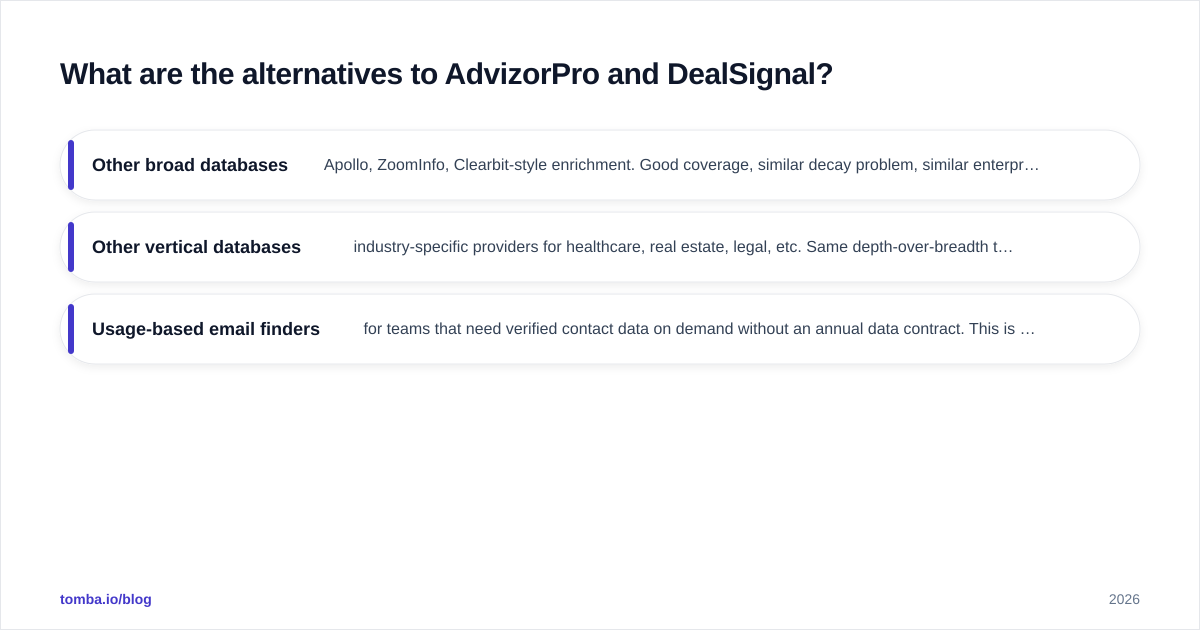
ZoomInfo, Clearbit-style enrichment. Good coverage, similar decay problem, similar enterprise pricing. (See our take on Apollo alternatives and Clearbit alternatives.)
- Other vertical databases — industry-specific providers for healthcare, real estate, legal, etc. Same depth-over-breadth trade-off AdvizorPro makes for finance.
- Usage-based email finders — for teams that need verified contact data on demand without an annual data contract. This is where Tomba sits, with per-search pricing, a bulk email finder for lists, and a Tomba API to wire verification directly into your pipeline.
The right answer is often a combination: a database for discovery plus a finder/verifier for the last-mile accuracy that keeps your emails landing in the inbox.
The bottom line#
AdvizorPro and DealSignal aren't really competitors — they're answers to different questions. If you live and breathe the financial-advisor market, AdvizorPro's regulatory depth is hard to beat. If you need clean, re-verified contacts across many industries with intent layered on top, DealSignal's on-demand model earns its keep. Both demand enterprise budgets and annual commitments, and both still leave you responsible for verifying records before you hit send.
If your real need is simpler — accurate, verified email addresses without a six-figure data contract — start with the Tomba Email Finder. Find professional emails by domain, name, or company, verify them in the same workflow, and scale from a free 25-search tier up to API-grade volume as your outbound grows. Pair it with whichever database fits your market, and you get the best of both: broad discovery and inbox-ready accuracy.
// get started
Find, verify and enrich your first contacts today
Start on the free plan with 25 searches a month, then scale when your team is ready.
Free plan · No credit card required · GDPR & CCPA
// about the author