AdvizorPro vs SMARTe 2026: Which B2B Data Tool Wins?
AdvizorPro targets financial-services data; SMARTe goes global B2B. We compare coverage, accuracy, pricing, and compliance to help you pick the right one in 2026.
Choosing a B2B data provider usually comes down to one question: do you need depth in a single vertical, or breadth across the whole market? AdvizorPro vs SMARTe is exactly that trade-off in one matchup. AdvizorPro is a specialist built around financial-services contacts, while SMARTe is a global sales-intelligence database with worldwide phone and email coverage. Picking the wrong one means paying for records you'll never call.
This guide breaks down coverage, accuracy, pricing, compliance, and integrations so you can decide which platform fits your motion — and where a focused tool like the Tomba email finder slots in if neither is a clean match.
TL;DR — AdvizorPro vs SMARTe at a glance#
- AdvizorPro is the better pick if you sell into financial services — RIAs, broker-dealers, insurance agents, wealth managers — because its data is enriched with AUM, licenses, and firm affiliations you won't find elsewhere.
- SMARTe wins on global breadth: 220M+ contacts, strong mobile-number coverage, and GDPR/CCPA-aligned sourcing for teams prospecting across regions and industries.
- Pricing is quote-based for both, which makes budgeting harder than with transparent per-seat tools.
- Accuracy is the real differentiator — neither vendor publishes an independent verification rate, so test both on your ICP before committing.
- If you mostly need verified emails by domain or name, a dedicated finder/verifier stack is faster and cheaper than either platform.

What is AdvizorPro?#
AdvizorPro is a B2B data platform built specifically for the financial-services industry. Instead of trying to cover every vertical, it indexes advisors, registered investment advisors (RIAs), broker-dealers, insurance producers, and wealth-management firms — then layers on attributes that matter in that niche: assets under management, regulatory licenses (Series 7, 65, etc.), custodian relationships, and firm hierarchy.
That specialization is the entire pitch. If you sell software, compliance services, or investment products to advisors, generic databases bury the people you want under millions of irrelevant records. AdvizorPro's filters let you build a list of, say, fee-only RIAs managing $100M–$500M in a specific state in minutes.
The trade-off: outside financial services, AdvizorPro has little to offer. You're paying for depth in one industry, so it only makes sense if that industry is your market.
What is SMARTe?#
SMARTe is a global sales-intelligence and contact-data platform. Its value proposition is breadth and reach: a database spanning 220M+ professional contacts and tens of millions of companies, with a particular emphasis on accurate mobile phone numbers and direct-dial coverage across North America, EMEA, and APAC.
SMARTe positions itself as a revenue operations and outbound enablement tool — feeding enriched contacts into your CRM, browser extension prospecting, and bulk list-building for SDR teams. Compliance is a headline feature: the company markets GDPR- and CCPA-aligned data sourcing, which matters if you prospect into Europe.
Where AdvizorPro is a scalpel, SMARTe is a wide net. That's ideal for horizontal SaaS and services companies whose buyers could sit in any industry, but it means you won't get the vertical-specific enrichment (licenses, AUM) that a financial-services seller depends on.
How do AdvizorPro and SMARTe compare head-to-head?#
The fastest way to see the gap is side by side. Here's how the two stack up on the attributes buyers actually evaluate.
| Attribute | AdvizorPro | SMARTe |
|---|---|---|
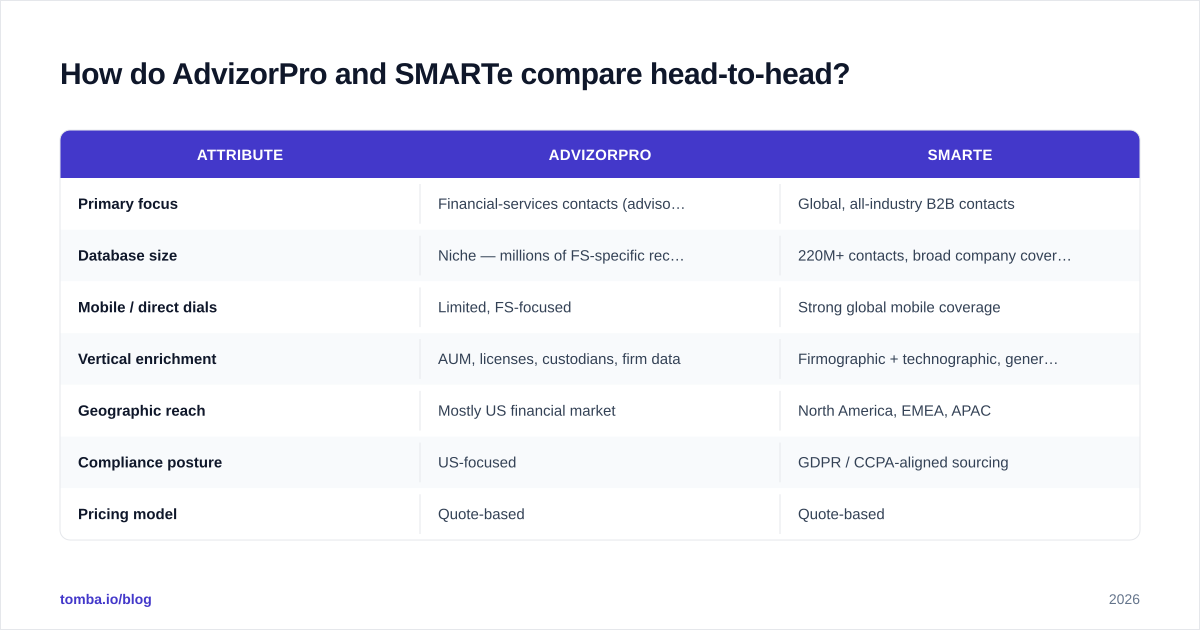
| Primary focus | Financial-services contacts (advisors, RIAs, insurance) | Global, all-industry B2B contacts |
| Database size | Niche — millions of FS-specific records | 220M+ contacts, broad company coverage |
| Mobile / direct dials | Limited, FS-focused | Strong global mobile coverage |
| Vertical enrichment | AUM, licenses, custodians, firm data | Firmographic + technographic, generic |
| Geographic reach | Mostly US financial market | North America, EMEA, APAC |
| Compliance posture | US-focused | GDPR / CCPA-aligned sourcing |
| Pricing model | Quote-based | Quote-based |
| Best for | Selling into financial services | Horizontal outbound at scale |
The pattern is clear: AdvizorPro trades breadth for depth, and SMARTe does the reverse. There's almost no overlap in who each one serves best, which actually makes the decision easier than most tool comparisons.
Which has better data accuracy?#
Accuracy is where every data vendor's marketing gets vague — and AdvizorPro and SMARTe are no exception. Neither publishes a third-party-audited bounce or verification rate, so you should treat any "95% accurate" claim as a starting hypothesis, not a fact.
A few realities to keep in mind:
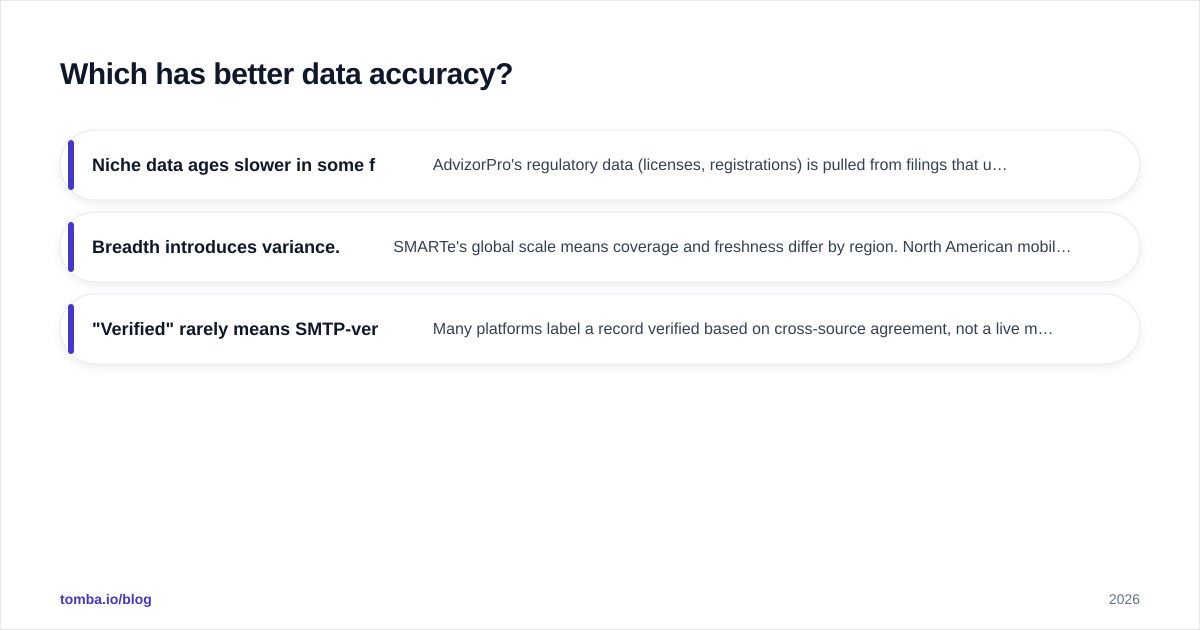
- Niche data ages slower in some fields, faster in others. AdvizorPro's regulatory data (licenses, registrations) is pulled from filings that update on predictable cycles, so it tends to be reliable. Job-change data in any vertical decays fast — roughly 30% of B2B contacts change roles each year.
- Breadth introduces variance. SMARTe's global scale means coverage and freshness differ by region. North American mobile data is typically stronger than long-tail APAC records.
- "Verified" rarely means SMTP-verified. Many platforms label a record verified based on cross-source agreement, not a live mailbox check. That's not the same as knowing the inbox exists today.
The only honest way to compare is to run a sample. Pull 200 contacts from each that match your ideal customer profile, then push them through an independent email verifier and a dialer. The platform that delivers the most connected calls and inboxed emails for your specific list is the winner — regardless of headline stats.


How does pricing compare?#
Both AdvizorPro and SMARTe use quote-based pricing, which is the norm for vertical and enterprise data vendors but a headache for buyers who want to compare line items.
A few things to push on during a sales call:
- Credit definition. Ask exactly what consumes a credit — a search, a revealed contact, a verified email, or an enrichment call. Vendors define this differently, and it dramatically changes effective cost.
- Seat vs volume. Some plans charge per user, others per record. If you have a small team pulling large lists, volume pricing is friendlier; a large team pulling small lists is the opposite.
- Export limits and rollover. Find out whether unused credits roll over and whether there's a monthly export cap that throttles bulk list-building.
- Contract length. Annual lock-ins are common. Negotiate a pilot or month-to-month trial before signing 12 months.
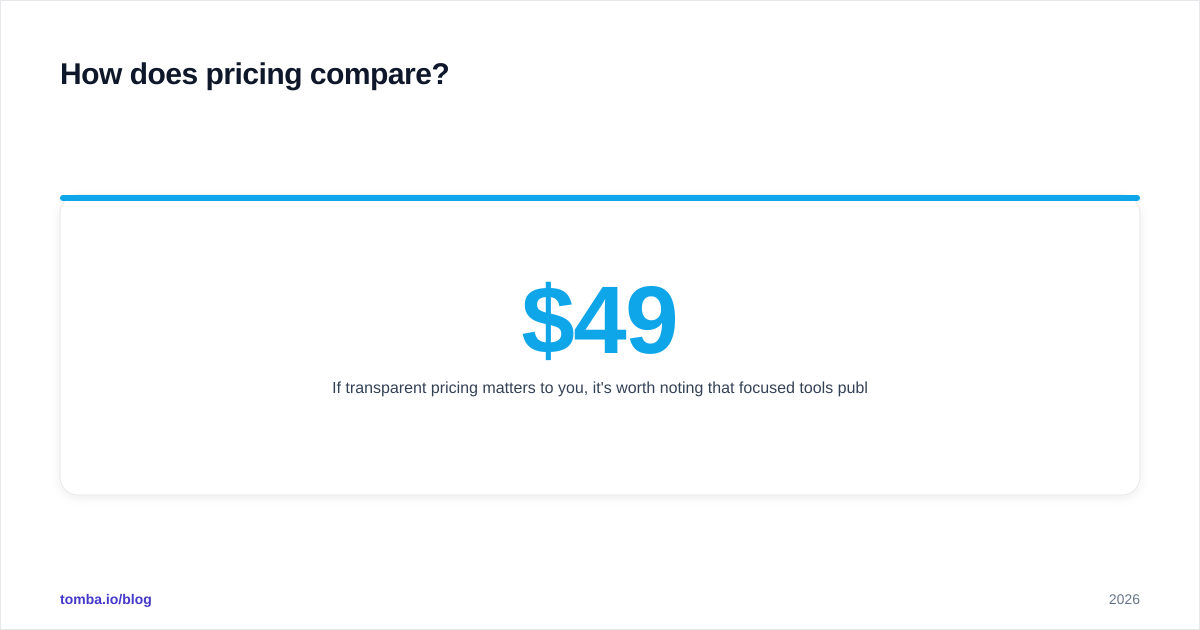
If transparent pricing matters to you, it's worth noting that focused tools publish their tiers openly. Tomba, for example, lists a free tier (25 searches/mo), Starter at $49/mo, Growth at $99/mo, and Pro at $249/mo — you can see the full Tomba pricing without a sales call. That predictability is one reason teams pair a niche database with a transparent finder rather than buying everything from one quote-based vendor.
What about compliance and data sourcing?#
If you prospect into Europe, compliance isn't optional. SMARTe leans into this, marketing GDPR- and CCPA-aligned sourcing and offering documentation around how contacts are collected and the legitimate-interest basis for outreach. For teams running EMEA campaigns, that paper trail reduces risk.
AdvizorPro operates primarily in the US financial market, where the regulatory concerns are different — think SEC/FINRA context around the advisors themselves rather than data-privacy regimes like GDPR. Its data is sourced largely from public filings and regulatory disclosures, which is a clean provenance story for US outreach but doesn't address European requirements because that's not its market.
Whichever you choose, your own outreach still has to comply. Verify consent where required, honor suppression requests, and keep your sender reputation healthy — bad data and aggressive sending tank email deliverability faster than any vendor can fix.
Which integrations and workflows do they support?#
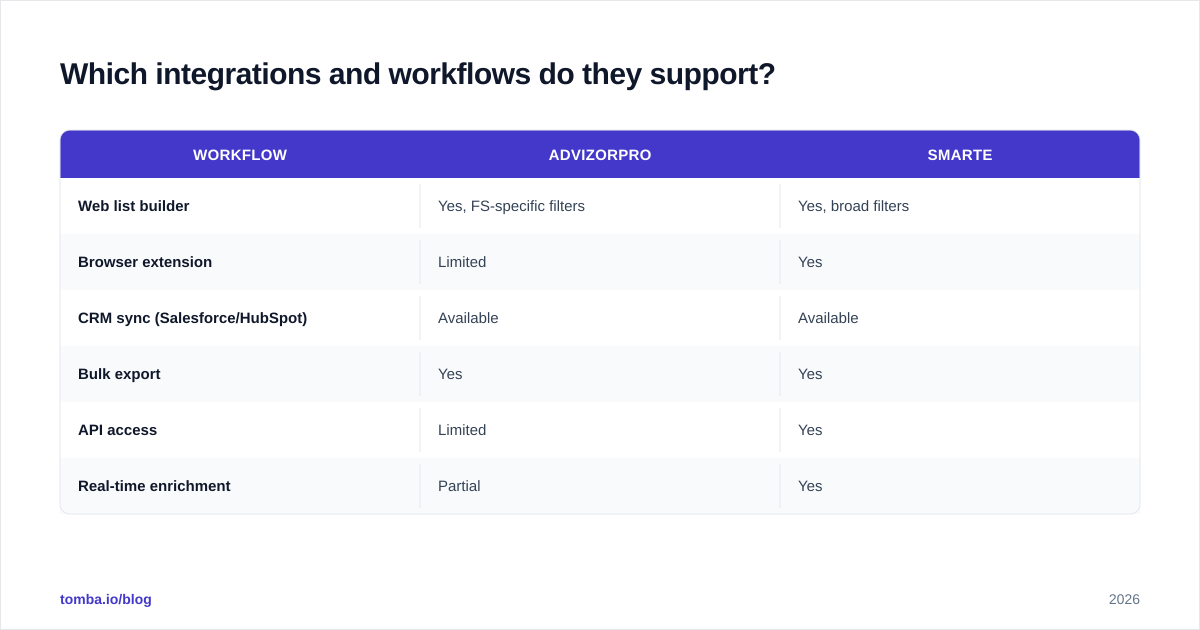
Data is only useful where your reps already work. Both platforms offer the standard surfaces — a web app for list-building, a browser extension for on-the-fly prospecting, and CRM sync — but the depth varies.
| Workflow | AdvizorPro | SMARTe |
|---|---|---|
| Web list builder | Yes, FS-specific filters | Yes, broad filters |
| Browser extension | Limited | Yes |
| CRM sync (Salesforce/HubSpot) | Available | Available |
| Bulk export | Yes | Yes |
| API access | Limited | Yes |
| Real-time enrichment | Partial | Yes |
For teams that live in their CRM, the integration depth matters as much as the raw data. If you're standardizing on HubSpot or Salesforce, confirm whether sync is native or runs through a middleware layer — and whether enrichment happens in real time or as a nightly batch.
Many teams end up with a hybrid stack: a vertical database for targeting, a broad provider for reach, and a dedicated finder/verifier for the last-mile email work. You can wire that together with tools like the Tomba API or bulk email finder so that contacts from any source get verified before they hit your sequencer.
When should you choose a dedicated email finder instead?#
Here's the case neither vendor will make for you: sometimes you don't need a full sales-intelligence platform at all.
If your actual job-to-be-done is "find and verify the work email for a known person or company," a focused finder is faster, cheaper, and more transparent than a quote-based database. You're not paying for AUM enrichment or 220M records you'll never touch — you're paying to turn a name and domain into a verified inbox.
Choose a dedicated finder when:
- You already know who you want to reach (from LinkedIn, events, referrals) and just need the email.
- Your ICP is too varied for a single vertical database but too small to justify enterprise data spend.
- You want predictable, published pricing instead of annual contracts.
- You need a verification layer on top of lists you're already buying from AdvizorPro or SMARTe.
This is exactly where Tomba fits. Use domain search to pull every public email pattern at a target company, the email finder to resolve specific people, and the verifier to scrub bounces before you send. It's not a replacement for a vertical database when you genuinely need that depth — it's the connective tissue that makes whatever data you buy actually deliverable.
The bottom line: AdvizorPro vs SMARTe#
The decision is unusually clean. Sell into financial services? AdvizorPro's licenses, AUM, and firm data are worth the niche premium. Prospecting horizontally across regions and industries? SMARTe's global reach and mobile coverage win. There's so little overlap that "which is better" almost always resolves to "which describes your market."
What both share is the quote-based pricing and unaudited accuracy claims common to enterprise data — so pilot before you commit, and verify everything against your real list. Cross-reference vendor claims on independent review sites like G2 and Capterra, and pressure-test data freshness yourself rather than trusting a deck.
And whichever database you land on, the contacts still have to reach a real inbox. Start with the Tomba Email Finder to turn names and domains into verified, send-ready emails — free for your first 25 searches, with transparent pricing from $49/mo when you scale. Pair it with your niche or global database and you get the best of both: targeted data and deliverable outreach.
// get started
Find, verify and enrich your first contacts today
Start on the free plan with 25 searches a month, then scale when your team is ready.
Free plan · No credit card required · GDPR & CCPA
// about the author