Affinity Pricing Reviews 2026: Pros, Cons, and Costs
An honest 2026 breakdown of Affinity CRM pricing, real user reviews, and the pros and cons — so you know whether the relationship-intelligence platform is worth its quote-based price tag.
TL;DR
- Affinity is a relationship-intelligence CRM built mostly for venture capital, private equity, and dealmaking teams — not a general sales CRM.
- Pricing is quote-only. Public reviews and resellers report figures starting near $2,000 per user per year, usually with seat minimums, which puts it well above mainstream CRMs.
- The standout pros are automatic relationship capture, no manual data entry, and strong network/warm-intro mapping.
- The most common cons in reviews are opaque pricing, a steep learning curve, weaker fit for transactional B2B sales, and contact data that still needs enrichment.
- Affinity is worth it if relationships are your pipeline; if you run high-volume outbound, a cheaper CRM plus a dedicated email finder will stretch your budget further.
What is Affinity and who actually uses it?#
Affinity is a CRM that builds itself. Think of it like a personal assistant who reads every email and calendar invite your team sends, then quietly updates a shared address book so nobody has to type "had a call with X" ever again. Technically, it's a relationship-intelligence platform that mines your team's communication metadata to map who knows whom and how strong each relationship is.
That design tells you who it's for. Affinity's core market is venture capital, private equity, investment banking, and corporate development — teams where a single warm introduction can be worth millions and where the "pipeline" is a web of founders, co-investors, and advisors rather than a list of SaaS trials. The company is open about this on its official site, where the messaging centers on deal flow and network strength, not quota attainment.
If you're a transactional B2B SaaS team running cold outbound at volume, Affinity is probably not built for your motion. That distinction matters before you ever look at the price.
How much does Affinity cost in 2026?#
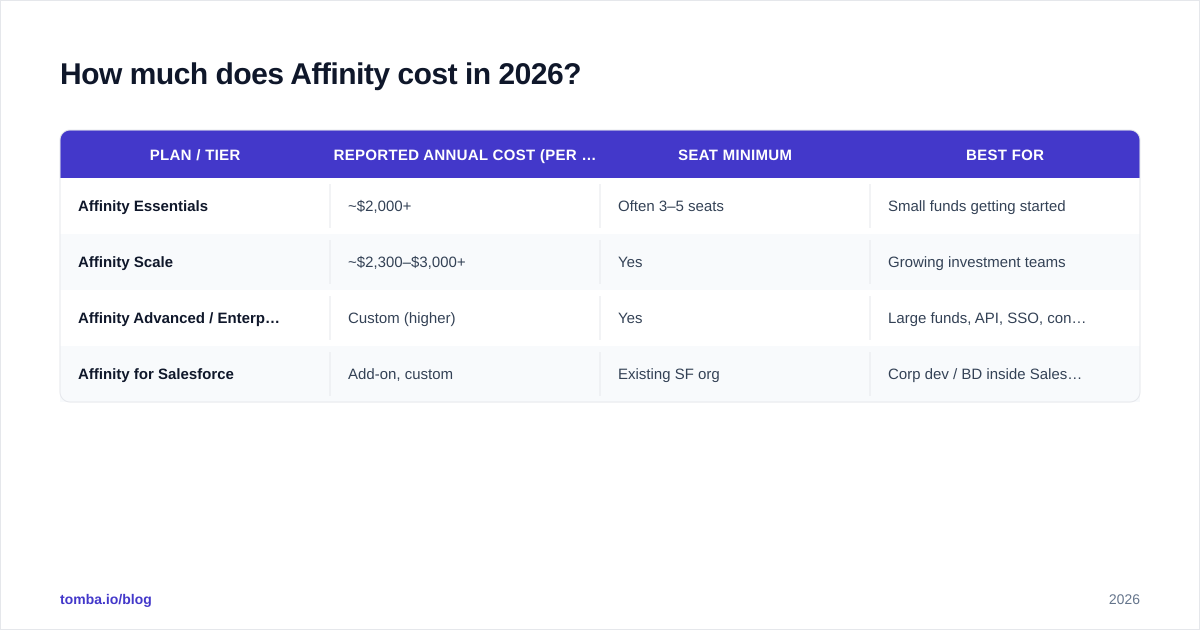
The honest answer: Affinity does not publish prices, and you have to request a quote. That alone is the single most-cited frustration in Affinity pricing reviews. Buyers report that quotes are per-user, annual, and frequently carry seat minimums, which pushes the entry point higher than a sticker price suggests.
Based on figures shared publicly across G2 and Capterra reviews, reseller pages, and buyer forums, the commonly reported ranges look like this. Treat these as directional, not a quote — only Affinity sales can confirm your number.
| Plan / tier | Reported annual cost (per user) | Seat minimum | Best for |
|---|---|---|---|
| Affinity Essentials | ~$2,000+ | Often 3–5 seats | Small funds getting started |
| Affinity Scale | ~$2,300–$3,000+ | Yes | Growing investment teams |
| Affinity Advanced / Enterprise | Custom (higher) | Yes | Large funds, API, SSO, controls |
| Affinity for Salesforce | Add-on, custom | Existing SF org | Corp dev / BD inside Salesforce |
Two things stand out. First, even the entry tier lands near or above $2,000/user/year, so a five-person fund is realistically looking at a five-figure annual contract. Second, because pricing is gated behind a sales call, your final number depends on negotiation, term length, and seat count more than a fixed rate card.
For comparison, a mainstream CRM like HubSpot or a lead-data tool publishes tiers you can read in thirty seconds. If transparent, self-serve pricing matters to you, that gap is worth weighing — and it's the same reason some teams pair a lighter CRM with affordable, published-price data tooling. You can see that kind of transparency on the Tomba pricing page, where tiers run from a free plan up to defined monthly amounts with no quote required.
What do Affinity reviews say about the pros?#
Across review sites, the praise for Affinity is consistent and specific. These are the strengths reviewers bring up again and again.
It eliminates manual data entry. This is the headline benefit. Affinity logs emails, meetings, and contacts automatically by reading communication metadata. Reviewers describe it as the first CRM their team actually keeps up to date, simply because nobody has to maintain it.
Relationship intelligence is genuinely differentiated. Affinity scores the strength of connections between your team and any contact, so you can answer "who here knows this founder best?" instantly. For dealmakers, that warm-intro mapping is the entire value proposition, and competitors rarely match it.
Deal-flow management fits investors. Pipelines, list views, and reminders are tailored to how funds track opportunities over months or years, not days. It feels purpose-built rather than a generic sales CRM bent into shape.
Email and calendar integration is deep. Because the product lives on top of your inbox, adoption tends to be high — the data shows up whether or not the team logs in daily.
What do reviewers complain about?#
No tool is all upside, and Affinity's cons are just as consistent in reviews.
Pricing is opaque and high. The quote-only model frustrates buyers who want to compare options quickly, and the per-seat cost is steep for small teams. Several reviewers note that scaling seats gets expensive fast.
There's a learning curve. The flexibility that powers Affinity also makes onboarding non-trivial. Teams report needing time and sometimes paid onboarding to use lists, fields, and automations well.
It's narrow outside its niche. Reviewers from transactional sales backgrounds find it heavier than they need. If you live in sequences, dialer activity, and high-volume outbound, a sales-engagement platform fits better.
Contact data still needs enrichment. Affinity captures who your team already talks to extremely well. It is not primarily a database for finding new contacts you don't know yet. When you need fresh, verified emails for net-new prospects, you'll still reach for a dedicated finder and verifier. That's where pairing Affinity with data enrichment and a standalone email verifier closes the gap.
How does Affinity compare to other CRMs and data tools?#
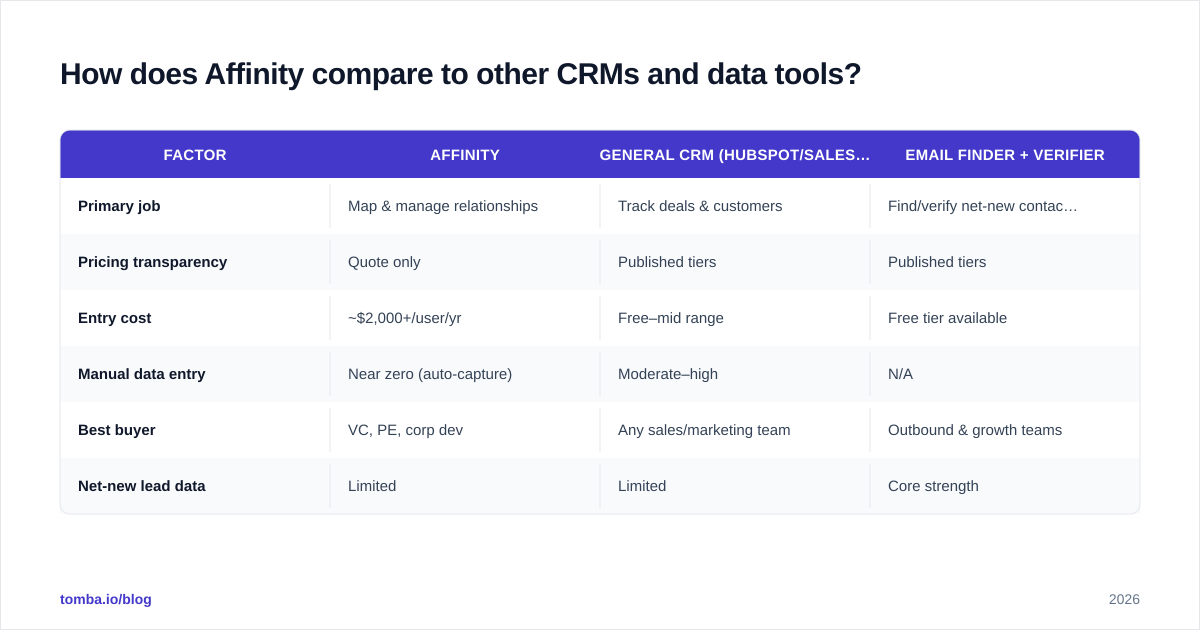
The right comparison depends on what job you're hiring the software to do. Affinity wins on relationship intelligence; it does not try to be a cheap, high-volume prospecting stack. Here's how the categories stack up.
| Factor | Affinity | General CRM (HubSpot/Salesforce) | Email finder + verifier |
|---|---|---|---|
| Primary job | Map & manage relationships | Track deals & customers | Find/verify net-new contacts |
| Pricing transparency | Quote only | Published tiers | Published tiers |
| Entry cost | ~$2,000+/user/yr | Free–mid range | Free tier available |
| Manual data entry | Near zero (auto-capture) | Moderate–high | N/A |
| Best buyer | VC, PE, corp dev | Any sales/marketing team | Outbound & growth teams |
| Net-new lead data | Limited | Limited | Core strength |
The takeaway: these tools are complements as often as competitors. Many funds run Affinity for relationship management and a separate, published-price data tool for sourcing. If your motion is outbound-heavy, the data tool may even be the bigger lever — you can route verified contacts into whatever CRM you already use through standard integrations.

Is Affinity worth the price in 2026?#
Conclusion first: Affinity is worth it when relationships are your product, and overkill when they aren't.
Buy Affinity if you run a fund or dealmaking team where warm introductions drive revenue, your network is your moat, and manual CRM upkeep has failed every time you've tried it. For that buyer, the auto-capture and relationship scoring justify a premium, quote-based price, because the alternative is losing deals you couldn't see were one connection away.
Think twice if you're a transactional B2B team measuring success in meetings booked per rep per week. You'll pay relationship-CRM prices for features your motion doesn't use, while still needing a separate tool to source contacts. In that case, a lighter CRM plus a dedicated finding-and-verifying stack usually delivers more pipeline per dollar.
A simple test: if you can name the 200 relationships that matter most to your business and you'd pay to never lose track of them, Affinity earns its keep. If instead you need to discover 2,000 new contacts this quarter, your money is better spent on a bulk email finder and verification.
How do you get more value from Affinity (or any relationship CRM)?#
Whatever CRM you land on, the data flowing into it determines the results. A relationship CRM is only as useful as the contacts and context it holds, and auto-capture can't invent details for people your team hasn't met yet.
Three practical moves keep any CRM healthy:
- Enrich before you import. Append verified emails, titles, and company data so records are complete on day one rather than half-empty. Contact data enrichment handles this at scale.
- Verify to protect deliverability. Bad addresses inflate bounce rates and hurt sender reputation. Run lists through an email verifier before any outreach.
- Source net-new contacts deliberately. Use domain search to pull the right people at target accounts, then push them into your CRM. This is the gap relationship tools like Affinity leave open by design.
Do those three things and even an expensive CRM stops feeling like a system of record you're forced to maintain and starts acting like a pipeline you can trust.
Frequently asked questions#
Does Affinity publish its pricing? No. Affinity uses quote-based pricing, so you request a demo and receive a custom proposal. Public reviews report entry costs starting around $2,000 per user per year, often with seat minimums.
Is Affinity a good CRM for general B2B sales? It can work, but it's optimized for relationship-driven dealmaking (VC, PE, corp dev). High-volume, transactional sales teams often find a mainstream CRM plus a prospecting stack a better fit.
Does Affinity find new email addresses for me? Not as its core function. Affinity excels at capturing relationships you already have. For net-new, verified contact data you'll want a dedicated email finder.
What's the cheapest way to try a relationship-style workflow? Pair an affordable CRM with a free-tier data tool. You can test contact finding and verification at no cost before committing to a five-figure Affinity contract.
The bottom line#
Affinity is a strong, specialized product with a price to match — and the reviews reflect exactly that trade-off. The pros (zero-effort capture, real relationship intelligence, investor-grade deal flow) are real and hard to replicate. The cons (opaque, premium pricing, a learning curve, and limited net-new sourcing) are equally real and mostly hit teams outside its core niche.
If you're sourcing new prospects rather than nurturing an existing network, don't pay relationship-CRM rates to do it. Start with Tomba's Email Finder to pull accurate, verified professional emails by name, company, or domain — free to try, with transparent published pricing and no sales call required. Build a clean contact list first, plug it into whatever CRM fits your budget, and spend the savings on the relationships that actually close deals.
// get started
Find, verify and enrich your first contacts today
Start on the free plan with 25 searches a month, then scale when your team is ready.
Free plan · No credit card required · GDPR & CCPA
// about the author