Affinity vs HubSpot 2026: Which CRM Fits Your Team?
Affinity automates relationship intelligence for dealmakers; HubSpot runs full-funnel sales and marketing. Here's how the two CRMs actually compare in 2026 — pricing, data capture, fit, and where each one breaks.
Choosing between Affinity and HubSpot is really a choice between two philosophies of what a CRM is for. One assumes your pipeline lives in your relationships and your inbox. The other assumes your pipeline lives in a structured funnel you actively manage. Pick the wrong one and you fight your tooling every day.
This guide breaks down where each platform wins, what they cost, and which type of team should pick which — without pretending either is perfect.
TL;DR#
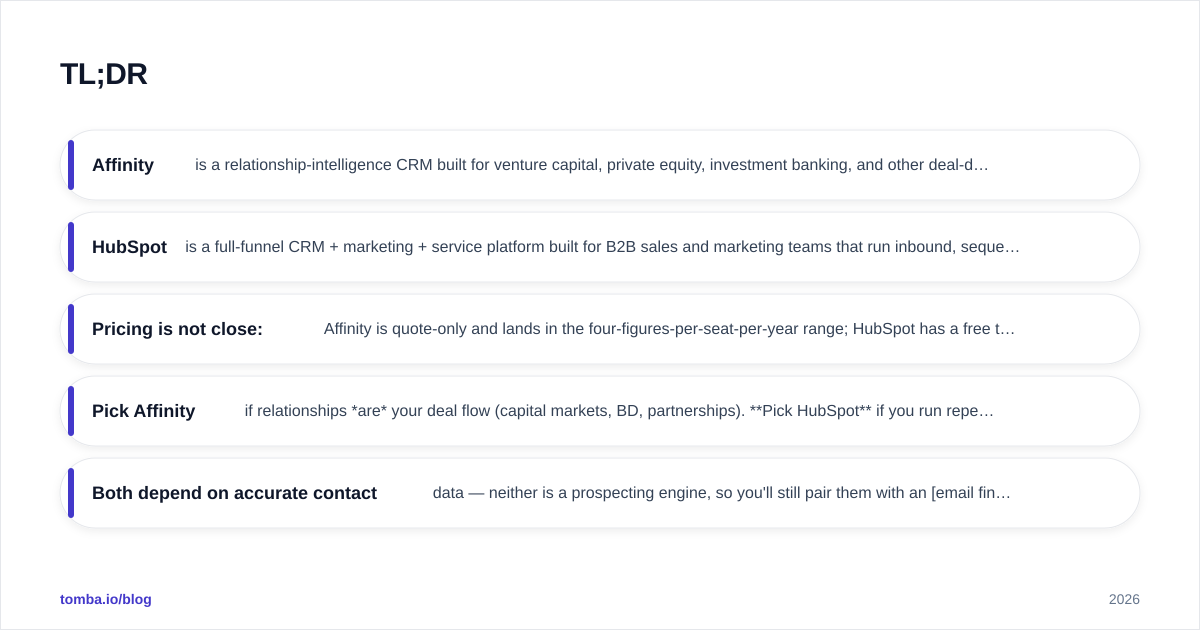
- Affinity is a relationship-intelligence CRM built for venture capital, private equity, investment banking, and other deal-driven teams. It auto-captures every email and meeting so reps never do manual data entry.
- HubSpot is a full-funnel CRM + marketing + service platform built for B2B sales and marketing teams that run inbound, sequences, and reporting at scale.
- Pricing is not close: Affinity is quote-only and lands in the four-figures-per-seat-per-year range; HubSpot has a free tier and scales from roughly $20/seat/mo to enterprise.
- Pick Affinity if relationships are your deal flow (capital markets, BD, partnerships). Pick HubSpot if you run repeatable sales motions, marketing campaigns, and need broad integrations.
- Both depend on accurate contact data — neither is a prospecting engine, so you'll still pair them with an email finder to fill gaps.
What is Affinity?#
Affinity is a CRM that automates the part of relationship management everyone hates: logging it. Think of it like a personal assistant who quietly reads every email and calendar invite your team sends, then keeps the CRM updated without anyone touching a keyboard. Technically, it uses "relationship intelligence" — it analyzes the communication history across your whole organization to score how strong a connection is to any given person or company.
That design is aimed squarely at deal-driven industries. Venture capital firms tracking thousands of founders, private equity teams managing proprietary deal flow, and investment banks juggling buy-side and sell-side relationships all live in a world where who knows whom is the asset. Affinity surfaces that automatically. You can see the official platform positions itself around dealmaking rather than generic sales.
The trade-off: Affinity is narrow on purpose. It is not built to run drip marketing campaigns, host landing pages, or score inbound leads from a blog.
What is HubSpot?#
HubSpot is a full-funnel customer platform. Where Affinity is a scalpel, HubSpot is a Swiss Army knife — a connected suite spanning Marketing Hub, Sales Hub, Service Hub, CMS, and Operations Hub, all sharing one CRM database.
That breadth is the point. A B2B team can capture a lead from a form, nurture it with automated email, route it to a rep with sequences and deal stages, then hand it to support — all inside one system. HubSpot's free tier and massive app marketplace made it the default CRM for SMBs and mid-market companies running inbound motions.
The trade-off runs the other direction from Affinity: HubSpot expects you to manage the funnel. It auto-logs interactions when connected to your inbox, but it does not natively map the strength of your relationship network the way Affinity does, and its data-entry burden grows as you customize.
Affinity vs HubSpot: how do they compare?#
Here is the head-to-head on the attributes that actually drive the decision.
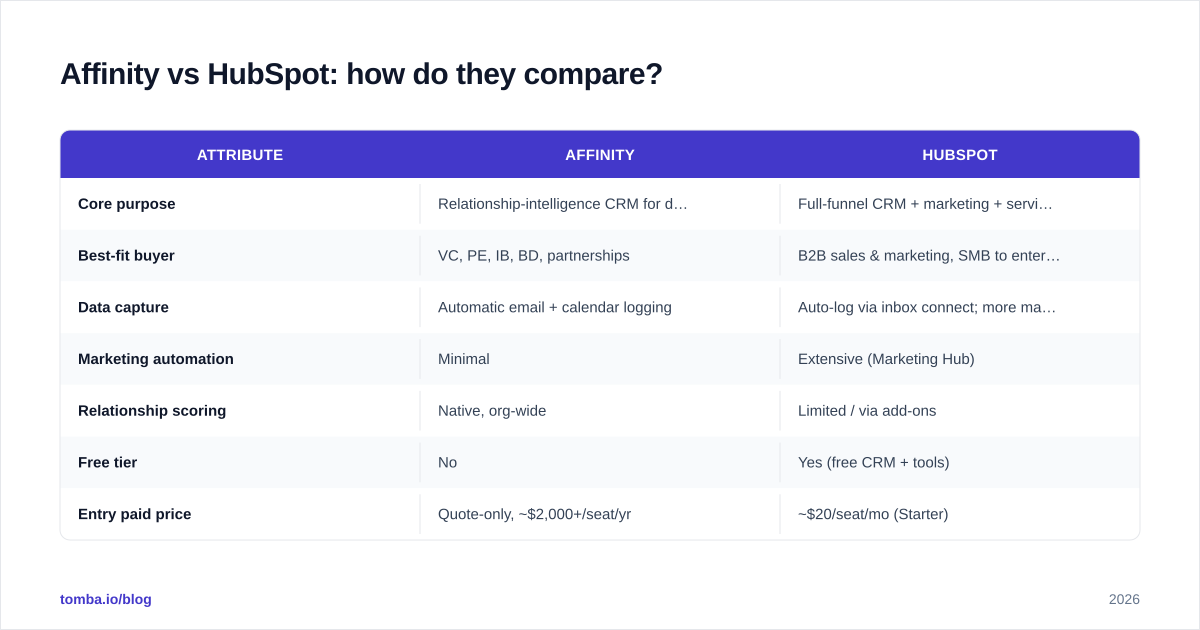
| Attribute | Affinity | HubSpot |
|---|---|---|
| Core purpose | Relationship-intelligence CRM for dealmakers | Full-funnel CRM + marketing + service |
| Best-fit buyer | VC, PE, IB, BD, partnerships | B2B sales & marketing, SMB to enterprise |
| Data capture | Automatic email + calendar logging | Auto-log via inbox connect; more manual on custom fields |
| Marketing automation | Minimal | Extensive (Marketing Hub) |
| Relationship scoring | Native, org-wide | Limited / via add-ons |
| Free tier | No | Yes (free CRM + tools) |
| Entry paid price | Quote-only, ~$2,000+/seat/yr | ~$20/seat/mo (Starter) |
| Reporting & dashboards | Pipeline + relationship analytics | Deep, customizable across hubs |
| Integration ecosystem | Focused, finance-oriented | 1,700+ app marketplace |
| Learning curve | Low for reps (auto-capture) | Moderate; grows with customization |
The pattern is clear: Affinity optimizes for zero rep effort on a narrow job, and HubSpot optimizes for broad capability across the whole revenue funnel.

Is Affinity better than HubSpot?#
Affinity is better than HubSpot only when your business model is relationship-driven and deal-centric. It is not a general upgrade.
Affinity wins when:
- Relationships are the product. In venture and PE, the firm that knows a founder first wins the deal. Affinity's org-wide relationship graph is genuinely hard to replicate in HubSpot.
- Reps refuse to log data. Partners and bankers are expensive and allergic to CRM hygiene. Affinity's automatic capture means the data exists whether or not anyone "uses the CRM."
- You don't run marketing campaigns. If you have no funnel of inbound leads to nurture, HubSpot's biggest strengths are dead weight you'd pay for anyway.
Where Affinity falls short: there is no free tier to test, pricing is opaque and steep, and if you later need marketing automation or service ticketing you'll be bolting on a second platform.
Is HubSpot better than Affinity?#
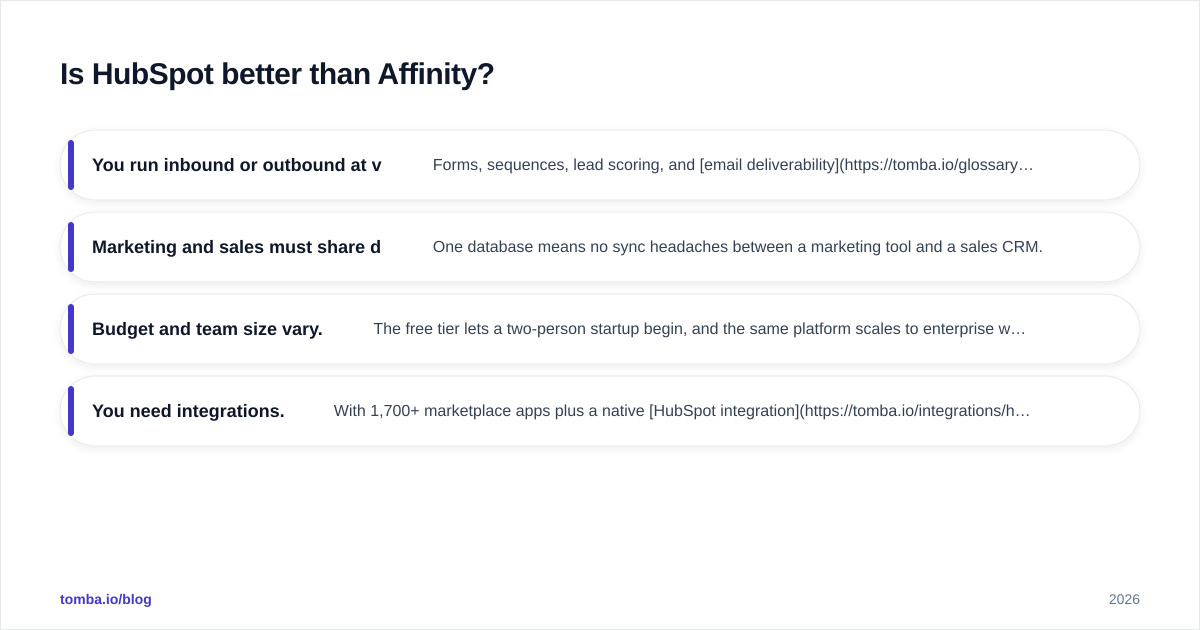
For most B2B companies running a repeatable sales motion, HubSpot is the better default — and it is dramatically cheaper to start.
HubSpot wins when:
- You run inbound or outbound at volume. Forms, sequences, lead scoring, and email deliverability tooling all live in one place.
- Marketing and sales must share data. One database means no sync headaches between a marketing tool and a sales CRM.
- Budget and team size vary. The free tier lets a two-person startup begin, and the same platform scales to enterprise without a migration.
- You need integrations. With 1,700+ marketplace apps plus a native HubSpot integration for enrichment, the ecosystem is unmatched.
Where HubSpot falls short: costs balloon fast once you add marketing contacts and premium hubs, advanced features sit behind Professional and Enterprise tiers, and it will never map your relationship network the way Affinity does out of the box.
How much do Affinity and HubSpot cost in 2026?#
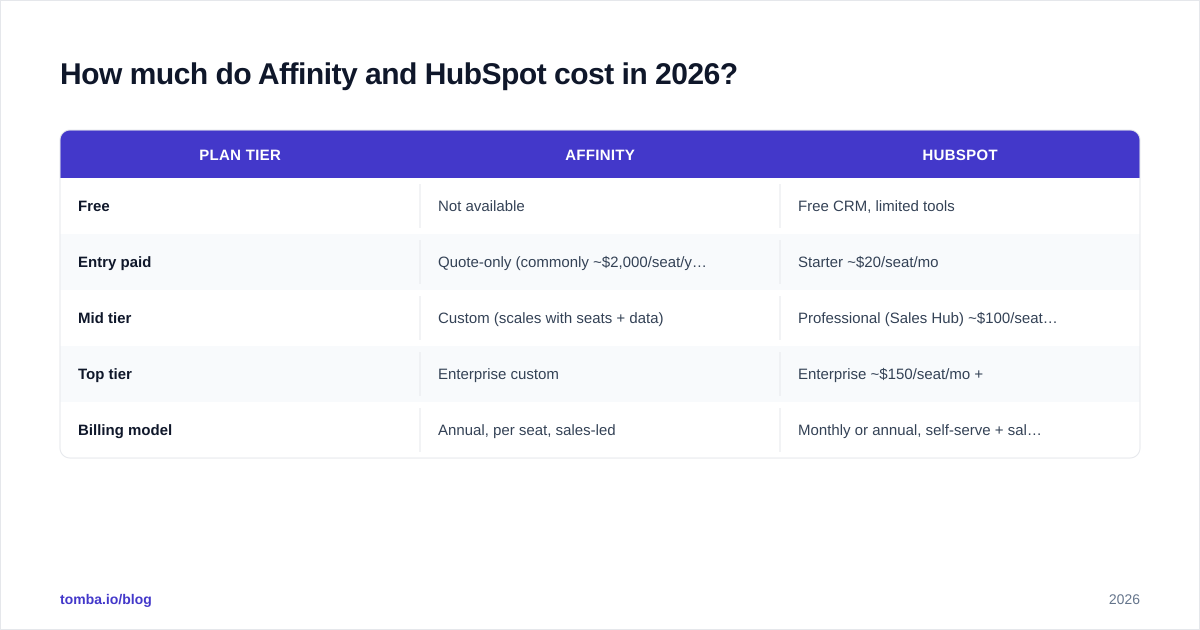
Pricing is the cleanest dividing line between these two, so treat it as a primary filter, not an afterthought.
| Plan tier | Affinity | HubSpot |
|---|---|---|
| Free | Not available | Free CRM, limited tools |
| Entry paid | Quote-only (commonly ~$2,000/seat/yr) | Starter ~$20/seat/mo |
| Mid tier | Custom (scales with seats + data) | Professional (Sales Hub) ~$100/seat/mo |
| Top tier | Enterprise custom | Enterprise ~$150/seat/mo + |
| Billing model | Annual, per seat, sales-led | Monthly or annual, self-serve + sales |
Two caveats. First, HubSpot's headline seat price hides the real cost driver: marketing contacts. As your database grows, Marketing Hub pricing climbs independently of seats. Second, Affinity's quote-only model means the only way to know your number is to talk to sales — and it is built for firms where one closed deal pays for the CRM many times over.
If you want a transparent point of comparison for adjacent data tooling, Tomba pricing is published openly: a free tier with 25 searches/month, Starter at $49/mo, Growth at $99/mo, and Pro at $249/mo.
Which type of team should choose which?#
Match the platform to your motion, not to a feature checklist. Here is the decision framework.
Choose Affinity if:
- You are in venture capital, private equity, investment banking, or M&A advisory.
- Your "pipeline" is a network of long-term relationships, not a 30-day sales cycle.
- Your highest-value users will never reliably log activity by hand.
- You have budget headroom and don't need marketing automation.
Choose HubSpot if:
- You run inbound marketing, outbound sales prospecting, or both.
- You want one platform from first touch to closed-won to support ticket.
- You're price-sensitive at the start but want room to scale.
- You depend on a wide integration ecosystem.
Consider neither (yet) if you're a tiny team that just needs a contact list and a few deal stages — a spreadsheet or a free CRM tier may be enough until your process stabilizes.
What about the data that feeds both CRMs?#
Here's the part both vendors gloss over: a CRM is only as good as the contact data inside it, and neither Affinity nor HubSpot is a prospecting engine. Affinity captures the relationships you already have. HubSpot stores the leads you already collected. Neither one reliably finds a decision-maker's verified email when all you have is a company name.
That gap is why most teams pair their CRM with a dedicated data layer:
- Use a domain search to pull every reachable contact at a target account before it enters the pipeline.
- Run new and existing records through an email verifier so bounces don't wreck your sender reputation.
- Push verified, enriched contacts straight into HubSpot via the native integration, or into Affinity via API/CSV.
This matters because CRM data decays fast — people change jobs, domains migrate, and a list that was clean six months ago is full of dead addresses today. Verifying before you sync keeps both platforms trustworthy.
Frequently asked questions#
Can Affinity and HubSpot work together? They can coexist, but it's uncommon. Teams that need both usually run Affinity for top-of-relationship BD and HubSpot for downstream marketing — syncing via middleware. Most organizations pick one as the system of record to avoid double data entry.
Does HubSpot have relationship intelligence like Affinity? Partially. HubSpot logs interactions and shows activity timelines, but it doesn't natively score org-wide relationship strength the way Affinity does. You'd need add-ons or custom reporting to approximate it.
Is Affinity worth the price for a small sales team? Usually no. Affinity's value scales with the dollar size of each relationship-driven deal. A standard SMB sales team gets more leverage from HubSpot's free or Starter tier plus a data tool.
Which is easier for reps to adopt? Affinity, for its narrow job — auto-capture means there's almost nothing to "adopt." HubSpot is broader, so adoption depends on how much you customize it.
The bottom line#
Affinity and HubSpot rarely compete for the same buyer once you frame the decision correctly. Affinity is the right call when relationships are your deal flow and you'll pay a premium to never log them by hand. HubSpot is the right call when you run a repeatable, multi-channel revenue motion and want one affordable platform that scales.
Whichever you choose, the CRM is the destination — not the source. The leads still have to come from somewhere, and they have to be accurate when they arrive. Tomba's Email Finder finds verified professional emails by name, company, or domain, then drops them straight into HubSpot or your Affinity pipeline — so your CRM starts with clean, reachable contacts instead of guesses. Start free with 25 searches a month and feed your CRM data it can actually trust.
Ready to find emails that actually work?
Join 150,000+ professionals who stopped guessing and started sending. Free credits on signup — no credit card required.
Get the Tomba newsletter
Practical outbound tactics and product updates — once every two weeks.
About the author