After Meeting Follow Up Email Sample: 12 Templates for 2026
Copy-paste after meeting follow up email samples for sales, networking, interviews, and discovery calls — plus timing, subject lines, and a reply-rate framework that works in 2026.
The meeting went well. Everyone nodded, you traded a few jokes, someone said "let's keep this moving." Then nothing — because the follow-up email never got sent, or got sent badly. The deal didn't die in the room. It died in the silence afterward.
This guide gives you a ready-to-use after meeting follow up email sample for every common scenario, plus the timing, subject lines, and structure that actually move things forward. Copy what fits, change the names, and send.
TL;DR#
- Send your follow-up within 24 hours — same-day if the meeting was hot. Speed signals competence.
- Every good follow-up does four things: thank, recap, confirm next step, make the next action effortless.
- Subject lines that reference a specific detail from the meeting beat generic "Great meeting you" lines on open rate.
- Use the templates below as a base, then personalize one concrete line — the part a template can't write for you.
- Bad contact data kills follow-ups before they start. Verify the address before you send with an email verifier.
Why does the after-meeting follow-up email matter so much?#
Think of a meeting like a first date that ended with "we should do this again." The interest is real, but interest fades fast without a concrete next step. The follow-up email is where you turn a warm feeling into a calendar invite.
The numbers back this up. Most B2B deals require multiple touchpoints after the first conversation, and the rep who follows up clearly and quickly is usually the one who wins — not because they were the smartest in the room, but because they were the easiest to say yes to. A clean follow-up reduces friction. It reminds the other person what you agreed on, removes ambiguity about who does what next, and gives them a one-click path forward.
There's also a quieter benefit: a well-written recap protects you. When you put "here's what we agreed" in writing, you prevent the slow drift where two parties remember the same meeting differently three weeks later.
What should every follow-up email include?#
Strong follow-ups are not creative writing. They follow a repeatable skeleton. Once you internalize the structure, you can write one in three minutes.
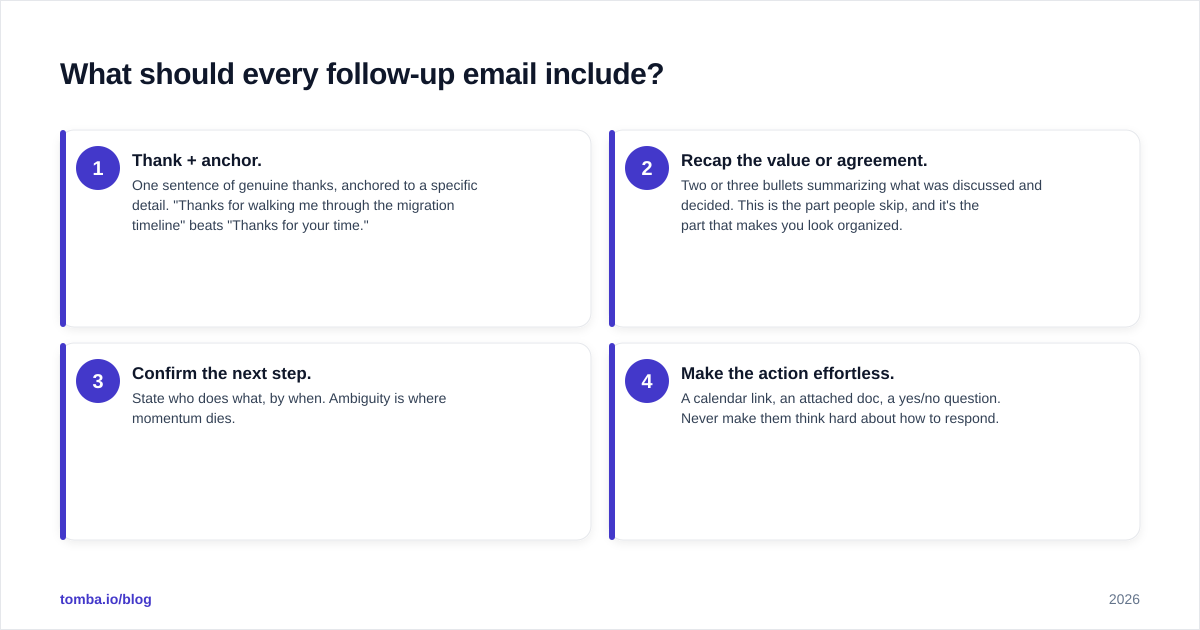
The four-part structure:
- Thank + anchor. One sentence of genuine thanks, anchored to a specific detail. "Thanks for walking me through the migration timeline" beats "Thanks for your time."
- Recap the value or agreement. Two or three bullets summarizing what was discussed and decided. This is the part people skip, and it's the part that makes you look organized.
- Confirm the next step. State who does what, by when. Ambiguity is where momentum dies.
- Make the action effortless. A calendar link, an attached doc, a yes/no question. Never make them think hard about how to respond.
Keep the whole thing under 150 words when you can. The person you met is busy. A wall of text gets archived.
What is the best after meeting follow up email sample for sales?#
Here's the workhorse — a post-discovery-call sales follow-up. Use it after a first or second meeting where there's clear interest but no commitment yet.
Subject: Recap + next step on [specific topic]
Hi [Name],
Thanks for the time today — the point about [specific pain they mentioned] really stuck with me, and I think we can help there.
Quick recap of what we covered:
- You're trying to [goal] but [obstacle] is slowing you down
- [Solution area] is the priority for this quarter
- You'd loop in [stakeholder] before any decision
Next step: I'll send the [proposal/pricing/case study] by Thursday. Could we hold 30 minutes next week to walk through it with [stakeholder]? Here's my calendar: [link].
Best,
[Your name]
The magic is in line one and the recap bullets. Everything else is scaffolding. If you want sharper opening lines fast, a cold email AI can draft variations you then edit down.
How soon should you send a follow-up email after a meeting?#
Conclusion first: within 24 hours, ideally same day. The half-life of a good meeting is short. Wait three days and the other person has moved on to forty other things; your recap now reads like archaeology.
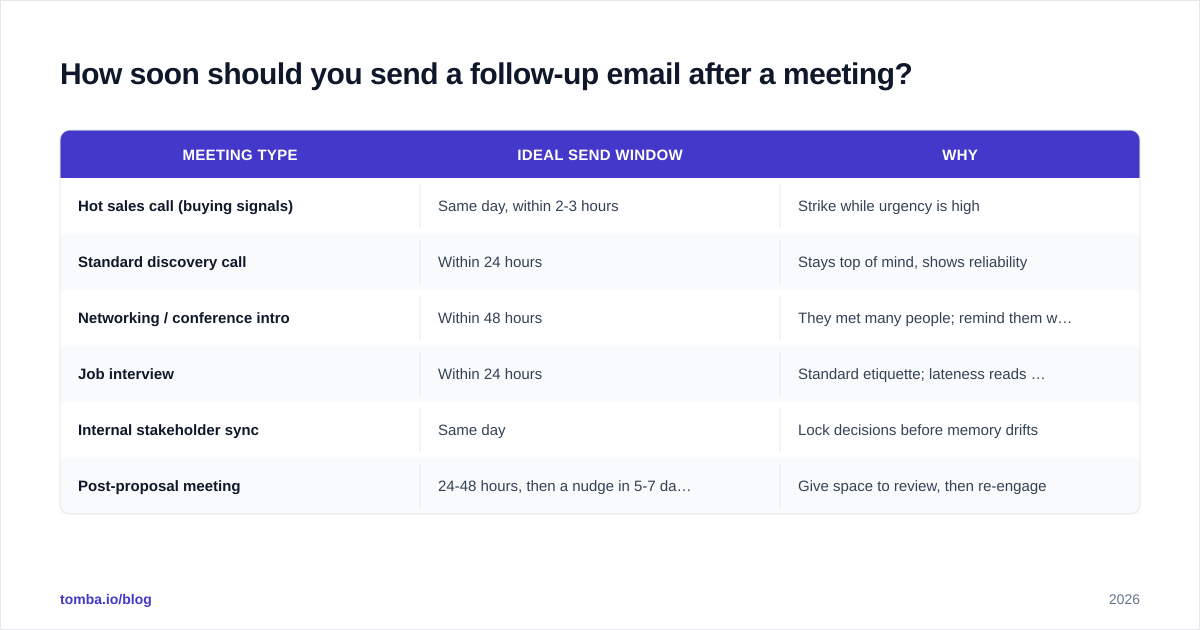
Here's a practical timing guide by scenario:
| Meeting type | Ideal send window | Why |
|---|---|---|
| Hot sales call (buying signals) | Same day, within 2-3 hours | Strike while urgency is high |
| Standard discovery call | Within 24 hours | Stays top of mind, shows reliability |
| Networking / conference intro | Within 48 hours | They met many people; remind them who you are |
| Job interview | Within 24 hours | Standard etiquette; lateness reads as disinterest |
| Internal stakeholder sync | Same day | Lock decisions before memory drifts |
| Post-proposal meeting | 24-48 hours, then a nudge in 5-7 days | Give space to review, then re-engage |
One caveat: faster isn't always better if it costs you accuracy. A same-hour email riddled with wrong details is worse than a thoughtful one the next morning. Speed and care are not opposites — batch your recap notes during the meeting so you can write fast without sacrificing quality.
What are follow-up samples for other scenarios?#
Sales isn't the only meeting that needs a follow-up. Here are four more ready-to-use samples.
Networking event follow-up#
Subject: Great chatting about [topic] at [event]
Hi [Name],
Really enjoyed our conversation about [specific thing] at [event] yesterday. You mentioned [detail] — it's stayed with me.
I'd love to keep in touch. If you're open to it, I'll send a quick intro to [person/resource] I mentioned. And if you're ever exploring [their area], happy to share what's worked for us.
Let's stay connected.
[Your name]
Job interview thank-you#
Subject: Thank you — [Role] interview
Hi [Name],
Thank you for the conversation today about the [Role] position. Hearing how the team approaches [specific challenge] made me even more excited about the opportunity.
I'm confident my experience with [relevant skill] maps directly to what you described. Happy to share [work sample / references] if useful.
Looking forward to next steps.
[Your name]
Post-proposal nudge (when they've gone quiet)#
Subject: Quick question on the [Project] proposal
Hi [Name],
Wanted to check in on the proposal I sent last week. Did the [pricing / scope / timeline] line up with what you had in mind?
Happy to adjust anything or hop on a quick call if it's easier to talk it through. No pressure either way — just want to make this easy for you.
Best,
[Your name]
Internal decision recap#
Subject: Decisions + owners from today's [meeting name]
Team,
Quick recap so we're aligned:
- Decision: [what was decided]
- Owner: [name] — due [date]
- Open item: [unresolved question], to revisit [when]
Shout if I missed anything.
[Your name]
Want more plug-and-play structures? Browse the full library of cold email templates and adapt them to your follow-up cadence.
How do you write a subject line that gets opened?#
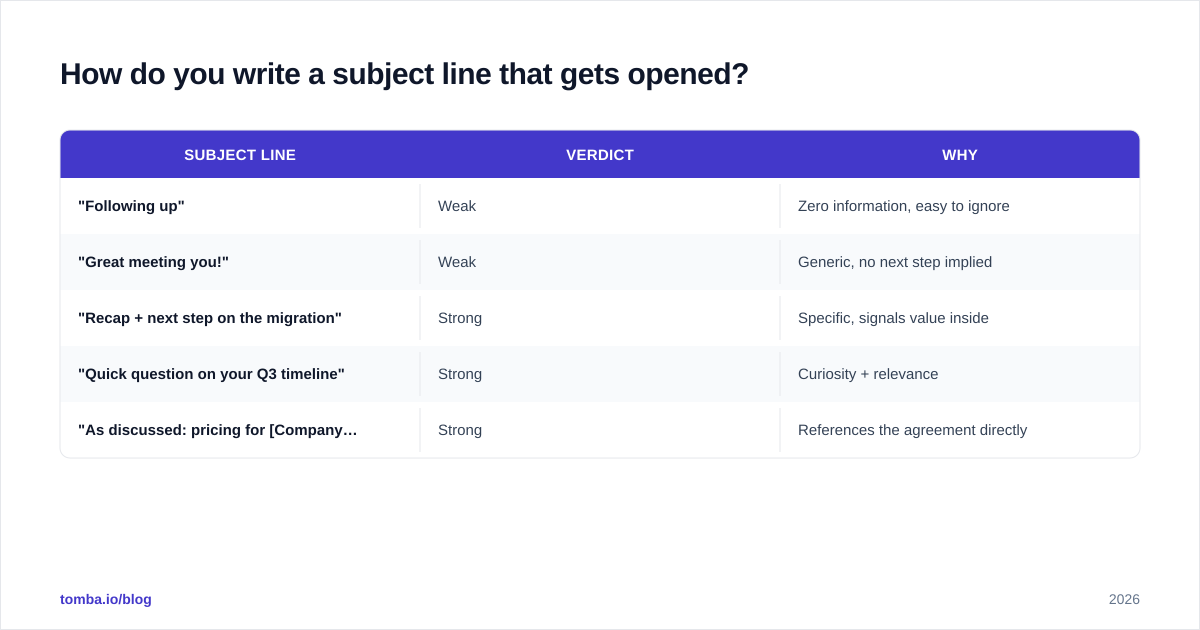
The subject line decides whether any of your careful writing gets read. Generic lines like "Following up" or "Great meeting you" blend into the noise. Specific lines that reference the meeting stand out.
Three rules that work:
- Reference a concrete detail. "Recap + next step on the Q3 migration" tells the reader exactly what's inside.
- Keep it under 50 characters so it doesn't truncate on mobile.
- Avoid spammy hype. Words like "free," "guarantee," and excessive punctuation can hurt placement. Run a draft through a spam checker if you're unsure, and read up on email deliverability basics so your careful note actually lands in the inbox.
| Subject line | Verdict | Why |
|---|---|---|
| "Following up" | Weak | Zero information, easy to ignore |
| "Great meeting you!" | Weak | Generic, no next step implied |
| "Recap + next step on the migration" | Strong | Specific, signals value inside |
| "Quick question on your Q3 timeline" | Strong | Curiosity + relevance |
| "As discussed: pricing for [Company]" | Strong | References the agreement directly |
If you write a lot of these, a subject line generator gives you starting options you can sharpen.
What mistakes kill follow-up emails?#
Most failed follow-ups share the same handful of errors. Avoid these and you're ahead of most of your competition.
- No clear next step. "Let me know your thoughts" puts the work on them. Propose a specific action instead.
- Sending to the wrong or unverified address. You can write the perfect email, but if it bounces or hits a dead inbox, none of it matters. This is the most preventable failure of all.
- Being too long. Three tight bullets beat three dense paragraphs.
- No personalization. A template sent verbatim reads like a template. Change one line to something only you could have written.
- Giving up after one email. Persistence wins deals. A polite second and third touch is normal and expected — most replies come after the first message, not on it.
- Vague timing. "Sometime next week" invites delay. "Thursday at 2pm?" invites a yes.
That second point deserves emphasis. If you collected a business card, scribbled an address, or guessed a format, confirm it before you hit send. The cost of a bounced follow-up is the entire deal. Use a reliable email finder to confirm the right professional address, or run your list through a bulk verify pass before a sequence. For the etiquette and cadence side of multi-touch outreach, HubSpot's sales follow-up guidance and the data-backed cadence research summarized on G2 are solid neutral references.
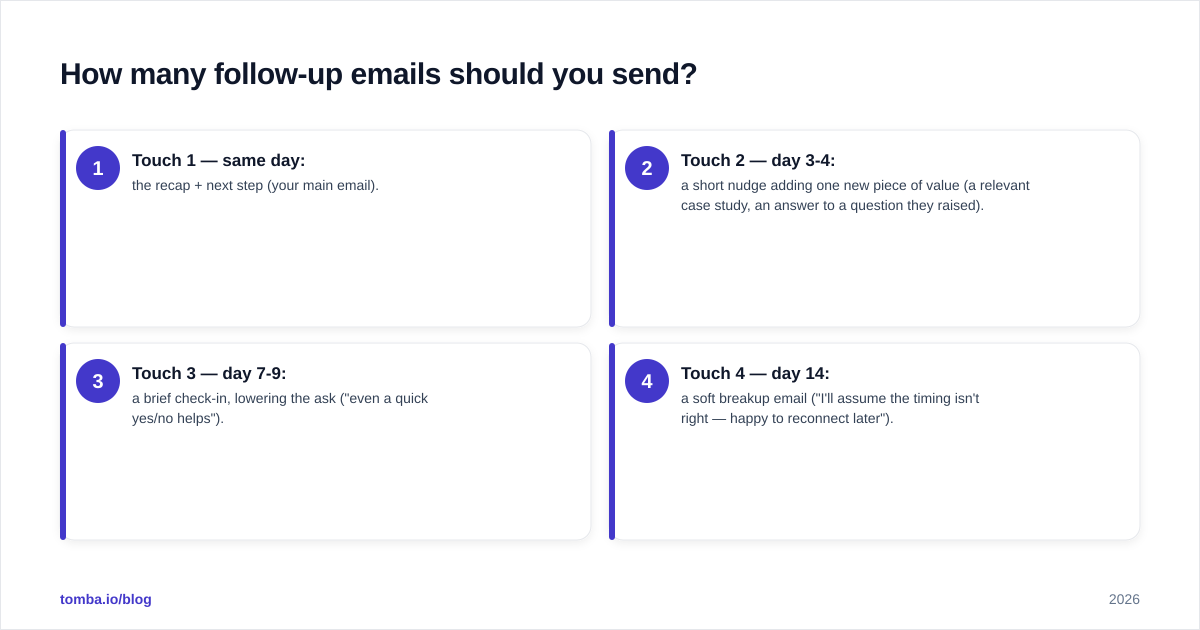
How many follow-up emails should you send?#
Conclusion: usually three to five touches, spaced out, before you let a thread go cold or move to a different channel.
A simple cadence that respects the other person's time:
- Touch 1 — same day: the recap + next step (your main email).
- Touch 2 — day 3-4: a short nudge adding one new piece of value (a relevant case study, an answer to a question they raised).
- Touch 3 — day 7-9: a brief check-in, lowering the ask ("even a quick yes/no helps").
- Touch 4 — day 14: a soft breakup email ("I'll assume the timing isn't right — happy to reconnect later").
Each message should add something, not just say "checking in again." If you're managing many threads, automating the reminders while keeping the writing human is the balance to strike. Pairing verified contact data with a thoughtful cadence is what separates a follow-up system from random nagging — and it's why teams pair their outreach tools with accurate data sources rather than guessing. (For benchmarks on how reps structure multi-step sequences, the public playbooks on Salesforce's blog are a useful neutral reference.)
Put your follow-up system on a foundation of good data#
A perfect follow-up email is worthless if it lands in the wrong inbox. Before you send a single recap, make sure you have the right address — that's the one variable that quietly decides whether all your careful writing gets read or bounces into the void.
Tomba's Email Finder confirms the correct professional email by name and company domain, so every follow-up you send actually reaches a human. Start free with 25 searches a month, and scale up on the Starter plan at $49/mo when your pipeline grows. Pair it with the built-in email verifier and you'll never lose a warm meeting to a cold bounce again. Write the email well — and send it to an address that exists.
// get started
Find, verify and enrich your first contacts today
Start on the free plan with 25 searches a month, then scale when your team is ready.
Free plan · No credit card required · GDPR & CCPA
// about the author