Agile CRM vs HubSpot 2026: Which CRM Actually Fits?
Agile CRM vs HubSpot in 2026: a no-fluff breakdown of pricing, features, contact limits, and which CRM actually fits a small sales team versus a scaling revenue org.
Choosing between Agile CRM and HubSpot usually comes down to one tension: how much CRM do you actually need today, and how much room do you want to grow into. Both promise sales, marketing, and service in one place. They land in very different spots on price, polish, and ceiling.
TL;DR — Agile CRM vs HubSpot in one minute#
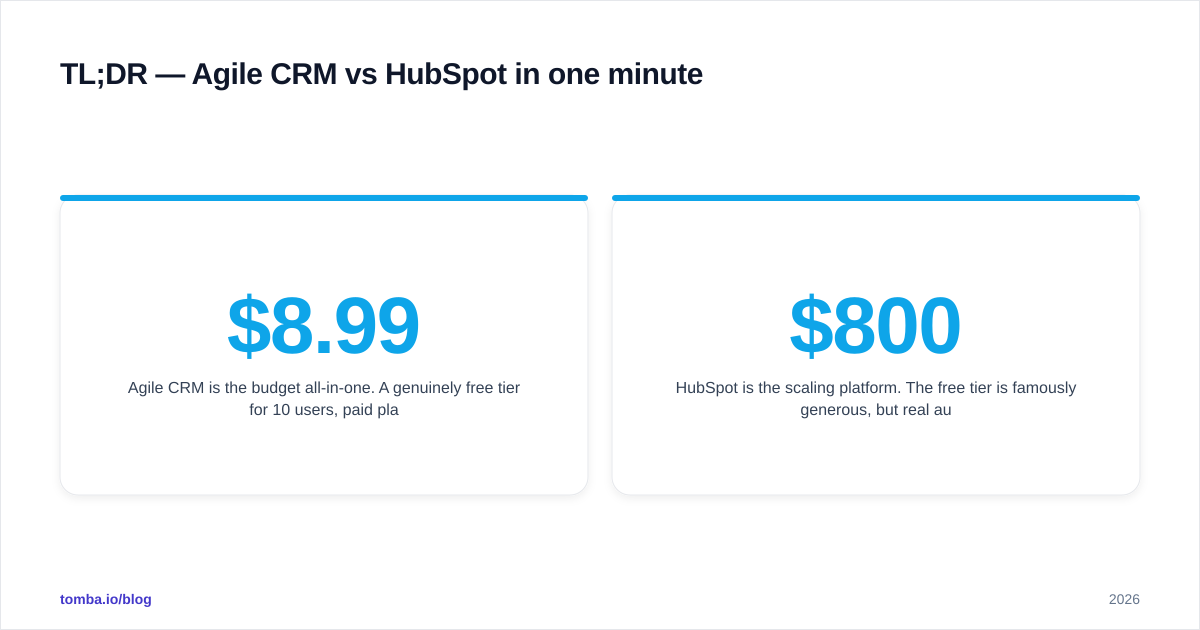
- Agile CRM is the budget all-in-one. A genuinely free tier for 10 users, paid plans from roughly $8.99/user/month, and a 50,000-contact cap on most tiers make it attractive for small teams that want CRM, marketing, and helpdesk without a big bill.
- HubSpot is the scaling platform. The free tier is famously generous, but real automation, reporting, and removing branding push you into Starter, Professional, and Enterprise tiers that climb fast — Professional Marketing alone starts near $800–$1,600/month.
- Pick Agile CRM if you're cost-sensitive, under ~10 users, and want one tool that does a bit of everything without per-seat sticker shock.
- Pick HubSpot if you're building a repeatable revenue engine, need deep reporting and integrations, and can justify the spend as you grow.
- Either way, the CRM is only as good as the data in it. Clean, verified contact records are what make automation and reporting trustworthy.
What is Agile CRM?#
Agile CRM is an all-in-one CRM aimed squarely at small businesses. It bundles three things most vendors sell separately: sales CRM (contacts, deals, telephony), marketing automation (email campaigns, landing pages, web popups), and a service desk (tickets, canned responses, SLAs).
Its pitch is value. The free plan covers up to 10 users and includes core contact management, deal tracking, and basic email. Paid tiers — Starter, Regular, and Enterprise — add automation nodes, integrations, and higher limits while staying well below what enterprise platforms charge. For a founder or a five-person sales team, that bundle is hard to ignore.
The trade-off is depth and polish. Agile's interface feels dated next to newer tools, the reporting is functional rather than rich, and the contact ceiling (50,000 on most plans) becomes a real constraint once your database grows.
What is HubSpot?#
HubSpot is a customer platform built around a free CRM core, with separate "Hubs" for Marketing, Sales, Service, Content, and Operations. You can start free and bolt on capabilities as you need them.
The free CRM is legitimately useful: unlimited users, up to 1,000,000 contacts, deal pipelines, email tracking, and basic forms. The catch is that the features teams actually scale on — automation workflows, custom reporting, sequences, and removing HubSpot branding — live in the paid tiers. Those tiers (Starter, Professional, Enterprise) are priced per Hub, and Professional/Enterprise marketing pricing also scales with your marketing contact count.
HubSpot's strengths are ecosystem and execution: a 1,500+ app marketplace, polished UX, strong reporting, and an academy that makes onboarding painless. You pay for that maturity.
Agile CRM vs HubSpot: how do they compare on price and features?#
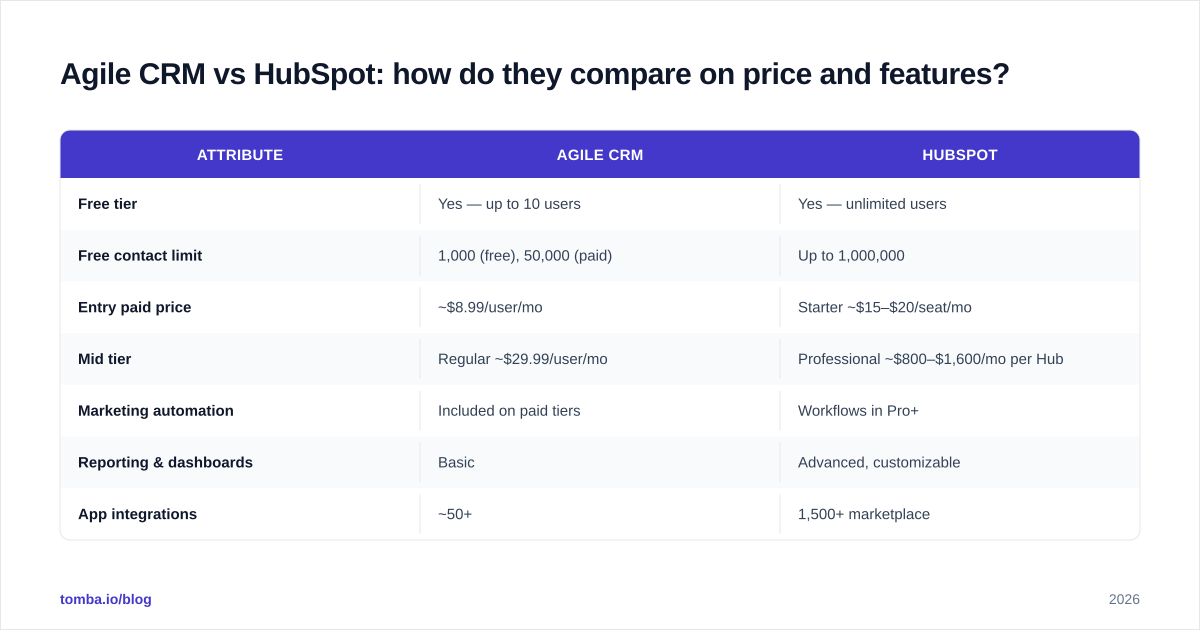
Here's the head-to-head on the attributes that actually drive the decision. Prices are list and rounded; always confirm current numbers on each vendor's pricing page since both adjust tiers regularly.
| Attribute | Agile CRM | HubSpot |
|---|---|---|
| Free tier | Yes — up to 10 users | Yes — unlimited users |
| Free contact limit | 1,000 (free), 50,000 (paid) | Up to 1,000,000 |
| Entry paid price | ~$8.99/user/mo | Starter ~$15–$20/seat/mo |
| Mid tier | Regular ~$29.99/user/mo | Professional ~$800–$1,600/mo per Hub |
| Marketing automation | Included on paid tiers | Workflows in Pro+ |
| Reporting & dashboards | Basic | Advanced, customizable |
| App integrations | ~50+ | 1,500+ marketplace |
| Helpdesk / service | Built in | Separate Service Hub |
| Best for | Cost-sensitive SMBs | Scaling revenue teams |
The pattern is clear. Agile CRM wins on raw cost-per-feature for small teams. HubSpot wins on ceiling, polish, and ecosystem — but the price gap widens dramatically once you need Professional-level features.

Which CRM is better for a small sales team?#
For a team under 10 people that needs the basics done cheaply, Agile CRM is the pragmatic answer. You get contact management, deal stages, email campaigns, and a help desk for the price of a few coffees per user. There's no marketing-contact metering to surprise you on the next invoice.
HubSpot's free tier is also a strong starting point for small teams — arguably stronger on UX and contact capacity. The risk is the upgrade cliff. The moment you want automated workflows, sequences, or branded emails, you're looking at Starter or Professional pricing that can multiply your monthly cost overnight. Many small teams start free on HubSpot and stall there, using it as a glorified contact list because the next tier isn't justified yet.
A useful rule: if your growth plan is steady and budget-bound, Agile keeps costs predictable. If you expect to scale fast and want a platform you won't outgrow, HubSpot's headroom is worth the eventual spend.
Which CRM is better for scaling and reporting?#
HubSpot, clearly. This is where the price difference earns its keep.
Once you're running multiple campaigns, scoring leads, attributing revenue, and coordinating sales and marketing, HubSpot's reporting and automation are in a different class. Custom report builders, revenue attribution, sequence analytics, and a deep integration marketplace let a revenue operations team build a genuine engine. Agile CRM can run automations and show dashboards, but it isn't designed for that level of cross-functional reporting.
If your roadmap includes a dedicated RevOps or marketing-ops function, the question stops being "which is cheaper" and becomes "which platform can my team build on for years." That answer leans HubSpot.
What are the hidden costs and limits to watch?#
Both tools have gotchas the marketing pages soften.
Agile CRM:
- The 50,000-contact cap on standard paid tiers is a hard wall for data-heavy teams.
- Automation node limits scale with tier — complex journeys may force an upgrade.
- The integration library is modest, so niche tools may need Zapier or custom work.
- UX is dated; expect a learning curve that feels older than newer competitors.
HubSpot:
- Marketing Hub Professional and Enterprise price partly on marketing contacts, so a growing list inflates the bill.
- Onboarding fees apply to Professional and Enterprise tiers (often a few thousand dollars, one-time).
- Removing HubSpot branding and unlocking automation requires paid tiers — the free version is a funnel.
- Per-Hub pricing means a team wanting Marketing + Sales + Service pays three times.
Read both vendors' fine print, and cross-check independent reviews on G2 and Capterra before committing — buyer reviews surface the limits that sales demos skip.
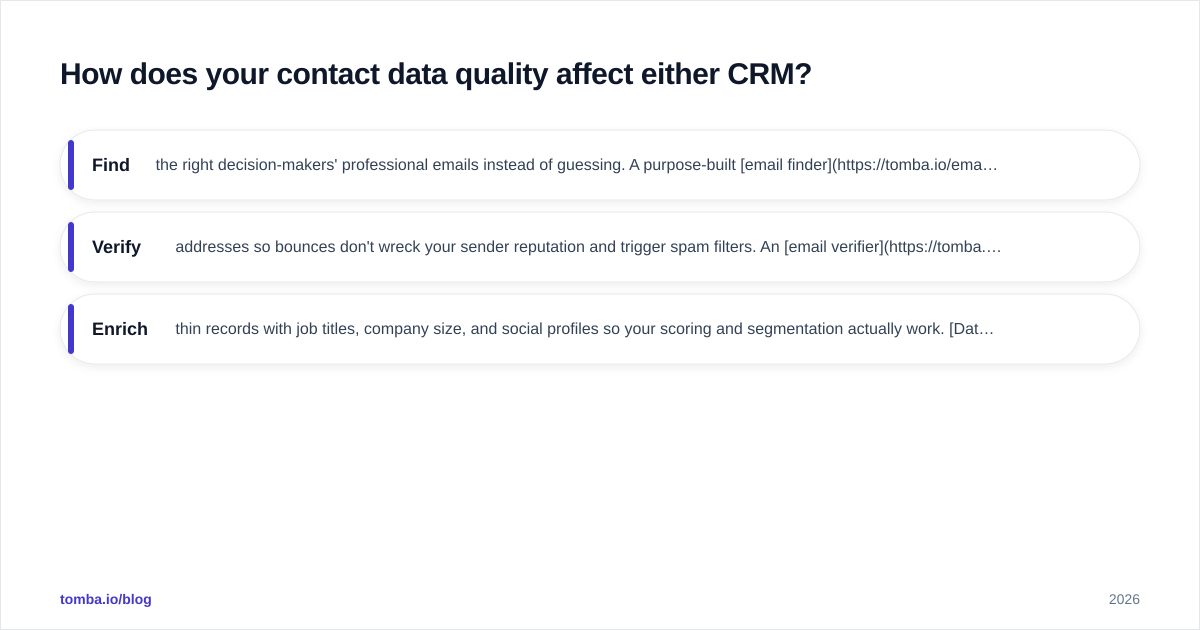
How does your contact data quality affect either CRM?#
Conclusion first: the most expensive CRM in the world is worthless if it's full of bad email addresses. Garbage in, garbage out applies brutally to automation.
Think of your CRM as a kitchen. Agile CRM and HubSpot are different stoves — one cheap and reliable, one premium and powerful. But neither cooks a good meal with spoiled ingredients. The "ingredients" here are accurate, verified contact records: real email addresses, correct names, current companies.
This is where a dedicated data layer matters more than the CRM brand. Before you import or sync contacts, you want to:
- Find the right decision-makers' professional emails instead of guessing. A purpose-built email finder pulls verified business addresses by name and domain.
- Verify addresses so bounces don't wreck your sender reputation and trigger spam filters. An email verifier checks deliverability before you send.
- Enrich thin records with job titles, company size, and social profiles so your scoring and segmentation actually work. Data enrichment fills the gaps your forms miss.
Both Agile CRM and HubSpot are only as smart as the data feeding them. If you sync HubSpot with a tool like Tomba via the HubSpot integration, you keep verified contacts flowing into your pipeline automatically — which means your automations fire against real people, not dead addresses.
So which should you choose — Agile CRM or HubSpot?#
Here's the honest decision tree.
Choose Agile CRM if:
- You have fewer than ~10 users and a tight budget.
- You want sales, marketing, and helpdesk in one cheap bundle.
- Your contact database will stay under 50,000.
- Predictable, low per-seat pricing matters more than polish.
Choose HubSpot if:
- You're building a scalable revenue engine, not just storing contacts.
- You need advanced reporting, attribution, and 1,500+ integrations.
- You can justify Professional-tier spend as you grow.
- UX, onboarding, and ecosystem maturity are worth a premium.
There's no universal winner — there's a fit for your stage. A bootstrapped SMB and a Series B SaaS company will rationally pick different tools. What both need identically is clean data. Compare the CRMs on the features above, then decide which side of the budget/ceiling trade-off you're on. You can verify current list pricing directly at HubSpot's site and on Agile CRM's pricing page.
Final word: get the data right before the CRM#
Whichever CRM you land on, your results trace back to contact quality. A premium platform full of bounced emails performs worse than a budget one full of verified, enriched records.
That's where Tomba's Email Finder earns its place in your stack. Find verified professional emails by name or domain, verify them before they hit your CRM, and enrich every record so your Agile CRM or HubSpot automations run on real, deliverable data. Tomba starts free with 25 searches a month, and paid plans begin at $49/month — see Tomba pricing for the full breakdown. Pick your CRM for the ceiling you need; feed it data you can trust.
// get started
Find, verify and enrich your first contacts today
Start on the free plan with 25 searches a month, then scale when your team is ready.
Free plan · No credit card required · GDPR & CCPA
// about the author