Agile CRM vs Salesforce 2026: Which CRM Fits Your Team?
Agile CRM vs Salesforce: a neutral, feature-by-feature breakdown of pricing, automation, scalability, and which CRM actually fits your team in 2026.
Choosing a CRM is less about which tool has the longest feature list and more about which one your reps will actually open every morning. Agile CRM and Salesforce sit at opposite ends of that decision: one is a budget-friendly all-in-one built for small teams, the other is the enterprise standard that runs Fortune 500 revenue orgs. Picking wrong costs you months of migration pain and a pile of unused licenses.
TL;DR — Agile CRM vs Salesforce at a glance#
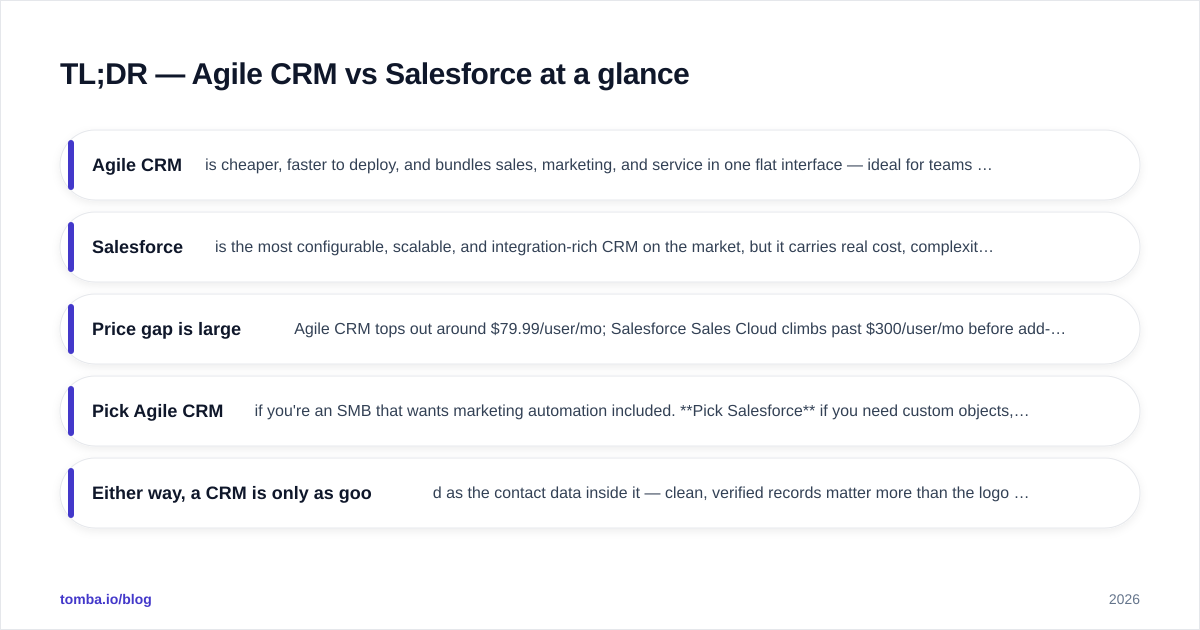
- Agile CRM is cheaper, faster to deploy, and bundles sales, marketing, and service in one flat interface — ideal for teams under ~25 reps who want speed over depth.
- Salesforce is the most configurable, scalable, and integration-rich CRM on the market, but it carries real cost, complexity, and admin overhead.
- Price gap is large: Agile CRM tops out around $79.99/user/mo; Salesforce Sales Cloud climbs past $300/user/mo before add-ons.
- Pick Agile CRM if you're an SMB that wants marketing automation included. Pick Salesforce if you need custom objects, complex pipelines, or 50+ seats.
- Either way, a CRM is only as good as the contact data inside it — clean, verified records matter more than the logo on the login screen.
What is Agile CRM?#
Agile CRM is an all-in-one customer relationship platform aimed squarely at small and mid-sized businesses. Think of it like a Swiss Army knife: sales tracking, email marketing, helpdesk, and landing pages all fold into one tool, so a five-person team isn't paying for and stitching together four separate subscriptions.
It launched as a value play — generous free tier, low per-seat pricing, and a deliberately shallow learning curve. You can import contacts, build a deal pipeline, and fire off an automated email sequence on day one without hiring a consultant. The tradeoff is depth: its reporting, custom-object flexibility, and ecosystem are modest next to enterprise platforms.
Agile CRM works best when your processes are still simple enough to fit a clean, opinionated interface. Once your sales motion needs heavy customization, you start bumping into ceilings.
What is Salesforce?#
Salesforce is the category-defining CRM — the platform most people picture when they hear "CRM." It's a cloud suite where Sales Cloud, Service Cloud, Marketing Cloud, and the Einstein AI layer can be assembled into almost any revenue workflow you can diagram.
Its superpower is configurability. Custom objects, custom fields, Apex code, Flow automation, and the massive AppExchange marketplace mean that if your business has a weird process, Salesforce can model it. That's why it dominates enterprise CRM market share. The cost of that power is complexity: most serious Salesforce orgs employ a dedicated admin or pay a consulting partner, and onboarding is measured in weeks or months, not hours.
You can read more about what a CRM is and where it fits in your stack if you're newer to the category.
Agile CRM vs Salesforce: side-by-side comparison#
Here's the head-to-head on the attributes that actually drive the decision.
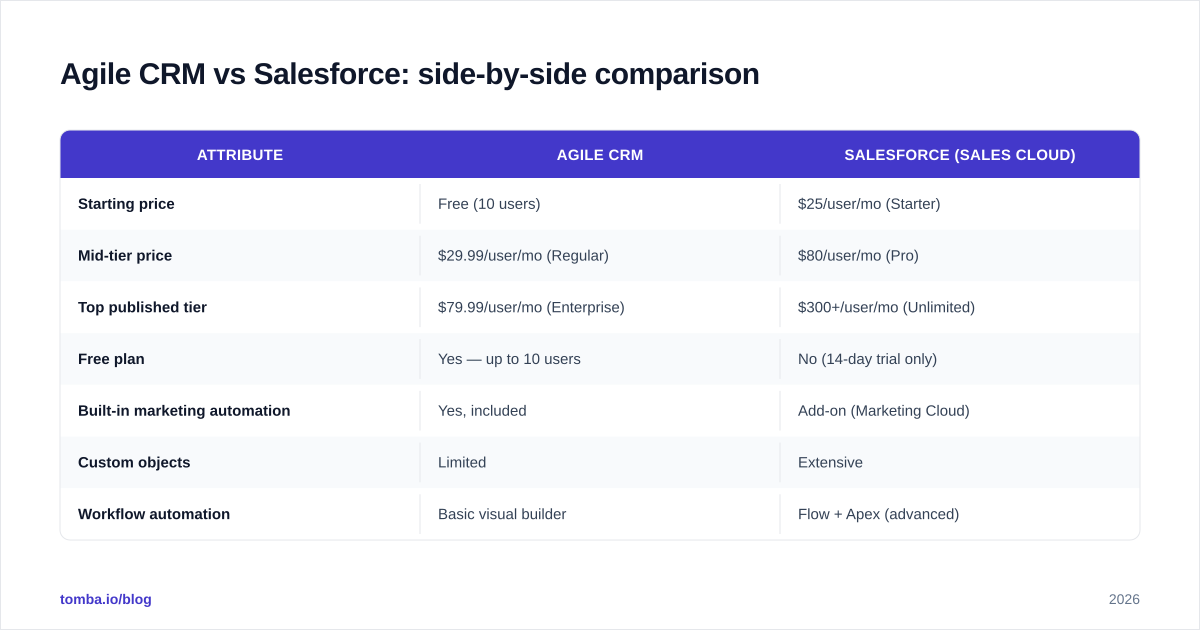
| Attribute | Agile CRM | Salesforce (Sales Cloud) |
|---|---|---|
| Starting price | Free (10 users) | $25/user/mo (Starter) |
| Mid-tier price | $29.99/user/mo (Regular) | $80/user/mo (Pro) |
| Top published tier | $79.99/user/mo (Enterprise) | $300+/user/mo (Unlimited) |
| Free plan | Yes — up to 10 users | No (14-day trial only) |
| Built-in marketing automation | Yes, included | Add-on (Marketing Cloud) |
| Custom objects | Limited | Extensive |
| Workflow automation | Basic visual builder | Flow + Apex (advanced) |
| Native integrations | ~50 | 3,000+ via AppExchange |
| AI features | Minimal | Einstein (predictive + generative) |
| Admin overhead | Low | High (often dedicated admin) |
| Best fit | SMBs, 1–25 reps | Mid-market to enterprise |
| Onboarding time | Hours to days | Weeks to months |
The pattern is clear: Agile CRM wins on price and time-to-value; Salesforce wins on ceiling and customization. Neither is "better" in the abstract — they're tuned for different company sizes.
Is Salesforce better than Agile CRM?#
Better for whom? That's the only honest framing. Salesforce is objectively more capable — more objects, more automation logic, more AI, more integrations. If capability were the only axis, the comparison would end here.
But capability you don't use is just cost and friction. A 12-person agency running Salesforce Unlimited is paying enterprise prices to use maybe 20% of the platform, while a dedicated admin's salary quietly dwarfs the license fees. For that team, Agile CRM delivers 90% of the value they'll actually touch at a fraction of the total cost.
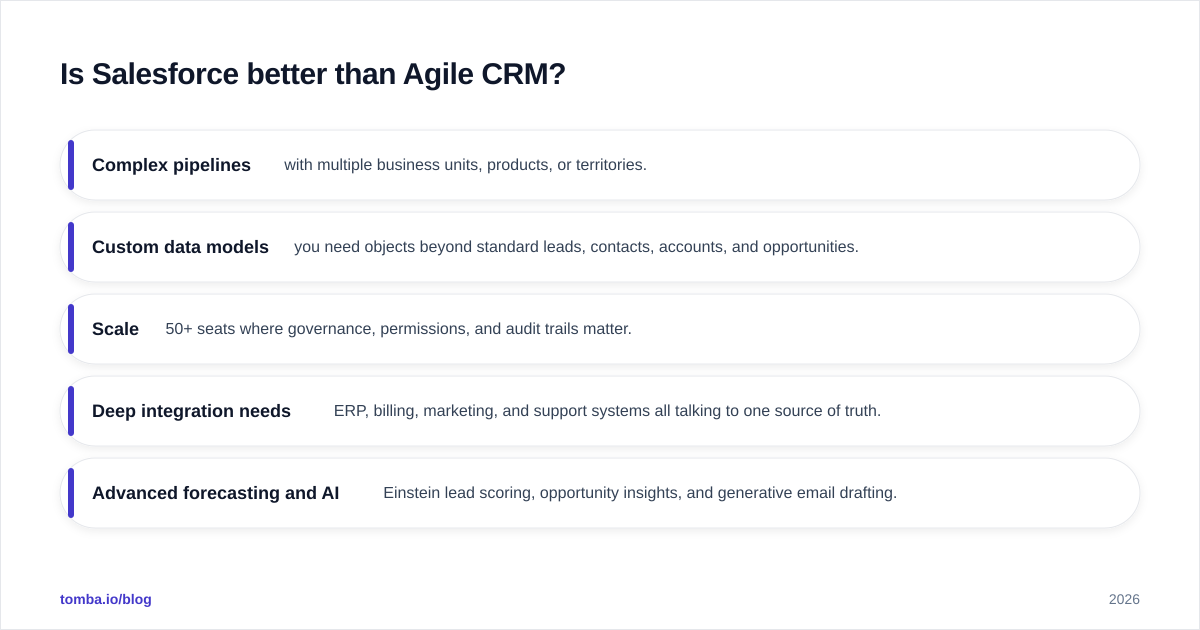
Salesforce pulls clearly ahead when you hit any of these:
- Complex pipelines with multiple business units, products, or territories.
- Custom data models — you need objects beyond standard leads, contacts, accounts, and opportunities.
- Scale — 50+ seats where governance, permissions, and audit trails matter.
- Deep integration needs — ERP, billing, marketing, and support systems all talking to one source of truth.
- Advanced forecasting and AI — Einstein lead scoring, opportunity insights, and generative email drafting.
If none of those apply, Salesforce's advantages are theoretical for you, and Agile CRM is the rational pick.
How does pricing really compare?#
Sticker price tells only part of the story; total cost of ownership is where the gap widens.
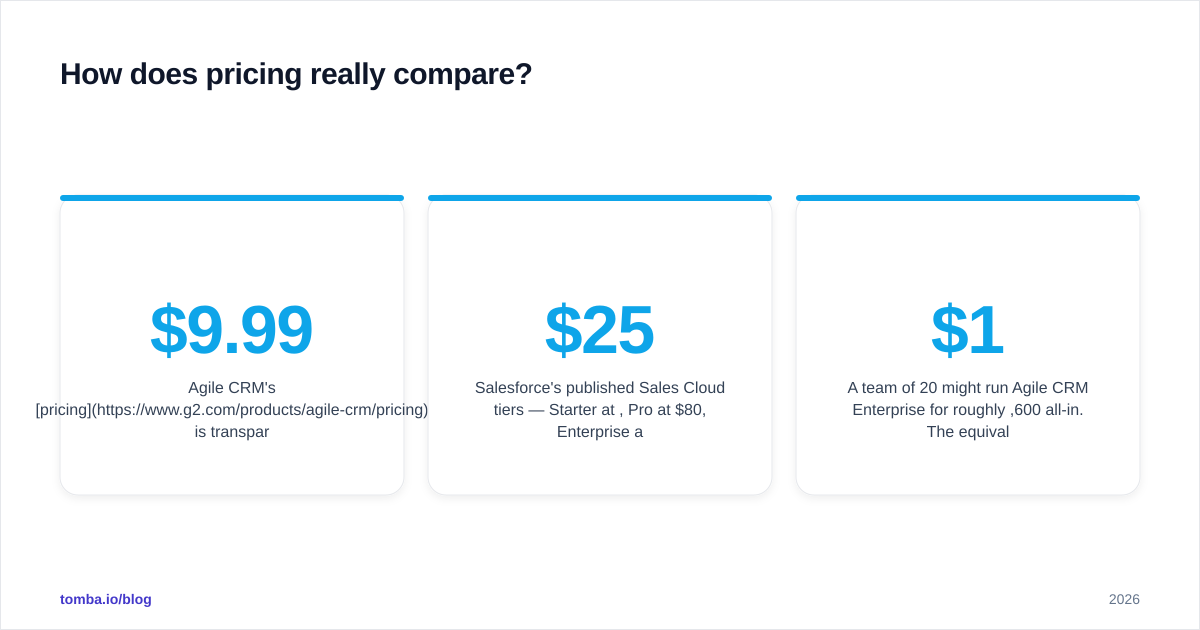
Agile CRM's pricing is transparent and flat: free for up to 10 users, $9.99 for Starter, $29.99 for Regular, and $79.99 for Enterprise per user per month. Marketing automation, helpdesk, and telephony are bundled into those tiers. What you see is roughly what you pay.
Salesforce's published Sales Cloud tiers — Starter at $25, Pro at $80, Enterprise at $165, and Unlimited at $300+ per user per month — are the floor, not the ceiling. The real bill usually includes:
- Add-on clouds (Marketing Cloud, CPQ, Service Cloud) billed separately.
- AppExchange apps to fill gaps, each with its own subscription.
- Implementation — a consulting partner for any non-trivial setup.
- Admin headcount — most orgs above ~25 seats need at least a part-time admin.
A team of 20 might run Agile CRM Enterprise for roughly $1,600/month all-in. The equivalent Salesforce footprint, once add-ons and admin time are counted, can run several times that. Whether that premium is worth it depends entirely on how much of Salesforce's depth you genuinely use.
What about automation and integrations?#
Automation is where the philosophical difference shows. Agile CRM gives you a clean visual campaign builder — drag nodes, set triggers, automate follow-ups and lead scoring. It covers the 80% of automations most SMBs need without scripting.
Salesforce Flow plus Apex code is a different universe. You can model multi-step approval chains, cross-object triggers, and logic that branches on dozens of conditions. It's genuinely programmable — which is exactly why it needs someone who knows how to program it.
On integrations, Agile CRM offers around 50 native connectors covering the common stack — email, telephony, social, and a few dozen SaaS tools. Salesforce's AppExchange lists thousands of apps, and almost every B2B SaaS vendor ships a native Salesforce connector first. If your operation depends on niche tools talking to your CRM, Salesforce's ecosystem is hard to beat. Tomba, for instance, offers a native Salesforce integration so verified contact data flows straight into your records.
Which CRM should you choose in 2026?#
Match the tool to your stage, not to its reputation. Here's the quick decision logic.
Choose Agile CRM if you:
- Run a team of 1–25 and want sales plus marketing in one bill.
- Need to be live this week, not next quarter.
- Prefer a flat, predictable price with no surprise add-ons.
- Have straightforward pipelines that fit a standard data model.
Choose Salesforce if you:
- Are scaling past 25–50 seats with governance needs.
- Require custom objects, complex automation, or multi-cloud workflows.
- Want best-in-class AI forecasting and a near-infinite integration catalog.
- Can budget for implementation and ongoing admin support.
A useful gut check: if you can't name three Salesforce features you'd configure in month one, you probably don't need Salesforce yet. Many companies start on Agile CRM (or a similar lightweight tool), outgrow it, and migrate to Salesforce when complexity finally justifies the overhead. That's a healthy progression, not a mistake — buying enterprise software before you have enterprise problems is the more common error.
Why your CRM is only as good as your data#
Here's the part both vendors gloss over: a CRM is a database, and a database full of bounced emails, duplicate records, and stale contacts will fail you no matter how much you paid for it. Reps lose trust in the system, automation fires at dead addresses, and your sender reputation takes the hit.
Whichever platform you land on, the contacts you load in determine your results. That means finding accurate, decision-maker email addresses and verifying them before they ever touch a sequence. A clean import beats a clever workflow every time. Compare your options on Capterra if you're still shortlisting, but budget time for data hygiene regardless of the winner.
This is the gap a dedicated data layer fills. Use a tool to source verified emails by company domain, enrich your leads with firmographic detail, and validate addresses before they hit your pipeline — so your shiny new CRM starts with records you can trust instead of a list you have to clean later.
Final verdict#
Agile CRM and Salesforce aren't really competing for the same customer. Agile CRM is the smart default for lean SMBs who value speed, simplicity, and an all-in-one bill. Salesforce is the right call for organizations whose complexity has outgrown off-the-shelf tooling and who can resource it properly. Be honest about which company you are today — not the one you hope to become in three years — and the choice usually makes itself.
Before you migrate a single contact into either platform, make sure those contacts are real. Tomba's Email Finder locates verified professional email addresses by name, company, or domain, so your CRM launches with accurate, deliverable data instead of guesswork. Start free with 25 searches a month and see how clean records change what your pipeline can do — full Tomba pricing scales as your team grows.
// get started
Find, verify and enrich your first contacts today
Start on the free plan with 25 searches a month, then scale when your team is ready.
Free plan · No credit card required · GDPR & CCPA
// about the author