Agile Education Marketing vs ZoomInfo: 2026 Data Showdown
Agile Education Marketing owns K-12 and higher-ed contact data; ZoomInfo owns the broad B2B universe. Here's which one fits your pipeline in 2026 — and where a pay-as-you-go finder beats both.
Agile Education Marketing vs ZoomInfo: Which Data Source Wins in 2026?
Choosing between Agile Education Marketing and ZoomInfo is really a choice about how wide your market is. One is a scalpel built for the education sector. The other is a dragnet built for every industry on earth. Pick the wrong one and you either pay for millions of contacts you'll never email, or you pay a premium for a generalist database that's thin exactly where you sell.
This breakdown compares both on coverage, accuracy, pricing, compliance, and workflow fit — then shows where a pay-as-you-go email finder undercuts both when all you actually need is verified contact data.
TL;DR#
- Agile Education Marketing is a vertical specialist: deep K-12, higher-ed, and district-level contact data with education-specific firmographics (enrollment, grade span, funding). Best if education is your market.
- **
ZoomInfo** is a horizontal giant: 100M+ business contacts, intent data, org charts, and a full sales-intelligence platform. Best if you sell across industries and need scale plus signals.
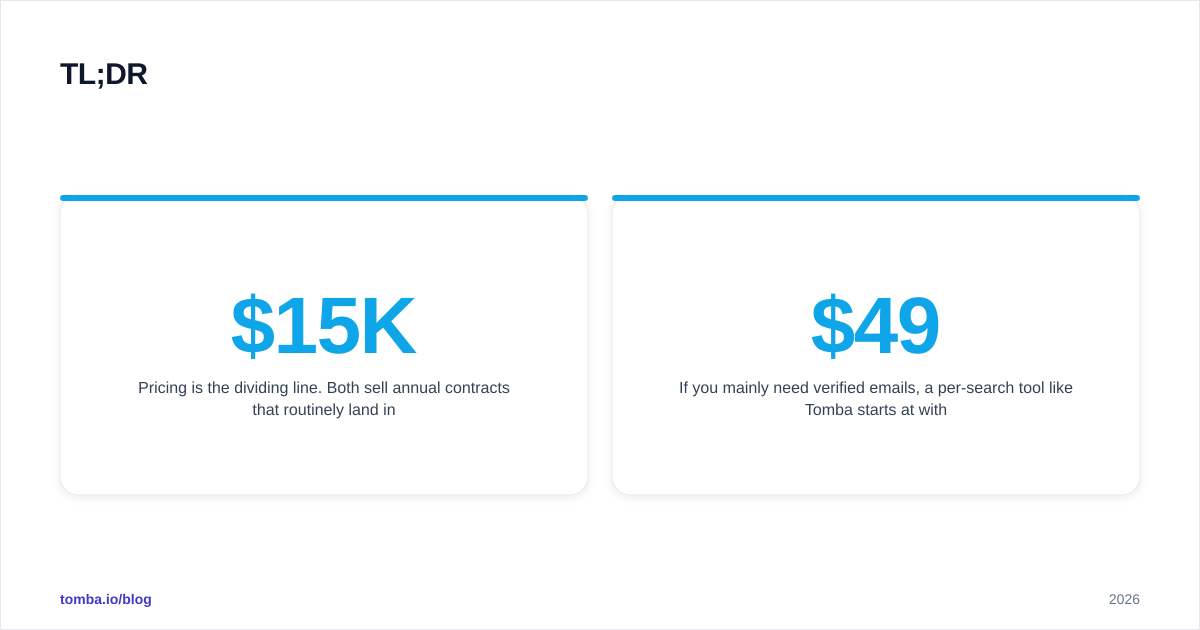
- Pricing is the dividing line. Both sell annual contracts that routinely land in the $15K–$40K+ range. Neither publishes simple self-serve pricing.
- Accuracy decays fast in education — staff turnover, role changes, and seasonal churn mean any list is only as good as its last refresh and verification pass.
- If you mainly need verified emails, a per-search tool like Tomba starts at $49/mo with no annual lock-in — and you verify on demand instead of trusting a list's age.
What is Agile Education Marketing?#
Agile Education Marketing (now part of the MDR / Dun & Bradstreet education portfolio) is a data and marketing-services provider focused entirely on the education vertical. Think teachers, principals, superintendents, district administrators, higher-ed faculty, procurement officers, and IT decision-makers across U.S. public and private institutions.
Its differentiator is depth inside one market. Instead of generic "company size" and "industry" tags, you get education-native attributes: student enrollment, grade levels served, Title I status, district budget bands, technology adoption, and role granularity that distinguishes a curriculum director from a building-level coordinator. For an edtech company, a textbook publisher, or a SaaS vendor selling into schools, that schema is gold — it lets you segment by the variables that actually predict a deal.
You can review their positioning directly at agileeducationmarketing.com. The catch: it's a managed, list-and-services model. You typically buy data sets, appends, or campaign services rather than self-serve credits.
What is ZoomInfo?#
ZoomInfo is the 800-pound gorilla of B2B sales intelligence. It maintains a database of well over 100 million professional contacts and tens of millions of companies, layered with org charts, technographics, intent signals, scoops (sales triggers), and workflow automation. Its platform also bolts onto your CRM and sequencer so reps work data without leaving their stack.
Where Agile goes deep on one vertical, ZoomInfo goes wide across all of them. You can build a list of CFOs at Series-B fintechs in Austin one minute and VP-Engineering at logistics firms the next. You can read more about the platform at zoominfo.com and see thousands of practitioner reviews on G2.
The trade-offs are cost and education depth. ZoomInfo covers schools and universities — but as just another industry vertical, not a purpose-built schema. You won't reliably filter by grade span or Title I status the way Agile lets you.

Agile Education Marketing vs ZoomInfo: side-by-side#
| Attribute | Agile Education Marketing | ZoomInfo |
|---|---|---|
| Core focus | K-12 + higher-ed only | All B2B industries |
| Contact volume | Millions (education-scoped) | 100M+ global business contacts |
| Education firmographics | Deep (enrollment, grade, funding, Title I) | Basic (industry = "education") |
| Intent / buying signals | Limited | Strong (intent, scoops, technographics) |
| Org charts | Partial | Extensive |
| Pricing model | Annual list/services contract | Annual platform contract |
| Typical entry cost | ~$10K–$30K/yr (custom) | ~$15K–$40K+/yr (custom) |
| Self-serve free tier | No | No (trial via sales) |
| Best for | Edtech, publishers, school-focused SaaS | Multi-industry sales/marketing teams |

The table makes the decision almost mechanical: if 80%+ of your TAM is schools, districts, or universities, Agile's schema saves you hours of filtering and gives you fields ZoomInfo simply doesn't carry. If your TAM spans industries — or you need intent data to time outreach — ZoomInfo's breadth and signals win.
Is Agile Education Marketing better than ZoomInfo for selling to schools?#
For pure education go-to-market, yes — with a caveat. Agile's education-native attributes let you run plays that are impossible on a generalist tool. Want every curriculum director at districts with 5,000+ students that recently passed a technology bond? Agile can express that. ZoomInfo will hand you "education" contacts and leave the precision to you.
The caveat is freshness. Education is one of the highest-churn verticals in B2B. Teachers move buildings, administrators rotate over summer, and email formats change after district IT consolidations. A list that was 95% accurate in August can be 80% accurate by November. That's not an Agile-specific flaw — it's physics for the vertical — but it means you should treat any education list as a starting point that needs verification before each send, not a permanent asset.
This is exactly where a real-time email verifier earns its keep: you validate the list right before the campaign rather than trusting a refresh cycle you don't control.
What about accuracy and bounce rates?#
Accuracy is where bought lists meet reality. Both vendors publish strong accuracy claims, and both are credible — at the moment of delivery. The problem is the gap between delivery and your actual send date.

A few practical truths:
- Catch-all domains are common in education. Many districts and universities run catch-all mail servers, so a standard SMTP check returns "valid" for addresses that may not exist. You need a catch-all verifier to score those properly instead of guessing.
- Role-based addresses inflate counts.
info@,office@, andprincipal@aliases pad a list but tank reply rates. - Verification beats vintage. A 3-month-old "verified" record is less trustworthy than one you re-checked this morning.
If your bounce rate creeps above 3–4%, mailbox providers start throttling you regardless of how prestigious your data vendor is. Protect your sender reputation by verifying close to send time — your data source is upstream of, not a substitute for, email deliverability hygiene.
How much do Agile Education Marketing and ZoomInfo cost?#
Neither publishes transparent pricing, and both steer you to a sales call and an annual contract. That's the single biggest friction point for small teams.
| Cost factor | Agile Education Marketing | ZoomInfo | Tomba |
|---|---|---|---|
| Pricing transparency | Quote-based | Quote-based | Public, self-serve |
| Contract length | Annual | Annual (often multi-year) | Monthly or free |
| Entry price | ~$10K+/yr custom | ~$15K+/yr custom | $49/mo (Starter) |
| Free option | No | No | 25 searches/mo free |
| Pay for unused data | Yes (list volume) | Yes (credit blocks) | No (credits as needed) |
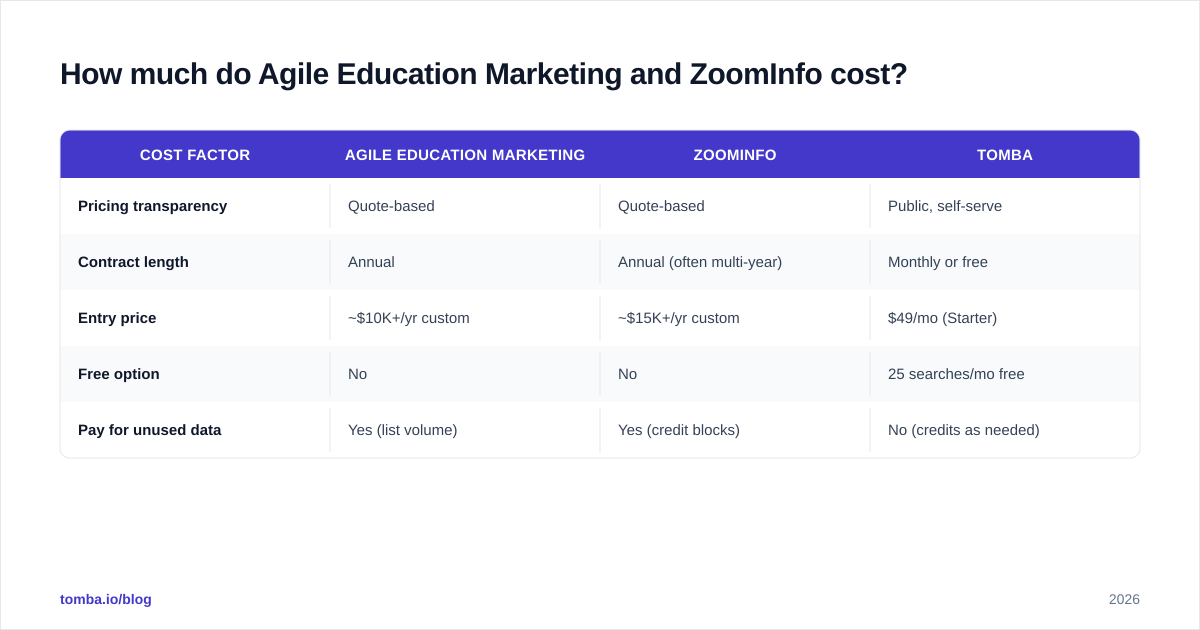
Two patterns matter here. First, you usually pre-pay for volume — credits or list sizes you may not consume, especially in a niche like education where your true addressable list is finite. Second, annual lock-in means a tool that underperforms still bills you for 12 months. For a team that just needs verified emails for a defined set of institutions, that's a lot of fixed cost. Compare that to transparent, monthly Tomba pricing and the math shifts for smaller and mid-market teams.

What about compliance and data sourcing?#
Education adds compliance wrinkles most B2B tools don't face. Marketing to school staff can intersect with FERPA-adjacent expectations, state student-privacy laws, and district opt-out policies — and you must never touch student PII. Both vendors operate within professional-contact rules (business email and role data, not student records), but you remain the data controller for your campaigns.
Whichever source you pick:
- Email professional/role addresses, not personal ones.
- Honor unsubscribes instantly and suppress globally.
- Keep provenance notes on where each record came from — useful if a district asks.
Understanding where your data comes from isn't a nice-to-have in this vertical; it's part of your defensibility. Ask any vendor — Agile, ZoomInfo, or otherwise — how records are sourced, refreshed, and verified before you sign.
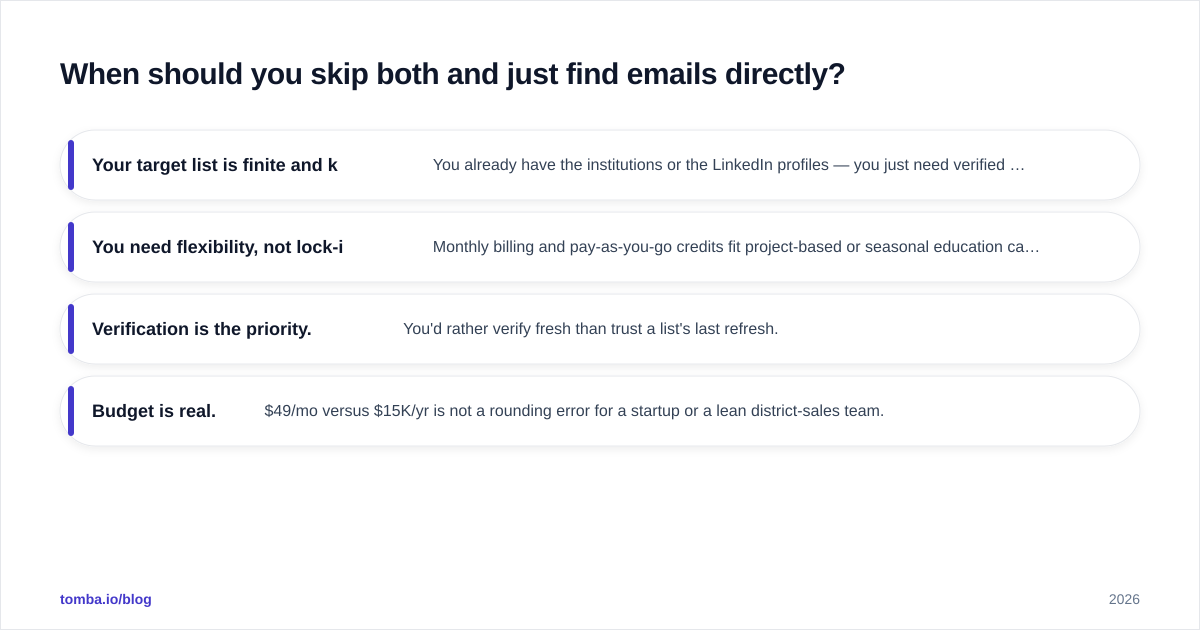
When should you skip both and just find emails directly?#
Skip the enterprise contract when your real need is narrower than the platform you're being sold. That's more common than vendors admit.
Use a direct email finder instead of a big-data subscription when:
- Your target list is finite and known. You already have the institutions or the LinkedIn profiles — you just need verified emails. Paying for a 100M-record database to find 2,000 contacts is overkill.
- You need flexibility, not lock-in. Monthly billing and pay-as-you-go credits fit project-based or seasonal education campaigns (back-to-school, budget season) far better than annual seats.
- Verification is the priority. You'd rather verify fresh than trust a list's last refresh.
- Budget is real. $49/mo versus $15K/yr is not a rounding error for a startup or a lean district-sales team.
Here's a simple decision framework.
The framework usually resolves like this: **broad, multi-industry, signal-driven outbound →
ZoomInfo. Deep, education-only, segment-heavy campaigns → Agile. Defined target lists where you mainly need verified contact details → a direct finder.** Many teams even pair them — use a niche or broad source to build the account list, then verify and fill gaps with a finder so you're not emailing stale records.
You can also pull contacts straight from company domains with domain search and validate questionable institutional servers with a catch-all finder — the two checks that matter most in the high-churn, catch-all-heavy education space.

Frequently asked questions#
Is Agile Education Marketing the same as ZoomInfo? No. Agile is an education-only data and marketing-services provider; ZoomInfo is a broad B2B sales-intelligence platform covering all industries. They overlap only where ZoomInfo happens to carry education contacts.
Which has more accurate education data? Agile's data is more granular for education (it carries education-specific fields ZoomInfo lacks), but raw accuracy on any list depends on refresh recency. Verify before every send regardless of vendor.
Can I get either without an annual contract? Rarely. Both lean on quote-based annual agreements. If you want monthly or pay-as-you-go, a self-serve finder is the practical route.
Do I still need email verification if I buy from these vendors? Yes. Education contacts churn fast and catch-all servers are common, so verifying close to send time protects your bounce rate and sender reputation.
The bottom line#
Agile Education Marketing wins on depth for school-and-university go-to-market; ZoomInfo wins on breadth, scale, and buying signals across every industry. Both win on coverage and lose on price transparency and annual lock-in.
But if you strip the question down to "I have a list of institutions and people — I just need verified emails I can trust today," neither enterprise contract is the efficient answer. Tomba's email finder gets you there with a free tier (25 searches/mo), a $49/mo Starter plan, real-time verification, catch-all detection, and an API when you're ready to automate — no annual commitment, no paying for data you'll never use. Start free, verify everything, and only scale up when the pipeline proves it's worth it.
Ready to find emails that actually work?
Join 150,000+ professionals who stopped guessing and started sending. Free credits on signup — no credit card required.
Get the Tomba newsletter
Practical outbound tactics and product updates — once every two weeks.
About the author