The Agoge Sequence: Aggressive Cold Email Follow-Ups (2026)
Most cold email dies after one send. The Agoge sequence stacks 7+ touches across angles to force a yes, no, or referral. Here's how to build one in 2026.
TL;DR
- The Agoge sequence is a high-frequency cold email framework: 7+ touches to the same prospect over ~2-3 weeks, each from a different angle, ending in a hard breakup.
- It is named after the brutal Spartan training regimen and was popularized in the B2B world by Daniel Fazio (Client Ascension). The idea: most replies come from follow-ups, not the first email.
- It works because persistence plus varied angles beats a single clever opener. You rotate value, social proof, a different pain, a loom, and a breakup.
- It only works on a clean foundation: verified emails, warmed domains, and tight targeting. Volume without deliverability just burns your domain.
- Use it for high-value, well-defined ICPs — not for spraying 50,000 unqualified contacts.
What is the Agoge sequence?#
The Agoge sequence is an aggressive, multi-touch cold email cadence designed to exhaust every reasonable angle on a prospect before you give up. Instead of the typical "email, bump, breakup" three-step flow, the Agoge stacks seven or more emails over two to three weeks, with each message attacking the offer from a new direction: a new pain point, a new proof point, a new format.
The core bet is simple and backed by every cold email benchmark out there: the majority of positive replies arrive after the first email. If you stop at touch two, you leave most of your pipeline on the table. The Agoge sequence is the structured, deliberate version of "follow up until they tell you to stop."
It is not a license to spam. The difference between an Agoge sequence and an annoying drip is that every touch carries a reason to exist — a fresh hook — rather than the lazy "just bumping this to the top of your inbox."
Where does the Agoge sequence come from?#
The name is borrowed from Sparta. The agoge was the rigorous education and training regimen mandatory for citizens of ancient Sparta — relentless, repetitive, and built to forge resilience. The metaphor is intentional: the sequence is meant to be disciplined and unrelenting.
In modern B2B sales, the term was popularized by Daniel Fazio and the Client Ascension community as a named pattern for high-frequency outbound. It spread because it gave a memorable label to something top reps already knew: structured persistence converts. The framework matters more than the brand around it — you can run an "Agoge" cadence in any sending tool.
How does the Agoge sequence work?#
The structure is a fixed skeleton of message types, sent to the same contact, spaced out so you stay just under the threshold of irritation. Each touch has a job.
A typical Agoge skeleton looks like this:
- The opener — short, personalized, one clear pain, one soft CTA.
- The value add — a resource, insight, or quick teardown relevant to them. No ask, or a very light one.
- The social proof — a specific result you got for a comparable company. Names and numbers beat adjectives.
- The different angle — reframe the offer around a second pain point in case the first one missed.
- The format switch — a Loom video, a one-line question, or a short case study link. Pattern interrupt.
- The "permission to close the file" — the soft breakup. "Should I assume this isn't a priority right now?"
- The hard breakup — final email, often the highest-replying one. "Closing your file — last call if timing changes."
Some operators extend to 9-12 touches and weave in other channels (LinkedIn views, connection requests, the occasional call). The email spine stays the same.
The non-negotiable rule: no two emails should feel the same. If a prospect could delete touch 4 and not notice it was different from touch 2, you have a drip, not an Agoge sequence.
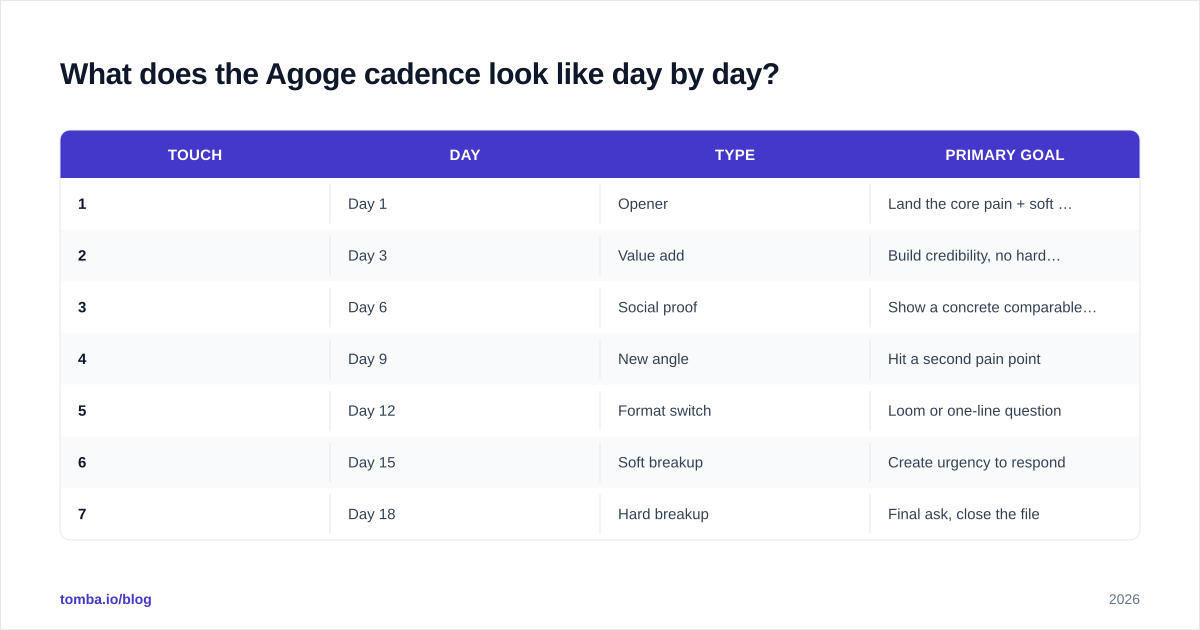
What does the Agoge cadence look like day by day?#
Spacing is where most people get it wrong. Too tight and you read as desperate; too loose and you lose momentum. A workable default over a two-to-three-week window:
| Touch | Day | Type | Primary goal |
|---|---|---|---|
| 1 | Day 1 | Opener | Land the core pain + soft CTA |
| 2 | Day 3 | Value add | Build credibility, no hard ask |
| 3 | Day 6 | Social proof | Show a concrete comparable result |
| 4 | Day 9 | New angle | Hit a second pain point |
| 5 | Day 12 | Format switch | Loom or one-line question |
| 6 | Day 15 | Soft breakup | Create urgency to respond |
| 7 | Day 18 | Hard breakup | Final ask, close the file |
Send on business days, ideally mid-morning in the prospect's time zone, and keep the whole thread on the same subject line so it lands as a reply chain. That threading is part of why later touches over-perform — they ride the context of everything before them.
How do you write each Agoge email?#
The copy rules are the same ones that govern all good cold email, just applied seven times with discipline:
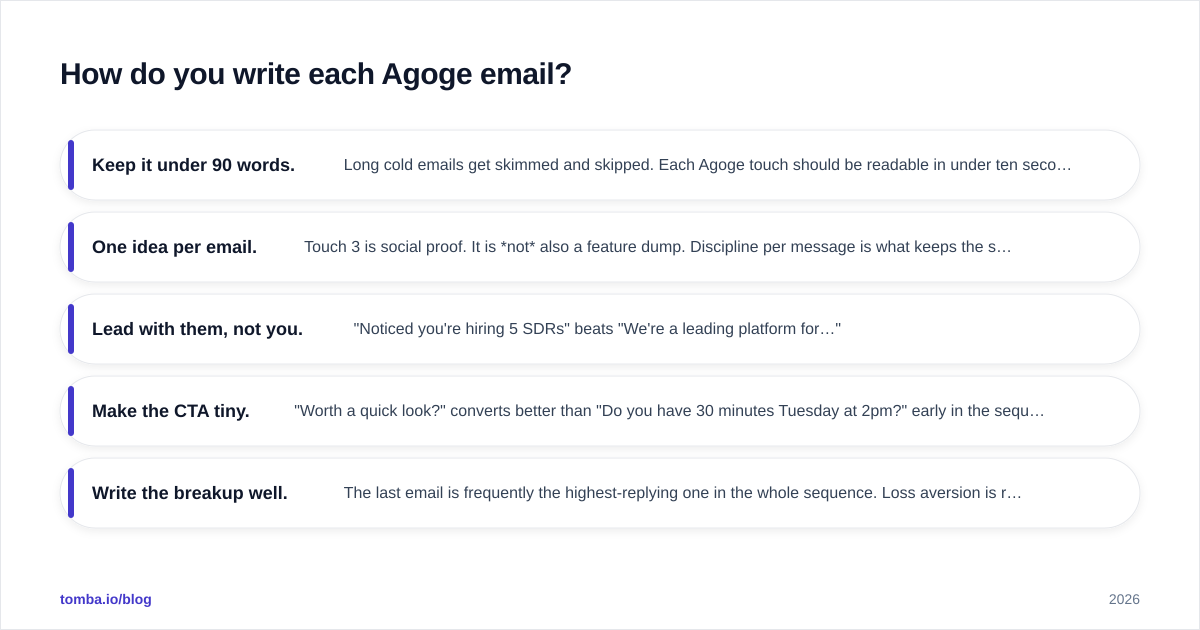
- Keep it under 90 words. Long cold emails get skimmed and skipped. Each Agoge touch should be readable in under ten seconds.
- One idea per email. Touch 3 is social proof. It is not also a feature dump. Discipline per message is what keeps the sequence varied.
- Lead with them, not you. "Noticed you're hiring 5 SDRs" beats "We're a leading platform for…"
- Make the CTA tiny. "Worth a quick look?" converts better than "Do you have 30 minutes Tuesday at 2pm?" early in the sequence. Save the calendar ask for once they engage.
- Write the breakup well. The last email is frequently the highest-replying one in the whole sequence. Loss aversion is real — "closing your file" pulls replies that "checking in" never will.
If writing seven distinct angles by hand sounds painful, that is the actual work of outbound. You can speed up first drafts with a cold email AI tool, but you still have to edit each touch so it reads like a human who did their homework. For benchmarks on what "good" looks like, HubSpot publishes ongoing sales email statistics worth checking before you set expectations.
Is the Agoge sequence better than a standard cold email sequence?#
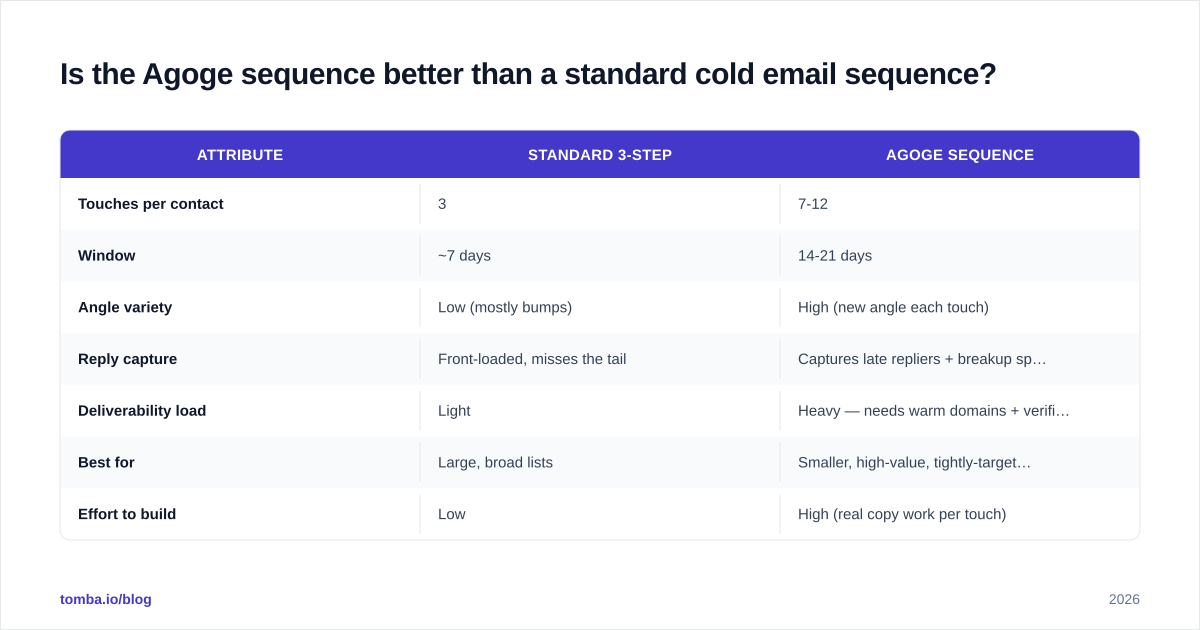
For high-value, well-targeted lists, usually yes — because it captures the long tail of replies a three-email sequence abandons. For massive, loosely-qualified lists, it can be worse: you are spending seven sends per contact, which means deliverability and reputation costs add up fast. Match the tool to the job.
| Attribute | Standard 3-step | Agoge sequence |
|---|---|---|
| Touches per contact | 3 | 7-12 |
| Window | ~7 days | 14-21 days |
| Angle variety | Low (mostly bumps) | High (new angle each touch) |
| Reply capture | Front-loaded, misses the tail | Captures late repliers + breakup spikes |
| Deliverability load | Light | Heavy — needs warm domains + verified data |
| Best for | Large, broad lists | Smaller, high-value, tightly-targeted ICPs |
| Effort to build | Low | High (real copy work per touch) |
The honest trade-off: the Agoge sequence buys you more replies at the cost of more sends, more copy, and more risk to your sender reputation if your foundation is weak. On a clean setup against a sharp ICP, that trade is almost always worth it. On a junk list, it just gets you blacklisted faster.
What do you need to run the Agoge sequence safely?#
Volume amplifies whatever you already have. If your data is dirty and your domain is cold, the Agoge sequence amplifies the damage. Three prerequisites are non-negotiable.
1. Verified, accurate contact data. Seven sends to a bad address is seven bounces against your reputation. Bounce rate is one of the fastest ways to wreck email deliverability, so every contact should be validated before the first touch. Run your list through an email verifier and remove or flag catch-all and risky addresses before you load the sequence.
2. Warmed sending infrastructure. Use multiple sending domains, keep per-inbox volume conservative (think 20-40 cold sends per inbox per day, not hundreds), and warm them for at least two to three weeks before going live. Authenticate everything — SPF, DKIM, DMARC. The Agoge sequence multiplies your daily send count, so plan inbox capacity accordingly.
3. A real ICP. The Agoge sequence is expensive per contact. That math only works when the contact is worth seven touches. Define your ideal customer tightly, then source the right people at the right companies rather than scraping everyone.
That sourcing step is where most sequences quietly fail — not on copy, but on who gets the copy. You need the actual decision-maker's address, not a generic info@ inbox. A domain search lets you pull verified contacts at a target company, and a dedicated email finder gets you the specific person by name. For pricing on running this at scale, see the Tomba pricing tiers.
What are the most common Agoge sequence mistakes?#
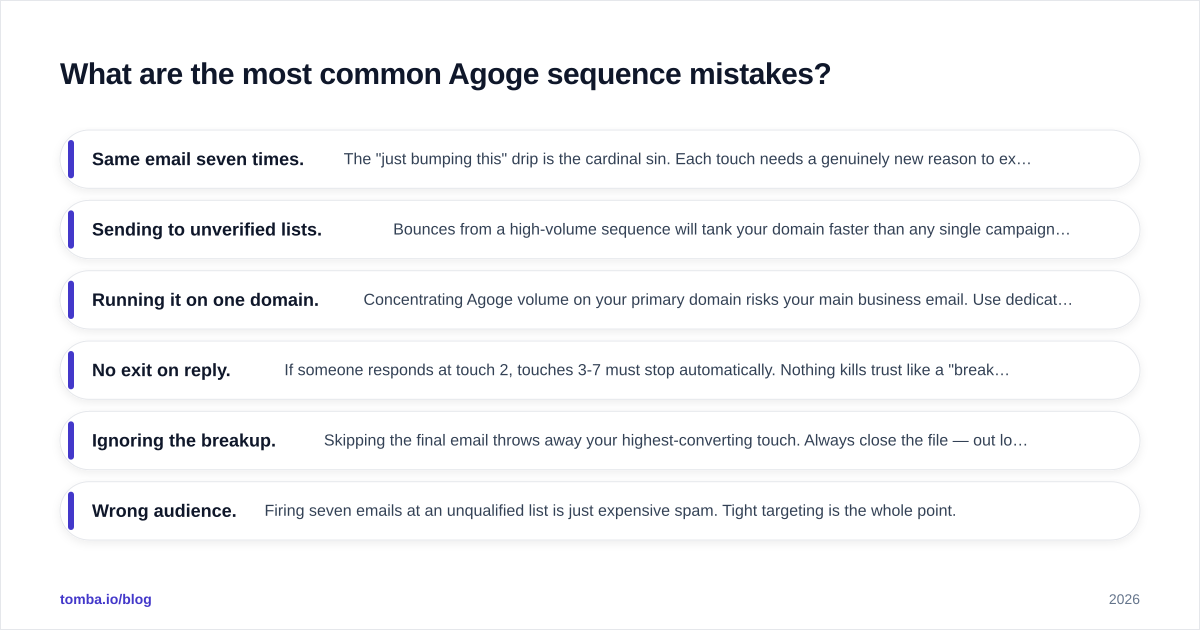
- Same email seven times. The "just bumping this" drip is the cardinal sin. Each touch needs a genuinely new reason to exist.
- Sending to unverified lists. Bounces from a high-volume sequence will tank your domain faster than any single campaign. Verify first, always.
- Running it on one domain. Concentrating Agoge volume on your primary domain risks your main business email. Use dedicated sending domains.
- No exit on reply. If someone responds at touch 2, touches 3-7 must stop automatically. Nothing kills trust like a "breakup" email sent to someone who already booked a call.
- Ignoring the breakup. Skipping the final email throws away your highest-converting touch. Always close the file — out loud.
- Wrong audience. Firing seven emails at an unqualified list is just expensive spam. Tight targeting is the whole point.
Track your response rate per touch so you can see which angles pull and which to cut. Most operators find one or two touches do disproportionate work — keep those, replace the dead weight.
Frequently asked questions#
How many emails is an Agoge sequence? Typically seven to twelve touches over two to three weeks. Seven is the common baseline; aggressive operators extend further and layer in other channels.
Is the Agoge sequence spam? Not if done correctly. The line is relevance and variety: targeted, verified, ICP-matched outreach where each touch adds something is legitimate prospecting. Identical bumps to a scraped list is spam. Always honor opt-outs and applicable email regulations.
How long should each Agoge email be? Under 90 words. Shorter emails get read; long ones get skipped. The breakup can be the shortest of all.
Does the Agoge sequence still work in 2026? Yes, but the bar is higher. Inbox filters and prospect fatigue mean personalization, deliverability hygiene, and tight targeting matter more than raw volume. The framework is sound; sloppy execution is what fails.
What tools do I need? A sending platform that supports multi-step sequences and auto-stops on reply, warmed domains, an email verifier, and a reliable source of accurate contact data.
Run your Agoge sequence on a clean foundation#
The Agoge sequence rewards persistence, but only when every email actually reaches a real, verified decision-maker. Garbage data turns seven disciplined touches into seven reputation-damaging bounces. Start by sourcing the right contacts: use the Tomba Email Finder to pull verified professional emails by name, company, or domain, then validate the list before you load it into your sequence. Get the foundation right, and the Agoge framework does the rest. Spin up a free account (25 searches a month, no card) and build your first targeted list today.
// get started
Find, verify and enrich your first contacts today
Start on the free plan with 25 searches a month, then scale when your team is ready.
Free plan · No credit card required · GDPR & CCPA
// about the author