AI Chatbot Lead Generation in 2026: The Complete Playbook
AI chatbots now qualify, route, and book leads while you sleep. Here's how to build a chatbot lead-gen engine in 2026 that actually fills your pipeline.
TL;DR
- AI chatbot lead generation uses conversational AI to capture, qualify, and route website visitors into your pipeline 24/7 — replacing static forms with a back-and-forth that converts higher.
- The biggest wins come from qualification and routing, not just capture: a good bot books meetings and disqualifies tire-kickers before a rep ever looks.
- Data quality is the silent killer. A chatbot that collects unverified emails feeds your CRM garbage, so pair capture with real-time email verification.
- Expect 2x–3x form-to-lead lift when you replace a 7-field form with a conversational flow — but only if the handoff to sales is instant.
- Tools range from no-code widgets (Drift, Intercom, Tidio) to LLM-native agents. Match the tool to your sales motion, not the hype.
What is AI chatbot lead generation?#
AI chatbot lead generation is the practice of using a conversational AI agent — on your website, in ads, or inside messaging apps — to start conversations with visitors, qualify them, and convert them into known, contactable leads.
Think of it like the difference between a vending machine and a good shop assistant. A static lead form is a vending machine: it only gives you something if the visitor already knows exactly what they want and is willing to punch in every field. An AI chatbot is the shop assistant who greets people, asks what they're after, steers them to the right thing, and quietly notes their contact details on the way out.
The "AI" part matters in 2026. Older rule-based bots followed rigid decision trees and broke the moment a visitor phrased something unexpectedly. Modern bots run on large language models, so they understand intent, handle messy phrasing, pull answers from your knowledge base, and adapt the qualifying questions based on what the visitor already said.
The output is the same thing your sales team has always wanted: a named person, a verified email, a phone number where it makes sense, and enough context to know whether they're worth a call.
Why are static forms losing to conversational AI?#
Static forms lose because every extra field is a tax on conversion. Industry data has shown for years that form conversion drops sharply as field count rises — and yet most B2B "contact us" forms still ask for seven or more fields up front. A chatbot sidesteps this by asking one question at a time, in a format that feels like a chat rather than an interrogation.
There are four structural reasons conversational AI outperforms:
- Progressive disclosure. The bot asks for the email only after the visitor is already invested in the conversation, not as the price of entry.
- Instant response. A bot replies in milliseconds. Research from vendors like HubSpot has long shown that lead response time is one of the strongest predictors of conversion — responding within minutes versus hours changes outcomes dramatically.
- Qualification in-line. The bot can ask "how many seats?" or "what's your timeline?" and branch accordingly, so sales only sees leads that fit.
- 24/7 coverage. Your best SDR sleeps. The bot does not, and roughly a third of B2B buying research happens outside business hours.
That said, "conversational" is not automatically "better." A bot that collects a typo'd email at 2 a.m. has manufactured a dead lead and a wasted follow-up. Volume without quality is just faster disappointment.
How does the AI chatbot lead generation funnel actually work?#
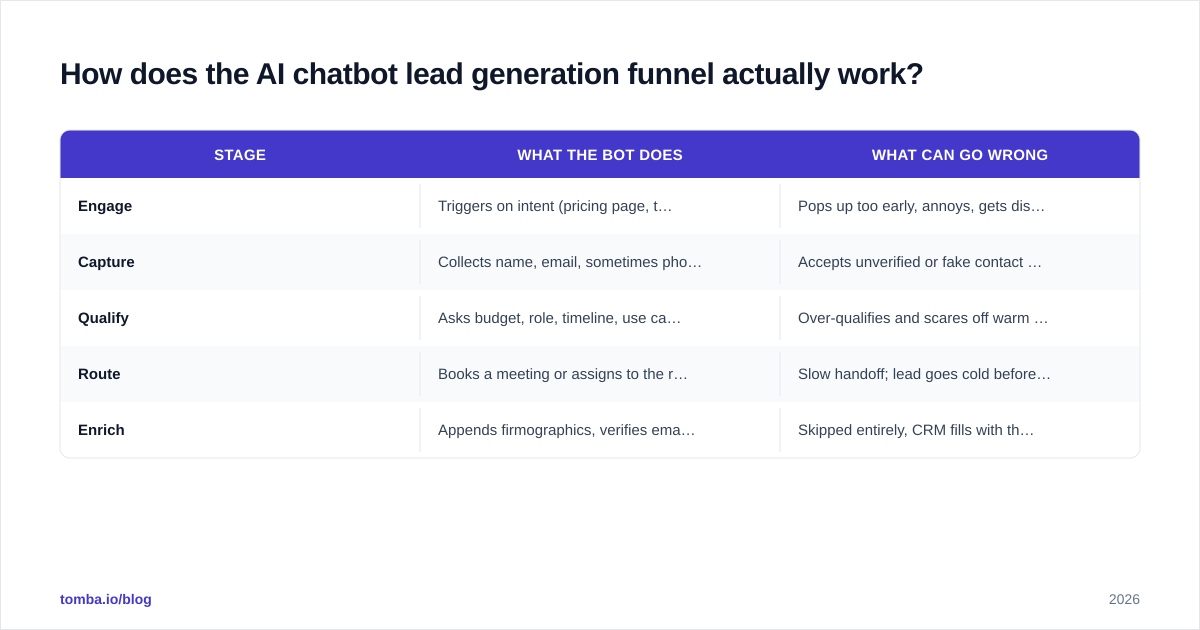
The funnel has five stages, and most teams under-invest in the last three. Capture is easy; the value is in what happens after.
| Stage | What the bot does | What can go wrong |
|---|---|---|
| Engage | Triggers on intent (pricing page, time-on-page, exit intent) | Pops up too early, annoys, gets dismissed |
| Capture | Collects name, email, sometimes phone | Accepts unverified or fake contact data |
| Qualify | Asks budget, role, timeline, use case | Over-qualifies and scares off warm leads |
| Route | Books a meeting or assigns to the right rep | Slow handoff; lead goes cold before contact |
| Enrich | Appends firmographics, verifies email/phone | Skipped entirely, CRM fills with thin records |
The capture-to-enrich gap is where pipelines leak. A chatbot that hands sales a row with john@gmial.com (note the typo) and no company data isn't generating leads — it's generating cleanup work.
This is why serious teams wire verification and enrichment directly into the capture step. The moment the bot collects an email, an email verifier can confirm it's deliverable, and a data enrichment call can append the company, role, and size before the record ever lands in front of a rep. The lead arrives qualified and clean.
What should you look for in an AI chatbot tool?#
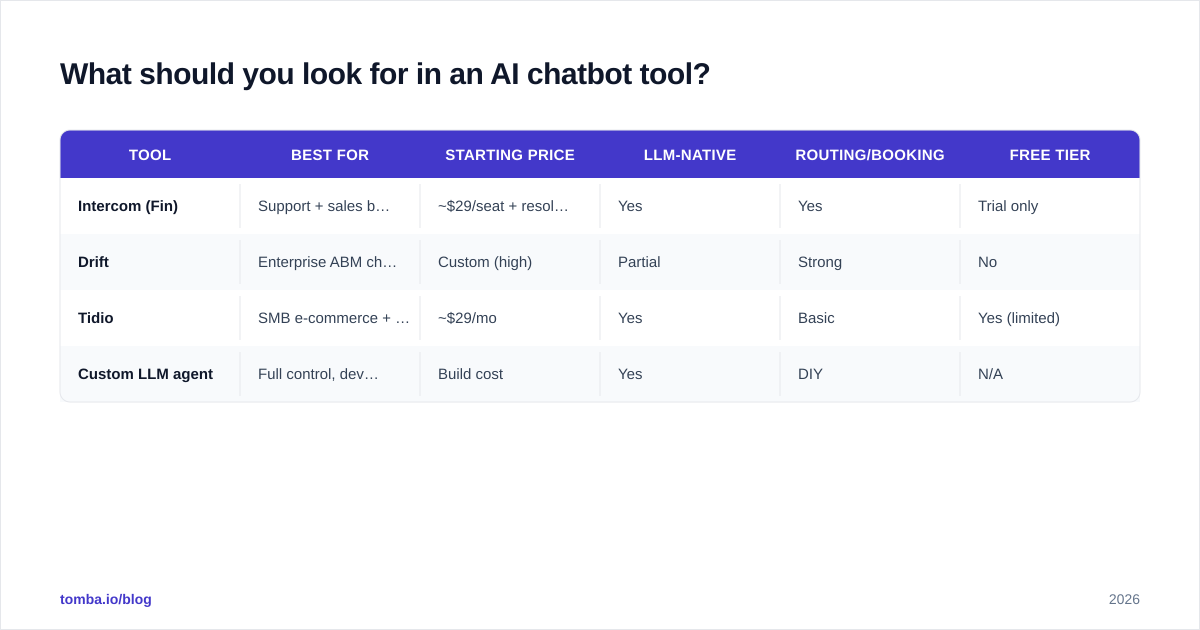
Match the tool to your sales motion. A product-led SaaS company that wants self-serve signups has different needs than an enterprise team chasing six-figure deals. Here's how the main categories stack up.
| Tool | Best for | Starting price | LLM-native | Routing/booking | Free tier |
|---|---|---|---|---|---|
| Intercom (Fin) | Support + sales blend | ~$29/seat + resolution fees | Yes | Yes | Trial only |
| Drift | Enterprise ABM chat | Custom (high) | Partial | Strong | No |
| Tidio | SMB e-commerce + B2B | ~$29/mo | Yes | Basic | Yes (limited) |
| Custom LLM agent | Full control, dev team | Build cost | Yes | DIY | N/A |
When you evaluate, weigh these five things in order:
- Qualification depth. Can it branch logically, or is it a glorified FAQ? Check vendor demos and cross-reference real reviews on G2 before trusting marketing claims.
- Handoff speed. Does it book directly into a rep's calendar, or dump a transcript into a queue someone checks twice a day?
- Data hygiene hooks. Can you call an external API mid-conversation to verify the email or enrich the company? If not, you'll bolt it on later anyway.
- CRM integration. Native sync to your CRM (HubSpot, Salesforce, Pipedrive) beats a
Zapier patch job for reliability.
- Cost model. Per-resolution pricing can spike unpredictably. Per-seat is easier to forecast.
How do you keep chatbot leads clean and verified?#
Verify at the point of capture, not in a nightly batch. By the time a batch job runs, your SDR may have already emailed a dead address and dented your sender reputation.
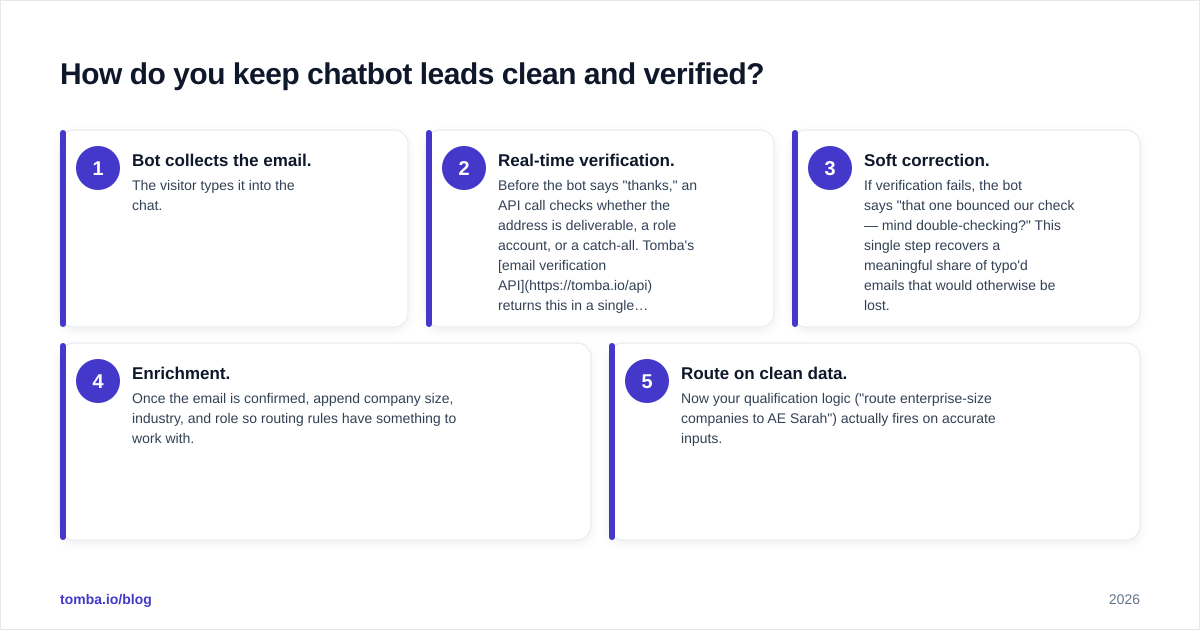
The clean-lead pattern looks like this:
- Bot collects the email. The visitor types it into the chat.
- Real-time verification. Before the bot says "thanks," an API call checks whether the address is deliverable, a role account, or a catch-all. Tomba's email verification API returns this in a single request, so the check is invisible to the visitor.
- Soft correction. If verification fails, the bot says "that one bounced our check — mind double-checking?" This single step recovers a meaningful share of typo'd emails that would otherwise be lost.
- Enrichment. Once the email is confirmed, append company size, industry, and role so routing rules have something to work with.
- Route on clean data. Now your qualification logic ("route enterprise-size companies to AE Sarah") actually fires on accurate inputs.
Two practical notes. First, watch out for catch-all domains — addresses that accept everything and verify "valid" but may still bounce. A dedicated catch-all verifier flags these so you can treat them with appropriate caution rather than false confidence. Second, if your bot also collects phone numbers for sales callbacks, validate them the same way; a phone validator keeps your dialer from burning time on disconnected lines.
The principle is simple: the chatbot is your front door, but verification is the bouncer. Skip the bouncer and your CRM fills with people who will never convert.
What does a high-converting chatbot conversation look like?#
The best flows feel helpful first and salesy second. They lead with the visitor's problem and earn the contact details by being useful, not by gating value behind a form wall.
A strong B2B flow on a pricing page might run like this:
- Bot: "Looking at plans? I can help you figure out which fits. Roughly how many people on your team would use this?"
- Visitor: "About 20."
- Bot: "Got it — the Growth plan covers that with room to scale. Want me to send a side-by-side of Growth vs. Pro so you can compare?"
- Visitor: "Sure."
- Bot: "What's the best email for that?" (captures + verifies in the background)
- Bot: "Sent. One more — are you evaluating for a specific quarter, or just exploring?"
Notice what happened. The bot qualified team size (a firmographic), delivered value (the comparison), captured a verified email, and gauged timeline — all without a single form field. The visitor never felt sold to. By the time this lands in the CRM, a rep knows the company size, intent, and timeline.
Contrast that with the failure mode: a bot that opens with "Enter your email to chat." That's a vending machine wearing a chatbot costume, and visitors treat it accordingly.
For teams running outbound alongside inbound chat, the same verified contact data flows into your prospecting motion. Once you know a lead's company, a tool like domain search can surface the other decision-makers at that account, turning a single chatbot conversation into a multi-threaded opportunity.
How do you measure AI chatbot lead generation performance?#
Track conversion and quality, because optimizing one without the other is how teams fool themselves. A bot can double "leads" by lowering the bar, then quietly halve your win rate.
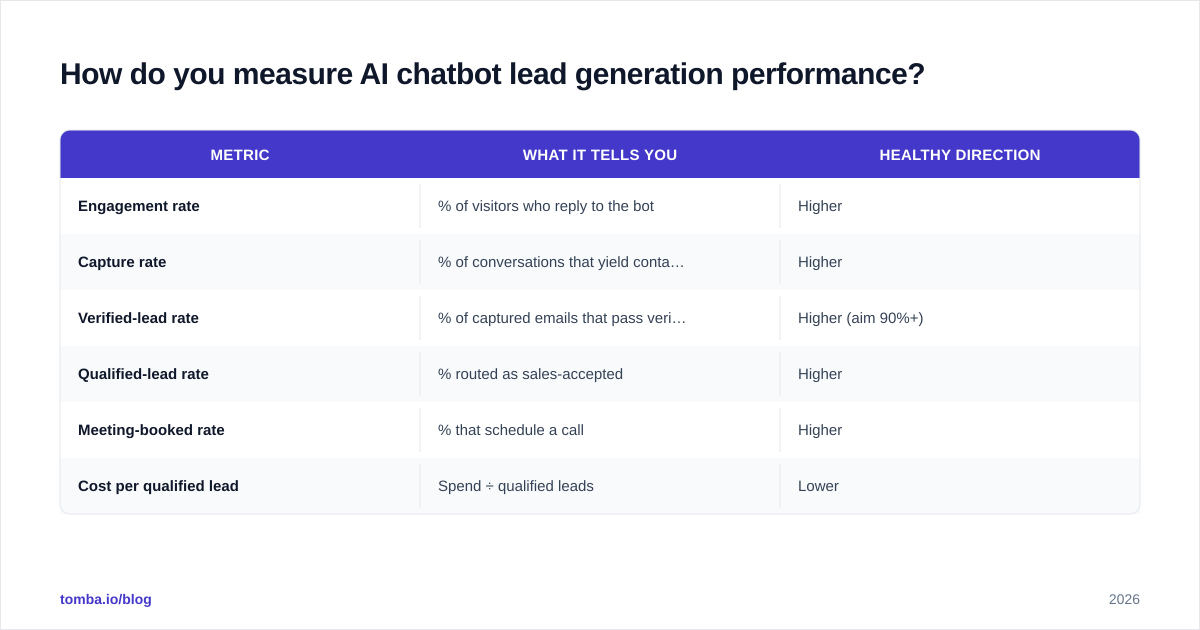
The metrics that matter:
| Metric | What it tells you | Healthy direction |
|---|---|---|
| Engagement rate | % of visitors who reply to the bot | Higher |
| Capture rate | % of conversations that yield contact info | Higher |
| Verified-lead rate | % of captured emails that pass verification | Higher (aim 90%+) |
| Qualified-lead rate | % routed as sales-accepted | Higher |
| Meeting-booked rate | % that schedule a call | Higher |
| Cost per qualified lead | Spend ÷ qualified leads | Lower |
The verified-lead rate is the one most teams forget to instrument. If your bot captures 1,000 emails a month but only 70% are deliverable, you don't have 1,000 leads — you have 700, plus 300 reasons your bounce rate is climbing and your domain reputation is eroding. Watching this number is also the cheapest deliverability insurance you'll buy; a clean list protects email deliverability across every campaign downstream.
Review transcripts weekly, too. The questions visitors ask that the bot fumbles are a free roadmap for both your product messaging and your next round of bot training.
Is AI chatbot lead generation worth it for small teams?#
Yes, and arguably more so than for large ones — because a small team can't staff 24/7 coverage any other way. A two-person sales team plus a well-built bot can respond to every inbound visitor instantly, qualify them, and only spend human time on the ones worth it. That's leverage you can't buy with headcount at that stage.
The trap small teams fall into is treating the chatbot as the whole system. It isn't. The chatbot is one component in a pipeline that also needs verification, enrichment, and a fast handoff. Get those right and a modest bot outperforms a fancy one bolted onto a leaky funnel.
Start lean: one bot on your highest-intent pages (pricing, demo, key product pages), wired to verify every email on capture, routing straight to a shared calendar. Measure the verified-qualified-lead rate, fix the worst conversation drop-offs, and expand from there.
Where does Tomba fit in your chatbot stack?#
Your chatbot opens the conversation — Tomba makes sure the contact data behind it is real. The moment your bot captures an email, run it through the Tomba Email Finder and verification stack to confirm deliverability, fill in missing work emails, and enrich the lead with company and role data before it ever reaches a rep. Pair that with the email finder API to do it all in-line, invisibly, mid-conversation.
Tomba's pricing starts with a free tier (25 searches/month) so you can test the verification-on-capture flow before committing, then scales to Starter at $49/mo and Growth at $99/mo as your chatbot volume grows. Build the bot however you like — just don't let it hand your sales team unverified leads. Start free, wire verification into your capture step, and watch your CRM fill with contacts worth calling.
// get started
Find, verify and enrich your first contacts today
Start on the free plan with 25 searches a month, then scale when your team is ready.
Free plan · No credit card required · GDPR & CCPA
// about the author