Best AI Cold Calling Tools in 2026: Features, Pricing, Picks
AI cold calling tools now dial, transcribe, coach, and even talk for you. Here's how the 2026 field compares — features, pricing, and which fits your team.
TL;DR
- AI cold calling tools split into three buckets: AI-assisted dialers (parallel/power dialing + live transcription), AI coaching software (post-call scoring and objection analysis), and autonomous AI voice agents (a synthetic voice runs the call end to end).
- For most B2B teams in 2026, the highest ROI is still an AI-assisted dialer plus call coaching — not a fully autonomous robot caller, which carries compliance and trust risk.
- Pricing ranges from roughly $30/user/mo for basic AI dialers to $150+/user/mo for full conversation-intelligence suites.
- Data quality decides everything. The best dialer is useless against wrong numbers, so a clean source of verified B2B phone numbers is the real prerequisite.
- Skip to the comparison table below if you just want the shortlist.
What are AI cold calling tools?#
AI cold calling tools are software that uses machine learning, speech recognition, and large language models to make outbound sales calls faster, smarter, or fully automated. Think of them as the difference between a paper map and live GPS: you were always going to drive the route, but now something is watching traffic, rerouting you, and telling you when you're about to miss the turn.
In practice, "AI cold calling" is an umbrella term covering very different products. Some only speed up dialing and log notes. Some listen to your live calls and whisper suggestions. A growing few replace the human entirely with a synthetic voice. Lumping them together is how buyers end up paying for a robot voice agent when what they needed was a faster dialer.
The framework above maps the three categories against two axes: how much of the call the AI handles, and how much human judgment stays in the loop. Where your team lands depends on call volume, deal complexity, and how regulated your market is.
What are the three categories of AI cold calling tools?#
AI-assisted dialers#
These keep a human rep on the line but remove the dead time. A parallel dialer rings four to ten numbers at once and connects you only when a human picks up. Layered on top: live transcription, automatic CRM logging, local presence numbers, and voicemail drop. The AI handles the tedium; you handle the conversation.
Best for: SDR teams making 80+ dials a day who already have a script that works.
AI coaching and conversation intelligence#
This category records and analyzes every call, then scores it. The AI flags talk-to-listen ratio, detects objections, spots which talk tracks correlate with booked meetings, and surfaces coaching moments for managers. It doesn't change the call in real time so much as make the next 100 calls better. If you want to raise your team's response rate, this is usually where the gains hide.
Best for: managers scaling a team and trying to make average reps perform like top reps.
Autonomous AI voice agents#
The newest and noisiest category. A synthetic voice — often indistinguishable from a human for the first few seconds — runs the entire call: opener, qualification, objection handling, and meeting booking. No rep on the line.
Best for: very high-volume, low-complexity top-of-funnel motions, lead reactivation, or list cleaning. Risky for relationship-driven enterprise sales, and increasingly regulated (more on that below).
Which AI cold calling tools are best in 2026?#
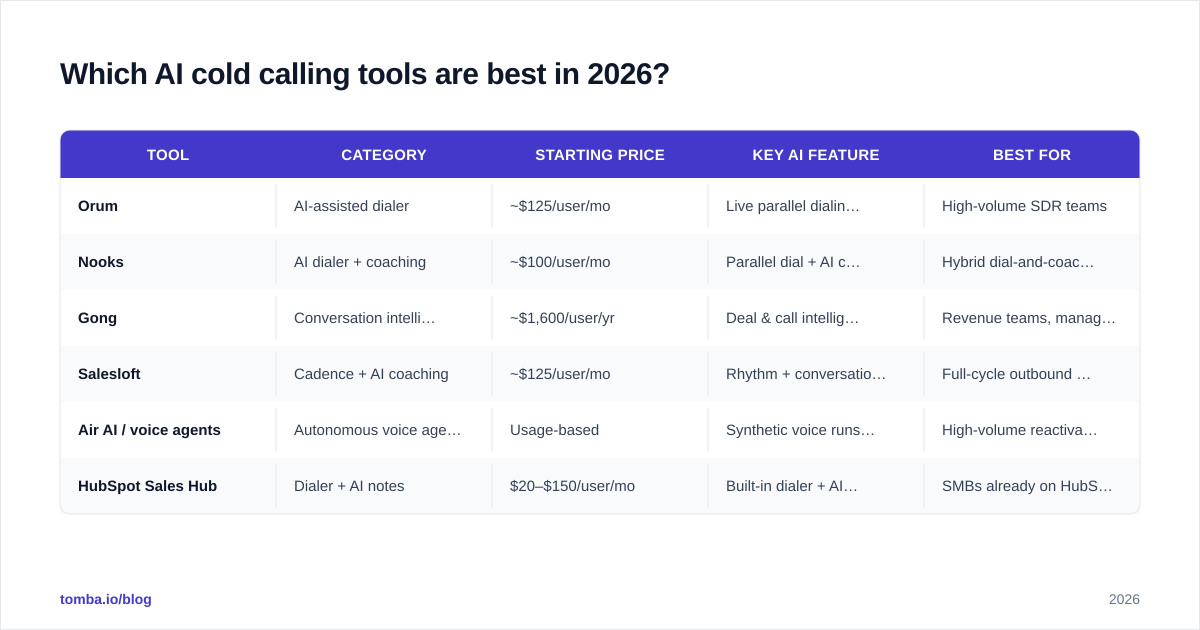
Below is a side-by-side look at representative tools across the three categories. Prices are list prices per user per month and move often, so treat them as ballpark and confirm on each vendor's pricing page.
| Tool | Category | Starting price | Key AI feature | Best for |
|---|---|---|---|---|
| Orum | AI-assisted dialer | ~$125/user/mo | Live parallel dialing + answer detection | High-volume SDR teams |
| Nooks | AI dialer + coaching | ~$100/user/mo | Parallel dial + AI call analysis | Hybrid dial-and-coach teams |
| Gong | Conversation intelligence | ~$1,600/user/yr | Deal & call intelligence at scale | Revenue teams, managers |
| Salesloft | Cadence + AI coaching | ~$125/user/mo | Rhythm + conversation AI | Full-cycle outbound orgs |
| Air AI / voice agents | Autonomous voice agent | Usage-based | Synthetic voice runs the call | High-volume reactivation |
| HubSpot Sales Hub | Dialer + AI notes | $20–$150/user/mo | Built-in dialer + AI summaries | SMBs already on HubSpot |
A few honest caveats. Gong is priced and built for whole revenue teams, not solo reps, so the per-seat math only works at scale. Autonomous voice agents are usage-based and can look cheap until volume scales — and they carry the most regulatory exposure. And nearly every tool here assumes you already have accurate numbers to dial, which most teams don't.
For an independent read on user reviews and feature grids, G2's sales engagement category and Gartner's peer reviews are the least biased starting points.
)
Is an AI voice agent better than a human cold caller?#
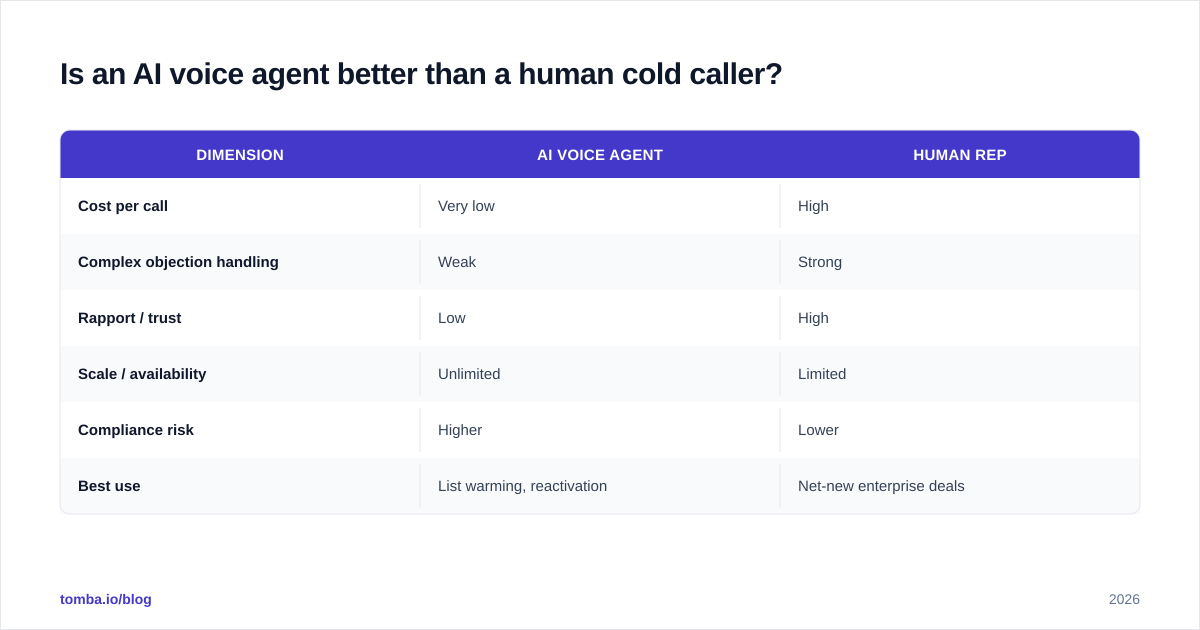
Short answer: not yet, for most B2B sales — and "better" depends entirely on the job.
For pure throughput on simple tasks (confirming interest, reactivating dormant leads, cleaning a list), an AI voice agent wins on cost and tirelessness. It never gets call reluctance, never needs a coffee, and dials at 3 a.m. across time zones.
For anything that requires reading hesitation, building rapport with a skeptical VP, or improvising past a curveball objection, humans still win clearly. Buyers can tell. And the moment a prospect realizes they've been talking to a bot they didn't consent to, the trust cost outweighs the efficiency gain.
There's also a compliance dimension you can't wave away. In the US, the FCC has moved to treat AI-generated voices in robocalls under existing TCPA restrictions, and several states require disclosure when a caller is synthetic. Before deploying an autonomous agent, read the FTC's guidance on telemarketing rules and check your jurisdiction. "The AI did it" is not a defense regulators accept.
| Dimension | AI voice agent | Human rep |
|---|---|---|
| Cost per call | Very low | High |
| Complex objection handling | Weak | Strong |
| Rapport / trust | Low | High |
| Scale / availability | Unlimited | Limited |
| Compliance risk | Higher | Lower |
| Best use | List warming, reactivation | Net-new enterprise deals |
The pragmatic 2026 setup for most teams: humans on the calls, AI on everything around the call. That's the sales automation sweet spot — automate the busywork, keep the judgment human.
How do you choose the right AI cold calling tool?#
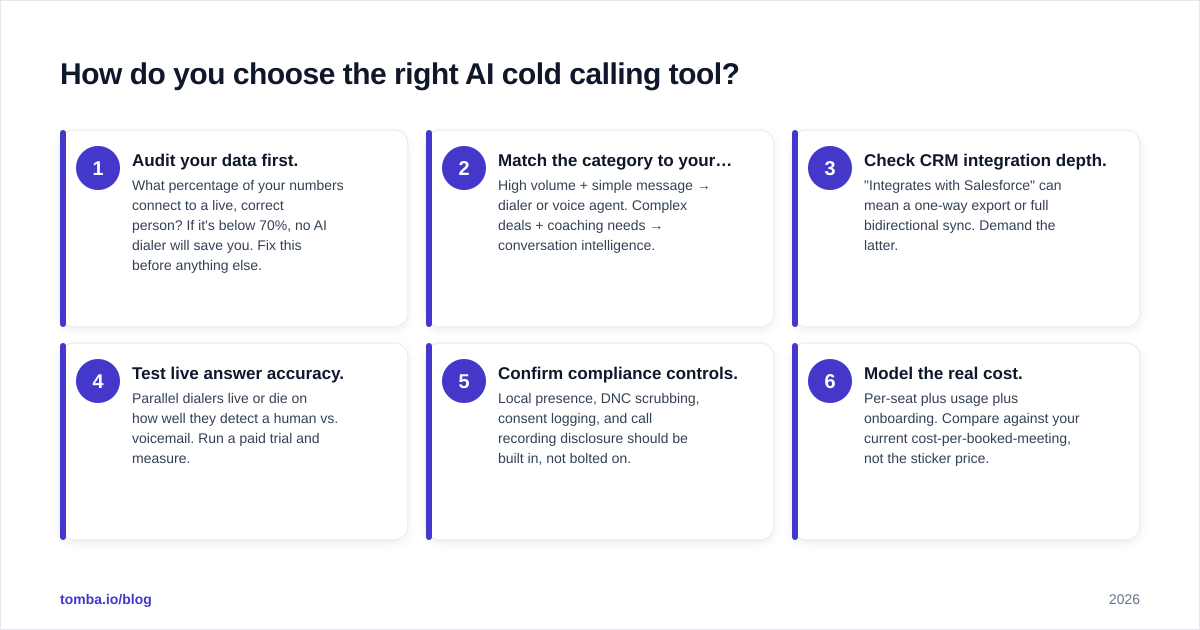
Work through these in order. The order matters because spending on a dialer before fixing your data is like buying a faster car with no fuel.
- Audit your data first. What percentage of your numbers connect to a live, correct person? If it's below 70%, no AI dialer will save you. Fix this before anything else.
- Match the category to your motion. High volume + simple message → dialer or voice agent. Complex deals + coaching needs → conversation intelligence.
- Check CRM integration depth. "Integrates with Salesforce" can mean a one-way export or full bidirectional sync. Demand the latter.
- Test live answer accuracy. Parallel dialers live or die on how well they detect a human vs. voicemail. Run a paid trial and measure.
- Confirm compliance controls. Local presence, DNC scrubbing, consent logging, and call recording disclosure should be built in, not bolted on.
- Model the real cost. Per-seat plus usage plus onboarding. Compare against your current cost-per-booked-meeting, not the sticker price.
)
Why does data quality matter more than the AI?#
Because the smartest dialer in the world still dials whatever number you feed it. AI cold calling tools optimize the call; they do nothing for the list. If 35% of your numbers are wrong, you've automated dialing dead ends faster.
This is the part most "best AI cold calling tools" lists skip, and it's the part that actually moves pipeline. Connect rate is a function of phone-number accuracy first and dialer technology second. Before you evaluate a single AI feature, make sure your contact records are real, current, and reachable.
That's where your prospecting stack matters. A verified source of direct-dial B2B numbers feeds the dialer; clean, enriched contact records feed the CRM the AI reads from. Tomba's phone finder surfaces direct B2B phone numbers, and the phone validator checks that a number is live and correctly formatted before it ever hits your dialer queue. Pairing accurate numbers with data enrichment means your AI tool spends its time talking to the right people instead of burning minutes on disconnected lines.
It's also why pure phone tools rarely stand alone. Cold calling is one channel in a multi-touch sequence — call, email, LinkedIn, repeat. The same contact you dial should be the one you email, which is why teams pair direct dials with a verified work email from an email finder. When the data layer is unified, the AI on top finally has something accurate to work with.
What does an AI cold calling workflow look like in practice?#
Here's a realistic 2026 stack, end to end:
- List building: Pull target accounts, enrich each contact with a verified direct dial and work email. Validate numbers before import.
- Sequencing: A cadence tool schedules call, email, and social touches in rhythm.
- Dialing: An AI parallel dialer connects reps only to live answers, drops voicemails automatically, and logs every attempt.
- Live assist: Real-time transcription surfaces objection-handling prompts on screen.
- Post-call: Conversation intelligence scores the call, updates the CRM, and flags coaching moments for the manager.
- Refinement: Weekly, the AI shows which openers and talk tracks booked the most meetings. You double down on what works.
Notice the AI shows up at five different stages — but never replaces the rep's judgment on a complex call. That's the model that's winning. Reasonable people disagree on how fast autonomous agents will take over the simpler end of this; our read is that the regulated, trust-sensitive middle of B2B stays human-led through 2026.
For teams already running HubSpot, much of this is native — see HubSpot's own breakdown of AI in sales for how the dialer and AI summaries fit their CRM. Tomba's data plugs into that flow through the HubSpot integration, so enriched, verified contacts land where your dialer already lives.
How much should you budget for AI cold calling tools?#
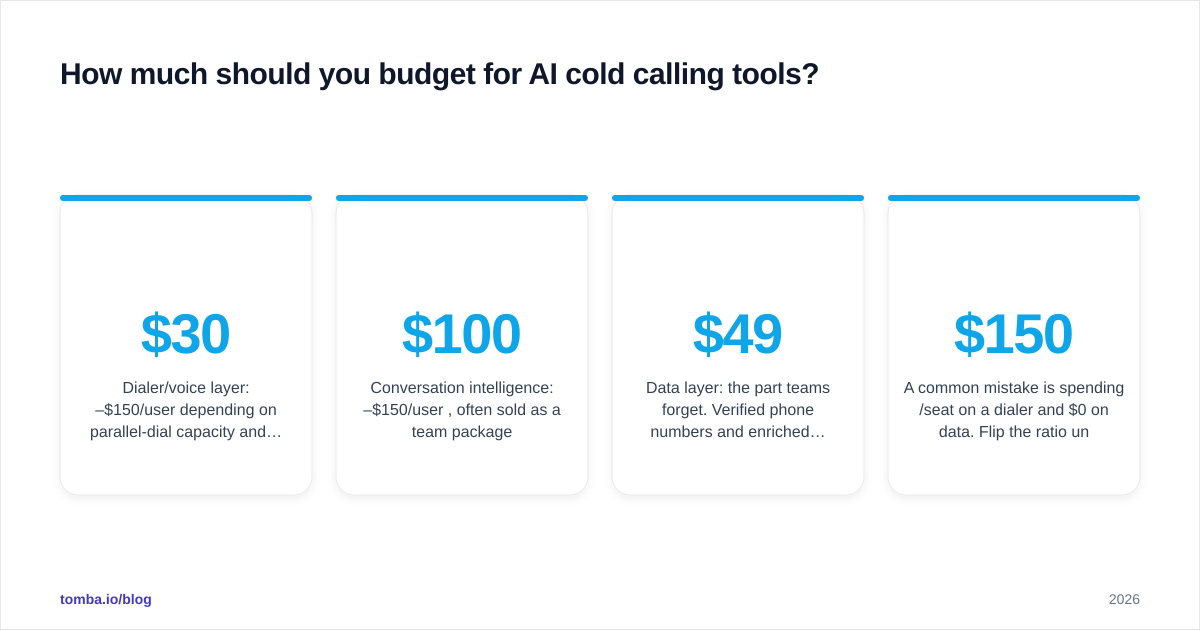
Budget in layers, not as a single line item:
- Dialer/voice layer: $30–$150/user/mo depending on parallel-dial capacity and AI features.
- Conversation intelligence: $100–$150/user/mo, often sold as a team package.
- Data layer: the part teams forget. Verified phone numbers and enriched contacts. Tomba's plans start with a free tier (25 searches/mo) and scale from Starter at $49/mo to Growth at $99/mo and Pro at $249/mo — see full Tomba pricing for credit allocations.
A common mistake is spending $150/seat on a dialer and $0 on data. Flip the ratio until your connect rate is healthy, then invest in dialing speed. A 60% accurate list on a premium dialer loses to an 90% accurate list on a basic one, every time.
The bottom line#
AI cold calling tools in 2026 are genuinely good — at the parts of the call that aren't the conversation. Use AI to dial faster, log automatically, and coach your team toward what works. Be cautious with fully autonomous voice agents until the compliance picture settles and your brand can absorb the trust risk. And above all, fix your data before you fix your dialer.
If your connect rate is the bottleneck, start where the calls start: with accurate, verified contact data. Tomba's Email Finder gives your reps verified work emails to pair with direct dials, so every AI-powered call lands on a real, reachable person — and every follow-up has somewhere to go. Spin up the free tier, validate your next list, and let your AI cold calling tool do its job against data that's actually worth dialing.
// get started
Find, verify and enrich your first contacts today
Start on the free plan with 25 searches a month, then scale when your team is ready.
Free plan · No credit card required · GDPR & CCPA
// about the author