AI Cold Email Personalization Mistakes to Avoid in 2026
AI made personalization cheap, which is exactly why it stopped working. Here are the 9 AI cold email personalization mistakes killing your reply rates in 2026 — and how to fix each one.
AI was supposed to make cold email personal again. Instead it flooded inboxes with the same robotic "I loved your recent post about [topic]" opener, sent 10,000 times an hour. The tooling got faster; the replies got rarer.
This guide breaks down the specific AI cold email personalization mistakes that are tanking reply rates in 2026, why each one fails, and what to do instead. The fix is rarely "more AI." It's better inputs, tighter relevance, and knowing when a human sentence beats a generated paragraph.
TL;DR#
- Personalization is not the same as a personalized-looking sentence. Buyers now pattern-match AI openers instantly and delete on sight.
- Bad data breaks AI personalization before the prompt ever runs. Wrong name, dead company, stale title — garbage in, garbage in the spam folder.
- The biggest mistake is personalizing the intro but not the offer. A custom first line attached to a generic pitch converts worse than no personalization.
- Volume thinking kills relevance. Sending 5,000 "personalized" emails is usually worse than 300 genuinely researched ones.
- The fix is a tiering framework: verify the data, segment by signal, personalize the relevance (not just the greeting), and reserve deep manual work for tier-one accounts.
Why does AI cold email personalization fail so often?#
The short answer: AI personalization fails because it optimizes for looking personalized rather than being relevant.
Think of it like a greeting card. A handwritten note from a friend lands differently than a card where someone scrawled your name above a pre-printed message. The pre-printed part is still generic — adding your name on top doesn't make it personal, it just makes the genericness more obvious. Most AI cold email does exactly this: it bolts a custom-sounding sentence onto a templated pitch and hopes the seam doesn't show. It always shows.
There's also a volume problem. AI removed the cost of writing, so teams cranked output 10x. But the inbox didn't get 10x bigger, and buyers got 10x better at spotting the pattern. The result is that the median personalized email in 2026 performs worse than a plain, honest one did in 2021.
Below are the nine mistakes that cause most of the damage, grouped into data, content, and strategy failures.
What are the most common AI personalization mistakes?#
Mistake 1: Personalizing on broken data#
This is the failure that happens before the AI even runs. If your record says "Hi {FirstName}" and FirstName is blank, null, or "Sales Team," no prompt on earth saves you. The same goes for outdated job titles, merged companies, and contacts who left 14 months ago.
AI amplifies bad data because it confidently writes around it. Feed it a stale title and it will craft a flattering, specific-sounding line about a role the person no longer holds — which is worse than saying nothing.
Fix it at the source. Run your list through an email verifier before enrichment, and confirm the contact actually exists at the company using domain search. Clean data is the cheapest personalization upgrade available.
Mistake 2: Personalizing the opener, not the offer#
The single most common pattern: a beautifully researched first line ("Saw you just opened a second office in Austin — congrats!") followed by the exact same pitch you sent everyone else.
Buyers read the first sentence, feel briefly seen, then hit the generic paragraph and realize the intro was bait. That whiplash is worse than a cold open, because now you've signaled "I researched you just enough to manipulate you."
Real personalization changes the relevance of the offer. If the Austin office matters, your pitch should connect to scaling a regional team — not pivot back to your standard feature list.
Mistake 3: The "I loved your recent post" formula#
Every AI tool can scrape a LinkedIn post and reference it. That's exactly why it no longer works — it became a tell. When a prospect sees "I really resonated with your post on [topic]," they now read it as "a bot scraped my feed."
If you reference content, prove you actually engaged with it: quote a specific claim and disagree, or extend the idea with something the author didn't say. Generic praise of content is anti-personalization in 2026.
Mistake 4: Over-personalizing trivial details#
Mentioning that someone's company uses a specific shade of blue, or that they posted about their dog, doesn't build rapport — it's creepy and signals desperation. AI is very good at finding trivia and very bad at judging whether trivia is relevant.
Personalization should map to a business reason the prospect would care about your email. If the detail doesn't connect to a problem you solve, leave it out.
Mistake 5: Letting AI invent facts#
Generative models hallucinate. Left unchecked, they'll claim a prospect "recently raised a Series B" that never happened, or congratulate them on an award they didn't win. One fabricated fact destroys credibility for the entire sequence.
Constrain the model to a verified field set. Pull real funding, headcount, tech-stack, and role data through data enrichment and pass only those fields into the prompt. Never let the model free-associate about the company.
How is personalization different from relevance?#
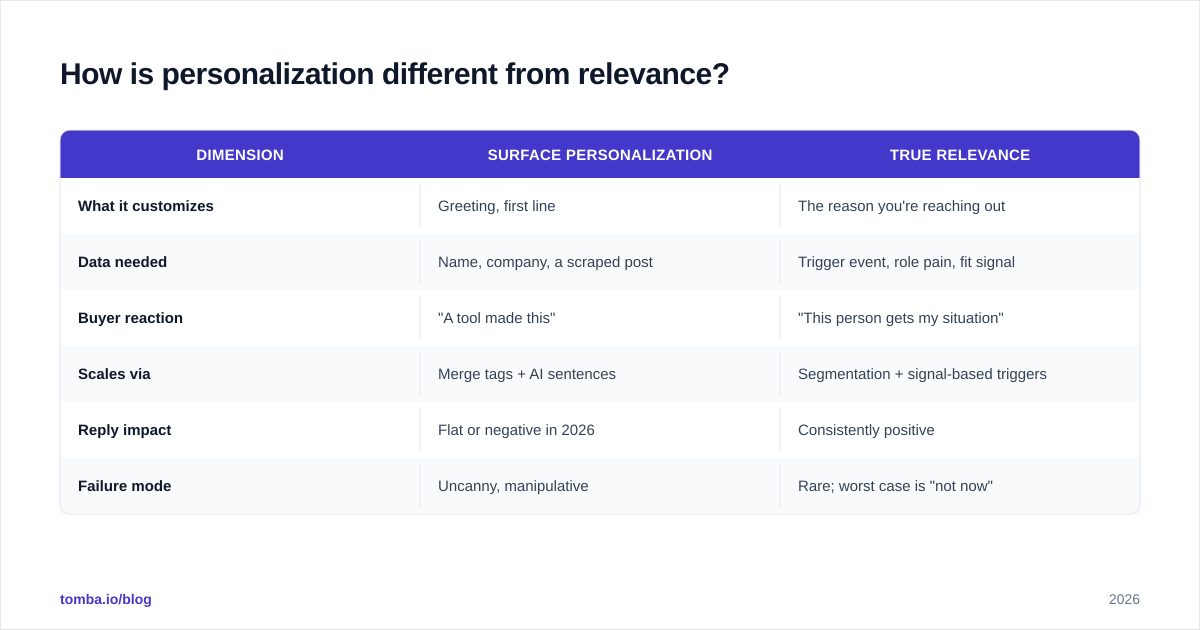
Relevance beats personalization. Here's the distinction that most teams miss.
| Dimension | Surface personalization | True relevance |
|---|---|---|
| What it customizes | Greeting, first line | The reason you're reaching out |
| Data needed | Name, company, a scraped post | Trigger event, role pain, fit signal |
| Buyer reaction | "A tool made this" | "This person gets my situation" |
| Scales via | Merge tags + AI sentences | Segmentation + signal-based triggers |
| Reply impact | Flat or negative in 2026 | Consistently positive |
| Failure mode | Uncanny, manipulative | Rare; worst case is "not now" |
A relevant email can have zero name-dropping and still outperform a "personalized" one, because it speaks to a problem the buyer actually has right now. That's the bar. The question isn't "did I mention something about them?" — it's "would this person agree I understood their situation before I hit send?"
Mistake 6: Ignoring trigger events#
The best personalization input isn't biographical, it's temporal: a new hire, a funding round, a product launch, a job posting that reveals a pain point. AI can write about these brilliantly — but only if your data pipeline surfaces them. Most don't, so the AI defaults to evergreen trivia.
Wire timing signals into your sequencing. Reaching out the week a company posts a role you can help fill beats a perfectly worded email sent at a random time. For more on this, our breakdown of response rate drivers covers why timing often outweighs wording.
How do you personalize at scale without sounding like a bot?#
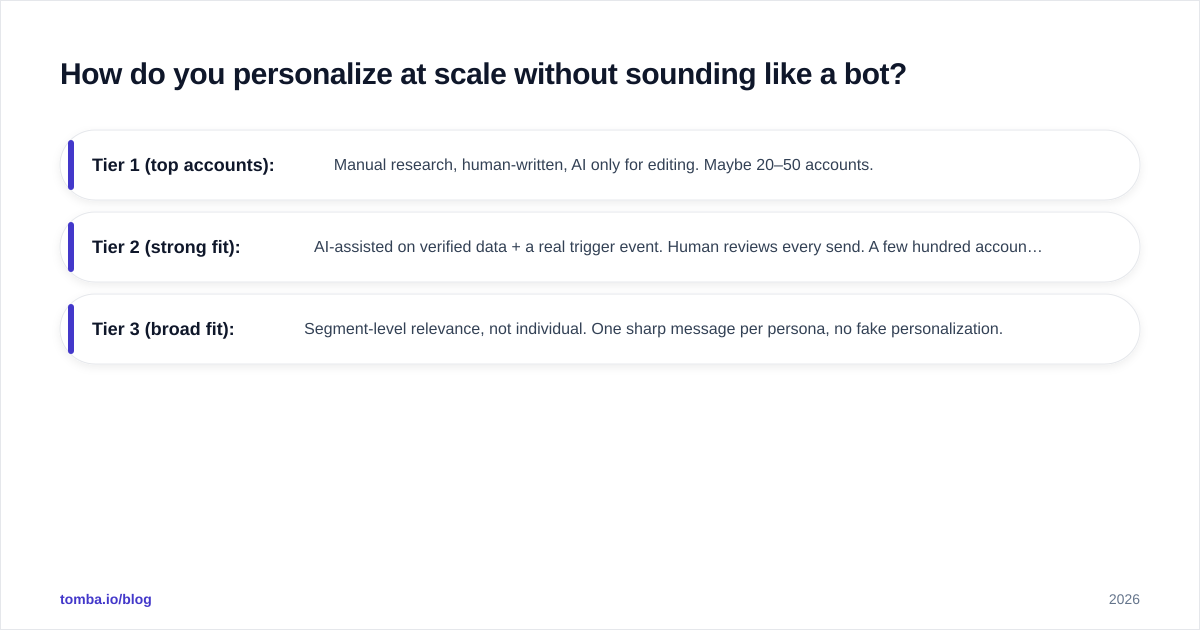
Use a tiering framework. You cannot manually research 5,000 prospects, and you shouldn't try to AI-blast them either. Segment by account value and apply the right depth to each tier.
- Tier 1 (top accounts): Manual research, human-written, AI only for editing. Maybe 20–50 accounts.
- Tier 2 (strong fit): AI-assisted on verified data + a real trigger event. Human reviews every send. A few hundred accounts.
- Tier 3 (broad fit): Segment-level relevance, not individual. One sharp message per persona, no fake personalization.
Mistake 7: Treating all prospects as Tier 1#
Trying to deeply personalize every email is how teams burn out and ship sloppy work. Conversely, treating everyone as Tier 3 wastes your best-fit accounts. Match effort to opportunity.
Mistake 8: Personalizing into the spam folder#
None of this matters if the email never lands. High-volume "personalized" sending from a cold domain torches your sender reputation, and AI-spun text often trips spam filters with unnatural phrasing. Warm your domain, keep volume sane, and watch your email deliverability metrics before scaling any sequence.
You can pressure-test copy with a free spam checker before launch — AI-generated text fails spam scoring more often than people expect.
Mistake 9: Never testing the AI against a human control#
Teams adopt AI personalization and never check whether it actually beats their old approach. Sometimes the generated version loses. Always run an A/B test: AI-personalized vs. a plain, relevant, human-written control. Let reply data decide, not the novelty of the tool.
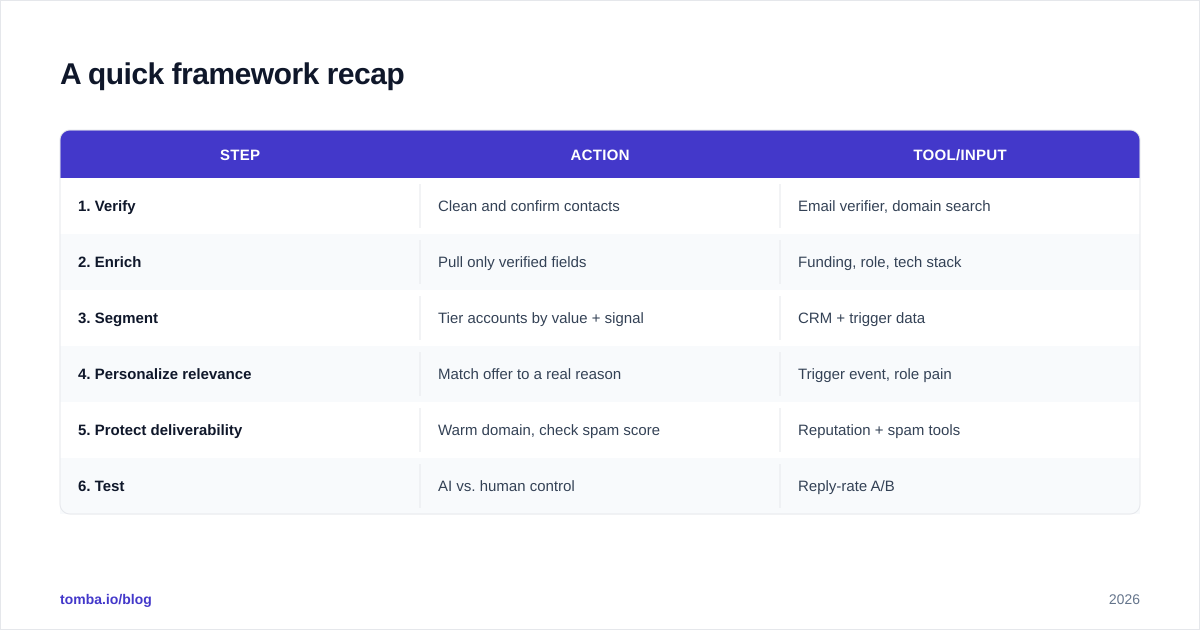
A quick framework recap#
| Step | Action | Tool/Input |
|---|---|---|
| 1. Verify | Clean and confirm contacts | Email verifier, domain search |
| 2. Enrich | Pull only verified fields | Funding, role, tech stack |
| 3. Segment | Tier accounts by value + signal | CRM + trigger data |
| 4. Personalize relevance | Match offer to a real reason | Trigger event, role pain |
| 5. Protect deliverability | Warm domain, check spam score | Reputation + spam tools |
| 6. Test | AI vs. human control | Reply-rate A/B |
If you only change one thing, change step 4: stop personalizing the greeting and start personalizing the reason you're emailing.
What does good AI personalization actually look like?#
It looks restrained. The model handles research synthesis and editing; the human owns the angle and the offer. The opener references a verified, relevant signal — not scraped trivia. The pitch connects directly to that signal. And the whole thing reads like a person who did their homework wrote it in two minutes, because that's essentially what happened.
For deeper reading on where AI genuinely helps versus where it backfires, both HubSpot's sales blog and peer-reviewed tool breakdowns on G2 are worth following — they track buyer sentiment shifts faster than most vendor blogs. And if you want the academic grounding on why over-automation erodes trust, the concept of the uncanny valley applies directly to copy, not just faces: near-human-but-off triggers more rejection than obviously-templated.
Get your personalization inputs right first#
Every personalization mistake above traces back to one thing: the inputs. You can't write a relevant email to the wrong person, a dead address, or a stale title — and no model fixes that for you.
Start by making sure you're emailing real, current, reachable people. The Tomba Email Finder finds and verifies professional email addresses by name, company, or domain, so your AI is working from accurate data instead of guesses. Pair it with the email verifier to strip dead addresses before they hurt your deliverability, and check Tomba pricing — the free tier gives you 25 searches a month to test it, with paid plans starting at $49/mo. Clean inputs first, clever copy second. That order is the whole game.
// get started
Find, verify and enrich your first contacts today
Start on the free plan with 25 searches a month, then scale when your team is ready.
Free plan · No credit card required · GDPR & CCPA
Get the Tomba newsletter
Product and data updates
// about the author