AI Dialer for Cold Calling: The 2026 Buyer's Guide
An AI dialer can triple connect rates and kill dead-air gaps — but only if you pick the right type. Here's how parallel, predictive, and power dialers compare in 2026.
TL;DR
- An AI dialer for cold calling automates number dialing, voicemail drops, call logging, and answering-machine detection so reps talk to more humans and waste less time on dead air.
- The three live-call architectures — power, predictive, and parallel — solve different problems. Parallel dialers maximize connects; power dialers maximize call control and compliance safety.
- Connect rate is mostly a data problem, not a dialer problem. A dialer that auto-dials bad numbers just burns your caller ID faster.
- Expect to pay roughly $70–$150 per seat per month for a serious AI dialer, plus telephony and local-presence costs.
- The highest-ROI move is pairing a dialer with verified mobile numbers — feed it a clean list from a tool like Tomba's phone finder and connect rates climb before you change anything else.
What is an AI dialer for cold calling?#
An AI dialer for cold calling is software that automates the mechanical parts of outbound phone prospecting: looking up the next number, dialing it, detecting whether a human or a voicemail picked up, dropping a pre-recorded voicemail, and logging the result back to your CRM. The "AI" layer adds answering-machine detection, real-time transcription, sentiment cues, call summaries, and sometimes next-best-action coaching while the rep is still on the line.
Think of it like cruise control for a sales floor. The rep still steers the conversation, but the dialer handles the tedious pedal-work — finding the on-ramp, merging, and logging the mileage — so a rep spends their energy on talking instead of typing seven-digit numbers and waiting through four rings.
The payoff is measured in talk time. A manual caller realistically completes 40–60 dials a day with maybe 5–8 real conversations. A rep on a well-tuned dialer with clean data can hit 200+ dials and 15–25 conversations. That gap is the entire business case.
How does an AI dialer actually work?#
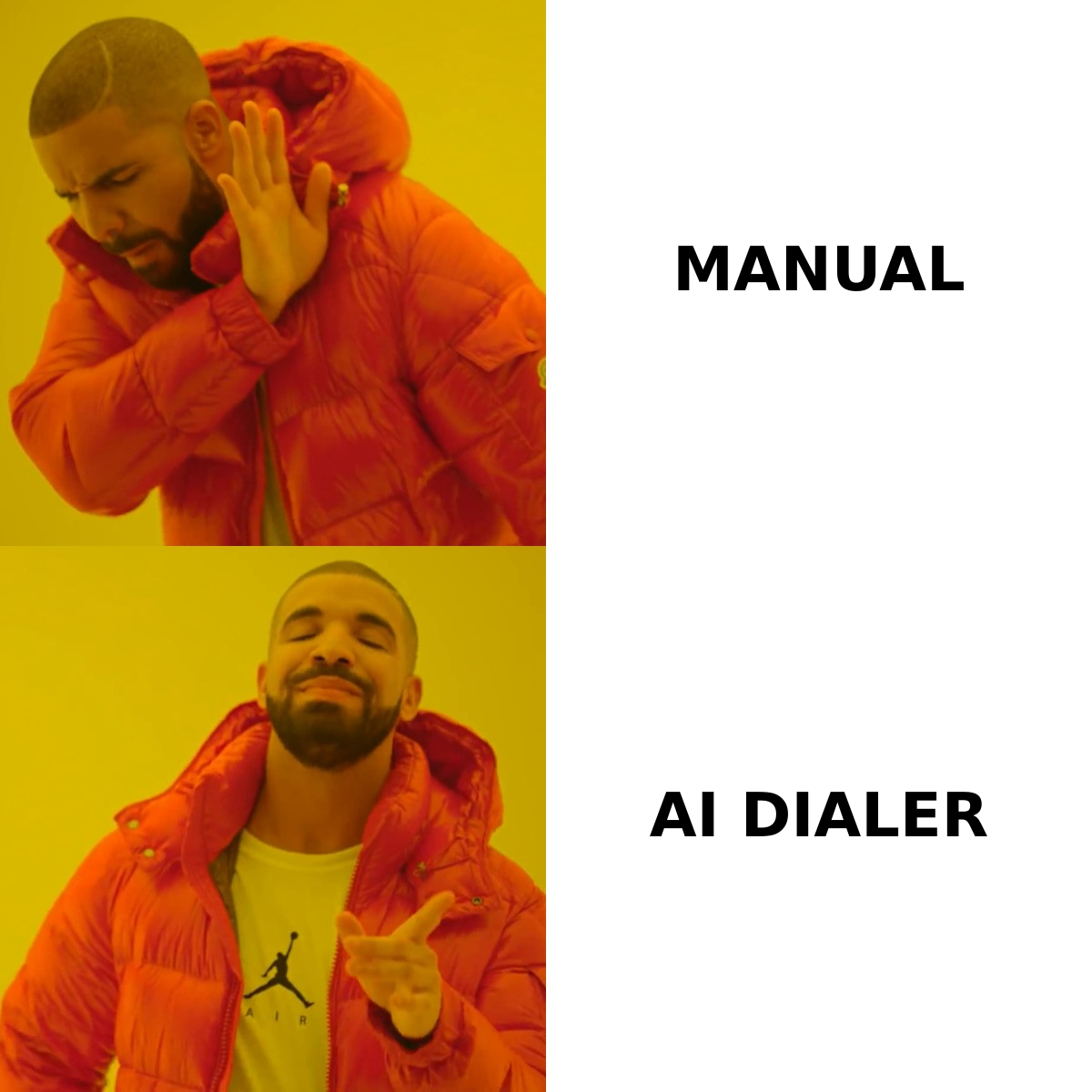
Every AI dialer runs the same core loop, just at different speeds and ratios:
- List ingestion — it pulls contacts and phone numbers from your CRM, a CSV, or a list-building tool.
- Dial trigger — depending on the dialer type, it dials one line per rep or many lines at once.
- Answering-machine detection (AMD) — AI classifies the pickup as human, voicemail, or invalid in under a second.
- Connection routing — humans get routed to an available rep; voicemails get an optional one-click drop.
- Disposition + logging — the outcome (connected, no answer, callback, DNC) is written back to the CRM automatically.
- Coaching layer — transcription, talk-ratio analysis, and post-call summaries feed the rep and their manager.
The single most important variable is the dial-to-rep ratio. That ratio is what separates the three dialer types — and choosing wrong is how teams either leave connects on the table or get flagged for abandoned calls.
What are the types of AI dialers?#
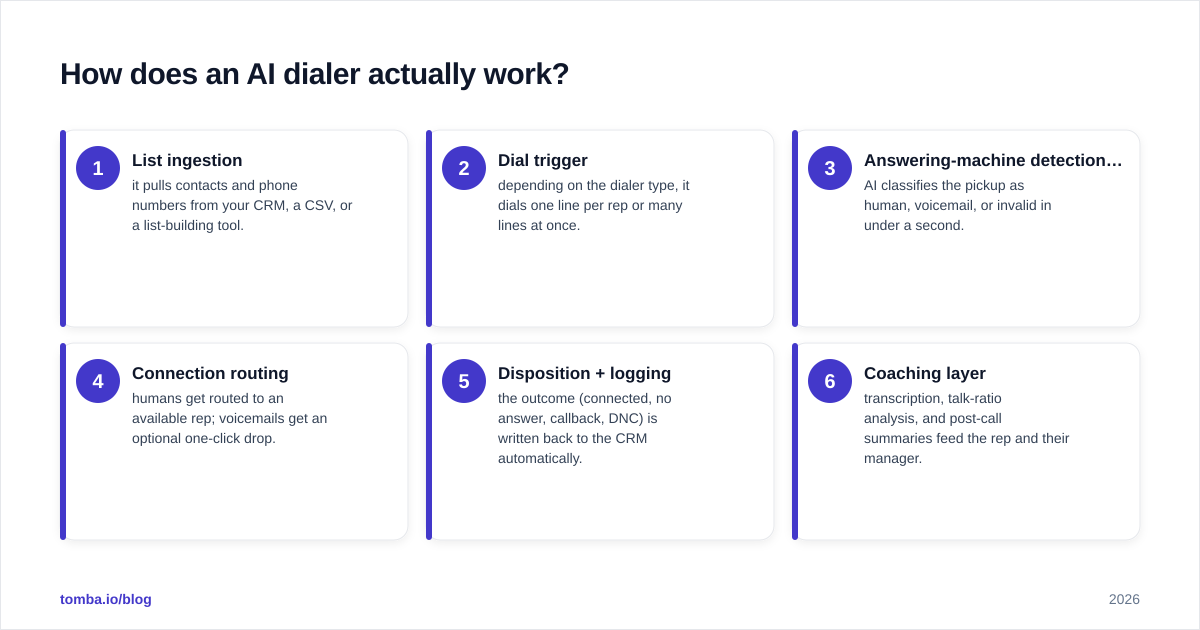
There are three architectures worth knowing. They are not "good, better, best" — they are trade-offs between connect volume and call quality.
| Dialer type | How it dials | Best for | Main risk |
|---|---|---|---|
| Power dialer | One number per rep, auto-advances | Low-volume, high-value B2B calls | Slower connect rate |
| Predictive dialer | Many numbers, algorithm predicts rep availability | Large teams, high-volume lists | Abandoned/dropped calls, compliance exposure |
| Parallel dialer | Dials 3–10 lines per rep, connects the first human | SDR teams chasing connect rate | Burns through list fast; needs clean data |
| Preview dialer | Shows rep the record before dialing | Complex, research-heavy deals | Lowest dials per hour |
A power dialer is the safe default for most B2B teams. It keeps a one-to-one ratio, so there is no risk of a prospect picking up to dead air because every rep was busy. A predictive dialer pushes the ratio above 1:1 and uses statistics to guess when a rep will be free — efficient, but it can abandon calls and draws regulatory scrutiny. A parallel dialer is the aggressive modern favorite for SDR teams: it rings several numbers simultaneously and drops the rep onto the first human who answers.
The catch with parallel and predictive dialing is that they consume your list — and your sender reputation — at high speed. If 40% of your numbers are wrong, you are not 40% less efficient; you are training carriers to flag your caller ID as spam. That is why data quality matters more than the dialer brand.
Is an AI dialer better than manual dialing?#
Yes for volume-driven roles, no for a small number of strategic accounts. The honest answer depends on your motion.
For an SDR team running outbound at scale, the math is one-sided. More talk time means more conversations means more meetings. A dialer that doubles connected calls effectively doubles pipeline from the same headcount. Layer in automatic logging and you reclaim the 30–60 minutes per rep per day usually lost to CRM data entry.
For a senior AE working ten named enterprise accounts, a dialer adds little. Those calls are pre-researched, scheduled, and personal. Auto-dialing through them gains nothing and risks making a high-touch motion feel like a boiler room.
The teams that get burned are the ones that buy a parallel dialer, point it at a stale list, and wonder why their numbers get marked as spam within two weeks. The tool amplified what they fed it. Garbage in, garbage dialed.
What features matter most in 2026?#
Not every "AI" label is equal. Here is what actually moves connect and conversion rates, ranked by impact.
- Local presence / caller ID management — matching the area code of the prospect lifts answer rates, but rotating numbers carelessly gets them flagged. Look for managed number health and STIR/SHAKEN attestation.
- Answering-machine detection accuracy — sub-second, low-false-positive AMD is the difference between a parallel dialer that works and one that hangs up on real humans.
- CRM-native logging — every call, disposition, and recording should land in HubSpot, Salesforce, or Pipedrive without a rep lifting a finger. Check the Tomba integrations page for how enrichment data flows into the same systems.
- Real-time transcription + summaries — turns every call into searchable text and a one-line CRM note.
- Compliance tooling — automatic DNC scrubbing, time-zone-aware calling windows, consent tracking, and call-recording disclosures.
- Coaching analytics — talk-to-listen ratio, monologue detection, and keyword tracking so managers coach from data, not vibes.
A feature checklist is necessary but not sufficient. The best dialer in the world still dials whatever number you give it — which brings us to the part most buyers underinvest in.
Why does data quality beat dialer choice?#
Because connect rate is a function of number accuracy, and no algorithm fixes a wrong number. This is the part vendors gloss over.
Suppose two teams buy the identical parallel dialer. Team A dials a list where 85% of mobile numbers are correct and current. Team B dials a list at 55% accuracy. Same software, same scripts, same reps — Team A connects roughly 1.5x more often and keeps their caller ID clean far longer because they are not hammering disconnected lines. The dialer didn't make the difference. The data did.
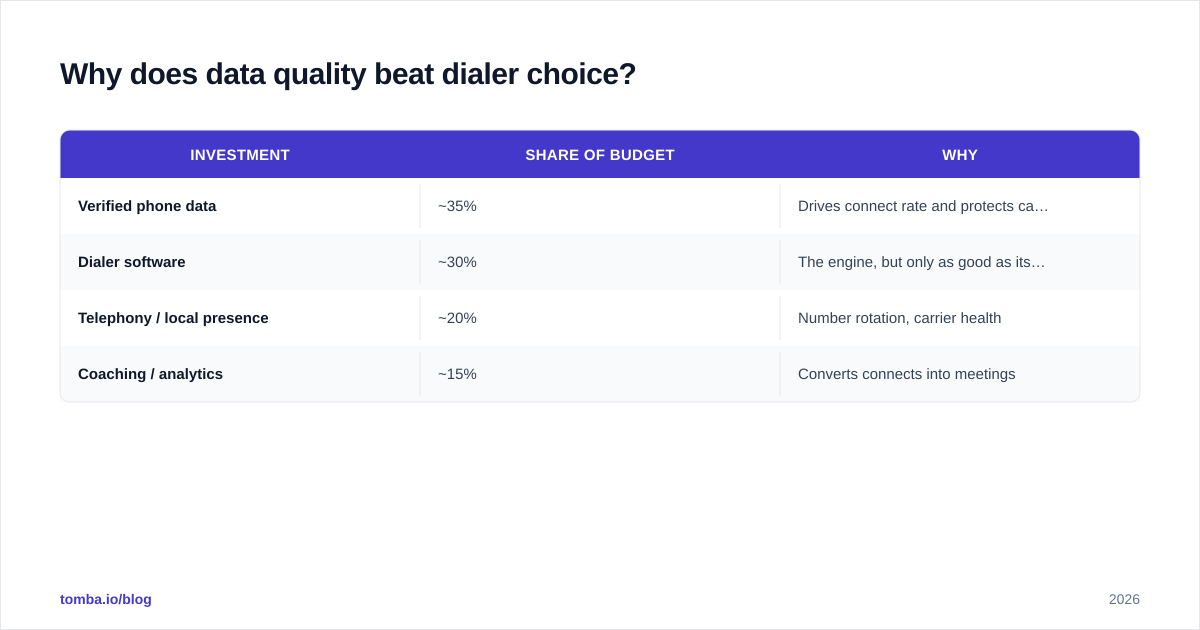
This is why your spend should be split, not concentrated. A reasonable budget allocation for a cold-calling motion looks like this:
| Investment | Share of budget | Why |
|---|---|---|
| Verified phone data | ~35% | Drives connect rate and protects caller ID |
| Dialer software | ~30% | The engine, but only as good as its fuel |
| Telephony / local presence | ~20% | Number rotation, carrier health |
| Coaching / analytics | ~15% | Converts connects into meetings |
Before a number ever reaches your dialer, it should be enriched and validated. Pull direct dials with a phone finder, run them through a phone validator to drop disconnected lines, and enrich the contact record so reps open every call knowing the title, company, and a relevant hook. Teams that wire data enrichment into the front of the dial loop consistently outperform teams that bolt a fancy dialer onto a dirty list.
It is also worth remembering that phone is one channel. The strongest outbound plays pair a call with a verified email touch, so a clean list from an email finder lets the same prospect get a coordinated call-plus-email sequence instead of a single cold ring.
How much does an AI dialer cost in 2026?#
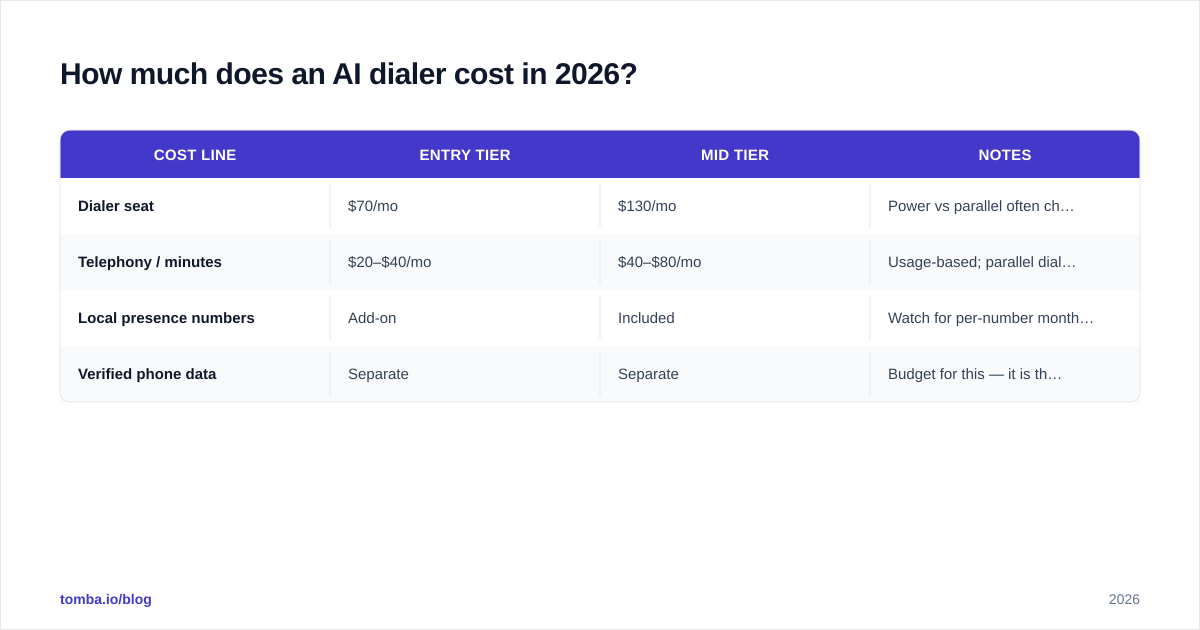
Expect $70–$150 per seat per month for the dialer software, before telephony. Here is a realistic comparison of the cost components, using representative market ranges rather than promising any specific vendor's price (always confirm on the official site, e.g. G2's dialer category for current listings).
| Cost line | Entry tier | Mid tier | Notes |
|---|---|---|---|
| Dialer seat | $70/mo | $130/mo | Power vs parallel often changes the price |
| Telephony / minutes | $20–$40/mo | $40–$80/mo | Usage-based; parallel dialers burn more |
| Local presence numbers | Add-on | Included | Watch for per-number monthly fees |
| Verified phone data | Separate | Separate | Budget for this — it is the multiplier |
For the data layer, Tomba pricing starts with a free tier (25 searches/month), then Starter at $49/mo, Growth at $99/mo, and Pro at $249/mo — which lets you verify and enrich numbers before they hit whatever dialer you choose, instead of paying a dialer vendor premium rates for stale contact data.
The mistake is comparing dialers on sticker price alone. A $70 dialer fed bad data costs more per meeting than a $130 dialer fed clean data, because cost-per-meeting — not cost-per-seat — is the metric that pays the bills.
What about compliance and caller reputation?#
Treat compliance as a feature, not an afterthought. In 2026, carrier-level spam labeling is the bigger day-to-day threat for most teams, even more than regulatory fines.
A few non-negotiables:
- STIR/SHAKEN attestation so your calls are authenticated and less likely to show "Spam Likely."
- Number health monitoring — rotate numbers before they get flagged, not after.
- DNC and consent management baked into the dial flow, with time-zone-aware calling windows.
- Recording disclosures appropriate to each jurisdiction.
Predictive and parallel dialers carry more exposure here because abandoned-call rates and high-velocity dialing are exactly the patterns carriers and regulators watch. If you run those aggressively, your data hygiene and number management have to be tighter, not looser. Industry bodies like the U.S. Federal Communications Commission (see the FCC's robocall resources) publish the rules worth tracking. When in doubt, a power dialer with verified data is the lower-risk path to the same pipeline.
How do you pick the right AI dialer?#
Match the dialer to your motion, then make data quality the deciding investment. A simple decision path:
- Few high-value accounts? Use a power or preview dialer. Volume isn't your problem; preparation is.
- High-volume SDR motion? A parallel dialer wins on connects — but only commit if your list is verified above ~80% accuracy.
- Large team, dialing huge lists? A predictive dialer can work, provided you have the compliance tooling and number management to handle the abandoned-call risk.
- In every case: verify and enrich numbers before dialing. The dialer is the engine; clean data is the fuel.
If you remember one thing: buyers overspend on dialer features and underspend on the list. Flip that ratio and your connect rate climbs before you touch a script.
The bottom line#
An AI dialer for cold calling is one of the highest-leverage tools an outbound team can buy — but it is a multiplier, not a miracle. It amplifies whatever you feed it. Point a parallel dialer at a clean, verified list and you will out-dial and out-connect competitors twice your size. Point it at a stale CSV and you will torch your caller ID in a fortnight.
Start with the fuel. Build a verified, enriched calling list with Tomba's phone finder and data enrichment, validate every number before it reaches your dialer, and pair each call with a coordinated email touch from the email finder. Get the data right first, and almost any competent dialer will pay for itself. Spin up a free Tomba account and feed your dialer the clean numbers it deserves.
// get started
Find, verify and enrich your first contacts today
Start on the free plan with 25 searches a month, then scale when your team is ready.
Free plan · No credit card required · GDPR & CCPA
// about the author