AI Drip Campaigns: How to Automate Sequences in 2026
AI drip campaigns turn static autoresponders into adaptive sequences that branch on real behavior. Here's how to build, time, and measure them in 2026.
TL;DR
- AI drip campaigns are automated email sequences where send timing, content, and branching are decided by a model reacting to live recipient behavior — not a fixed calendar.
- They beat classic autoresponders on reply rate because they stop emailing people who already converted, re-route cold leads, and personalize each step at scale.
- The build has four parts: clean data, a trigger map, AI-written variants, and a deliverability guardrail. Skip any one and the whole thing underperforms.
- You still need accurate contact data first. A model can't personalize an email to an address that bounces.
- Start small: one trigger, three steps, measured against a static control. Scale only what beats the control.
What is an AI drip campaign?#
An AI drip campaign is an automated email sequence where a model — not a hardcoded schedule — decides what gets sent, to whom, and when. Think of a classic drip campaign as a vending machine: press the button, get can #1, then can #2 on day three, then can #3 on day seven, regardless of who's standing there. An AI drip campaign is more like a good waiter. It reads the table, notices you've already ordered dessert, and skips the upsell you no longer need.
The "drip" part is old. Marketers have run scheduled autoresponders for two decades. What changed is the decision layer. Modern sequences pull in signals — opens, clicks, replies, page visits, CRM stage, even intent data — and let an AI choose the next move from a set of possible branches. The result reads less like a broadcast and more like a one-to-one conversation that happens to be automated.
That distinction matters because buyers have gotten ruthless about ignoring anything that smells like a blast. A 2025 survey of B2B buyers reported that the majority delete cold sequences within the first two emails if the content doesn't reflect their actual situation. AI drip campaigns exist to close exactly that gap.
How is an AI drip campaign different from a normal drip sequence?#
The short answer: a normal drip is a fixed path, and an AI drip is a decision tree that rewrites itself.
A traditional sequence has one road. Every recipient walks it at the same pace. If lead A replies on email two and lead B ignores everything, they still both get email three on schedule — which means lead A gets pestered after they already raised their hand, and lead B gets the same generic nudge that already failed.
An AI drip campaign branches. When lead A replies, the sequence pauses and routes them to a human or a booking link. When lead B goes silent, the model tests a different angle — a new subject line, a shorter message, a different value prop — instead of repeating the approach that isn't landing.
Here's the practical difference laid out:
| Dimension | Static drip campaign | AI drip campaign |
|---|---|---|
| Send timing | Fixed calendar (day 1, 3, 7) | Adapts to engagement and time-zone signals |
| Content | One version per step | Multiple AI-generated variants, chosen per recipient |
| Branching | None — everyone walks one path | Behavior-based branches (reply, click, no-open) |
| Exit logic | Manual or list-based | Auto-exits on conversion or negative signal |
| Optimization | Manual A/B test, slow | Continuous, per-segment learning |
| Best for | Simple onboarding, newsletters | Sales outreach, nurture, re-engagement |
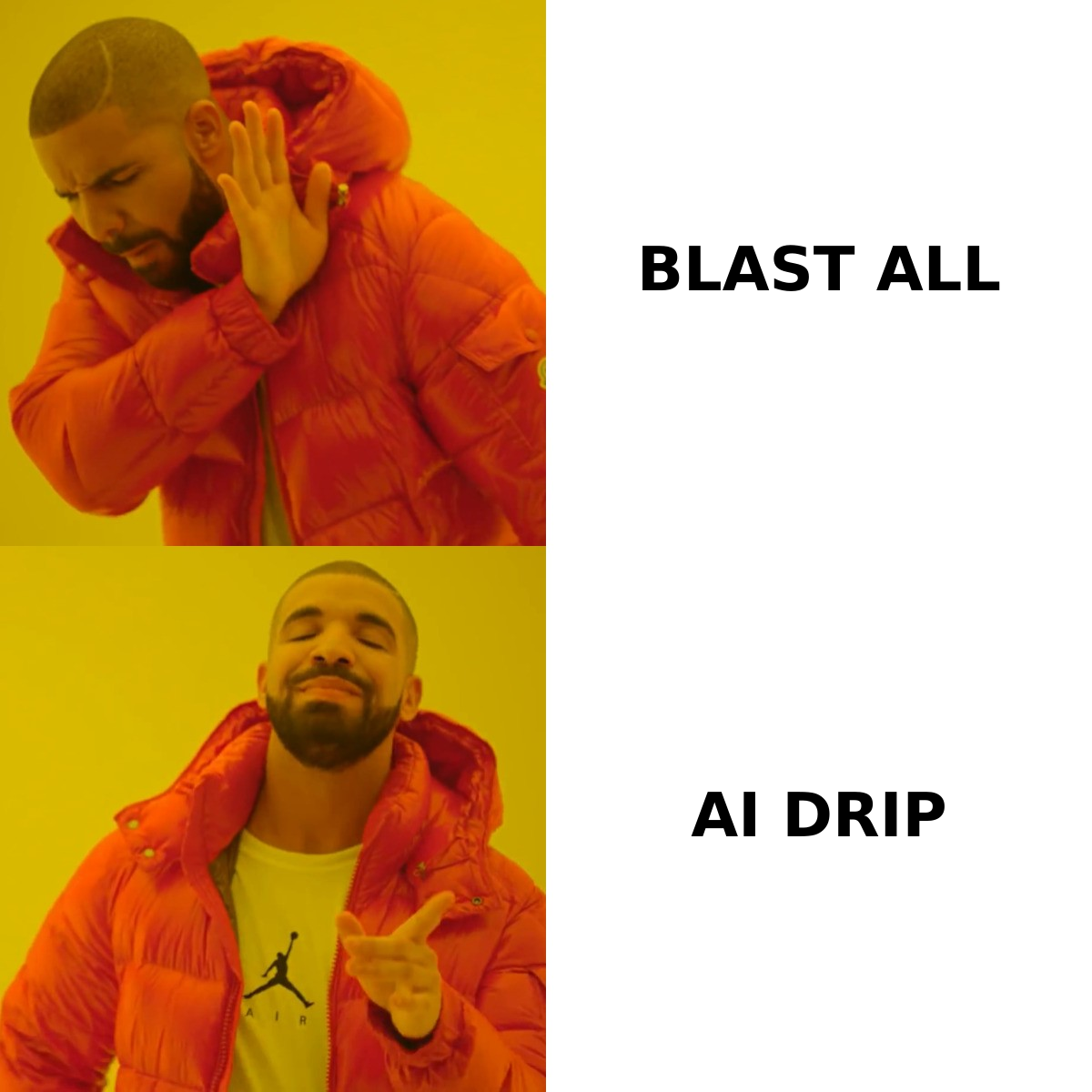
Notice what the table does not claim: AI does not replace strategy. It replaces the manual labor of running dozens of micro-experiments and pausing the right people at the right time. The strategy — who you target, what you offer, why they should care — is still yours.
Why do AI drip campaigns get better results?#
They get better results because they remove the three biggest leaks in a normal sequence: wasted sends, generic copy, and bad timing.
They stop emailing the wrong people. The single fastest way to tank a sender reputation is to keep hitting unengaged or converted contacts. AI drip campaigns watch for conversion and disengagement signals and exit those contacts automatically. That protects your email deliverability and keeps your domain out of spam folders.
They personalize past the first name. "Hi {{firstName}}" stopped impressing anyone around 2014. An AI layer can reference a prospect's role, their company's recent news, the page they visited, or the specific objection they raised in a prior reply — and write a fresh variant for each. Done well, this lifts reply rates without adding headcount.
They fix timing per person. Static drips send when you scheduled. AI drips can send when each recipient is most likely to open, based on their historical engagement window. A small shift in send time often moves open rates more than another round of subject-line tweaking.
There's a caveat worth stating plainly: none of this works on a dirty list. If 20% of your addresses bounce, the model is optimizing against noise, and your reputation erodes before the campaign gets a chance. Run your list through an email verifier before the first send. Garbage in, throttled out.
What does an AI drip campaign actually look like?#
A working setup has four layers. Skip one and the whole thing wobbles.
1. Clean, enriched data#
You need accurate emails, plus enough context for the AI to personalize — title, company, industry, seniority. This is where most campaigns quietly fail. A model writing to jhon@compny.com produces a beautiful, undeliverable message. Pull verified contacts with a domain search and enrich the gaps before you build anything else.
2. A trigger map#
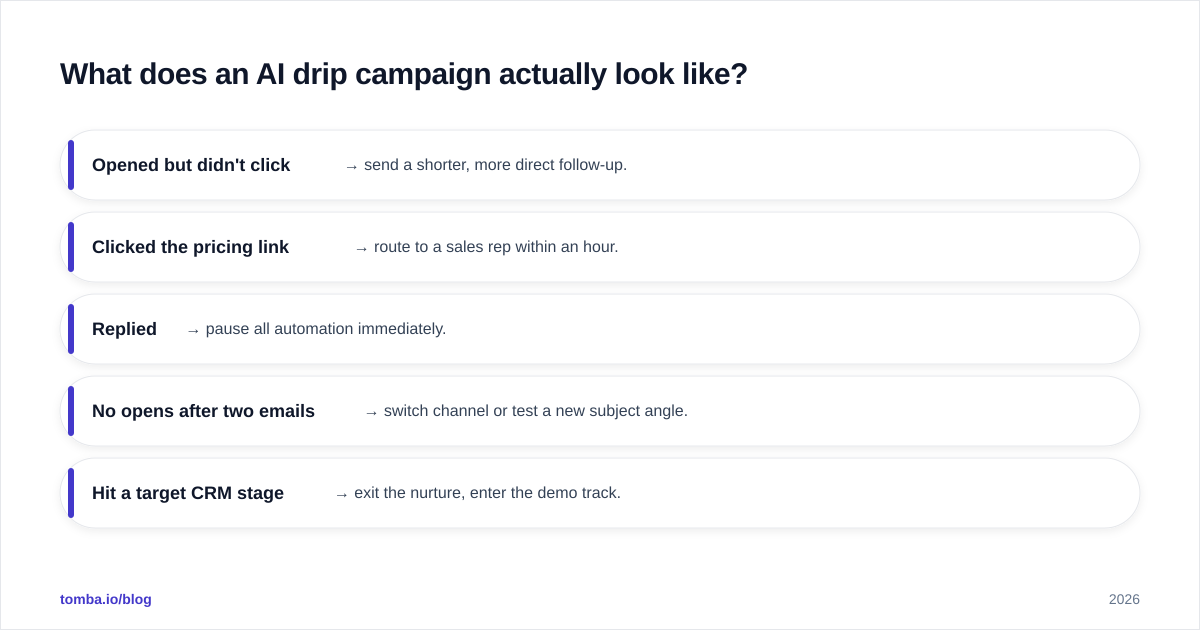
Triggers are the "if this, then that" rules that drive branching. Common ones:
- Opened but didn't click → send a shorter, more direct follow-up.
- Clicked the pricing link → route to a sales rep within an hour.
- Replied → pause all automation immediately.
- No opens after two emails → switch channel or test a new subject angle.
- Hit a target CRM stage → exit the nurture, enter the demo track.
3. AI-generated content variants#
For each step, the model produces multiple versions tuned to segment and signal. You approve a template and the guardrails; the AI fills in the per-recipient specifics. Keep a human in the loop on tone — models still occasionally produce copy that's confident and wrong.
4. A deliverability guardrail#
This is the layer teams forget. Volume caps, warm-up pacing, sender reputation monitoring, and SPF/DKIM checks all sit here. The smartest sequence in the world fails if it lands in spam. Treat deliverability as a first-class part of the campaign, not an afterthought.
How do you build your first AI drip campaign?#
Start narrow. One trigger, one segment, three steps, measured against a static control. Resist the urge to automate everything in week one.
Step 1 — Define one job. Pick a single outcome: book a demo, re-engage churned trials, nurture inbound leads. One job keeps the branching logic legible.
Step 2 — Build and verify the list. Source contacts, then verify them. Treat any list over a few hundred addresses as untrusted until checked. For larger pulls, a bulk email finder plus verification in one pass saves hours.
Step 3 — Write the base sequence. Draft three emails manually first. You can't direct an AI to write good variants if you can't write one good version yourself. The base is your reference for tone and offer.
Step 4 — Add the branches. Layer in two or three triggers — reply-pause, click-accelerate, no-open-retest. Don't add a branch you won't actually measure.
Step 5 — Run against a control. Send the AI version to half your segment and the static version to the other half. If the AI version doesn't beat the control on reply rate after a statistically meaningful sample, debug before you scale.
Which tools run AI drip campaigns?#
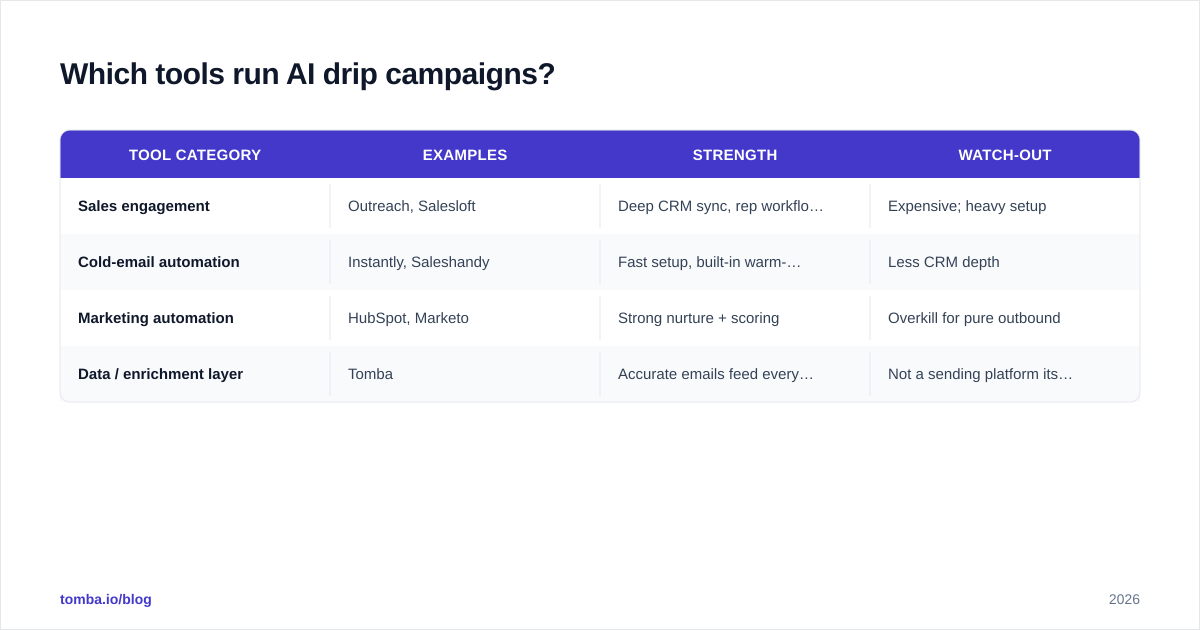
The market splits into three buckets: sales-engagement platforms, cold-email tools, and marketing-automation suites. Most teams end up combining one execution tool with a separate data layer for accurate contacts.
| Tool category | Examples | Strength | Watch-out |
|---|---|---|---|
| Sales engagement | Outreach, Salesloft | Deep CRM sync, rep workflows | Expensive; heavy setup |
| Cold-email automation | Instantly, Saleshandy | Fast setup, built-in warm-up | Less CRM depth |
| Marketing automation | HubSpot, Marketo | Strong nurture + scoring | Overkill for pure outbound |
| Data / enrichment layer | Tomba | Accurate emails feed every tool | Not a sending platform itself |
A quick reality check on the categories: HubSpot's automation docs are a good primer if you're nurturing inbound, while G2's sales-engagement category is the fastest way to compare execution tools by verified review. The pattern that holds across all of them — your sequencing tool is only as good as the data feeding it. That's why teams pair their sender with a dedicated enrichment source rather than relying on whatever stale records sit in the CRM.
If you're weighing a switch, our breakdowns of an Instantly alternative and an Outreach alternative walk through the trade-offs without the marketing gloss.
How do you measure an AI drip campaign?#
Measure the sequence, not the individual email. The whole point of branching is that any single message is just one path through the tree.
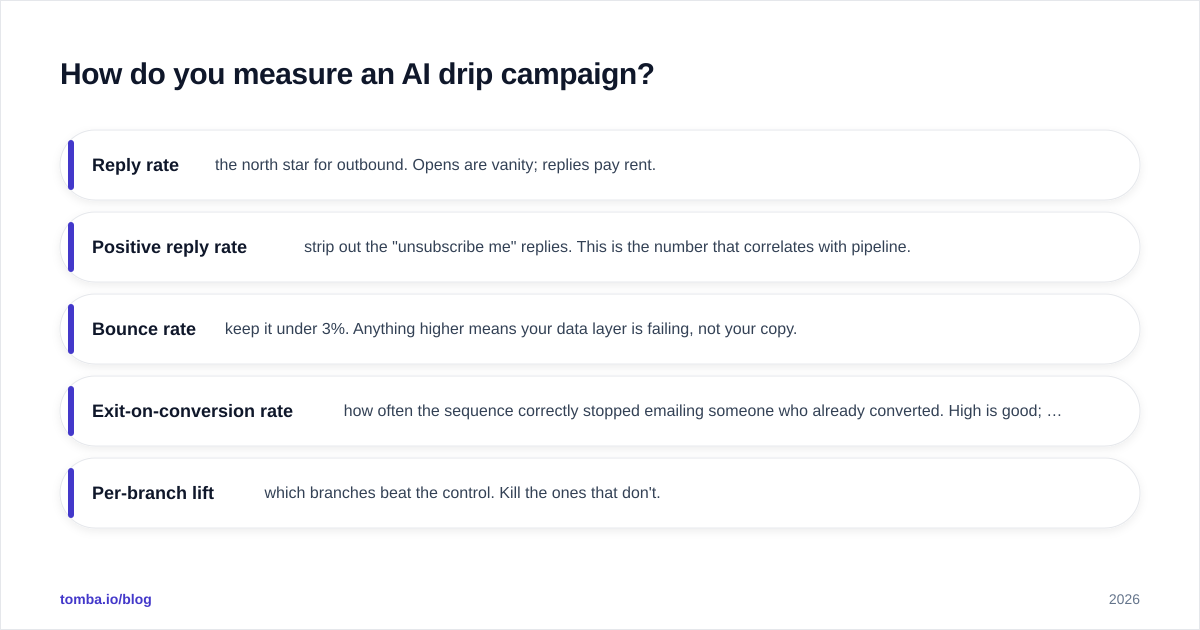
Track these five:
- Reply rate — the north star for outbound. Opens are vanity; replies pay rent.
- Positive reply rate — strip out the "unsubscribe me" replies. This is the number that correlates with pipeline.
- Bounce rate — keep it under 3%. Anything higher means your data layer is failing, not your copy.
- Exit-on-conversion rate — how often the sequence correctly stopped emailing someone who already converted. High is good; it means your triggers work.
- Per-branch lift — which branches beat the control. Kill the ones that don't.
A practical benchmark: if your AI version isn't beating your static control by a meaningful margin on positive reply rate, you don't have an AI drip campaign — you have an expensive autoresponder. Cut it, learn from it, and rebuild the branch that failed.
One more discipline: watch your response rate trend over weeks, not days. AI sequences improve as they accumulate signal, but they also decay when your list ages. Refresh and re-verify contacts on a cadence — quarterly at minimum for fast-moving industries.
What are the common mistakes to avoid?#
Automating before validating. If a manual three-email sequence doesn't convert, automating it just sends a failing message faster. Prove the offer works by hand first.
Treating AI copy as final. Models hallucinate company facts and occasionally strike the wrong tone. Keep a human approval step on templates and a spot-check on live sends.
Ignoring deliverability. Teams obsess over copy and forget warm-up, volume caps, and authentication. A perfect email in the spam folder converts at zero.
Skipping verification. This is the recurring theme for a reason. Personalization on a bad address is wasted compute and a reputation hit. Verify first, always.
Over-branching. Ten branches you can't measure are worse than three you can. Complexity you don't track is just risk you can't see.
Where does contact data fit in all this?#
Data is the foundation the entire campaign stands on — and it's the layer AI can't fix for you. A model can write a flawless, hyper-personalized message, but it cannot conjure a working email address or a correct job title out of thin air. If your inputs are wrong, every downstream step inherits the error.
That's the case for separating your data layer from your sending layer. Your cold-email or sales-engagement tool executes the sequence. A dedicated finder-and-verifier sources and validates the contacts that feed it. Keeping these separate means you can swap sending tools without rebuilding your data pipeline, and you always know which layer to debug when reply rates drop.
This is exactly the gap Tomba fills. Use the Tomba Email Finder to source accurate, verified professional emails by name, company, or domain — then push them into Instantly, Outreach, HubSpot, or whatever runs your sequences. Pair it with the verifier to keep bounce rates under control as your lists age. Plans start free with 25 searches a month and scale to $49/mo on Starter; see full Tomba pricing for the tier that matches your volume. Build the AI drip campaign on clean data, and the automation finally has something worth optimizing.
// get started
Find, verify and enrich your first contacts today
Start on the free plan with 25 searches a month, then scale when your team is ready.
Free plan · No credit card required · GDPR & CCPA
// about the author