AI Email Marketing Strategy: The 2026 Growth Playbook
Build an AI email marketing strategy that segments, writes, and sends smarter in 2026 — with a framework, tool comparison, and metrics that actually move revenue.
TL;DR
- An AI email marketing strategy is not "let a bot write your newsletter." It is using machine learning across four jobs: segmentation, content, timing, and list hygiene.
- The biggest wins come from data quality and segmentation — not clever subject lines. Garbage contacts sink even the best AI copy.
- Use AI to draft and personalize at scale, but keep a human editor on brand voice and claims.
- Send-time and frequency optimization typically lift open and click rates more reliably than generative copy alone.
- Measure revenue per recipient and deliverability, not just opens — Apple Mail Privacy Protection made open rate a vanity metric.
What is an AI email marketing strategy?#
An AI email marketing strategy is a plan for applying machine learning to the repetitive, data-heavy parts of email — deciding who gets which message, when, and what it says — so your team spends time on strategy instead of spreadsheets.
Think of it like hiring a very fast junior analyst who never sleeps. The analyst can sort 200,000 contacts into micro-segments, draft 40 subject-line variants, and predict the best send hour for each person. What it cannot do is decide your positioning, own your brand voice, or take responsibility for a false claim. That part stays with you.
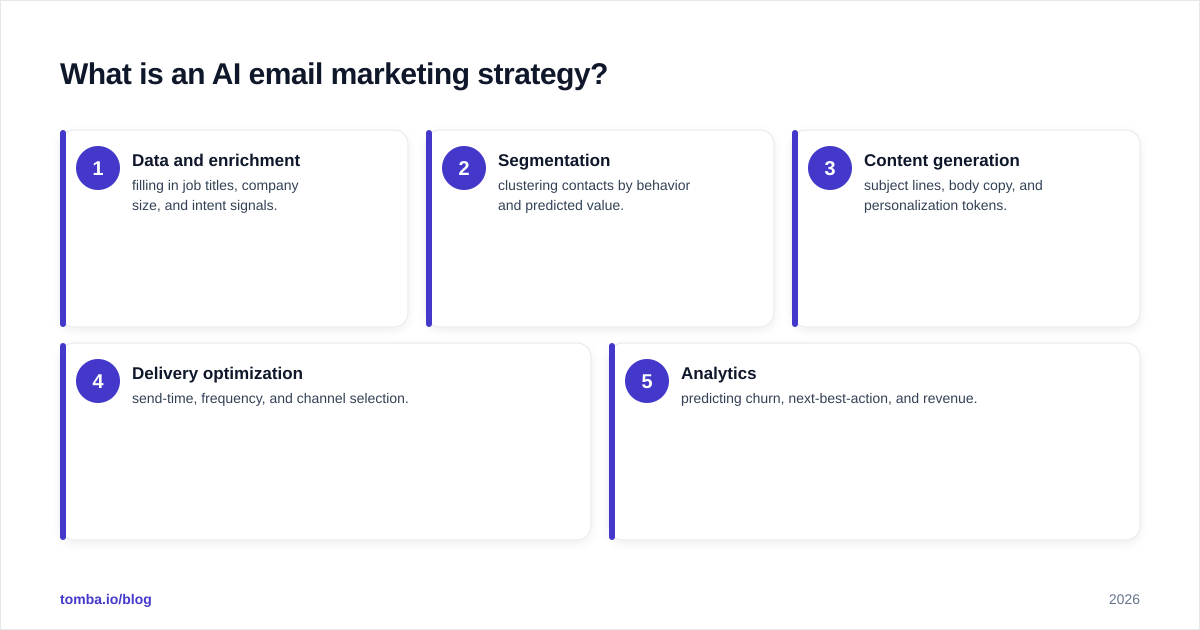
In practice, AI touches five layers of the email stack:
- Data and enrichment — filling in job titles, company size, and intent signals.
- Segmentation — clustering contacts by behavior and predicted value.
- Content generation — subject lines, body copy, and personalization tokens.
- Delivery optimization — send-time, frequency, and channel selection.
- Analytics — predicting churn, next-best-action, and revenue.
Most teams bolt AI onto layer 3 (writing) first because it is the most visible. That is backwards. The compounding returns live in layers 1 and 2.
Why does data quality decide your results?#
Because AI amplifies whatever you feed it — including the mistakes. If 18% of your list is invalid, fake, or role-based addresses, an AI that sends "smarter" just hits the same dead inboxes faster and harder, dragging down your sender reputation.
A clean list is the foundation that makes every downstream model better. Before you turn on a single AI workflow, run your contacts through an email verifier and remove hard bounces, spam traps, and catch-all addresses you cannot confirm. Then enrich the survivors so segmentation has something to work with.

Here is the order of operations that actually works:
- Verify every address at capture and again before major sends.
- Enrich with firmographic and role data via contact enrichment so segments are based on reality, not guesses.
- Deduplicate so one human is not three records voting three times in your model.
- Suppress unengaged contacts on a schedule instead of mailing them forever.
Skip this and your AI email marketing strategy becomes an expensive way to send irrelevant mail at scale.
How do you build an AI email marketing strategy step by step?#
Follow a sequence. Each step feeds the next, so doing them out of order wastes the work.
Step 1 — Set the metric that matters. Pick revenue per recipient or pipeline influenced, not open rate. Apple's Mail Privacy Protection auto-loads images, which inflates opens for a large share of your list. Anchor on clicks, replies, and revenue instead.
Step 2 — Clean and enrich the list. As above. No model survives dirty data.
Step 3 — Build behavioral segments. Let the model cluster by recency, frequency, monetary value, and engagement trend. Aim for 5–8 actionable segments, not 50 you will never use.
Step 4 — Generate and personalize content. Use AI to draft variants per segment, then have a human edit for voice and accuracy. Tools like a cold email AI writer or a subject line generator speed the first draft.
Step 5 — Optimize timing and frequency. Let the model choose per-recipient send windows and cap frequency to protect engagement.
Step 6 — Test, measure, and feed back. Every send is training data. Pipe outcomes back into the model weekly.
Which parts should AI handle vs a human?#
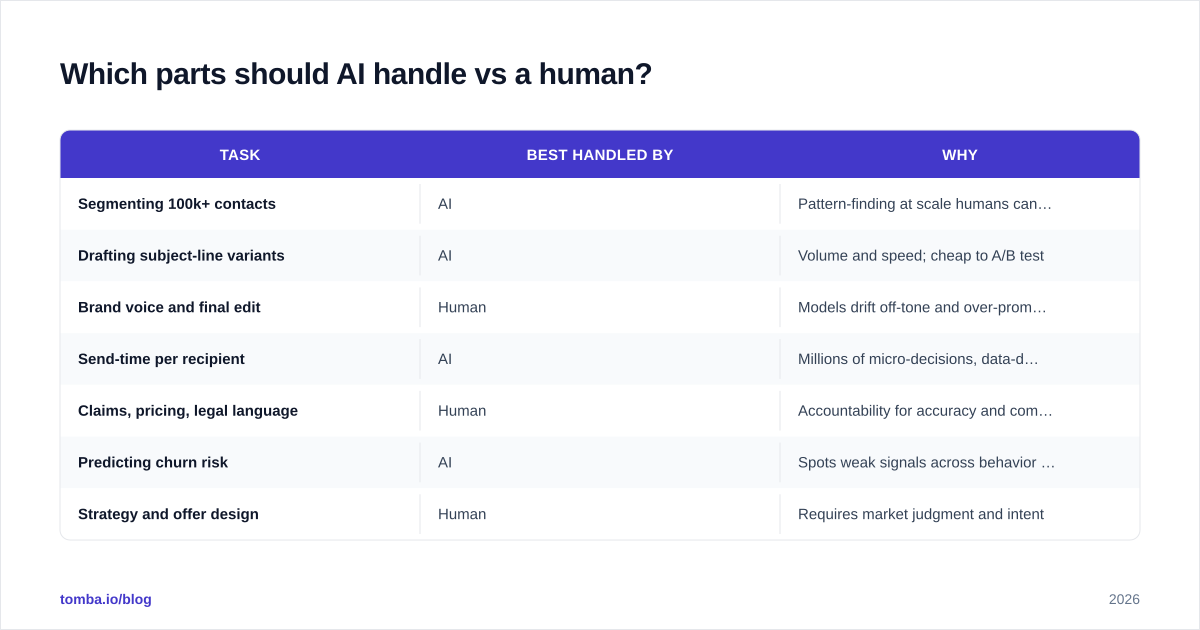
Split the work by what each side is good at. AI is fast and tireless; humans own judgment and accountability.
| Task | Best handled by | Why |
|---|---|---|
| Segmenting 100k+ contacts | AI | Pattern-finding at scale humans can't match |
| Drafting subject-line variants | AI | Volume and speed; cheap to A/B test |
| Brand voice and final edit | Human | Models drift off-tone and over-promise |
| Send-time per recipient | AI | Millions of micro-decisions, data-driven |
| Claims, pricing, legal language | Human | Accountability for accuracy and compliance |
| Predicting churn risk | AI | Spots weak signals across behavior history |
| Strategy and offer design | Human | Requires market judgment and intent |
The pattern: AI proposes, a human disposes. Never let a generative model push copy live without review — it will eventually hallucinate a feature, a discount, or a stat you never approved.
What does the 2026 AI email tool landscape look like?#
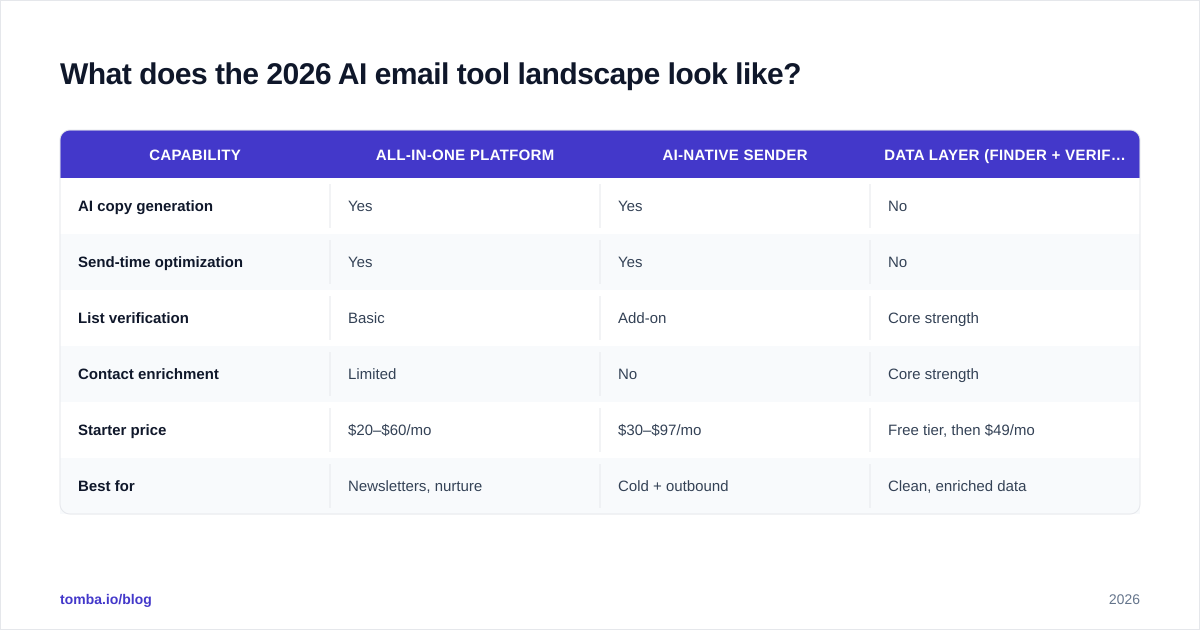
The market splits into three buckets: all-in-one marketing platforms with AI bolted on, AI-native sending tools, and the data layer that feeds them. You usually need one from each.
| Capability | All-in-one platform | AI-native sender | Data layer (finder + verifier) |
|---|---|---|---|
| AI copy generation | Yes | Yes | No |
| Send-time optimization | Yes | Yes | No |
| List verification | Basic | Add-on | Core strength |
| Contact enrichment | Limited | No | Core strength |
| Starter price | $20–$60/mo | $30–$97/mo | Free tier, then $49/mo |
| Best for | Newsletters, nurture | Cold + outbound | Clean, enriched data |
For the data layer specifically, Tomba pricing starts with a free tier (25 searches/mo), then Starter at $49/mo, Growth at $99/mo, and Pro at $249/mo — so you can verify and enrich before any address ever enters your sending platform.
When comparing AI marketing platforms head-to-head, lean on neutral review data from G2 and HubSpot's email benchmarks rather than vendor claims. And remember that no AI sender fixes a bad list — that job belongs upstream.
How do you write AI email copy that does not sound like a robot?#
Give the model constraints, examples, and a job — not a vague "write a marketing email" prompt. The quality of the output tracks the quality of the brief almost perfectly.
A strong prompt includes:
- Audience: the exact segment ("SaaS founders, 11–50 employees, opened last 3 emails").
- Goal: one action ("book a 15-minute demo").
- Voice samples: paste two of your best-performing emails.
- Constraints: length, reading level, no superlatives, one CTA.
- Banned words: your personal AI-tell list ("unlock," "elevate," "in today's landscape").
Then run the draft through a human edit and a spam checker before it ships. The edit catches tone drift; the spam check catches trigger words and broken formatting that hurt email deliverability.
One more rule: personalize with data you actually have. An AI that invents a "congrats on your recent funding round" line for a company that never raised money does more damage than a generic greeting. This is exactly why the enrichment step matters — real personalization needs real fields.
What metrics prove your AI email strategy is working?#
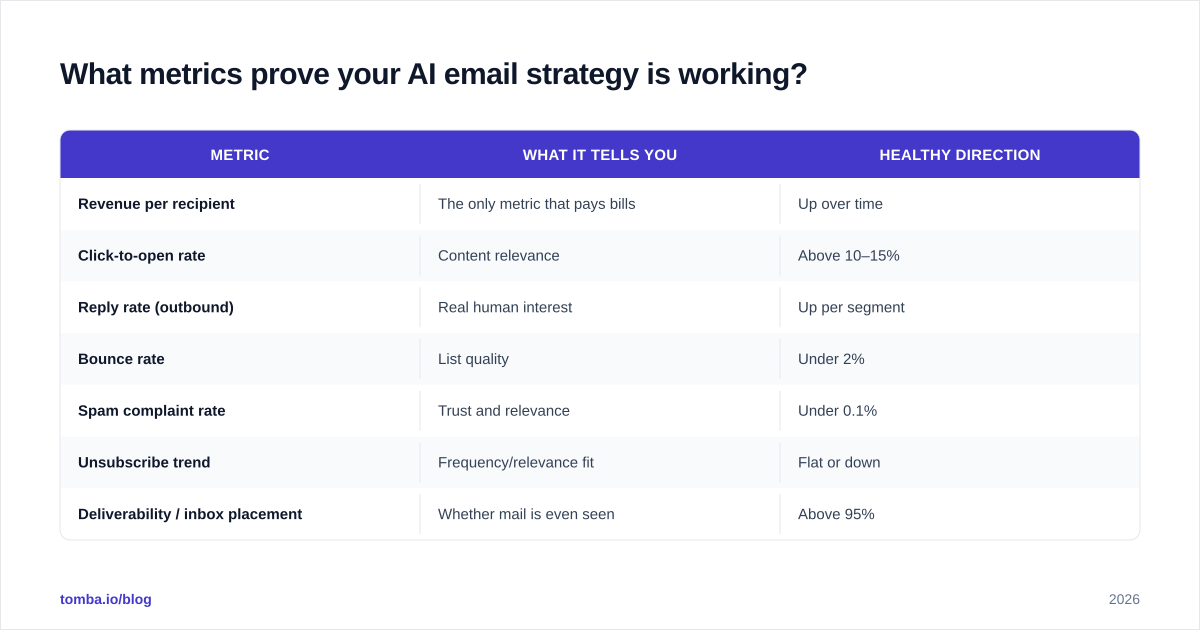
Track outcomes, not activity. Here is the scoreboard that survives privacy changes and tells you the truth.
| Metric | What it tells you | Healthy direction |
|---|---|---|
| Revenue per recipient | The only metric that pays bills | Up over time |
| Click-to-open rate | Content relevance | Above 10–15% |
| Reply rate (outbound) | Real human interest | Up per segment |
| Bounce rate | List quality | Under 2% |
| Spam complaint rate | Trust and relevance | Under 0.1% |
| Unsubscribe trend | Frequency/relevance fit | Flat or down |
| Deliverability / inbox placement | Whether mail is even seen | Above 95% |
Notice open rate is missing from the top of the list. After Mail Privacy Protection, it is noisy at best. Use click-to-open and reply rate as your relevance signals instead. And watch bounce and complaint rates like a hawk — they are the early warning system for sender reputation damage, which is far harder to repair than to prevent.
If your bounce rate creeps up, the fix is almost never the AI copy. It is the list. Re-verify, suppress the dead weight, and the model's predictions get sharper because they are trained on contacts that actually exist.
Common mistakes to avoid#
- Automating before cleaning. Scaling sends on a dirty list multiplies the damage.
- Optimizing opens. You will chase a privacy-inflated number into bad decisions.
- Letting AI publish unedited. One hallucinated claim can trigger compliance and trust problems.
- Over-segmenting. Fifty segments you can't staff is worse than six you can.
- Ignoring frequency. AI that can send more does not mean you should. Cap it.
Conclusion: start with the data layer#
The fastest path to a working AI email marketing strategy in 2026 is counterintuitive: spend your first week on data, not on the AI writing tools everyone demos. Clean, verified, enriched contacts make every downstream model — segmentation, timing, content — measurably better. Dirty data makes all of them worse, no matter how advanced the AI.
That is where Tomba fits. Before your emails ever reach a marketing platform, use the Tomba Email Finder to source accurate, professional addresses and pair it with the email verifier and data enrichment to build a list your AI can actually trust. Start free with 25 searches a month, prove the lift on one segment, then scale. Get the data layer right and the rest of your AI email marketing strategy compounds from there.
Ready to find emails that actually work?
Join 150,000+ professionals who stopped guessing and started sending. Free credits on signup — no credit card required.
Get the Tomba newsletter
Practical outbound tactics and product updates — once every two weeks.
About the author