AI Email Writing Tools in 2026: The Complete Buyer's Guide
AI email writing tools promise to draft cold outreach, replies, and sequences in seconds. Here's which ones actually convert in 2026 — and how to feed them the data that makes them work.
TL;DR
- AI email writing tools draft cold outreach, follow-ups, and replies in seconds, but the output is only as good as the context and data you feed them.
- The best tools in 2026 combine a strong language model with personalization variables, deliverability checks, and CRM data — not just a blank prompt box.
- Generic, ungrounded AI copy is the fastest way to torch your reply rate. Real first-line personalization still wins.
- Pricing ranges from free browser tools to $99+/mo platforms; match the tier to your send volume, not the hype.
- An AI writer without verified contact data is a race car with no fuel — pair your writer with a clean source like the Tomba Email Finder.
What are AI email writing tools?#
AI email writing tools are software that drafts, rewrites, or personalizes emails using large language models. Think of one as a junior copywriter who works in milliseconds: you give it a goal ("book a demo with a VP of Engineering"), some context about the recipient, and it returns a ready-to-send draft.
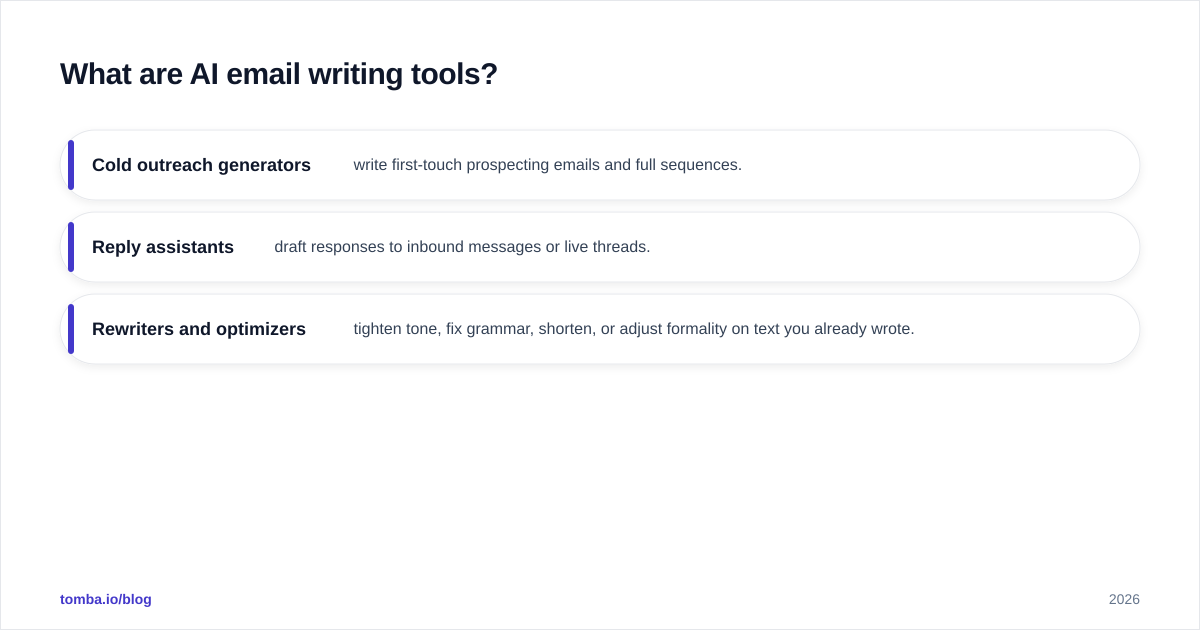
The category splits into three jobs:
- Cold outreach generators — write first-touch prospecting emails and full sequences.
- Reply assistants — draft responses to inbound messages or live threads.
- Rewriters and optimizers — tighten tone, fix grammar, shorten, or adjust formality on text you already wrote.
The difference between a tool that saves you hours and one that wrecks your sender reputation comes down to one thing: grounding. A model that only sees your prompt produces fluent, generic filler. A model that sees the prospect's role, company, recent activity, and a verified email address produces something a human will actually answer.
Why does AI email copy fail so often?#
Most AI email copy fails because it is confident and empty at the same time. The model has no idea who it is writing to, so it fills the gap with hedging language, fake compliments, and the same three-sentence structure every competitor's AI also generates.
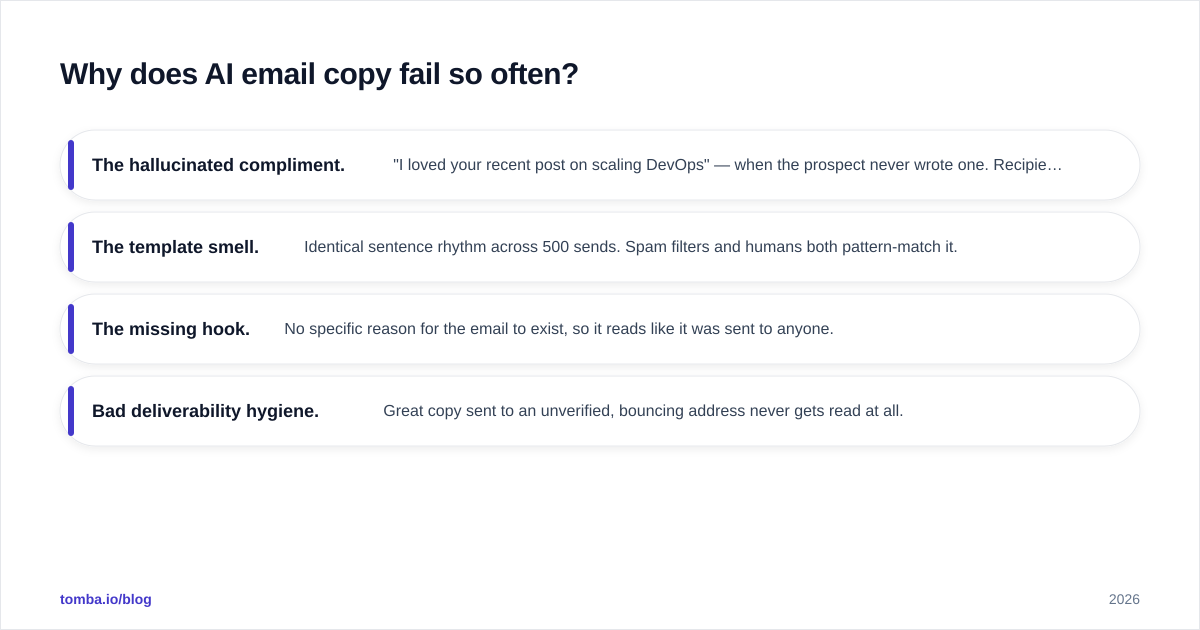
Here are the failure modes you will recognize:
- The hallucinated compliment. "I loved your recent post on scaling DevOps" — when the prospect never wrote one. Recipients spot this instantly.
- The template smell. Identical sentence rhythm across 500 sends. Spam filters and humans both pattern-match it.
- The missing hook. No specific reason for the email to exist, so it reads like it was sent to anyone.
- Bad deliverability hygiene. Great copy sent to an unverified, bouncing address never gets read at all.
That last point matters more than the writing. According to HubSpot's research on email marketing, relevance and list quality drive engagement far more than clever phrasing. If your AI writes a perfect email to a dead inbox, your reply rate is still zero.
What features separate good AI email tools from gimmicks?#
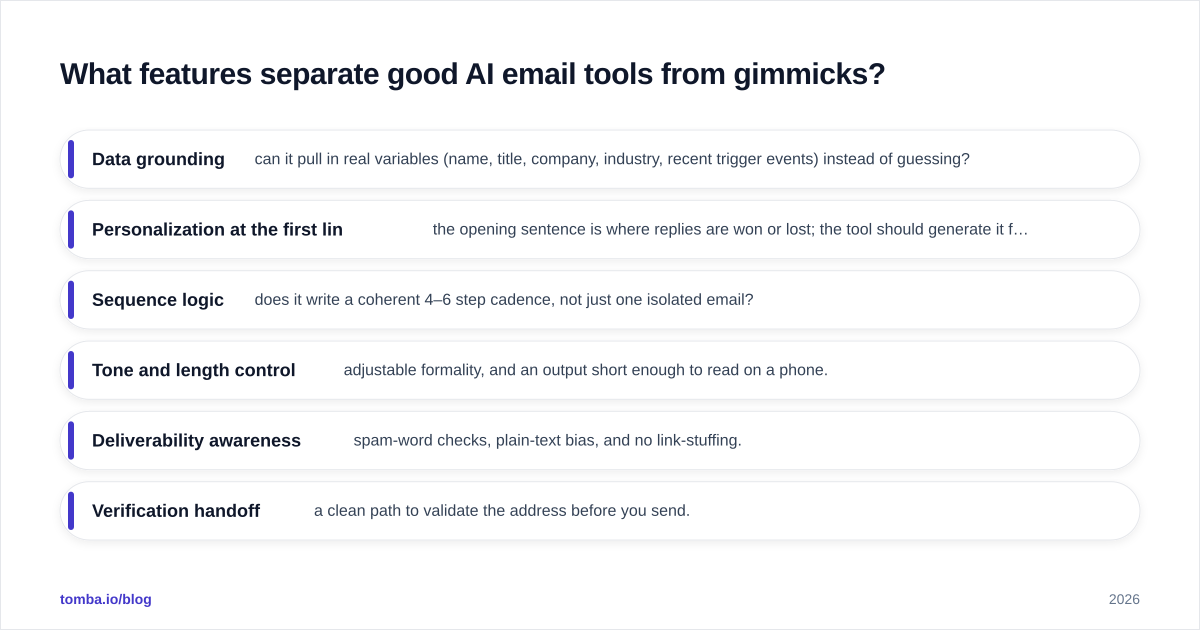
The good ones do more than wrap a chatbot in a sidebar. Use this checklist when you evaluate any AI email writing tool.
- Data grounding — can it pull in real variables (name, title, company, industry, recent trigger events) instead of guessing?
- Personalization at the first line — the opening sentence is where replies are won or lost; the tool should generate it from real signals.
- Sequence logic — does it write a coherent 4–6 step cadence, not just one isolated email?
- Tone and length control — adjustable formality, and an output short enough to read on a phone.
- Deliverability awareness — spam-word checks, plain-text bias, and no link-stuffing.
- Verification handoff — a clean path to validate the address before you send.
A tool that nails the writing but ignores the data layer is solving the easy half. Pair any writer with a verified source. You can find professional addresses by domain, name, or company with the email finder, then confirm they are deliverable with the email verifier before a single draft goes out.
Which AI email writing tools are worth comparing in 2026?#
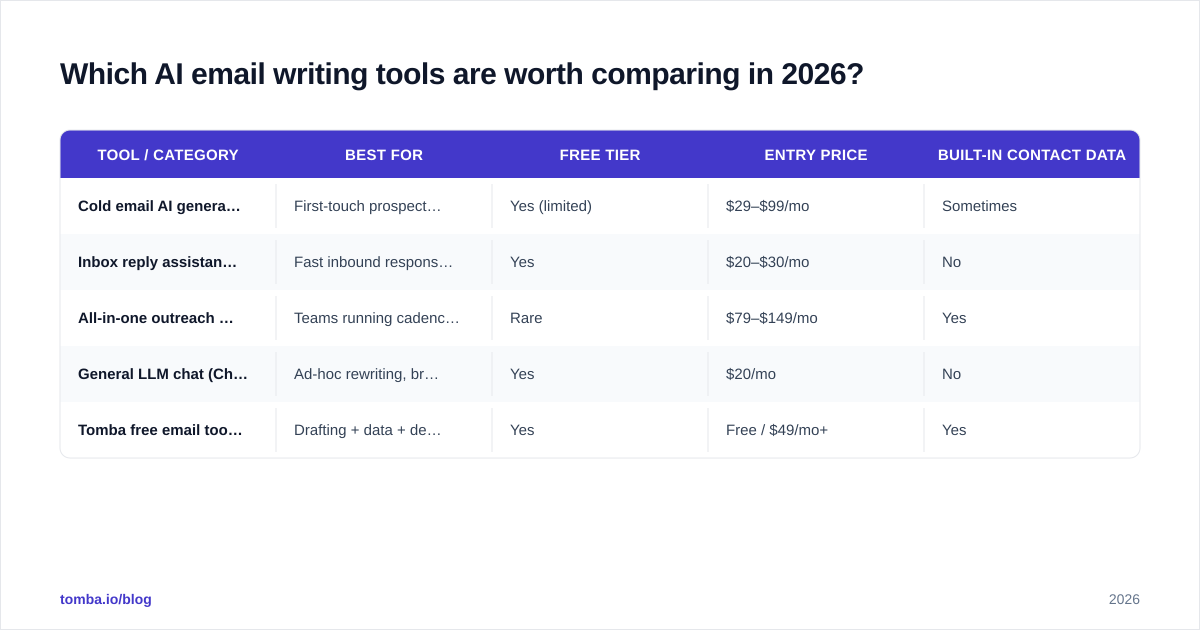
Below is a practical comparison of the main categories of AI email tooling you will encounter, framed by what they cost and who they fit. Prices reflect typical published entry tiers in 2026 and move often — always confirm on the vendor's own site.
| Tool / category | Best for | Free tier | Entry price | Built-in contact data |
|---|---|---|---|---|
| Cold email AI generators | First-touch prospecting + sequences | Yes (limited) | $29–$99/mo | Sometimes |
| Inbox reply assistants | Fast inbound responses | Yes | $20–$30/mo | No |
| All-in-one outreach suites | Teams running cadences at scale | Rare | $79–$149/mo | Yes |
| General LLM chat (ChatGPT/Claude) | Ad-hoc rewriting, brainstorming | Yes | $20/mo | No |
| Tomba free email tools | Drafting + data + deliverability | Yes | Free / $49/mo+ | Yes |
A few honest notes on the table:
- General LLMs like ChatGPT are excellent rewriters and brainstorming partners, but they have no idea who your prospect is and no deliverability guardrails. Use them for tone, not targeting.
- All-in-one suites bundle data and sending, which is convenient, but you pay for seats you may not use, and the bundled data is often shallower than a dedicated finder.
- Free, focused tools can outperform expensive suites when you stitch them together yourself. For pure drafting, the cold email AI writer and the AI email response generator cover outbound and inbound without a subscription.
You can cross-check any vendor's real-world reputation on a peer-review site like G2 before you commit budget. Marketing pages oversell; verified user reviews surface the deliverability and support problems that matter.
How do you actually use an AI email writing tool well?#
Treat the AI as a drafting engine, not an autopilot. The workflow that consistently produces replies looks like this.
1. Build a clean, verified list first#
The copy comes second. Start by finding the right people and confirming their addresses are live. Use domain search to pull the contacts at a target company, then verify them. Writing brilliant copy before you have a deliverable list is backwards.
2. Feed the model real context#
Give the tool the prospect's role, the company's industry, and one specific trigger — a funding round, a job posting, a product launch. The single best predictor of a good AI draft is the quality of the variables you pass it.
3. Let AI write the first line, you keep the ask#
The opening sentence is where personalization lives, so let the model generate three options grounded in your context. But write the call to action yourself — keep it to one clear, low-friction ask.
4. Run a deliverability pass#
Check for spam triggers, strip heavy HTML, and keep links to one. A subject line tester and a spam checker catch the problems that quietly kill open rates.
5. Test, measure, iterate#
Send small batches. Track reply rate, not just opens. Feed the winners back into your prompts. AI shortens the loop; it does not replace the loop.

Will AI email writing tools hurt my deliverability?#
They can — but only if you let volume outrun quality. AI makes it trivial to send 1,000 emails a day, and that is exactly the trap. Mailbox providers in 2026 weigh engagement heavily; a flood of low-relevance AI mail to unverified addresses spikes your bounce and spam-complaint rates, which drags down sender reputation for every future send.
Protect yourself with three habits:
- Verify before you send. Bounces are the single fastest way to get throttled. A catch-all verifier helps you handle the risky domains AI tools love to guess at.
- Keep volume human. Ramp gradually and warm new domains. AI scale is a feature, not a target.
- Write to be answered, not just opened. Replies are the strongest positive signal you can send a mailbox provider, and genuinely personalized copy earns them.
In other words, AI writing and deliverability are not separate problems. The same discipline — real data, verified addresses, relevant copy — solves both at once.
When should you skip AI and write it yourself?#
Skip the AI for your highest-value, lowest-volume emails. A first message to a dream account, a delicate negotiation reply, or a note to a warm referral deserves your own words. The ROI math is simple: when you are sending five emails that each could be worth six figures, the minutes you save with AI are not worth the risk of sounding automated.
Use AI where the volume is high and the stakes per message are moderate: top-of-funnel prospecting, follow-up nudges, meeting confirmations, and routine inbound triage. That is where the time savings compound and a slightly generic line costs you little.
A reasonable rule: let AI draft, but never let it send unread. Every email still passes one human glance before it leaves. That single checkpoint preserves the quality that makes the whole channel work.
The bottom line#
AI email writing tools in 2026 are genuinely useful — as drafting engines bolted onto good data and good judgment. The tools that win are the ones grounded in real contact information, tuned for deliverability, and supervised by a human who knows the difference between personalized and merely fluent. The tools that lose are blank prompt boxes generating confident filler to addresses that bounce.
Get the foundation right and the writing tool becomes a force multiplier. Get it wrong and it is an expensive way to land in spam.
Start with the data layer. Before you automate a single word, find and verify the people you actually want to reach with the Tomba Email Finder — search by domain, name, or company, confirm the address is deliverable, and feed your AI writer the verified context it needs to earn a reply. The free tier gives you 25 searches a month to test it, with paid plans starting at $49/mo when you scale. Good copy is the second half of the job. Clean data is the first.
Ready to find emails that actually work?
Join 150,000+ professionals who stopped guessing and started sending. Free credits on signup — no credit card required.
Get the Tomba newsletter
Practical outbound tactics and product updates — once every two weeks.
About the author