AI Follow Up Email: Templates and Tactics That Convert in 2026
Most deals die in the follow-up, not the first touch. Here's how to use AI follow up email workflows to stay human, stay relevant, and actually get replies in 2026.
TL;DR
- 80% of B2B sales happen between the 5th and 12th touch, yet most reps stop after two — an AI follow up email system fixes the follow-through gap, not the opener.
- AI is best used for drafting, personalization, and timing, not for blasting generic "just checking in" notes that get ignored.
- The winning pattern: human strategy + AI execution. You set the angle and the offer; the model handles variants, tone, and scale.
- Verified contact data matters more than clever copy. A perfect follow-up to a bounced address earns you nothing.
- This guide gives you a 5-step framework, copy-paste templates, a timing cadence, and a tool comparison you can act on today.
Why do most follow-up emails fail?#
Short answer: reps quit too early and personalize too little. The first email is the easy part. The follow-up is where revenue actually lives — and where almost everyone gets lazy.
Think of follow-ups like watering a plant. One soak does nothing if you never come back. But dumping a bucket on it every hour kills it just as fast. Most "just bumping this to the top of your inbox" emails are that bucket: high frequency, zero new value, and the prospect tunes out.
The data backs this up. Industry benchmarks from HubSpot consistently show that a large share of closed deals require five or more touches, while the median rep sends two and gives up. The gap between "two emails" and "a thoughtful seven-touch sequence" is the entire game.
An AI follow up email doesn't win because the AI is smarter than you. It wins because it removes the two reasons humans stop: it's tedious to write the fourth variation, and it's hard to remember who needs a nudge on which day. Solve those two problems and your reply rate climbs without any copywriting genius.
What is an AI follow up email, exactly?#
An AI follow up email is any follow-up message where a language model handles part of the work: drafting the body, generating personalized variants, adapting tone to the prospect's last reply, or deciding the best send time based on engagement signals.
It is not a button that spams your list. The useful version sits in one of three buckets:
- Draft assist — you give context (who, what offer, what happened last), the AI returns a tight first draft you edit in 20 seconds.
- Reply-aware response — the prospect wrote back ("not now," "send pricing," "wrong person"), and the AI proposes a context-appropriate reply.
- Sequence personalization at scale — you have 300 prospects in a campaign and the AI tailors each follow-up to the company, role, and trigger event.
The line that separates a tool that helps from one that hurts is new information per send. Good AI follow-ups always add something — a relevant case study, a new angle, a resource, a sharper question. Bad ones restate "circling back." If you want to dig into the mechanics of what moves the needle, our breakdown of email response rate benchmarks is a useful baseline.
How do you structure an AI follow up email sequence?#
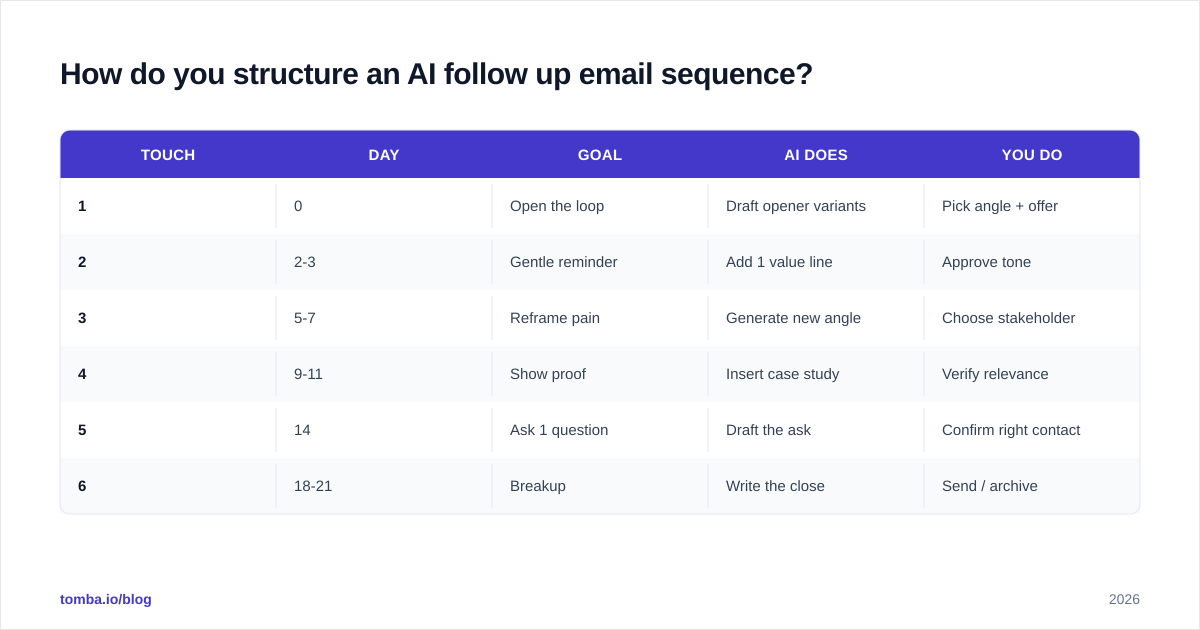
Use a five-part framework. Set the strategy yourself, then let AI fill each slot with variants. Here's the model to anchor on.
1. The reminder (Day 2-3). Short, references the original email, adds one new line of value. No guilt-tripping. No "did you see my last email?"
2. The reframe (Day 5-7). Approach from a different angle — a different pain point, a different stakeholder benefit. AI is great at generating these alternate angles fast.
3. The proof (Day 9-11). Drop a case study, a metric, or a relevant customer story. Social proof does the persuading so you don't have to.
4. The question (Day 14). One specific, easy-to-answer question. "Are you the right person for this, or should I reach out to someone on your data team?"
5. The breakup (Day 18-21). Permission to close the loop. Counterintuitively, the breakup email often gets the highest reply rate of the sequence because it triggers loss aversion.
The AI's job is to write five different messages that ladder value, not five reworded copies of the same ask. Feed the model your five strategic slots and it will respect the structure. Tools like the cold email AI writer are built to generate exactly these laddered variants instead of one-size-fits-all blasts.
Sample cadence at a glance#
| Touch | Day | Goal | AI does | You do |
|---|---|---|---|---|
| 1 | 0 | Open the loop | Draft opener variants | Pick angle + offer |
| 2 | 2-3 | Gentle reminder | Add 1 value line | Approve tone |
| 3 | 5-7 | Reframe pain | Generate new angle | Choose stakeholder |
| 4 | 9-11 | Show proof | Insert case study | Verify relevance |
| 5 | 14 | Ask 1 question | Draft the ask | Confirm right contact |
| 6 | 18-21 | Breakup | Write the close | Send / archive |
What does a good AI follow up email actually look like?#
Here are three templates you can adapt. Keep them under 90 words. Every one adds something new.
Template 1 — The value reminder (Touch 2):
Hi {First Name}, quick follow-up on my note about {pain point}. Since I wrote, {company} just {trigger event / new resource}. Thought it might be relevant given your focus on {goal}. Worth a 15-minute look next week?
Template 2 — The reframe (Touch 3):
Hi {First Name}, I may have led with the wrong angle. Most {role} I talk to care less about {original angle} and more about {new angle}. If that's truer for you, here's a 2-minute teardown of how {customer} handled it: {link}. Open to comparing notes?
Template 3 — The breakup (Touch 6):
Hi {First Name}, I don't want to clutter your inbox, so this is my last note. If {outcome} isn't a priority this quarter, no problem — I'll close the file. If it is, just reply "yes" and I'll send times. Either way, thanks for reading.
Notice what AI handles well here: swapping {new angle}, matching tone to the prospect's seniority, and producing 50 personalized versions of Template 1 in the time it takes you to drink a coffee. What AI handles badly: knowing your actual offer and which trigger event matters. That part stays human. If you want a library to start from, the email templates collection gives you tested skeletons to feed the model.
Should you let AI write the whole follow-up?#
No — and this is the most important rule in the guide. Conclusion first: use AI as a co-pilot, not an autopilot.
The failure mode is obvious once you've seen it. A team flips on full automation, the model writes "I hope this email finds you well" 4,000 times, every prospect recognizes the pattern, and the domain's reply rate craters. Worse, generic AI sludge at volume can hammer your sender reputation and land you in spam folders, which is far more expensive than a slow week of outreach.
Here's the division of labor that works:
- Human owns: the offer, the target list, the strategic angle, the final approve/edit, and the relationship judgment.
- AI owns: first drafts, tone matching, variant generation, scheduling, and reply triage.
When a prospect replies with nuance — "we're mid-migration, ping me in Q3" — that's a human moment. You can use an AI email response generator to draft the reply, but you read it, you adjust it, and you set the actual reminder. The AI accelerates; you decide.
A simple gut check: if you'd be embarrassed for the prospect to know a bot wrote it unedited, edit it. If the message would still make sense coming from you personally, you're in good shape.
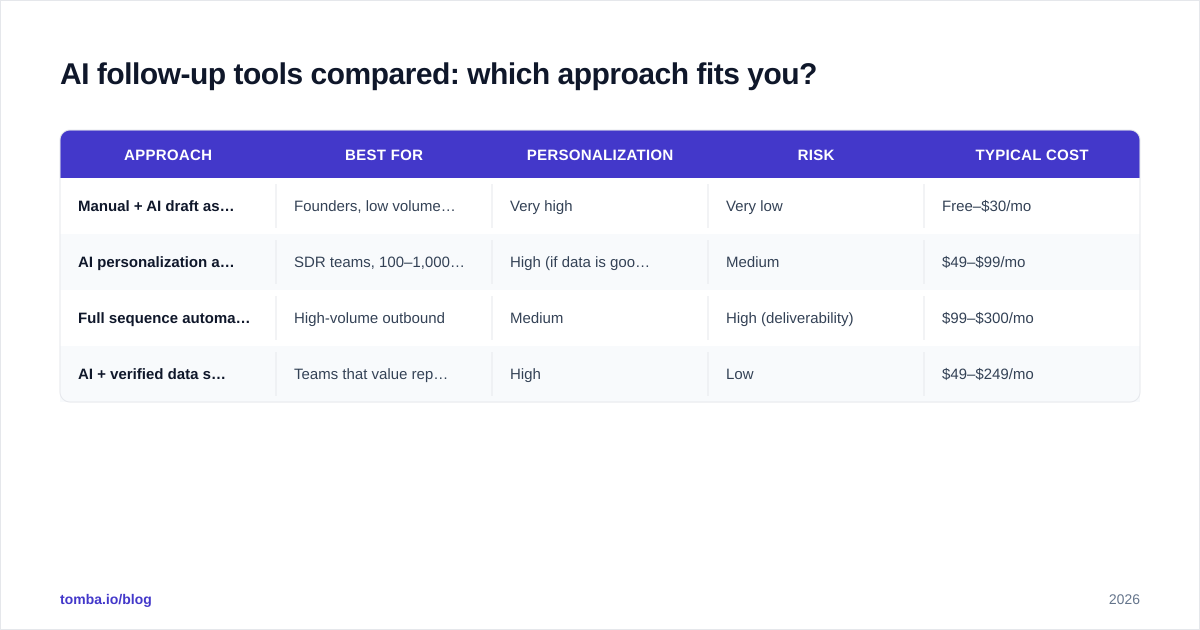
AI follow-up tools compared: which approach fits you?#
There's a spectrum from "AI helps me write" to "AI runs the whole sequence." Match the approach to your volume and risk tolerance.
| Approach | Best for | Personalization | Risk | Typical cost |
|---|---|---|---|---|
| Manual + AI draft assist | Founders, low volume, high-ACV deals | Very high | Very low | Free–$30/mo |
| AI personalization at scale | SDR teams, 100–1,000 prospects/mo | High (if data is good) | Medium | $49–$99/mo |
| Full sequence automation | High-volume outbound | Medium | High (deliverability) | $99–$300/mo |
| AI + verified data stack | Teams that value reply rate over send volume | High | Low | $49–$249/mo |
Notice the bottom row. The differentiator in 2026 isn't who has the fanciest model — everyone has GPT-class drafting now. It's who pairs AI copy with clean, verified contact data. A brilliant follow-up sent to j.smith@oldcompany.com after the person changed jobs is wasted compute. That's why a data layer underneath your AI matters as much as the copy layer. You can compare full plans on the Tomba pricing page, and it's worth reading how vendor-neutral reviewers on G2 score tools on data accuracy, not just features.
How does timing affect AI follow-up reply rates?#
Timing is a multiplier, not a detail. The same email sent at the right moment can double its reply rate.
Three timing principles AI executes better than humans:
- Spacing. Don't follow up daily. The 2–3 day gap early, widening to 4–5 days later, respects the prospect's inbox. AI scheduling tracks this per-contact so you never double-send.
- Engagement triggers. If a prospect opened your last email three times yesterday, that's a signal to follow up now, not next Tuesday. Reply-aware tools surface these moments.
- Send windows. Most B2B replies cluster Tuesday–Thursday, mid-morning in the recipient's timezone. AI handles timezone math across a global list without you maintaining a spreadsheet.
One caution: every send is a deposit or withdrawal from your email deliverability. Volume without verification is the fastest way to bankrupt that account. Verify before you send, warm up your domain, and let AI handle cadence — but never let it handle hygiene for you.
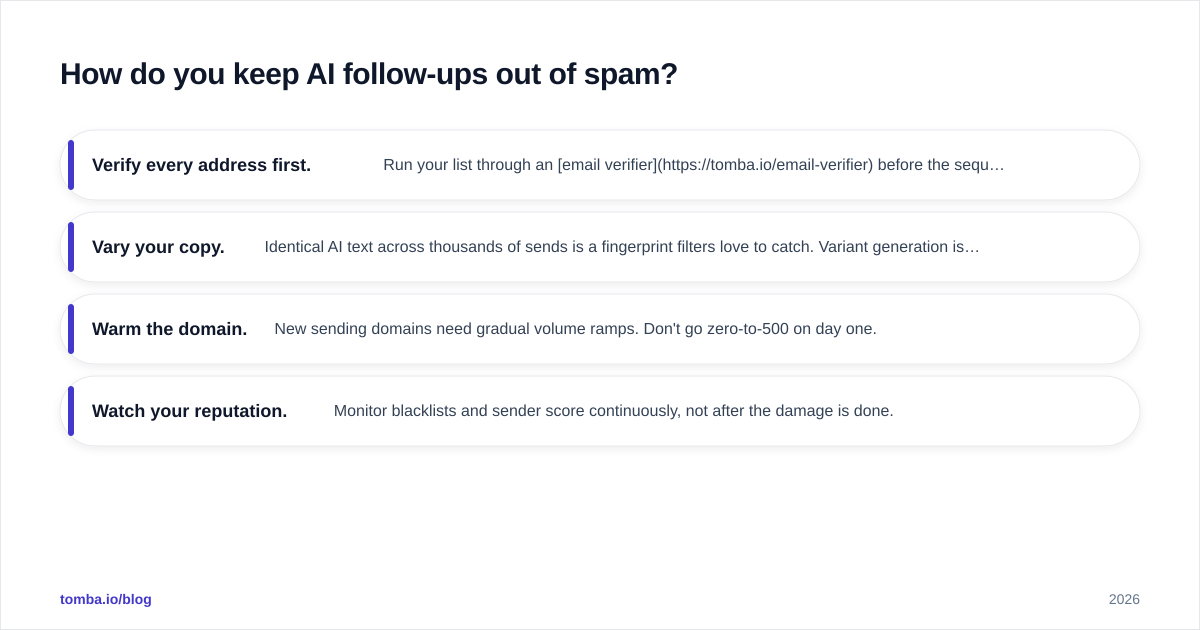
How do you keep AI follow-ups out of spam?#
Deliverability is the unglamorous foundation. The best AI follow up email in the world earns nothing from the spam folder. Four non-negotiables:
- Verify every address first. Run your list through an email verifier before the sequence starts. Bounces above 2–3% signal mailbox providers that you're a spammer.
- Vary your copy. Identical AI text across thousands of sends is a fingerprint filters love to catch. Variant generation isn't just for reply rate — it's deliverability insurance.
- Warm the domain. New sending domains need gradual volume ramps. Don't go zero-to-500 on day one.
- Watch your reputation. Monitor blacklists and sender score continuously, not after the damage is done.
Get these right and AI scale becomes an asset. Get them wrong and AI just helps you fail faster and louder.
Frequently asked questions#
How many follow-ups should an AI sequence send? Five to seven touches over roughly three weeks is the proven range for most B2B outbound. More than that and reply rates fall off while spam risk climbs. Quality and spacing beat raw volume every time.
Will prospects know an AI wrote my follow-up? Only if you ship it unedited. AI-generated drafts that you personalize, trim, and approve read as human because the strategy and final voice are yours. The tell is always the generic, un-edited template.
Can AI follow-ups replace my SDR team? No. AI removes the tedious 80% — drafting, scheduling, variant creation — so your reps spend their time on judgment, relationships, and the high-value replies that close deals. It's leverage, not a replacement.
What's the single biggest factor in follow-up success? Verified contact data. Clever copy sent to a dead inbox converts at zero. Build the data layer first, then layer AI copy on top.
The bottom line#
AI doesn't fix bad strategy — it scales whatever you already have. Point it at a sharp offer, a verified list, and a value-laddered cadence, and an AI follow up email system becomes the most reliable revenue lever in your stack. Point it at a generic "just checking in" template and a dirty list, and you've just automated your way into the spam folder faster.
Start with the data. Before you write a single follow-up, make sure you're reaching real, current inboxes. Tomba's Email Finder gives you verified, accurate B2B email addresses by name, domain, or company — so every AI-crafted follow-up you send actually lands in front of a human who can say yes. Pair clean data with the cadence and templates above, and your follow-through stops leaking deals. Try the find email addresses tool free with 25 searches a month and build your first verified follow-up list today.
Ready to find emails that actually work?
Join 150,000+ professionals who stopped guessing and started sending. Free credits on signup — no credit card required.
Get the Tomba newsletter
Practical outbound tactics and product updates — once every two weeks.
About the author