AI for B2B Outreach in 2026: A Practical Playbook for Reps
AI for B2B outreach is past the hype. Here's how to use it to research, personalize, and sequence at scale without sounding like a robot in 2026.
TL;DR
- AI for B2B outreach works best as a research-and-drafting layer, not an autopilot. It compresses the hours reps spend on account research and first drafts, but humans still own targeting and final judgment.
- The biggest lever is not the writing model — it's the data feeding it. AI personalization built on stale or unverified contacts just sends polished email to the wrong people faster.
- Use AI for four jobs: account research, message personalization, sequence orchestration, and reply triage. Keep a human in the loop on list selection and anything that touches a named executive.
- Expect 2–4x more first drafts per rep, not 10x more booked meetings. Volume without deliverability discipline burns your domain.
- A realistic 2026 stack pairs an intent/research tool, a verified contact source, and a sending platform — with verification sitting between "found" and "sent."
What does "AI for B2B outreach" actually mean in 2026?#
AI for B2B outreach is the use of large language models and machine-learning signals to research accounts, draft personalized messages, sequence touches, and triage replies — the work that used to eat an SDR's morning before a single email went out.
Think of it like a sous-chef. The AI does the prep — chopping, measuring, laying out ingredients — so the rep can focus on the actual cooking: deciding who to target, what the offer is, and when to push versus walk away. The AI that promises to run the whole kitchen unattended is the one that sends "Hi {FirstName}" to a contact who left the company eight months ago.
By 2026 the category has split into three layers that you'll mix and match:
- Signal and research layer — intent data, technographics, news triggers, and account summaries.
- Generation layer — the model that writes the first draft of an email, LinkedIn note, or call script.
- Orchestration layer — the sequencing engine that decides timing, channel, and follow-up logic.
Most "AI SDR" products bundle all three and market the bundle as autonomy. The teams getting results treat them as separate, swappable components.
Why is AI outreach failing for so many teams?#
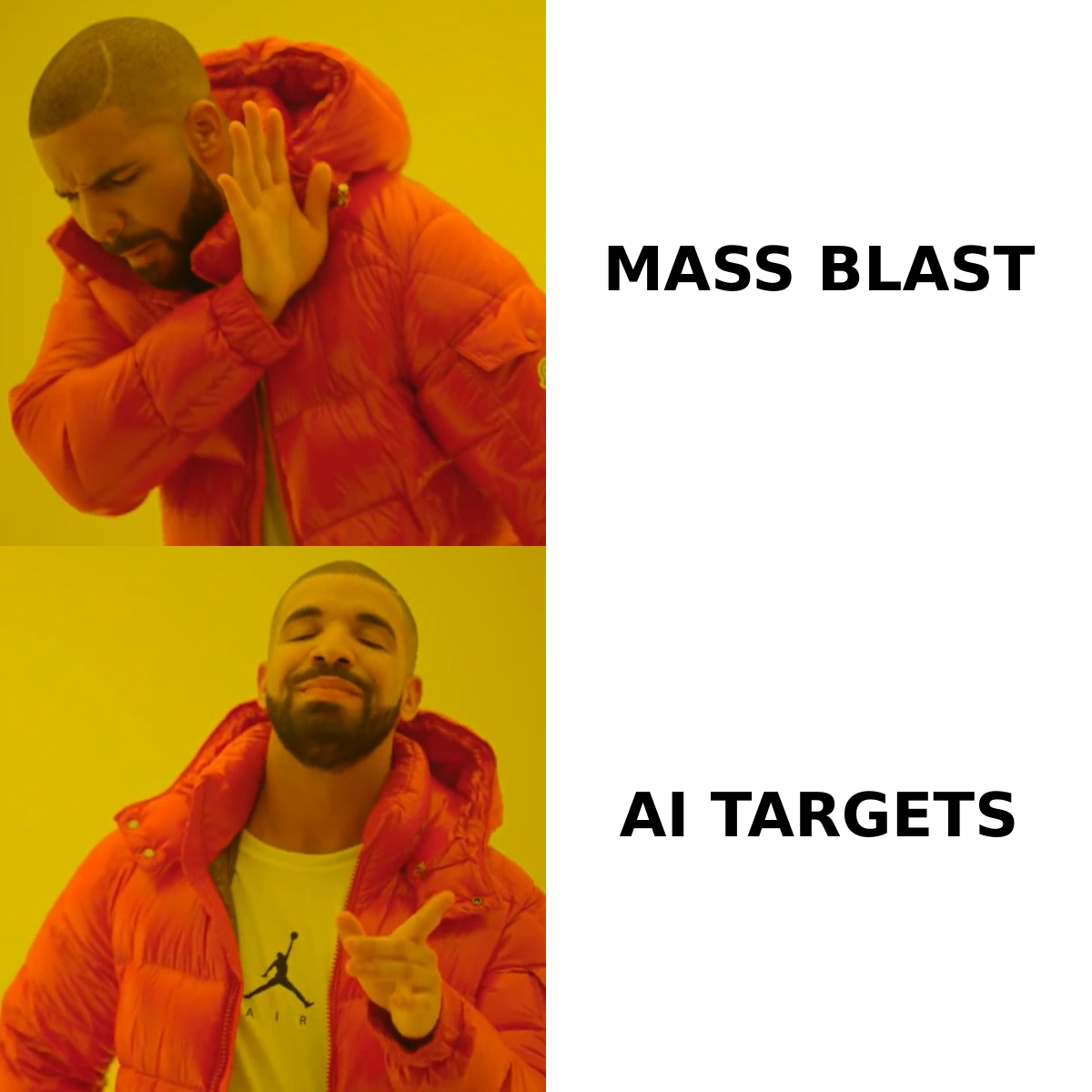
Because they bolted a fast writer onto a dirty list. AI doesn't fix bad targeting — it industrializes it.
Here's the failure pattern almost everyone hits first. A team buys an AI outreach tool, points it at a 50,000-row export from some scraped database, and turns on "hyper-personalization." The model writes a clever line about each prospect's company. The emails go out. Then:
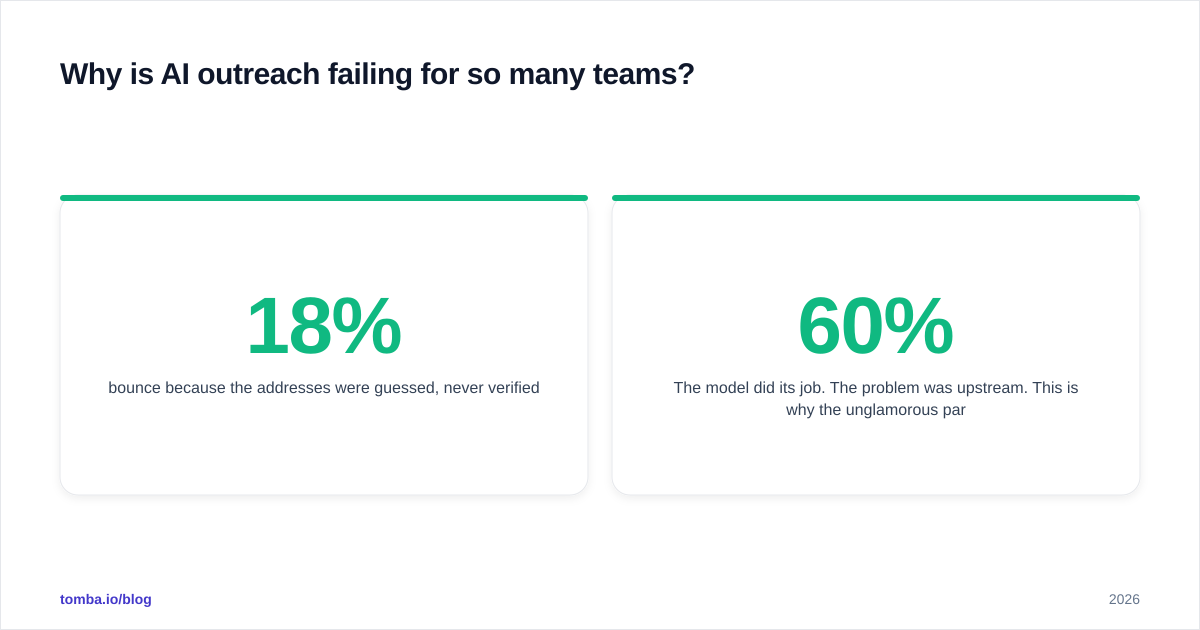
- 18% bounce because the addresses were guessed, never verified.
- Half of what lands hits catch-all domains where the inbox may not exist.
- The domain reputation craters inside a week, and even the good emails start landing in spam.
The model did its job. The problem was upstream. This is why the unglamorous parts — list hygiene, email verification, and catch-all handling — matter more than the prompt engineering. A 60% accurate list run through a brilliant AI writer is still a 60% accurate list.
The second failure is tone. Models default to a recognizable register: tidy, enthusiastic, slightly hollow. Buyers in 2026 have read thousands of these. A message that screams "generated" gets deleted faster than an obvious template, because it feels like effort was faked. The fix isn't a better model — it's feeding the model real, specific inputs (a recent funding round, a job posting, a product change) instead of asking it to invent relevance.
How should you split work between AI and humans?#
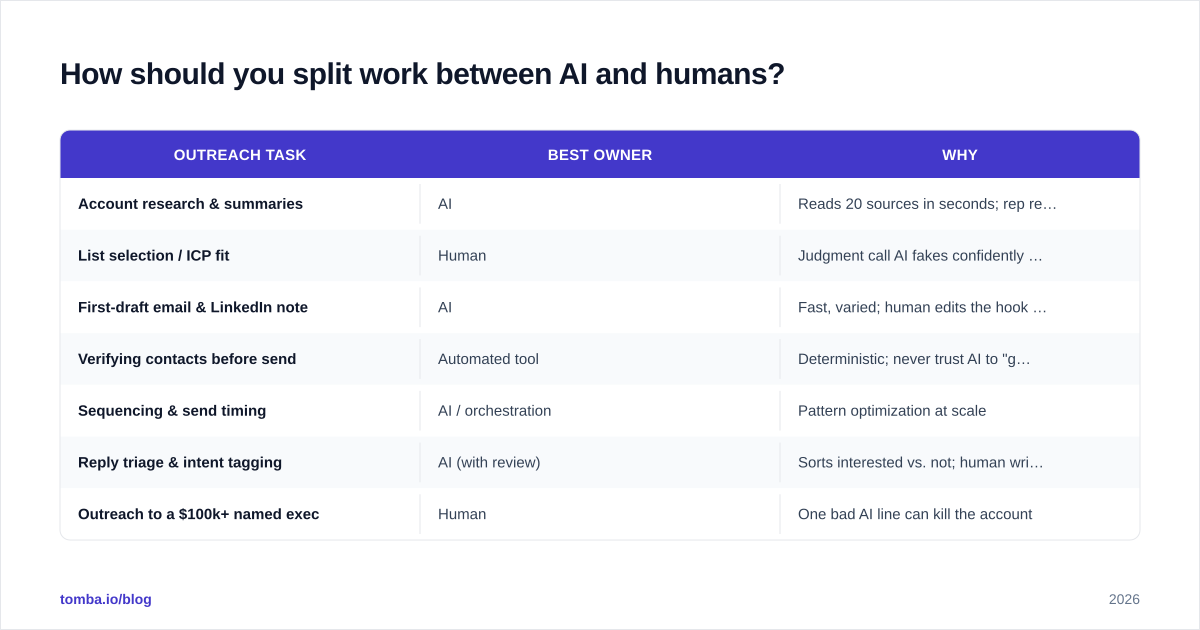
Conclusion first: let AI do research and drafting at volume; keep humans on targeting and any high-value named account. The line moves with deal size.
| Outreach task | Best owner | Why |
|---|---|---|
| Account research & summaries | AI | Reads 20 sources in seconds; rep reviews the summary |
| List selection / ICP fit | Human | Judgment call AI fakes confidently and gets wrong |
| First-draft email & LinkedIn note | AI | Fast, varied; human edits the hook and CTA |
| Verifying contacts before send | Automated tool | Deterministic; never trust AI to "guess" validity |
| Sequencing & send timing | AI / orchestration | Pattern optimization at scale |
| Reply triage & intent tagging | AI (with review) | Sorts interested vs. not; human writes the reply |
| Outreach to a $100k+ named exec | Human | One bad AI line can kill the account |
A useful rule: the more a single message matters, the more a human should touch it. Blasting 500 SMB prospects? Let AI carry 90% of the load. Chasing six enterprise logos? AI researches, a human writes every word.
This is also where deliverability lives or dies. AI makes it trivial to 5x your send volume, which is exactly how teams torch a domain. Pair any volume increase with warmup, authentication, and verification. Our breakdown of email deliverability fundamentals covers the guardrails; the short version is that volume without reputation management is a countdown timer.
What does a realistic AI outreach stack look like?#
A working 2026 stack has four jobs covered, ideally by tools that do one thing well rather than one tool claiming to do everything.
- Find and enrich — turn a name or company into a verified, current contact. This is where an email finder and data enrichment sit. Garbage in, garbage out starts here.
- Research and signal — intent data, news triggers, and account summaries the AI uses as raw material for relevance.
- Generate — the model drafting emails, notes, and call openers, fed by layers 1 and 2.
- Send and sequence — the platform managing inboxes, warmup, timing, and follow-ups.
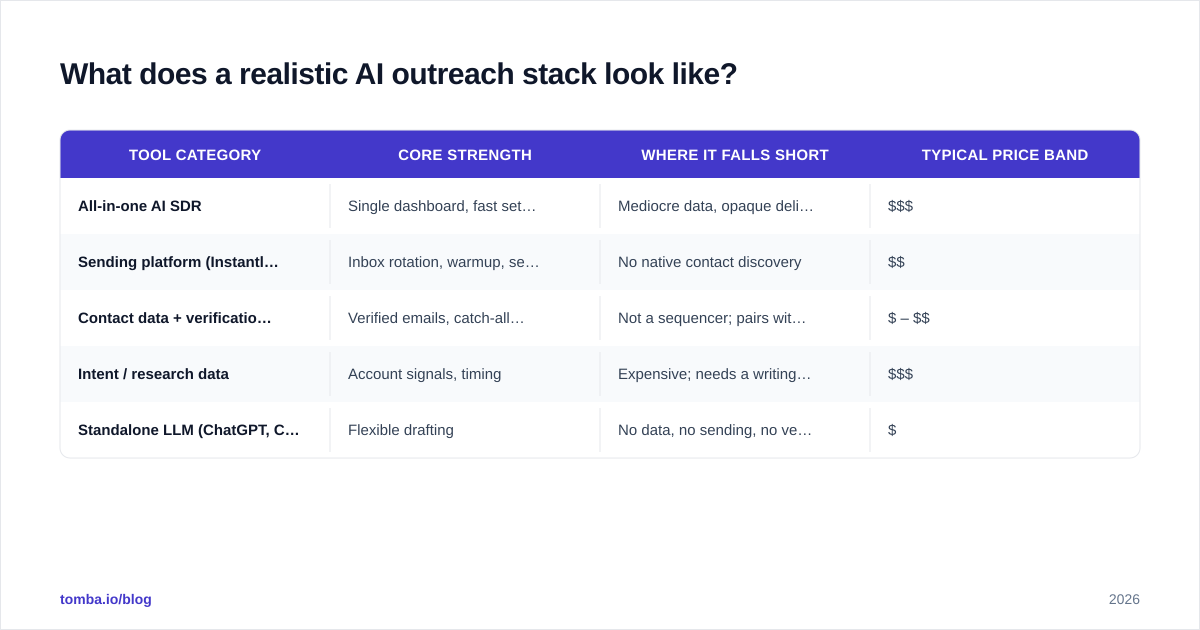
Notice verification sits between "find" and "send," not as an afterthought. Here's how the common tool categories compare on what they're actually good at:
| Tool category | Core strength | Where it falls short | Typical price band |
|---|---|---|---|
| All-in-one AI SDR | Single dashboard, fast setup | Mediocre data, opaque deliverability | $$$ |
| Sending platform (Instantly, Smartlead) | Inbox rotation, warmup, sequencing | No native contact discovery | $$ |
| Contact data + verification (Tomba) | Verified emails, catch-all checks, enrichment | Not a sequencer; pairs with one | $ – $$ |
| Intent / research data | Account signals, timing | Expensive; needs a writing layer | $$$ |
| Standalone LLM (ChatGPT, Claude) | Flexible drafting | No data, no sending, no verification | $ |
The mistake is buying the all-in-one because it demos well, then discovering its data layer is the weakest part. A more durable approach: own your data and verification, then plug a generation and sending layer on top. That way when a better writing model ships next quarter, you swap it without rebuilding your pipeline.
For pricing context, a verification-and-discovery layer like Tomba's plans starts free at 25 searches/month and runs $49/mo at the Starter tier — a fraction of what all-in-one "AI SDR" suites charge, and it keeps the most failure-prone layer (the data) under your control.

How do you write AI outreach that doesn't sound like AI?#
Feed it facts, constrain its voice, and cut the model's favorite filler. The relevance has to be real before the writing can be good.
A few concrete moves that separate human-grade output from obvious slop:
- Give the model one specific, verifiable detail per message. A funding round, a new VP hire, a job posting, a tech-stack change. "I saw you're hiring three SDRs in EMEA" beats any clever generic opener. If you can't find a real hook, the account probably isn't ready — don't let AI paper over that.
- Ban the tells. Prompt the model to avoid "I hope this email finds you well," "I wanted to reach out," "in today's landscape," and tidy three-part lists. These patterns are the buyer's instant-delete triggers.
- Cap the length. The best cold emails in 2026 are still 50–90 words. Models over-write by default; constrain hard.
- Write the CTA yourself. The ask is the highest-leverage line. AI tends toward soft, vague closes ("let me know if you'd like to learn more"). A specific, low-friction ask ("worth a 12-minute call Thursday?") converts better and is easy to hand-write.
For the drafting itself, you can keep it inside your existing stack — a tool like the cold email AI writer generates first drafts you then tighten, rather than copy-pasting from a chat window with no context. The workflow that scales is: AI drafts, human edits the hook and CTA, tool verifies the contact, platform sends.
If you want a credible outside benchmark on what's actually changing buyer behavior, HubSpot's annual sales research and Gartner's B2B buying findings both document the shift toward buyers who self-educate and resent low-effort outreach — which is exactly the gap good AI research can close and bad AI volume widens.
Will AI replace SDRs, or just change the job?#
It changes the job. The rep who survives 2026 spends less time researching and typing, and more time on judgment, targeting, and the conversations that AI can't have.
The honest framing is that AI removes the parts of the SDR role that were always low-value: copy-pasting LinkedIn data, writing the same intro fifty times, manually checking whether an email is still valid. What's left is the part that was always the actual skill — knowing which accounts are worth pursuing, reading a reply's subtext, and timing the follow-up.
Teams that fire their SDRs and replace them with an "autonomous agent" tend to learn an expensive lesson: the agent books meetings with people who were never going to buy, and the pipeline looks busy while win rates fall. The teams that win give each rep an AI research assistant and ask them to run 3–4x the accounts at the same quality bar. The headcount math changes, but the human stays in the loop where it counts.
Measure the right thing. More emails sent is not the goal; the metric is qualified meetings per domain reputation point spent. If your reply rate is climbing while your spam rate stays flat, AI is helping. If volume is up and your sender reputation is sliding, you've automated your way into the spam folder.
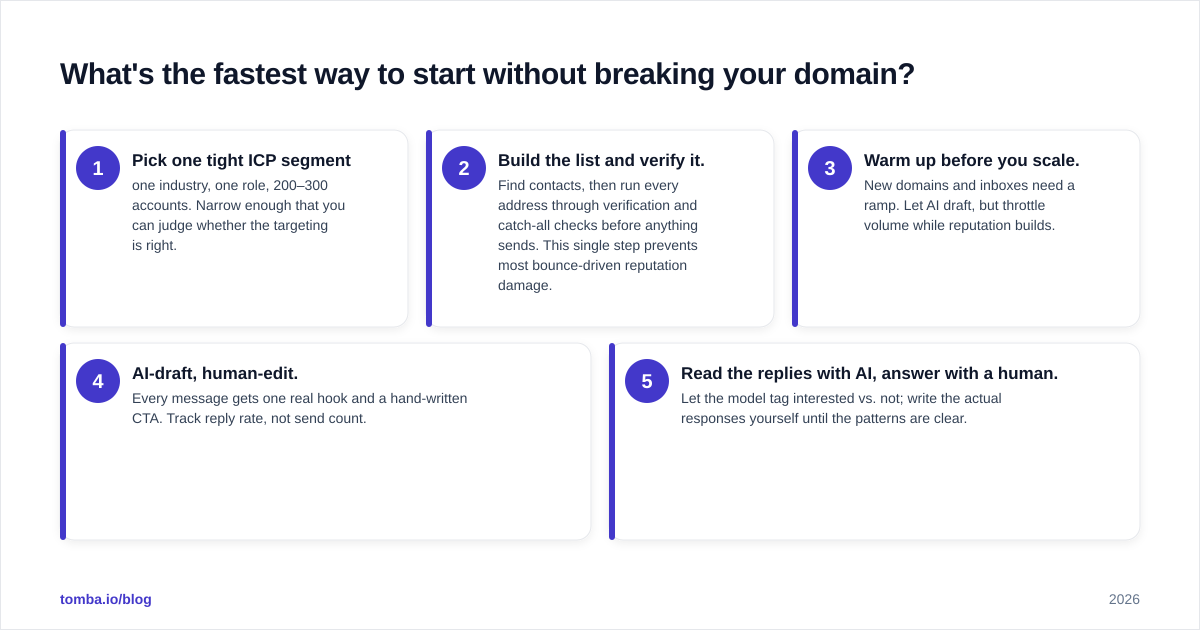
What's the fastest way to start without breaking your domain?#
Start small, verify everything, and prove the loop on one segment before you scale. Resist the urge to point AI at your whole TAM on day one.
A safe first 30 days:
- Pick one tight ICP segment — one industry, one role, 200–300 accounts. Narrow enough that you can judge whether the targeting is right.
- Build the list and verify it. Find contacts, then run every address through verification and catch-all checks before anything sends. This single step prevents most bounce-driven reputation damage.
- Warm up before you scale. New domains and inboxes need a ramp. Let AI draft, but throttle volume while reputation builds.
- AI-draft, human-edit. Every message gets one real hook and a hand-written CTA. Track reply rate, not send count.
- Read the replies with AI, answer with a human. Let the model tag interested vs. not; write the actual responses yourself until the patterns are clear.
The whole loop hinges on the data being clean. You can swap writing models, sequencers, and intent providers later — but if the contacts feeding the system are unverified, every layer above just amplifies the error.
The bottom line#
AI for B2B outreach in 2026 is a force multiplier on whatever you point it at. Point it at a verified, well-targeted list with real hooks, and a single rep covers the ground that used to take a team. Point it at a scraped export, and you'll generate beautiful spam at record speed.
Get the data layer right first. Before a single AI-written email goes out, make sure the contact is real, current, and reachable — start with the Tomba Email Finder to discover verified professional addresses by name, company, or domain, then let your AI stack do the part it's actually good at. Clean inputs are the difference between AI that books meetings and AI that burns your domain.
Ready to find emails that actually work?
Join 150,000+ professionals who stopped guessing and started sending. Free credits on signup — no credit card required.
Get the Tomba newsletter
Practical outbound tactics and product updates — once every two weeks.
About the author