AI for Bootstrapped SaaS Sales: The 2026 Lean Playbook
No SDR team, no $200k tooling budget. Here's how bootstrapped SaaS founders use AI to source, qualify, and close pipeline in 2026 — without burning runway.
TL;DR
- Bootstrapped SaaS founders don't lose to enterprise sales teams on headcount — they lose on wasted hours. AI closes that gap by automating the research, list-building, and follow-up that eats your week.
- The winning stack in 2026 is small: one data/email-finding tool, one AI writing layer, one lightweight CRM, and one sequencer. You can run it for under $200/month.
- AI is best at the boring middle of the funnel: enrichment, qualification scoring, and first-draft messaging. Keep the first call and the close human.
- Garbage data breaks every AI workflow downstream. Verified contact data is the foundation, not an afterthought.
- Measure replies and booked calls, not "emails sent." AI makes volume cheap, which makes discipline the real moat.
Why does bootstrapped SaaS sales need AI specifically?#
Because you are the SDR, the AE, the founder, and the support team — usually before lunch. A funded competitor hires a five-person sales org to brute-force pipeline. You can't, and you shouldn't try. AI is the only lever that gives one founder the output of a small team without the payroll.
Think of it like a commercial kitchen versus a home cook. The restaurant has ten people prepping, plating, and washing. The home cook has a dishwasher, a food processor, and a good set of knives. AI is your food processor: it won't invent the recipe, but it removes the 80% of the work that is pure chopping — finding contacts, researching accounts, drafting the first message, logging activity.
The math is brutal and clarifying. If you spend 12 hours a week manually building lists and copy-pasting into a CRM, that's roughly 600 hours a year you are not spending on product, customers, or actual selling conversations. AI doesn't make you a better closer. It buys back the hours so you can do the closing.
What does an AI sales stack for a bootstrapped SaaS actually look like?#
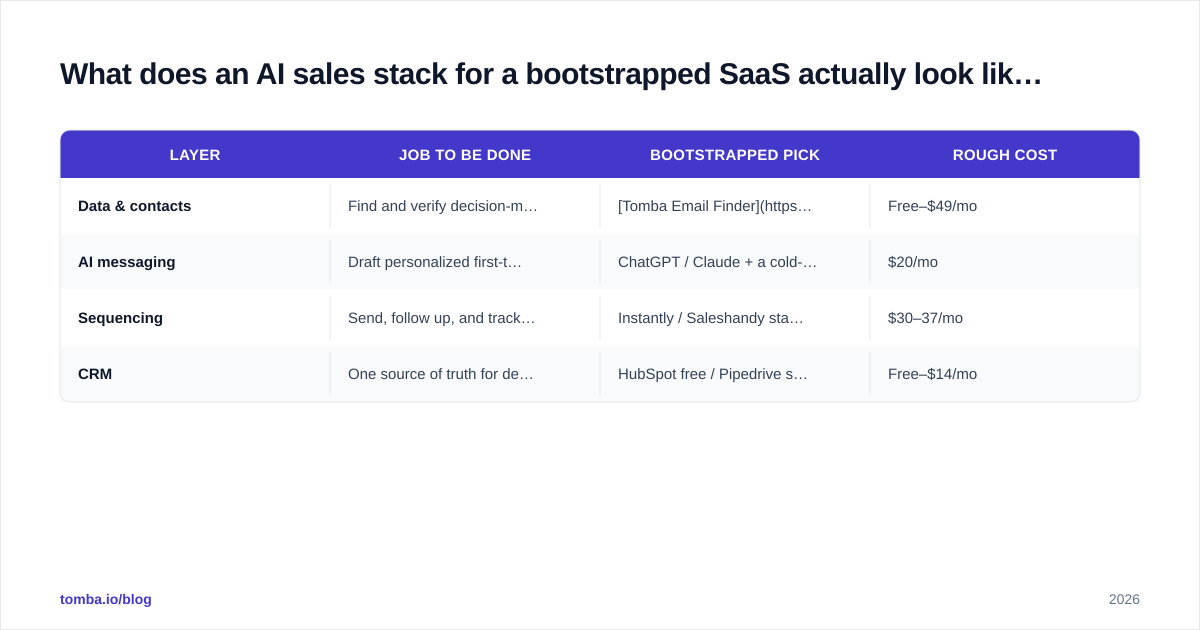
Keep it to four layers. Founders kill their margins by stacking eight overlapping tools they use at 10% each. You need data, messaging, orchestration, and a place to track it — nothing more until revenue justifies it.
| Layer | Job to be done | Bootstrapped pick | Rough cost |
|---|---|---|---|
| Data & contacts | Find and verify decision-maker emails | Tomba Email Finder | Free–$49/mo |
| AI messaging | Draft personalized first-touch + replies | ChatGPT / Claude + a cold-email AI | $20/mo |
| Sequencing | Send, follow up, and track at small volume | Instantly / Saleshandy starter | $30–37/mo |
| CRM | One source of truth for deals | HubSpot free / Pipedrive starter | Free–$14/mo |
That's a real, end-to-end revenue engine for well under $200 a month. Compare that to a single SDR's fully loaded cost — north of $6,000 a month in most US markets per HubSpot's sales benchmarks — and the leverage is obvious.
The discipline is in resisting expansion. Every tool you add is a tool you have to learn, maintain, and reconcile data across. Add the fifth tool only when the fourth is provably maxed out.
Substitute: 
How do you build a target list without a research team?#
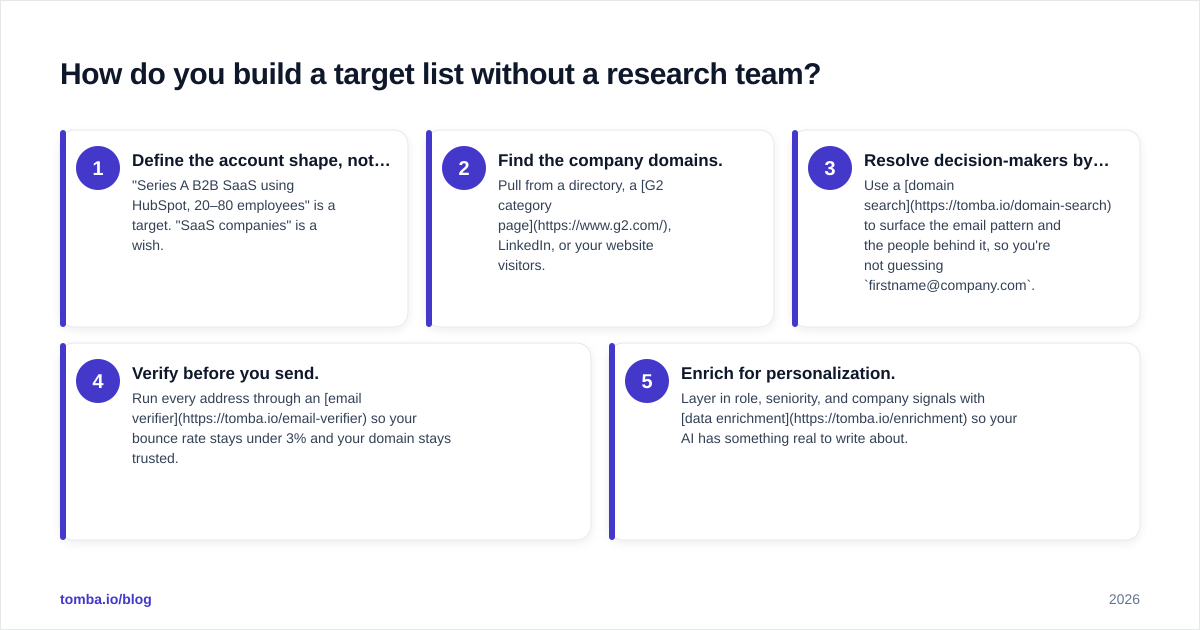
Start with the account, then resolve the person, then verify the email. Reversing that order is how founders end up with a giant list of bounced sends and a wrecked sender reputation.
Here's the lean workflow:
- Define the account shape, not just the industry. "Series A B2B SaaS using HubSpot, 20–80 employees" is a target. "SaaS companies" is a wish.
- Find the company domains. Pull from a directory, a G2 category page, LinkedIn, or your website visitors.
- Resolve decision-makers by domain. Use a domain search to surface the email pattern and the people behind it, so you're not guessing
firstname@company.com. - Verify before you send. Run every address through an email verifier so your bounce rate stays under 3% and your domain stays trusted.
- Enrich for personalization. Layer in role, seniority, and company signals with data enrichment so your AI has something real to write about.
The AI doesn't replace this pipeline — it accelerates each step. But the order is non-negotiable. Verified data is the foundation; AI built on bad data just produces confident-sounding nonsense faster.
Should you let AI write your cold emails?#
Yes — for the first draft, the variants, and the follow-ups. No — for the final send without a human read. AI is a fast intern, not a closer.
The failure mode is obvious the moment you've received one: the "Hi {{FirstName}}, I came across {{Company}} and was impressed by your work in {{Industry}}" template that screams automation. Buyers in 2026 pattern-match that in half a second and delete it. Mass-produced personalization is just spam wearing a name tag.
Use AI the right way:
- Feed it real signal. Give the model the enriched data — a recent funding round, a job posting, a specific product feature — and ask for one genuine, specific observation. Generic input yields generic output.
- Generate three angles, not thirty clones. Have it draft a pain-led, a curiosity-led, and a social-proof-led version. Pick the one that fits the account.
- Write the way you talk. Paste a few of your own real emails as a style sample so the output sounds like a founder, not a press release.
- Always edit the opener and the ask. The middle can be AI. The first line and the call-to-action are where deals are won or lost, so own them.
A useful rule: if you'd be embarrassed to have the prospect see that an AI wrote it verbatim, it's not ready. The AI gets you to 80% in 30 seconds; your 20% is what earns the reply.
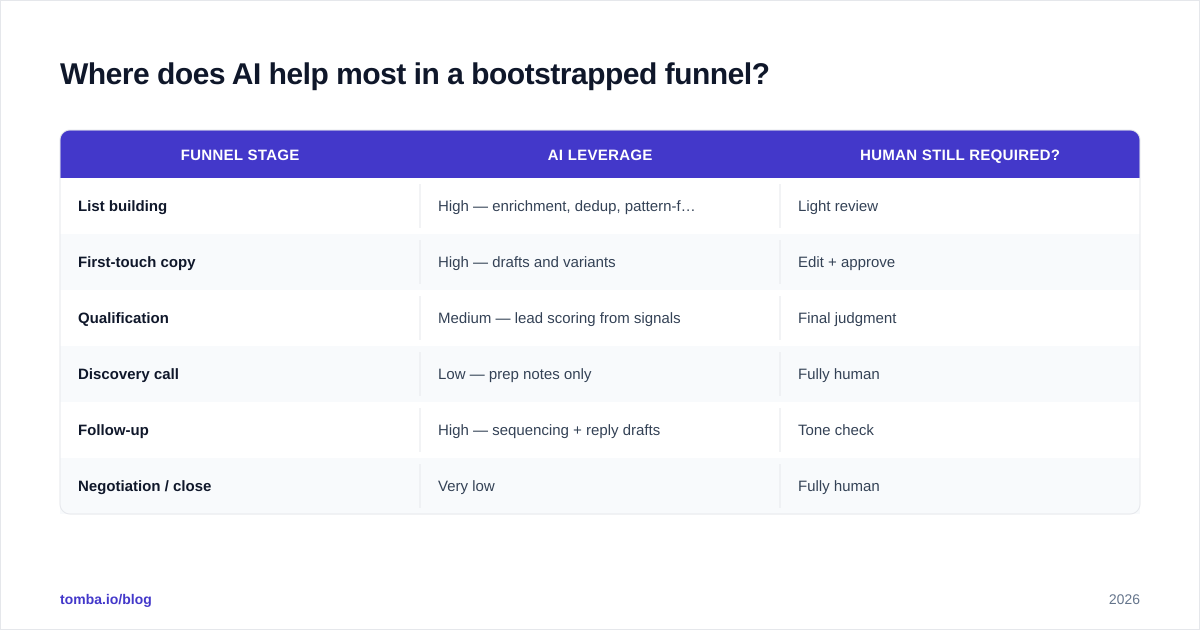
Where does AI help most in a bootstrapped funnel?#
In the unglamorous middle. Founders instinctively reach for AI to "write better emails," but the biggest time savings hide in research, qualification, and follow-up.
| Funnel stage | AI leverage | Human still required? |
|---|---|---|
| List building | High — enrichment, dedup, pattern-finding | Light review |
| First-touch copy | High — drafts and variants | Edit + approve |
| Qualification | Medium — lead scoring from signals | Final judgment |
| Discovery call | Low — prep notes only | Fully human |
| Follow-up | High — sequencing + reply drafts | Tone check |
| Negotiation / close | Very low | Fully human |
Notice the pattern: AI dominates the high-volume, low-judgment stages and disappears where trust and nuance decide the outcome. A bootstrapped founder's edge is being the actual founder on the call — don't automate the one thing your funded competitors can't fake.
For qualification, a simple AI-scored model beats gut feel. Feed the model your closed-won and closed-lost history and let it flag which inbound and outbound leads resemble your best customers. You stop spending your scarcest resource — founder hours — on deals that were never going to close.
What are the real risks, and how do you avoid them?#
The risks are deliverability, data decay, and over-automation. Each one can quietly kill a bootstrapped pipeline before you notice the numbers turning.
Deliverability collapse. AI makes sending 500 emails as easy as sending 5, which is exactly the trap. Blast unverified lists and your domain reputation tanks — then even your good emails land in spam. Warm up your domain, keep daily volume sane, authenticate with SPF and DKIM, and verify every address first. Tools get blamed for "not working" when the real cause is a burned domain.
Data decay. B2B contact data rots at roughly 25–30% per year as people change jobs — a figure Gartner and other analysts have tracked for years. An AI workflow running on a six-month-old list is automating waste. Re-verify before each campaign; it's cheaper than the reputation damage.
Over-automation. The temptation is to automate the entire funnel and "let it run." Resist it. The shiny new agent that promises to close deals while you sleep is usually a distraction from the boring discipline that actually works.
The founders who win with AI treat it as an amplifier of a system that already works, not a replacement for one they haven't built. Automate a broken process and you just get broken results, faster.
How do you measure whether the AI stack is working?#
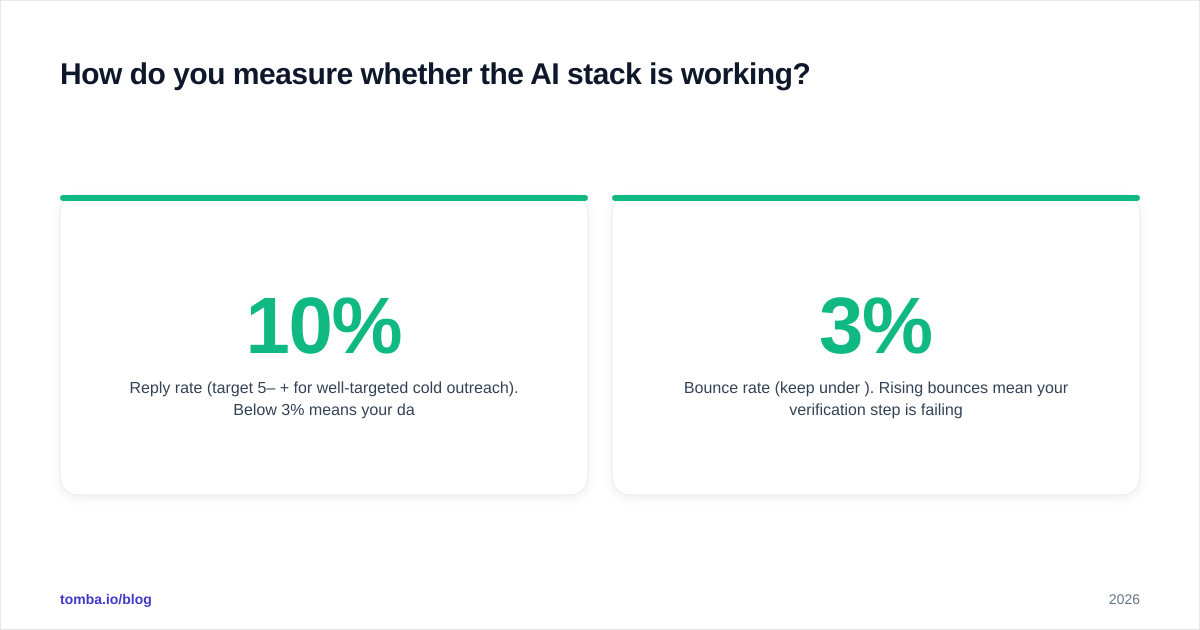
Track outcomes, not activity. AI makes vanity metrics explode — "10,000 emails sent" feels productive and means nothing. The only numbers that matter for a bootstrapped SaaS:
- Reply rate (target 5–10%+ for well-targeted cold outreach). Below 3% means your data or your targeting is off, not your subject line.
- Positive reply rate — replies that aren't "unsubscribe." This is your real signal.
- Booked calls per 100 contacts. The cleanest measure of whether the top of funnel is healthy.
- Bounce rate (keep under 3%). Rising bounces mean your verification step is failing.
- Cost per booked meeting. Divide your monthly stack cost by meetings booked. Watch it trend down as you tune.
Run this as a weekly five-minute review. If a metric moves the wrong way, you'll usually trace it to one of three things: stale data, a deliverability issue, or a message that stopped resonating. Fix the input, not the volume.
Want to scale a winning workflow? The Tomba API lets you wire finding and verification directly into your own scripts or no-code automations, so list-building runs in the background while you sell. Check current Tomba pricing to size the plan to your send volume.
What's the 30-day rollout for a solo founder?#
Don't boil the ocean. Stand up one channel, prove it, then expand.
- Week 1 — Foundation. Define one tight ICP. Build and verify a list of 100–200 accounts. Connect a CRM. No sending yet.
- Week 2 — Messaging. Draft three AI-assisted sequences for your single best segment. Edit every opener by hand. Warm up your sending domain.
- Week 3 — Launch small. Send to 20–30 contacts a day. Read every reply. Note what lands.
- Week 4 — Tune and scale. Double down on the winning angle, cut the losers, and only now consider adding a second channel or a sequencer upgrade.
By day 30 you'll have a working, measurable engine instead of a pile of half-used tools. That's the whole game for a bootstrapped SaaS: a small system that runs reliably beats a big system that runs occasionally.
The bottom line#
AI for bootstrapped SaaS sales isn't about replacing yourself — it's about deleting the busywork so the founder can do what only the founder can: build relationships and close deals. The stack is cheap, the leverage is real, and the discipline is what separates founders who scale from founders who just send more email.
It all starts with data you can trust. Before you automate a single send, make sure the contacts feeding your pipeline are real and reachable. Start free with the Tomba Email Finder — 25 searches a month at no cost — to find and verify decision-maker emails by domain, name, or company, then plug that clean data into the lean AI engine above and let your runway last longer.
// get started
Find, verify and enrich your first contacts today
Start on the free plan with 25 searches a month, then scale when your team is ready.
Free plan · No credit card required · GDPR & CCPA
// about the author