AI for Demand Generation in 2026: A Practical Playbook
AI for demand generation turns scattered intent signals into pipeline. Here's how the modern stack works, where it pays off, and what to avoid in 2026.
TL;DR
- AI for demand generation is not "write blog posts faster." It is the layer that scores intent, prioritizes accounts, personalizes outreach, and enriches contact data so your team spends time only on demand that is already forming.
- The biggest wins come from the unglamorous middle of the funnel: signal aggregation, lead scoring, and enrichment — not the AI-written ad you were promised.
- A working AI demand-gen stack has four parts: a signal layer, a scoring/prioritization layer, a content/creative engine, and a data-enrichment layer that makes every contact reachable.
- Accuracy of your underlying contact data caps the value of everything above it. Garbage in, confident garbage out.
- You can start small: one intent source, one scoring model, one enrichment provider, and a feedback loop back to your CRM.
What is AI for demand generation?#
AI for demand generation is the use of machine learning and large language models to find, rank, and engage buyers who are showing early signs of interest — before they raise their hand.
Think of demand generation like fishing. Traditional demand gen casts a wide net and hopes. AI demand gen is more like sonar: it tells you where the fish already are, how big they are, and which bait they respond to, so you cast deliberately. You still do the work of catching, but you stop wasting line on empty water.
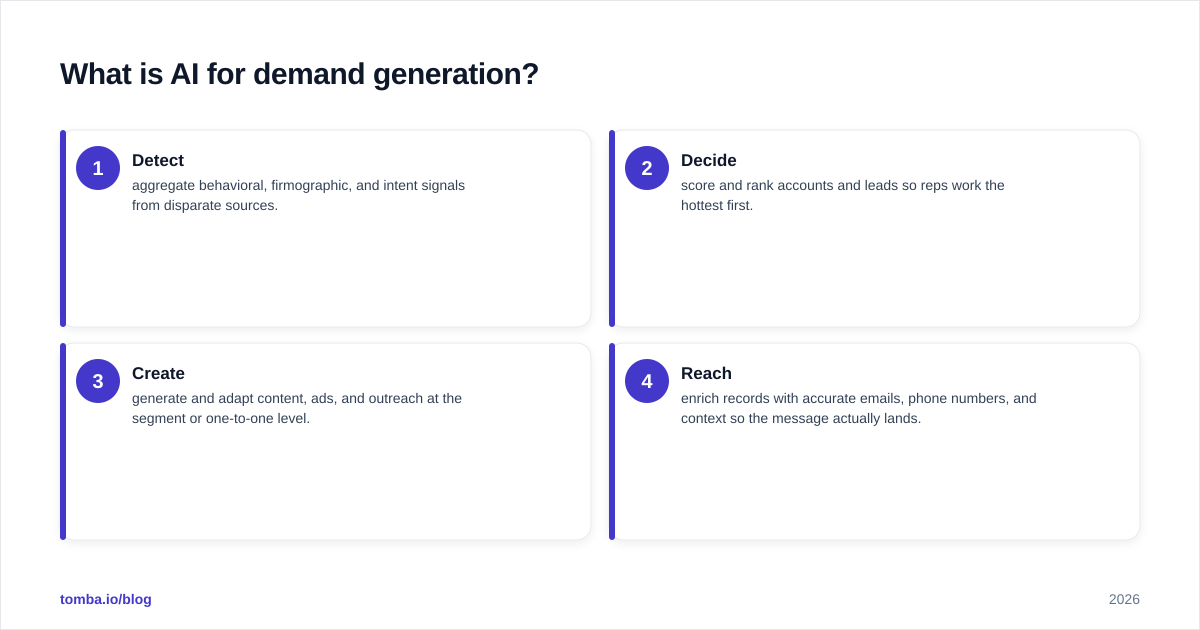
In practice, AI shows up across the funnel in four jobs:
- Detect — aggregate behavioral, firmographic, and intent signals from disparate sources.
- Decide — score and rank accounts and leads so reps work the hottest first.
- Create — generate and adapt content, ads, and outreach at the segment or one-to-one level.
- Reach — enrich records with accurate emails, phone numbers, and context so the message actually lands.
Most teams over-invest in job three (content generation) because it is visible and fun, and under-invest in jobs one, two, and four — which is where pipeline is actually won or lost.
Why does demand generation need AI now?#
Conclusion first: buyers go dark, and AI is the only economical way to see them again.
By 2026, the average B2B buying committee involves more stakeholders and does most of its research anonymously before ever talking to sales. Gartner's research on the B2B buying journey has long noted that buyers spend only a small fraction of their time with any single vendor's sales team. That means the majority of demand forms in the dark — on review sites, in communities, on competitor pages — where you have no direct visibility.
AI closes that gap in three ways:
- Scale of signals. No human can watch thousands of accounts across job changes, funding events, tech installs, content consumption, and web visits. Models can.
- Speed of response. Intent decays fast. A lead researching today is cold in two weeks. AI scoring routes the right lead to the right rep in minutes, not at next week's pipeline review.
- Personalization economics. Writing a genuinely tailored message to 500 prospects used to be impossible. With AI drafting and human editing, it is now a Tuesday.
The catch: AI amplifies whatever you feed it. If your contact data is stale or your scoring logic rewards vanity engagement, AI just helps you waste money faster and more confidently.
What does an AI demand-generation stack look like?#
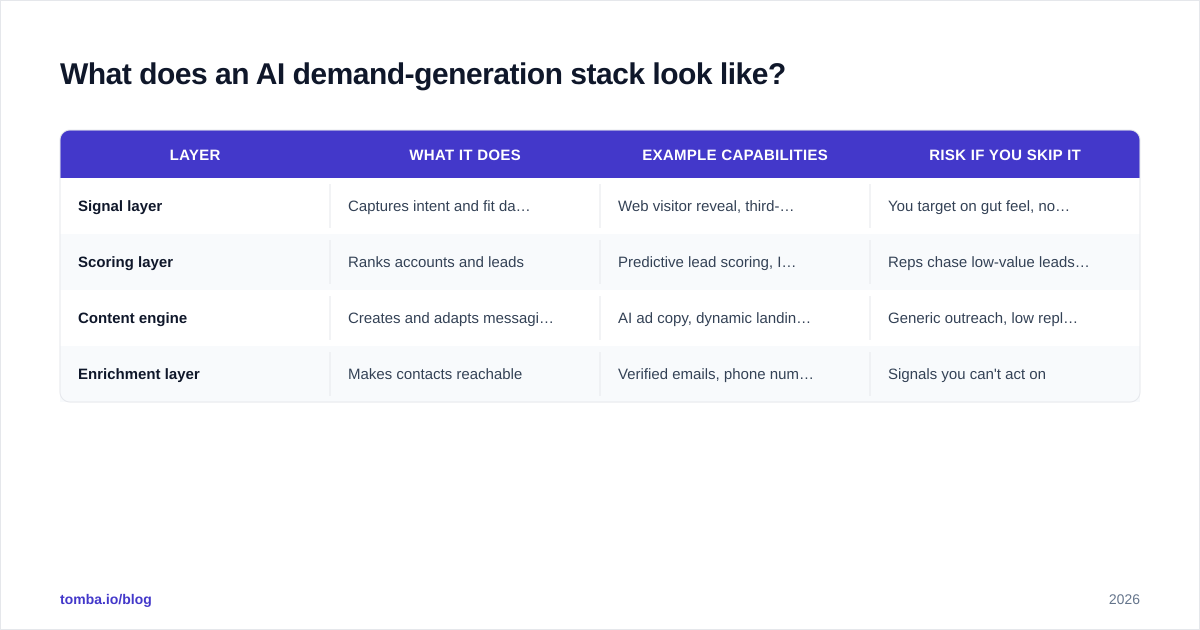
A modern stack maps cleanly to the four jobs above. You do not need a separate vendor for each box — many tools span two or three — but you do need every layer covered.
| Layer | What it does | Example capabilities | Risk if you skip it |
|---|---|---|---|
| Signal layer | Captures intent and fit data | Web visitor reveal, third-party intent, tech install data, job-change alerts | You target on gut feel, not evidence |
| Scoring layer | Ranks accounts and leads | Predictive lead scoring, ICP fit models, propensity-to-buy | Reps chase low-value leads first |
| Content engine | Creates and adapts messaging | AI ad copy, dynamic landing pages, sequence drafting | Generic outreach, low reply rates |
| Enrichment layer | Makes contacts reachable | Verified emails, phone numbers, firmographics | Signals you can't act on |
Notice the dependency: the content engine is worthless without enrichment beneath it. A perfect AI-written email to a bounced address generates exactly zero pipeline. This is why teams that lead with "AI copywriting" and ignore data quality plateau quickly.
To see anonymous demand forming on your own site, a website visitor reveal tool sits in the signal layer and turns unknown traffic into named companies you can score and pursue.
How does AI lead scoring actually work?#
AI lead scoring predicts which leads are most likely to convert by learning from your historical wins and losses, instead of relying on the arbitrary point systems marketers hand-build.
Here is the everyday version: a traditional scoring model is like a loyalty punch card — every action is worth a fixed stamp, whether or not it predicts a purchase. An AI model is like an experienced bartender who reads the room: it weighs the combination of signals that actually preceded past deals, and updates as new data arrives.
A workable model considers three signal families:
- Fit — does this account match your ICP? (industry, size, tech stack, region)
- Intent — are they researching now? (content consumption, web visits, review-site activity)
- Engagement — are they interacting with you? (email opens that lead somewhere, demo pages, pricing views)
The mistake most teams make is scoring on engagement alone, which rewards tire-kickers and newsletter junkies. A strong marketing qualified lead definition blends all three families and, critically, feeds closed-won and closed-lost outcomes back into the model so it keeps improving. Without that feedback loop, your "AI" is just a static formula with better marketing.
Can AI write demand-gen content that performs?#
Yes — but only with humans on the rails and accurate targeting underneath.
AI is genuinely good at:
- Drafting first versions of ads, emails, and landing-page variants at volume.
- Generating subject-line and headline variations for testing. A focused tool like a subject line generator removes the blank-page tax.
- Adapting one core message into segment-specific versions (by industry, role, or pain point).
- Summarizing long research into snackable nurture content.
AI is still weak at:
- Original point of view and genuine expertise — the things that make content rank and get shared.
- Knowing your customers' real objections, which live in sales-call recordings, not training data.
- Factual precision. Anything with a number, a claim, or a competitor name needs a human check.
The winning pattern is "AI drafts, human directs." Use AI to escape the blank page and to scale variation, then add the proprietary insight, the real customer quote, and the spiky opinion that no model can invent. HubSpot's research on AI in marketing consistently shows marketers using AI for ideation and first drafts while keeping editorial control — a sensible division of labor.

How do you keep AI demand gen from wrecking deliverability?#
Short answer: gate every AI-generated send behind verification and volume discipline, or you will torch your sender reputation.
AI makes it trivially easy to send more. That is exactly the danger. The faster you can generate personalized outreach, the faster you can hammer dead inboxes, trip spam filters, and damage your domain. Three guardrails matter:
- Verify before you send. Run every address through an email verifier so AI-built lists don't bounce. Bounce rate is the single fastest way to wreck email deliverability.
- Respect catch-all reality. Many B2B domains accept everything, then silently drop it. A catch-all verifier tells you which "valid" addresses are actually risky.
- Pace your volume. AI lets you 10x output overnight; your domain reputation cannot absorb that. Warm up, segment, and throttle.
The teams that lose at AI demand gen are usually the ones who treated "more sends" as the goal. Deliverability is a budget, not a faucet. Spend it on contacts your scoring layer says are worth it.
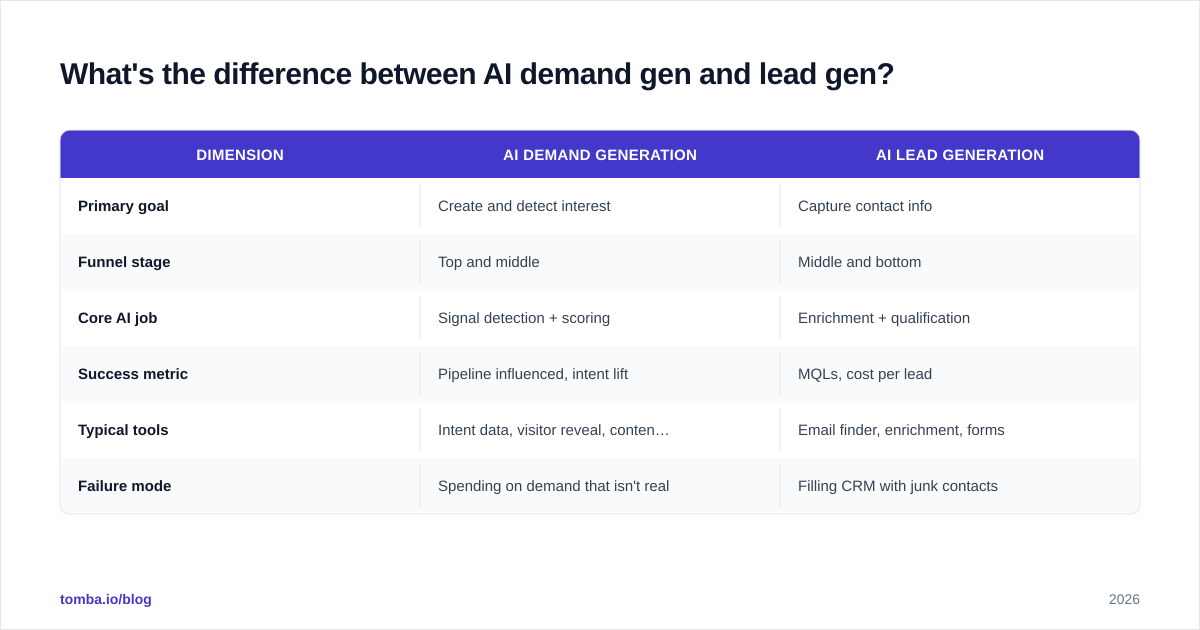
What's the difference between AI demand gen and lead gen?#
They overlap, but the intent differs. Demand generation creates and captures interest across the whole journey; lead generation captures contact details from people already interested. AI helps both, but the metrics and tactics diverge.
| Dimension | AI demand generation | AI lead generation |
|---|---|---|
| Primary goal | Create and detect interest | Capture contact info |
| Funnel stage | Top and middle | Middle and bottom |
| Core AI job | Signal detection + scoring | Enrichment + qualification |
| Success metric | Pipeline influenced, intent lift | MQLs, cost per lead |
| Typical tools | Intent data, visitor reveal, content AI | Email finder, enrichment, forms |
| Failure mode | Spending on demand that isn't real | Filling CRM with junk contacts |
In a healthy motion, the two are a relay. Demand gen surfaces the account that is heating up; lead gen converts that signal into a named, reachable contact your reps can work. The handoff between them is where most pipeline leaks — and where accurate data and a clean domain search close the gap by turning a hot company into the right person's verified email.
Where does contact data fit — and why does accuracy cap everything?#
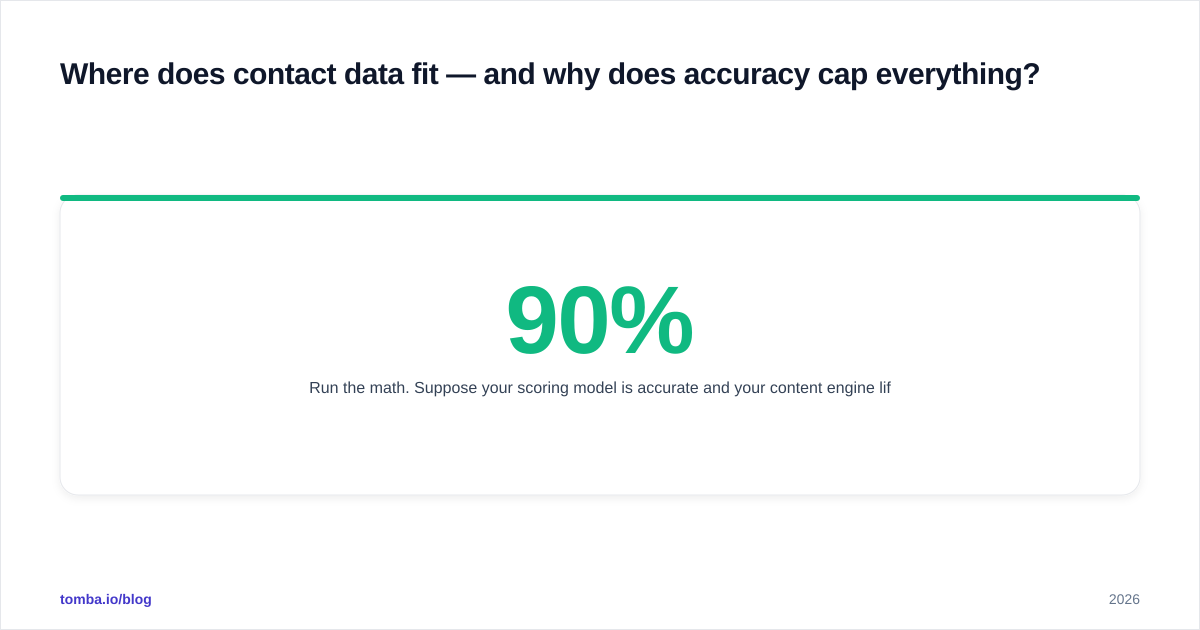
Accuracy is the ceiling on your entire AI demand-gen investment, because every layer above the data inherits its errors.
Run the math. Suppose your scoring model is 90% accurate and your content engine lifts reply rates by 30%. Impressive. Now suppose your contact data is 70% accurate. Roughly a third of your perfectly scored, beautifully written outreach goes to wrong or dead addresses. Your two upstream wins are silently halved by the layer everyone forgets to fund.
This is why enrichment is not a "nice to have" at the bottom of the stack — it is the multiplier on everything else. Practical priorities:
- Verify at the point of action, not in a quarterly cleanup. Stale-by-default is the natural state of B2B data; people change jobs constantly.
- Enrich with context, not just email. Title, seniority, department, and company signals let your scoring and personalization layers do their jobs. A data enrichment step turns a bare email into a usable record.
- Match the channel to the data you trust. If you have a verified mobile number from a phone finder, a call may beat a fifth email.
- Check vendor methodology. Ask where the data comes from and how it is validated; G2's category for sales intelligence is a reasonable place to compare provider reputations and review volume.
If you only fix one thing this quarter, fix the data layer. It is the cheapest way to make your existing AI investments perform better, because it lifts the ceiling on all of them at once.
How do you start without boiling the ocean?#
Pick one signal, one score, one enrichment step, and one feedback loop. Prove it, then expand.
A 30-day starter sequence that actually ships:
- Week 1 — one signal. Turn on website visitor reveal or a single intent source. Don't buy five data feeds you can't process.
- Week 2 — one score. Build a simple fit-plus-intent model. Even a transparent weighted model beats no prioritization, and it gives you a baseline to improve.
- Week 3 — one enrichment step. Wire an email finder and verifier into the path from "hot account" to "reachable contact," so scored demand becomes actionable instantly.
- Week 4 — close the loop. Push outcomes back to your CRM and review which scored leads converted. This is what makes the system get smarter instead of just busier.
Keep humans in the decision seat at every step. AI should compress the boring work — watching signals, ranking lists, drafting variants, finding addresses — so your team spends its judgment where judgment pays: the message, the offer, and the relationship.
The bottom line#
AI for demand generation works when you treat it as a pipeline, not a magic content button. Detect the demand, decide what's worth pursuing, create the message, and — the part everyone skips — reach the human with accurate, verified data. The team that nails the data layer beats the team with the fanciest AI copywriting every single quarter.
That last mile is where Tomba lives. Once your AI flags a hot account, the Tomba Email Finder turns it into a verified, reachable contact in seconds — by domain, name, or company — so your scored demand never dies in a bounced inbox. Start on the free tier (25 searches a month), and when the motion proves out, scale up through Tomba pricing that begins at $49/mo. Build the signals; let Tomba make them reachable.
// get started
Find, verify and enrich your first contacts today
Start on the free plan with 25 searches a month, then scale when your team is ready.
Free plan · No credit card required · GDPR & CCPA
// about the author