AI for Finding Leads: The 2026 Playbook for Sales Teams
AI for finding leads can source, score, and enrich B2B prospects in seconds instead of hours. Here's how the tech actually works, where it breaks, and how to build a 2026 pipeline that doesn't burn your sender reputation.
TL;DR
- AI for finding leads means using machine-learning models to source, match, score, and enrich prospect data automatically — replacing hours of manual list-building with seconds of compute.
- The biggest wins are speed and coverage; the biggest risks are stale data, hallucinated contacts, and deliverability damage from unverified emails.
- A real AI lead workflow has four stages: source → enrich → verify → score. Skip verification and you torch your sender reputation.
- Tool categories overlap: intent platforms, contact databases, email finders, and visitor-reveal tools each solve a different slice. Most teams stack two or three.
- You don't need the most expensive platform. You need accurate data, a verification step, and a way to push clean records into your CRM.
What does "AI for finding leads" actually mean?#
AI for finding leads is software that uses machine learning to identify, match, and qualify potential buyers without a human building the list by hand. Think of it like a metal detector for a beach: instead of digging every square foot yourself, the detector tells you where to dig. The AI scans signals — job titles, firmographics, web behavior, hiring data, tech stacks — and surfaces the accounts and people most likely to buy.
That's the promise. The reality is more granular. "Finding leads" with AI breaks into distinct jobs, and most tools are only good at one or two of them:
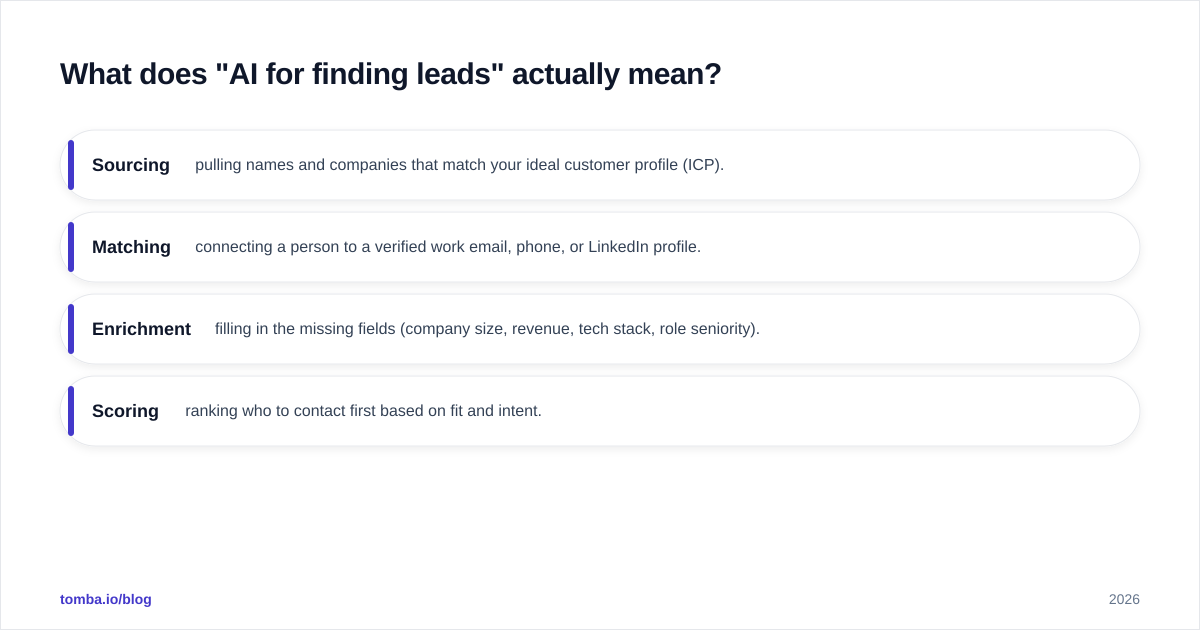
- Sourcing — pulling names and companies that match your ideal customer profile (ICP).
- Matching — connecting a person to a verified work email, phone, or LinkedIn profile.
- Enrichment — filling in the missing fields (company size, revenue, tech stack, role seniority).
- Scoring — ranking who to contact first based on fit and intent.
When a vendor says "AI-powered lead generation," ask which of those four they actually do. A platform that's brilliant at intent scoring may hand you contact emails that bounce 30% of the time. That gap is where deals — and sender reputations — go to die.
How does AI find and qualify leads under the hood?#
The mechanics are less magic than marketing suggests. Most AI lead tools combine a few well-understood techniques.
Pattern matching on email formats. Companies use predictable patterns — first.last@, flast@, first@. An AI email finder infers the pattern from known addresses at a domain, generates candidates, then verifies which one is live. If you've ever used a company email pattern checker, you've seen the simplest version of this.
Entity resolution. The same person appears as "Bob Smith" on LinkedIn, "Robert Smith" in a CRM, and "rsmith@" in an email log. Machine-learning models stitch these fragments into one identity so you don't import three duplicate records.
Intent modeling. Third-party data brokers track which companies are researching topics across the web. Models weigh those signals to predict purchase timing. This is probabilistic, not certain — treat "high intent" as a tiebreaker, not gospel.
Lookalike expansion. Feed the model your best 100 closed-won accounts and it finds 1,000 more that resemble them statistically. Useful for top-of-funnel, dangerous if your training set is small or biased.
The throughline: AI is excellent at narrowing and ranking a huge space of possibilities, and only as good as the underlying data when it comes to facts like "is this email real." That's why verification is a separate, non-negotiable step — covered below.
Is AI lead generation better than manual prospecting?#
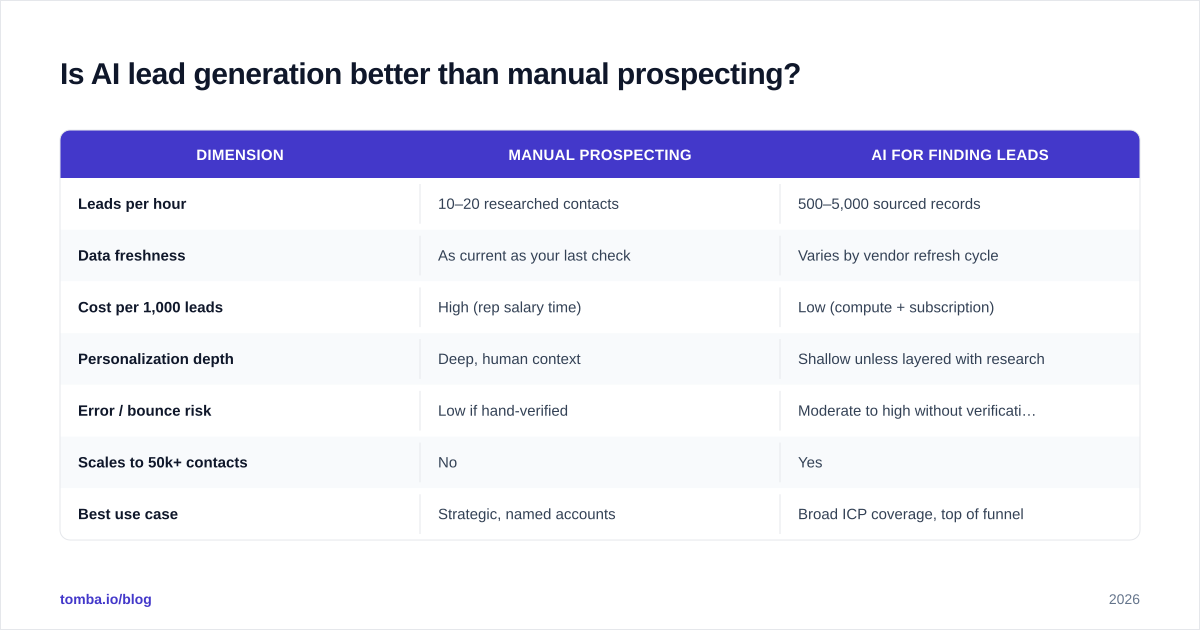
For volume and speed, yes — overwhelmingly. For precision on a short, high-value target list, not always. Here's the honest tradeoff.
| Dimension | Manual prospecting | AI for finding leads |
|---|---|---|
| Leads per hour | 10–20 researched contacts | 500–5,000 sourced records |
| Data freshness | As current as your last check | Varies by vendor refresh cycle |
| Cost per 1,000 leads | High (rep salary time) | Low (compute + subscription) |
| Personalization depth | Deep, human context | Shallow unless layered with research |
| Error / bounce risk | Low if hand-verified | Moderate to high without verification |
| Scales to 50k+ contacts | No | Yes |
| Best use case | Strategic, named accounts | Broad ICP coverage, top of funnel |
The smart move isn't choosing one. It's letting AI do the heavy lifting — sourcing 2,000 ICP-fit contacts overnight — then having reps add human research on the 50 that score highest. According to HubSpot's sales research, reps spend roughly a third of their day on non-selling tasks like list-building. AI claws that time back; humans spend it on relationships.
A warning that vendors gloss over: AI-sourced volume tempts teams to blast everyone. Sending to thousands of unverified addresses is the fastest way to wreck email deliverability and land in spam folders. Volume without verification is a liability, not an asset.
What are the main types of AI lead-finding tools?#
The market looks crowded because tools from different categories all claim "lead generation." They solve different problems. Here's how to tell them apart.
Contact databases and email finders. These map a name + company to a verified work email and phone. This is the foundation — without accurate contact data, intent scores are useless. A good email finder returns the address and a confidence score so you know what to trust.
Intent and account-intelligence platforms. Tools like 6sense and Demandbase surface which accounts are in-market. Strong on timing, weak on individual contact accuracy — you'll still need a finder to get the actual person's email.
Website visitor reveal. These de-anonymize the companies already browsing your site. High intent by definition, since they came to you. Pair a visitor identification tool with a contact finder to turn "Acme Corp visited pricing" into "email the Acme VP of Ops."
Enrichment APIs. These don't find new leads; they complete the ones you have. Push a half-empty record in, get firmographics and tech stack back. Data enrichment is what makes scoring models actually work.
Most go-to-market teams end up stacking two or three: a database for sourcing, an enrichment layer for context, and a verifier to keep the list clean. Check independent reviews on G2 before committing — category labels are marketing, user reviews are reality.
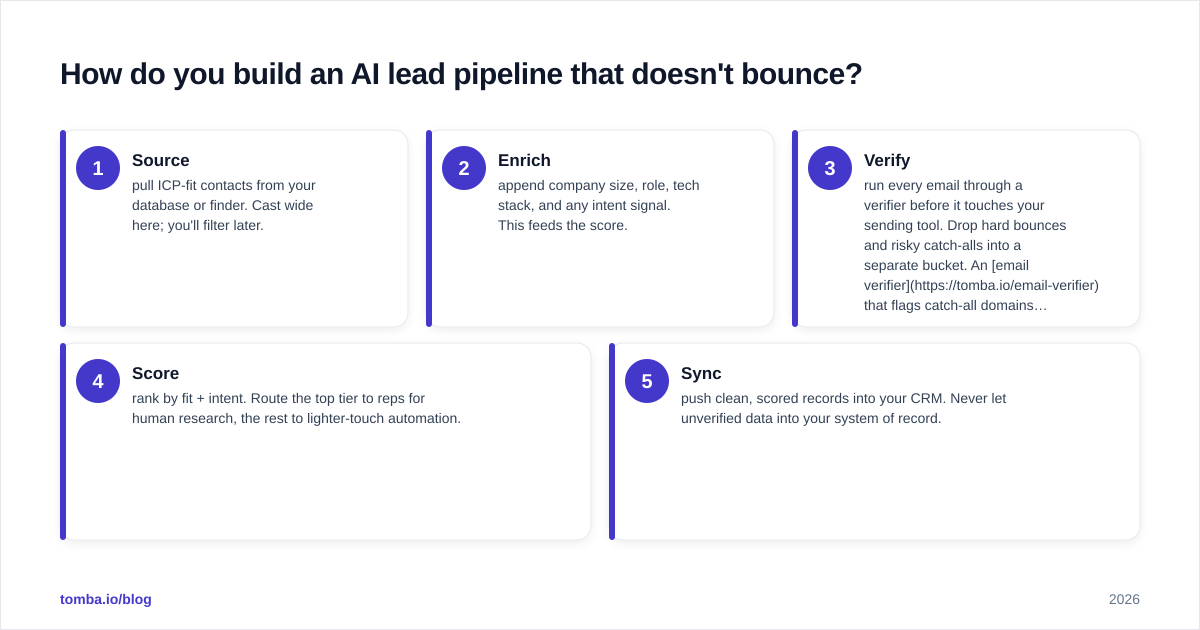
How do you build an AI lead pipeline that doesn't bounce?#
The single biggest mistake is treating "found" as "usable." Found means a model produced a candidate. Usable means it's been verified against a live mail server. The gap between those two states is where bounce rates live.
A pipeline that protects your domain looks like this:
- Source — pull ICP-fit contacts from your database or finder. Cast wide here; you'll filter later.
- Enrich — append company size, role, tech stack, and any intent signal. This feeds the score.
- Verify — run every email through a verifier before it touches your sending tool. Drop hard bounces and risky catch-alls into a separate bucket. An email verifier that flags catch-all domains saves you from silent reputation damage.
- Score — rank by fit + intent. Route the top tier to reps for human research, the rest to lighter-touch automation.
- Sync — push clean, scored records into your CRM. Never let unverified data into your system of record.
For high volume, batch the work. A bulk email finder lets you process thousands of records and verify them in one pass instead of one-by-one. The rule of thumb: if your bounce rate creeps above 2–3%, stop sending and re-verify. Mailbox providers read bounces as a signal you're a spammer, and that reputation is slow to rebuild.
What does AI lead generation cost in 2026?#
Pricing splits along the same category lines. Intent platforms run enterprise-priced (often $30k+/year). Contact finders and verifiers are far more accessible and usually credit-based, which suits teams that want to scale spend with usage rather than commit upfront.
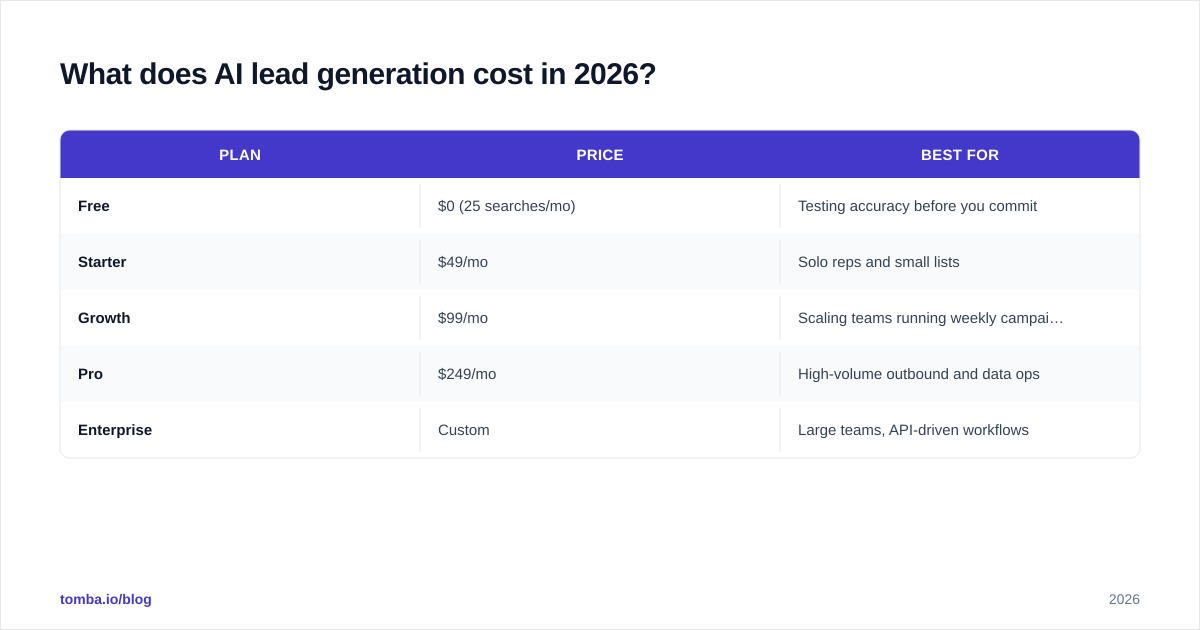
As a concrete reference point, Tomba's pricing follows the credit model most finders use:
| Plan | Price | Best for |
|---|---|---|
| Free | $0 (25 searches/mo) | Testing accuracy before you commit |
| Starter | $49/mo | Solo reps and small lists |
| Growth | $99/mo | Scaling teams running weekly campaigns |
| Pro | $249/mo | High-volume outbound and data ops |
| Enterprise | Custom | Large teams, API-driven workflows |
Two budgeting tips. First, always test a free tier against your own known contacts before paying — accuracy claims are easy to publish and hard to verify, so check them yourself. Second, factor verification into the cost, not as an afterthought. Sending to a cheap, unverified list and burning your domain costs far more than the verification credits would have.
For programmatic teams, an email finder API lets you wire sourcing and verification directly into your own app or data warehouse, so the whole source-enrich-verify loop runs without a human clicking export.
What are the limits and risks of AI for finding leads?#
Conclusion first: AI finds leads fast, but it does not understand your buyer, and it will confidently hand you wrong data if you let it.
Hallucinated or guessed contacts. Some tools "generate" plausible emails without verifying them. A confidence score below the high-90s should be treated as a guess. Always verify before sending.
Data decay. People change jobs constantly — B2B contact data degrades fast, and analysts at firms like Gartner have long flagged data quality as a top driver of wasted sales effort. A lead sourced six months ago may be three companies removed by now. Re-enrich before any major campaign.
Compliance. GDPR, CCPA, and similar regimes govern how you collect and store contact data. AI doesn't absolve you of consent and legitimate-interest obligations. Know your jurisdiction.
Over-automation. The tools make it trivial to message 10,000 people. That's exactly why response rates are falling across noisy channels. AI should sharpen your targeting so you send fewer, better messages — not more generic ones.
Garbage-in scoring. Lookalike and intent models inherit the biases of their training data. A small or skewed seed list produces a confidently wrong expansion. Audit your inputs.
None of these kill the value of AI lead generation. They just mean the human stays in the loop — defining the ICP, sanity-checking the output, and owning the verification gate.
How do you choose the right approach for your team?#
Match the stack to your motion, not to the flashiest demo.
- Solo founder or small team: Start with a free-tier email finder and a verifier. Source manually around a tight ICP, verify everything, and grow into automation later.
- Scaling SMB sales team: Add an enrichment layer and bulk processing. Score leads so reps focus on the top tier. This is the sweet spot for credit-based finders.
- Enterprise GTM: Layer intent and account intelligence on top of a contact database, with API-driven enrichment and verification feeding your CRM and data warehouse.
Whatever tier you're in, the foundation is the same: accurate contact data, a verification step you never skip, and clean records flowing into your CRM. Intent scores and AI rankings are multipliers on top of that foundation — they can't fix bad data underneath.
The bottom line#
AI for finding leads is genuinely transformative for coverage and speed, and genuinely dangerous if you confuse "found" with "verified." Source wide, enrich for context, verify ruthlessly, score honestly, and keep a human owning the ICP and the quality gate. Do that, and AI fills your pipeline without filling the spam folder.
Ready to put accurate contact data under your AI workflow? Start with the Tomba Email Finder — find professional emails by name, company, or domain, get a confidence score on every result, and verify before you send. The free tier gives you 25 searches a month to test accuracy against your own known contacts, no card required. Build your pipeline on data you can trust, then let the AI do the heavy lifting on top.
// get started
Find, verify and enrich your first contacts today
Start on the free plan with 25 searches a month, then scale when your team is ready.
Free plan · No credit card required · GDPR & CCPA
// about the author